Navigating HIPAA Regulations for AI Therapy

Outline
AI tools for therapy notes can save hours of admin each week, but they also handle some of the most sensitive data in healthcare. If your practice is subject to HIPAA and uses AI to transcribe sessions, draft progress notes, or engage clients between appointments, HIPAA applies to every step where the tool creates, receives, maintains, or transmits ePHI.
This guide covers what HIPAA requires when AI touches therapy data, where the real risks sit, and how to evaluate whether a platform meets the standard. Understanding HIPAA regulations for AI therapy before you adopt a tool is what keeps that adoption from turning into a compliance problem later.
What HIPAA regulations for AI therapy require
HIPAA protects electronic protected health information (ePHI): any health data that is stored, transmitted, or processed electronically. For AI therapy tools, ePHI includes session transcripts, progress notes, client intake data, mood logs, and anything a client shares through a digital platform.
Two HIPAA rules matter most:
- The Privacy Rule governs who can access and disclose patient information, and under what conditions.
- The Security Rule sets technical, administrative, and physical safeguards for protecting ePHI.
When an AI vendor creates, receives, maintains, or transmits ePHI on a covered entity’s behalf, the vendor generally acts as a business associate. Your practice still needs to evaluate the workflow, obtain the required assurances, and document its decisions.
What counts as ePHI in AI therapy notes
For a HIPAA-regulated practice, the following records can be ePHI when they identify a client:
- Session recordings and transcripts
- AI-generated progress notes (SOAP, DAP, BIRP)
A printable social work progress notes template supplies the official LCSW chart skeleton. HIPAA safeguards apply when AI touches that chart.
- Client intake forms and treatment plans
- Between-session check-ins, mood logs, or journaling data
- Any data linked to a client’s identity
The threshold is low: if data can be tied to a specific person and relates to their health, it is ePHI.
Three technical safeguard areas to evaluate
HIPAA’s Security Rule requires covered entities and business associates to protect ePHI with reasonable and appropriate safeguards. The rule allows a flexible approach based on risk analysis. Some implementation specifications, including encryption, are addressable: you must assess whether each is reasonable and appropriate, implement it when it is, or document why an equivalent alternative is appropriate.
The Security Rule does not prescribe TLS 1.2 or AES-256. Treat those as current vendor-security benchmarks to verify, not as the rule’s exact wording. These three areas provide a practical starting point for reviewing an AI platform.
1. Encryption selected through risk analysis
Encryption converts data into an unreadable format that can only be decoded with the correct key. For therapy notes, this means:
- In transit: verify current transport encryption, such as TLS 1.2 or higher, as data moves between your device and the server
- At rest: verify strong storage encryption, such as AES-256 or an equivalent control
Because therapy records contain highly sensitive ePHI, a vendor that cannot explain how it protects data in transit and at rest warrants closer risk analysis. Document the safeguard you select and the reason it is appropriate for your environment.
2. Access controls
Not everyone in a practice or organization should see every client’s notes. HIPAA requires access controls and person or entity authentication. In a vendor review, look for:
- User authentication: unique user IDs, with multi-factor authentication available as a stronger safeguard
- Role-based access: clinicians see the records authorized for their work; administrative staff receive only the access their duties require
- Regular access reviews: a documented cadence for confirming that each person still needs access. Quarterly review is a practical internal recommendation, not a fixed HIPAA requirement
If an AI platform gives every user access to all data by default, your practice should document how that design fits its access-authorization policy or choose a tool with more granular controls.
3. Audit trails
HIPAA requires mechanisms that record and examine activity in systems containing or using ePHI. A useful vendor audit log identifies the user, timestamp, and action. This matters because:
- It provides evidence of compliance during audits
- It helps detect unauthorized access quickly
- It creates accountability across the team
Ask the vendor how its audit controls work, which events they capture, and how your practice can retrieve the records for review.
Emosapien documents encryption, access controls, and audit trails as part of its security posture for clinical workflows.
Stay HIPAA-compliant with Emosapien
Emosapien is built with clinical-grade privacy and governance: encryption, access controls, and audit trails, so you can focus on care, not compliance.
Get StartedHow AI enhances therapy notes without compromising compliance
When built with HIPAA in mind, AI tools can improve documentation quality while reducing the time you spend on it.
Structured note generation: AI can draft SOAP, DAP, or BIRP notes from session transcripts, pre-filling fields that you review and finalize. Tools built for therapy can pair structured drafting with a BAA, strong encryption, and audit controls rather than treating compliance as a later add-on. This cuts documentation time without removing your clinical judgment from the process.
Pattern recognition: Over time, AI can surface trends in client data (changes in mood, recurring themes, shifts in risk indicators) that inform treatment decisions. These insights are generated from data already in the system, not shared externally.
Between-session engagement: AI-driven check-ins and journaling prompts can keep clients engaged between appointments, generating data that feeds back into their clinical record. When this runs within a HIPAA-compliant platform, the data stays protected end to end.
The key distinction: AI should support your documentation workflow, not bypass your oversight. You review, you edit, you sign off.
Risks to watch for
AI in therapy introduces specific compliance risks that practitioners should evaluate before adopting any tool.
For the day-to-day privacy side of that decision, map where client information enters the system, who can access it, and where copies remain after the note is finalized. See maintaining client confidentiality in mental health for the practice-level habits that sit alongside these technical safeguards.
Data breaches
AI systems process and store large volumes of ePHI. A breach could expose session content, diagnoses, and treatment plans. Evaluate how the platform handles incident response: do they have a breach notification process? Are backups encrypted?
Algorithmic bias
AI trained on non-representative datasets can produce biased outputs, for example misinterpreting cultural expressions of distress or under-flagging risk in certain populations. Ask vendors how they test for bias and what safeguards are in place.
Vendor compliance gaps
When an AI vendor acts as a business associate by creating, receiving, maintaining, or transmitting ePHI on a covered entity’s behalf, the covered entity must obtain the required written assurances, usually through a Business Associate Agreement (BAA). A vendor does not avoid that obligation by describing its platform as secure.
Model training on client data
Some AI platforms train their models on user data by default. For therapy notes, this is a serious concern. Confirm in writing that the vendor does not use client data to train general-purpose models.
A practical HIPAA compliance checklist for AI therapy tools
Before adopting any AI tool for therapy notes, use this checklist to apply HIPAA regulations for AI therapy to the vendor’s actual data flow:
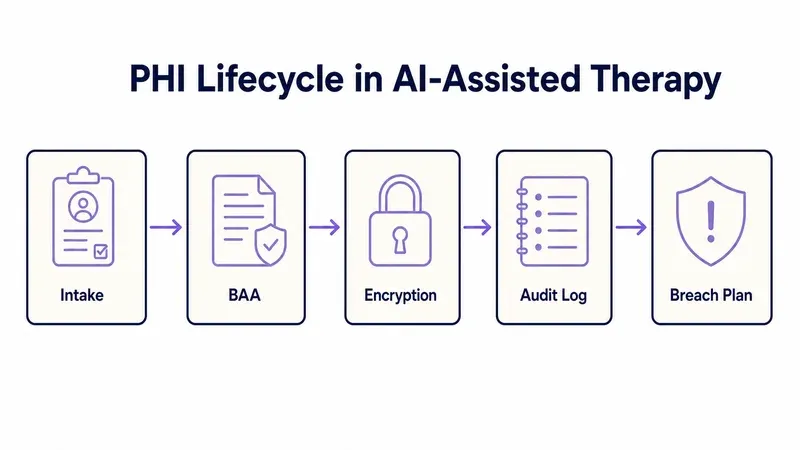
- BAA signed when required? If the vendor is a business associate, use the business associate agreements for therapists review checklist before ePHI moves.
- Encryption decision documented? Record how data is protected in transit and at rest, and why the selected controls are reasonable and appropriate for your environment.
- Access controls? Check unique user identification, authentication options, role-based authorization, and procedures for changing or ending access.
- Audit controls? Confirm the platform records system activity and lets your practice examine the records it needs.
- Data residency? Know where data is stored and whether it crosses jurisdictions. EU/EEA records may require a separate data-protection review.
- UK GDPR review? UK practices should run a GDPR checklist before session data enters any AI note workflow.
- Model training policy? Confirm client data is not used for model training.
- Breach response? Vendor has a documented incident response and notification plan.
- Staff training? Your team knows how to use the tool in a compliant way.
- Solo operating system? One-person practices still need documented roles, device controls, BAAs where required, and a review cadence.
- Need the full map? Start at the therapist compliance resource hub for HIPAA, BAAs, Part 2, state rules, supervision records, and risk documentation.
If a vendor can’t answer these clearly, that’s a signal. If you need pass/fail rows instead of a policy list, work the hipaa compliant ai note taker questionnaire before you send a BAA.
Training your team for HIPAA compliance with AI
Technology alone doesn’t ensure compliance; your team’s practices matter just as much.
Effective training should cover:
- How ePHI flows through the AI tool (where data goes, who can see it)
- How to recognize and report a potential breach
- When and how to use the AI tool’s features within HIPAA boundaries
- How to handle client questions about AI and data privacy
Make training recurring, not one-off. HIPAA regulations evolve, AI capabilities change, and staff turnover means new people need onboarding. A quarterly refresher can be a useful internal cadence, but HIPAA does not prescribe that interval.
The future of HIPAA-compliant AI in mental health
As AI capabilities grow, HIPAA compliance will need to keep pace. Several trends are shaping the landscape:
That wider shift is part of the future of AI therapy beyond documentation, with privacy safeguards and clinician oversight remaining essential.
- Predictive analytics: AI identifying clients at risk of deterioration, enabling earlier intervention
- Real-time session support: AI surfacing clinical insights during sessions, not just after
- Client-facing AI tools: chatbots and journaling assistants that operate within HIPAA guardrails
The practices that adopt AI early and compliantly will have an advantage: better documentation, stronger client engagement, and more time for clinical work. But only if compliance is built into the foundation, not bolted on afterward.
Key takeaways
- For a HIPAA-regulated practice, AI workflows that create, receive, maintain, or transmit ePHI need documented safeguards
- Use risk analysis to select reasonable and appropriate controls; HIPAA does not prescribe TLS 1.2 or AES-256
- Obtain a BAA when an AI vendor acts as a business associate
- Confirm the vendor does not train models on your client data
- Train your team on compliant use; technology alone is not enough
- Evaluate risks (breaches, bias, vendor gaps) before adoption, not after
HIPAA regulations for AI therapy are not a barrier to using AI in therapy; they’re the framework that makes responsible adoption possible.