
Therapy Worksheet Follow Up: Keep Clients Engaged Between Sessions
Most worksheets don’t fail because they’re “bad.” They fail because they’re static, and because therapy worksheet follow up often falls on your already-full plate. A worksheet is usually handed out at the end of a session, then life happens. By the time you meet again, the client either forgot, rushed it, or did it in a way that doesn’t translate into useful session material. You end up spending precious time reconstructing the week instead of building on it.
That’s where Emosapien’s Engagement Agent can help. It’s designed to make therapy worksheet follow up feel like continuous care, not “homework that may or may not happen.” Instead of you chasing, reminding, or manually summarizing, the Engagement Agent keeps clients gently engaged between sessions and prepares session-ready context for you.
For a full guide to choosing worksheets and using them clinically (modalities, examples, and templates), check this article.
What’s unique here (beyond “here are worksheets you can download”)
A lot of worksheet content online focuses on what worksheet to use and how to use it in session. Helpful, but it doesn’t solve follow-through.
This article focuses on what’s often missing in practice: therapy worksheet follow up that actually happens, without adding work for you. The Engagement Agent helps you operationalize worksheet use between sessions so clients respond in smaller steps, and you get cleaner insights back in the next session.
The Engagement Agent turns a worksheet into a guided follow-up flow
Instead of “complete this worksheet,” think of the worksheet as a short sequence that runs between sessions. This is where therapy worksheet follow up becomes realistic and sustainable.
1) It breaks worksheets into micro-steps clients can actually do
Many clients freeze at a full page. Emosapien turns the same worksheet into 3–6 small prompts spread across the week:
- identify the situation
- name the emotion (and intensity)
- capture the thought or urge
- try one alternative response
- reflect on what changed
This structure makes therapy worksheet follow up feel manageable for clients, and more useful for you.
2) It prompts at the right time, without you following up
Between-session nudges are often the difference between a worksheet being “a good idea” and being completed.
The Engagement Agent runs the reminders and check-ins on the cadence you choose, so therapy worksheet follow up doesn’t rely on you remembering to message, check, or chase.
3) It adapts when clients get stuck
Worksheets are usually one-size-fits-all. Real life isn’t.
If a client reports they’re overwhelmed or didn’t do the step, the Engagement Agent can shift the next prompt to something smaller and more supportive (for example, a barrier-focused reflection or grounding step). That keeps therapy worksheet follow up moving forward instead of collapsing into shame or avoidance.
4) It summarizes responses into session-ready context
This is where you get time back.
Instead of scanning scattered notes, you start the session with a clean snapshot of:
- repeated triggers and patterns
- what the client tried, what helped, what didn’t
- themes worth exploring
- a few clinically relevant questions to open the session
Good therapy worksheet follow up should reduce recap time, not add to it.
5) It keeps support aligned and bounded
Between-session support works best when it’s clear that:
- you remain in charge
- the client knows what to use in urgent situations
- prompts stay aligned to the treatment plan
That way, therapy worksheet follow up supports continuity without blurring boundaries..
Turn Worksheets Into Progress
Stop worksheets becoming homework, let Emosapien’s Engagement Agent turn them into between-session progress.
Two quick examples
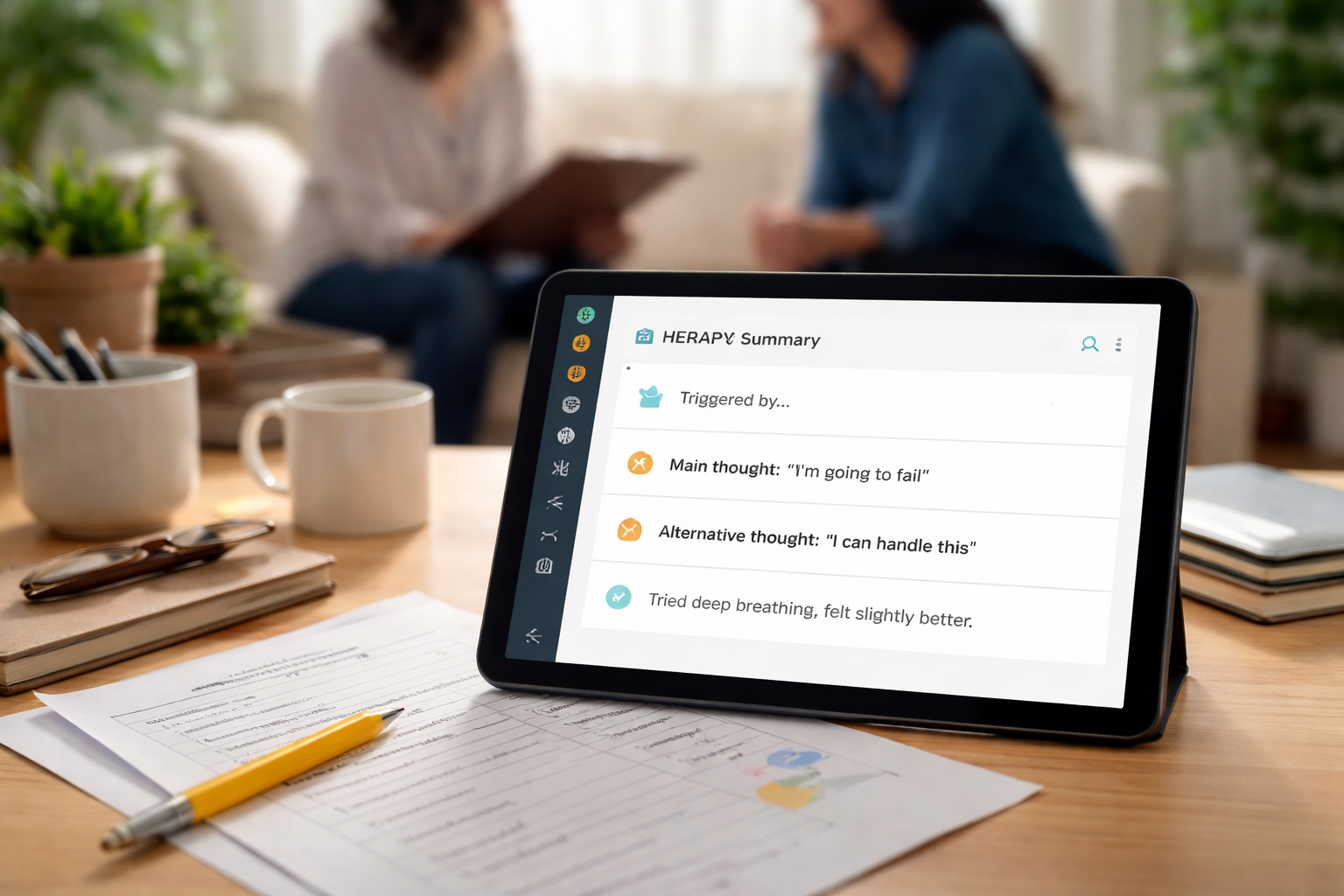
Example A: CBT thought record (without the blank-page problem)
Instead of: “Fill out a thought record this week.”
Try a flow like:
- “What situation stood out since our last session?”
- “What emotion showed up most strongly, and how intense was it?”
- “What was the main thought or prediction?”
- “What’s one alternative thought you’re willing to practice?”
- “What happened when you tried it (even once)?”
By the time you meet, you’re not asking “How was your week?” You’re asking, “I noticed this pattern, want to work with it?”
Example B: Relapse prevention worksheet (supportive, not intrusive)
Instead of: “Complete this worksheet before next time.”
Try:
- “Any cravings or urges this week (0–10)?”
- “What was the highest-risk moment?”
- “What did you do next?”
- “What support did you use, or avoid?”
- “What’s your plan for the next 24 hours if urges spike again?”
This keeps the worksheet clinically grounded while making it easier for clients to respond in real time.
What you get as the therapist: continuity, without extra admin
When worksheets are supported between sessions, therapy can feel less like isolated appointments and more like a continuous process.
Practically, that can mean:
- less recap time at the start of session
- more “in the work” time during session
- better follow-through on skills and action steps
- clearer patterns to guide your clinical decisions
And the key point: you don’t have to be the person doing the chasing.
A simple way to start (without overhauling your workflow)
If you want to try this without changing everything:
- Pick one worksheet you already like (thought record, values, diary card, exposure log).
- Convert it into 3–5 micro-prompts you’d actually want to review.
- Let the Engagement Agent run the between-session rhythm.
- Skim the summary before session and decide what to focus on.
That’s it. Start small, keep it sustainable.
Start your journey with Emosapien
If you want clients to actually use worksheets between sessions, and you want sessions to build on real momentum (without you spending extra time reminding, tracking, or summarizing), Emosapien is built for that.
Start your journey with Emosapien and let the Engagement Agent do the heavy lifting of between-session worksheet support, so you can stay focused on care, not coordination.