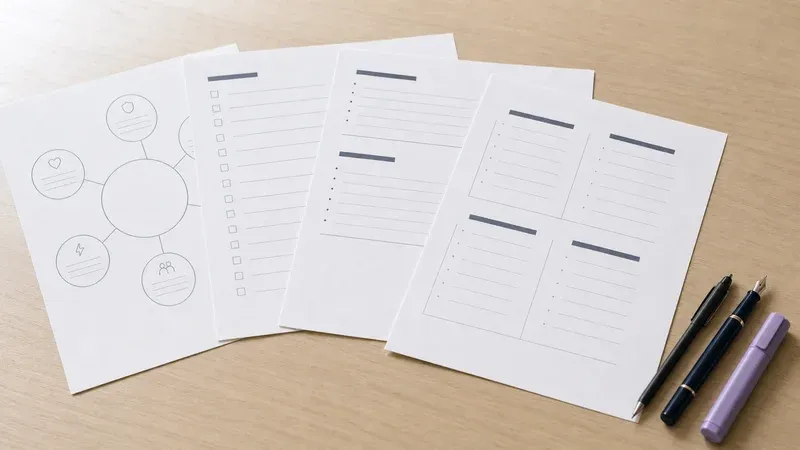
Therapy Worksheets: CBT, ACT, Trauma-Informed and more

Outline
A sheet can deepen the hour or flatten it. Without a formulation, it is homework. Against the formulation, it holds the work between sessions. Use these forms as clinical tools across CBT, ACT, DBT, and trauma-informed practice, not from one rigid frame.
Modality- and skill-specific worksheet guides
Open the guide that matches the formulation you already wrote.
- CBT worksheets pack (free download): thought record (5- and 7-column), restructuring, behavioral activation, distortions sheet.
- DBT worksheets pack (free download): diary card, DEAR MAN, TIPP distress-tolerance worksheet, ACCEPTS, emotion regulation.
- ACT therapy basics: flexibility, defusion, values, acceptance, and committed action before you choose the sheet.
- ACT worksheets: defusion, values, committed action, and acceptance on the six hexaflex processes. For a live sort, use the ACT matrix worksheet.
- IFS parts mapping worksheet: role, protective intent, unblending check, paced exile scope.
- IFS worksheets: parts map, 6 Fs check-in, Self-energy, with exile and unburdening held to scope.
- Coping skills worksheets: distress tolerance, grounding, emotion regulation, cognitive coping, split for adults, teens, and kids.
- Anger management worksheet: trigger, body cue, appraisal, intensity, skill choice.
- Impulse control worksheets: cue-to-urge map, pause plan, and the review you do next session.
- Self-esteem worksheet: core-belief evidence plus a values reappraisal, not a thought record.
- Boundaries worksheet: felt signal, named limit, rehearsed sentence.
- Communication skills worksheet: one ask, a listening check, a repair line. When the couple is the client, use the shared ask and the repair line. Two individual thought records will split the hour.
- Sleep hygiene worksheet: fixed wake time, wind-down, two-week log. Screen a medical driver first.
- Mental health worksheets: match the sheet to the concern (anxiety, depression, trauma, addictions, BPD, OCD, perinatal).
- Mental health activity sheets: behavioral experiment, activity log, window-of-tolerance check, trigger log.
- ACT defusion techniques: the move you can close this hour when one account of the week has crowded out the others and narrative work is not already yours. Do not hand a unique-outcomes page you have not trained to use.
- Couples therapy treatment plan: the shared goal line to keep when separation is the discharge, including a constructive ending. A coping list does not practice that objective.
Couples work has its own between-session set. The couples therapy worksheets hold a conflict-cycle map, a repair log, an appreciation exercise, and an intimacy check-in, each with a safety line. When the hour is a separation rather than a repair, the divorce therapy techniques sheet covers decision clarity, co-parenting, grief for the marriage, and a transition plan. Narrative practice uses different paper: narrative therapy worksheets for an externalized problem name, an influence map, a unique outcome, and an alternative story. When the next step is a certificate rather than a handout, compare hours and cost on the narrative therapy training checklist.
What is a therapy worksheet?
A therapy worksheet is a structured prompt for reflection, observation, or skill practice. It is not an intervention, not a substitute for judgment, and not proof that therapy is working.
Every sheet carries a theory of change. When that theory matches your formulation and the client is ready, the page supports the hour. When it does not, it interrupts.
When these forms are most useful in clinical practice
Timing is why these forms get a bad name. A good sheet, opened in the wrong hour, still fails.
Early, one page can name a shared language or put one concern outside the client. Across the week, it can bring back what memory flattens. See between-session therapy activities. When the form leaves the room and stalls, use strategies that help clients follow through on therapy homework without turning next session into a compliance grade.
Pattern only shows up in accumulation: mood, a relationship, self-talk. One sheet does not do that. The series does.
After a heavy hour, the page has to be optional. SAMHSA’s trauma-informed principles ask that work to resist retraumatization. If the worksheet starts to do the opposite, stop.
Therapy worksheet examples across different modalities
Most modalities already use structured reflection. They do not all call it a worksheet.
CBT worksheets
A thought record becomes form-filling when it leaves the formulation. Used well, it makes one hypothesis explicit for this client, not a generic cognitive model.
Download CBT Therapy Worksheet Template (.xlsx)
ACT worksheets
Keep the prompt in the client’s language. Do not turn a value into a goal. The page supports choice, not performance.
Download ACT Therapy Worksheet Template (.xlsx)
DBT worksheets
DBT uses an unusually structured worksheet system. The diary card is the piece that sets the hour. Chapman (2006) describes it as a self-monitoring form on which the client tracks treatment targets such as self-harm, suicide attempts, and emotional misery. You use that card to prioritize session time: life-threatening behavior first, then therapy-interfering behavior.
Partial completion still gives you a record for the hour.
The skills that card sits beside are the four modules in Linehan’s skills training: mindfulness, interpersonal effectiveness, emotion regulation, and distress tolerance (Linehan Institute).
Chain analysis worksheets come after the card sets the priority. Chapman (2006) describes that step as figuring out what led up to the behavior and the consequences that may be reinforcing it. Plan 20–30 minutes, often in the room the first time.
Interpersonal-effectiveness worksheets scaffold the core skill Linehan’s teaching notes name: obtaining objectives while maintaining relationships and self-respect (Linehan, 2015). The DEAR MAN worksheet is the planning artifact for these conversations. Those notes summarize the skill as DEAR MAN: Describe, Express feelings, Assert wishes, Reinforce, (stay) Mindful, Appear confident, and Negotiate. Assign it when you can still close the conversation this hour, and wait when you cannot.
Trauma-informed worksheets
SAMHSA’s TIP 57 is the behavioral-health guidance. SAMHSA’s trauma-informed principles name safety, collaboration, and empowerment, voice, and choice, and they ask the work to resist retraumatization. Keep the prompt optional and easy to stop. Grounding comes before interpretation.
Download Trauma-Informed Therapy Worksheet Template (.xlsx)
For the session-level structure and consent practices these worksheets sit inside, see the trauma informed care worksheet planning guide.
Psychodynamic-friendly prompts
Relational work already uses prompts. These do not interpret. They hold one experience until the next hour.
Download Psychodynamic Therapy Worksheet Template (.xlsx)
For the choice between modalities, see choosing worksheets for your practice style.
How to choose the right therapy worksheet
Choosing a therapy worksheet is clinical judgment. If you cannot say what the page is in service of right now, leave it in the folder.
How therapeutic worksheets fit the session
A therapeutic worksheet fails when you assign it because the hour feels thin. Name the job in one sentence, or leave the folder closed.
If they ask for a stack of printables, ask which hour the page has to survive before you open the folder. The request is not the formulation.
- Name the job before the page comes out.
- Fill the first row in the chair. A blank page sent home becomes a grade next week.
- One page. Write the review question on your note, and ask it by name next session.
- If they go quiet, tear up, or the body spikes, stop. Finish the row next time. You cannot undo the scare.
Pull therapist worksheets from the formulation you already wrote
A therapist worksheet extends the formulation you wrote last session. A thin hour is not a reason to add a form.
- Cognitive formulation, one situation, one hot thought: the CBT thought record. If they arrived with three pages of analysis, skip the record and run a behavioral experiment.
- Avoidance of a valued action: ACT values and defusion sheets. Leave the restructuring column in the folder.
- A target behavior you are counting week to week: the diary card in the DBT worksheets pack. Chapman (2006) describes that card as the form you use to prioritize session time. It is a data card, not insight homework.
- A protector speaking for a younger part, and you have already agreed the pace: IFS worksheets. Do not hand an exile prompt you have not scoped.
- A dominant story that has crowded out other accounts of the week: do not hand a unique-outcomes sheet unless narrative work is already yours. If it is not, use a defusion prompt from ACT defusion techniques. Do not fake a method you cannot close this hour.
Stay with that one frame. A second model turns the next hour into a reconciliation.
Hand free therapy worksheets for the problem they brought
Match the free sheet to the problem they walked in with. Use the hold rule in the row, not the diagnosis name on the chart.
| What they brought | Free sheet | Hold it when |
|---|---|---|
| One worry they can point at | CBT thought record | They can name one situation. Three pages of analysis means skip the record. |
| A worry they already know is unreasonable | Struggle switch | Disputing the thought is feeding the loop. |
| Withdrawal, nothing feels worth doing | Behavioral activation | The job is doing one thing, not examining a cognition. |
| An anger spike with a warning sign | Anger management worksheet | You need the body cue, not a values sort. |
| An urge in the minutes before the act | Impulse control worksheets | There is a cue-to-action sequence to interrupt. |
| A sleep complaint | Sleep hygiene worksheet | Screen a medical driver before you assign the log. |
| They cannot say no | Boundaries worksheet | The signal is in the body, and they need one sentence. |
| They talk past a partner | Communication skills worksheet | One ask, and one repair line. |
| A loss the depression log would flatten | Grief worksheets | The work is the bond, not a mood rating. |
| Substance use sitting next to the mood | Co-occurring disorders worksheets | One log that holds both. Two homework pages will compete. |
| A pattern more than one person will see | Family session sheets | Privacy in the home is part of the assignment. |
| The couple is the client | Communication skills worksheet | Two individual thought records will split the hour. |
When to fill free therapeutic worksheets in the room
The row tells you which sheet. It does not tell you whether to send it home. Free therapeutic worksheets belong in the chair first. If the name they used for the problem is not the problem, hold the obvious sheet and fill a different first row before they leave.
Counselor worksheets you reach for in a skills hour
When the contract is a named skill or a named conversation, counselor worksheets rehearse that move. Do not open a hexaflex, a parts map, or a chain analysis unless that modality is the contract and you can still close it.
What you actually reach for in that hour:
- A spike they have to get through before next week: coping skills worksheets, and the adult column if they are an adult.
- One conversation they keep postponing: the communication skills worksheet, or DEAR MAN if the frame is already DBT.
- Continuity, not a new insight: between-session homework worksheets.
- A commitment they made and then dropped: accountability worksheets. You review the commitment. You do not add a second skill to punish the miss.
Assign counseling worksheets with one review question
Counseling worksheets fail when you stack three skills and call that a plan. Assign one sheet, and say the review question out loud before they leave.
Therapeutic worksheets for adults, not a relabeled teen sheet
Therapeutic worksheets for adults have to survive a workday, a partner, or a kid who needs dinner. A prompt written for a parent or a school counselor is the wrong sheet. That life belongs on the teen worksheet guide. Do not relabel it for a 40-year-old.
Hand one adult page. A packet turns the next session into a hunt for which row they did.
- An overloaded role, a boundary sentence, or a work or money scene: adulthood worksheets. Circle one row. Keep it under ten minutes. Review that row by name.
- They will refuse another thought record, and the job is still engagement you will look at next session: fun worksheets for adults. Keep it light, and still review it by name.
- The stuck point is the conversation, not the mood: social skills worksheets for adults.
- Distress they have to ride, and you need the adult wording: the adult column on coping skills worksheets. The teen column will insult them, and they will stop bringing it back.
Tie treatment worksheets to the goal on the plan
Read the objective out loud before you pick a form. A treatment worksheet practices that line, and only that line. If you cannot point at the goal it serves, do not assign it.
The signed plan stays in the chart. The sheet is the try they can do on a bad Tuesday. Client copy, including the stop rule, is on the individual treatment plan.
- Pick the sheet that rehearses the objective, not the diagnosis name. Anxiety plan language sits on the anxiety treatment plan template. A withdrawal objective uses the depression treatment plan template, and the sheet is usually behavioral activation.
- Write the review question on the plan before they leave.
- If they bring it back blank, shrink the objective. Do not add a second sheet.
- If the objective is the first month after a separation filing, a coping list does not practice it. Keep the goal wording on the couples therapy treatment plan, including a constructive ending, and match the take-home page to that line.
Paper vs digital worksheets
Paper stays private only if they bring it back. A digital sheet can show the pattern across weeks, and it adds a consent decision before you send it. The question is not paper versus digital. It is whether the page stays inside the relationship.
Why most worksheets fail
They fail as tasks, not as designs. No review next session, and the blank page becomes shame. Completion is not engagement.
Used well, a sheet lowers the load. Used poorly, it adds to it.
From static worksheets to living clinical tools
The useful sheet is the one you reopen. Emosapien’s in-session co-therapy features hold continuity across intake, sessions, and outcomes. Judgment stays with you.
After the form, use the therapy worksheet follow-up guide. If the form is crowding the therapy, read helpful tool or hidden trap before you add a page.
Final thoughts
A sheet is not a modality, and it is not a substitute for being in the room.
A therapy worksheet extends the hour only if you will ask about it by name next session. Otherwise it is noise.
Structure should serve therapy, not the other way around.
References
- Chapman, A. L. (2006). Dialectical behavior therapy: Current indications and unique elements. Psychiatry (Edgmont), 3(9), 62-68.
- Linehan Institute. DBT Skills Training Manual. Teaching notes for mindfulness, interpersonal effectiveness, emotion regulation, and distress tolerance.
- Linehan, M. M. (2015). Teaching notes for DBT skills modules: Interpersonal effectiveness. In DBT Skills Training Manual (2nd ed.). Guilford Press.
- Substance Abuse and Mental Health Services Administration. TIP 57: Trauma-Informed Care in Behavioral Health Services.
- Substance Abuse and Mental Health Services Administration. Trauma-informed approaches and programs. Safety, collaboration, and empowerment, voice, and choice; resist retraumatization.