Treatment Plan Templates and Outcomes Tracking Examples

Outline
What is a treatment plan and why it matters
A treatment plan is a structured, written outline of the client’s goals, the problems you’re targeting, the interventions you’ll use, and how you’ll track progress over time. Good treatment plan templates make that structure repeatable across a caseload instead of starting from a blank page with every new client.
At minimum, a solid plan includes:
- The main problems or concerns you’re addressing
- Goals that matter to the client
- Measurable objectives linked to those goals
- Interventions you’ll use
- A rough timeline and review schedule
Aligning client goals, interventions and outcomes
Done well, a treatment plan keeps everyone on the same page:
- Client: understands what you’re working on together and what “better” might look like.
- You (and your team): have a shared roadmap that guides sessions, not just a list of symptoms.
- Future you: can quickly see where you started and how far the client has come.
Instead of vague aims like “feel less anxious,” a plan translates that into:
- A clear goal (for example, “reduce anxiety’s impact on work and sleep”)
- Specific objectives (for example, “decrease worry time to under 30 minutes daily”)
- Matched interventions (for example, CBT, exposure, skills training)
- Ways to notice change (for example, GAD-7 scores, attendance, subjective ratings)
When plans are done with, not just about, the client, they can increase engagement and give sessions a clearer direction.
Requirements from insurers, supervisors and regulators
Requirements vary by payer, jurisdiction, setting, and clinical need. For example, CMS coverage guidance for psychiatry and psychology services calls for periodic summaries of goals and progress, an updated treatment plan, and documentation that supports the medical necessity of ongoing treatment.
Depending on the applicable requirements, a plan may need to show:
- Medical necessity: why treatment is needed (symptoms, impairment, risk)
- Link to diagnosis: how goals and interventions relate to the diagnosis or presenting problems
- Specific, measurable goals: not just “improve functioning”
- Evidence-informed interventions: approaches that make sense given the problem and setting
- Review and updates: evidence that you’re monitoring progress and adjusting as needed
Clear treatment plans can make supervision and payer reviews easier by keeping the clinical reasoning, goals, and treatment response visible. They do not guarantee coverage or satisfy every jurisdiction’s recordkeeping rules.
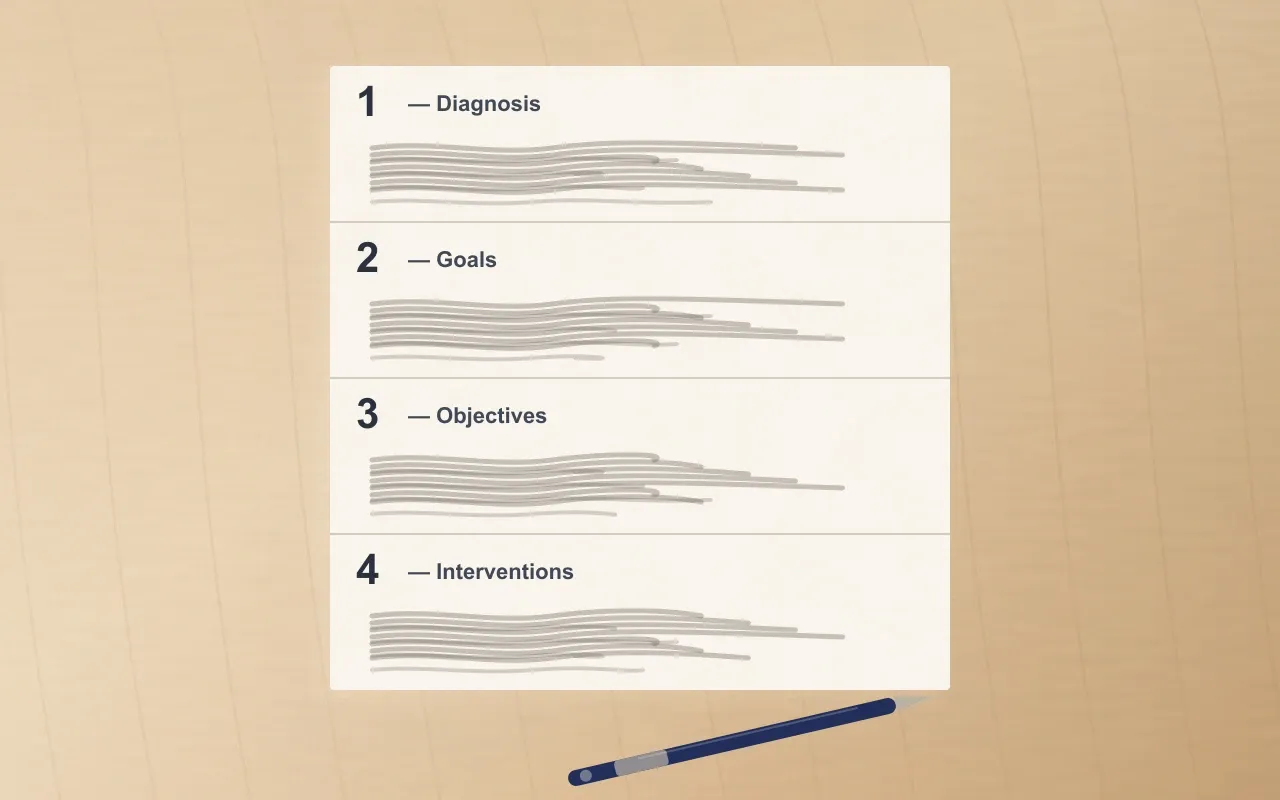
- 1 Diagnosis: current DSM-5-TR / ICD-10 diagnosis with relevant specifiers. This supports documentation of medical necessity.
- 2 Goals: what the client wants to be different by end of treatment. In their words, then translated into clinical language.
- 3 Objectives: measurable steps toward each goal (frequency, duration, intensity). What you'll actually track session-to-session.
- 4 Interventions: the modality and techniques you'll use, mapped to specific objectives. Reviewers want to see the linkage.
Treatment plan templates you can reuse
You can adapt these mental health treatment plan templates to your own forms or EHR. The structure is more important than the exact wording. The blank treatment plan template provides a focused starting point with worked CBT and ACT examples.
General outpatient therapy treatment plan template
Treatment plan example for depression
Treatment plan example for anxiety
Treatment plan example for trauma / PTSD
Treatment plan example for couples or family work
For the full couples-specific structure, including relationship-as-patient framing, modality choices, conjoint-billing decisions, and joint versus individual sessions, see the couples therapy treatment plan example companion guide.
Writing good goals, objectives and interventions
Many treatment plans fall down because goals are too vague, objectives aren’t measurable, or interventions are listed in a generic way.
Turning vague aims into measurable goals
Start with the client’s own words, then translate into something observable:
- Vague: “I want to feel happier.”
- More useful goal: “Increase daily activities and connections that give the client a sense of enjoyment and purpose.”
From there, create objectives that answer:
- What exactly will change?
- How much?
- By when?
- How will we know?
Examples:
- “Client will attend at least one social activity per week for 6 weeks.”
- “Client will reduce panic attacks from 4–5 per week to 1–2 per week within 8 weeks.”
If you need ready-made goal and objective statements, use the treatment plan goals and objectives guide.
Linking objectives to specific modalities (CBT, ACT, EMDR etc.)
It helps to make your therapeutic approaches visible in the plan:
- For CBT (Cognitive Behavioral Therapy)
- Interventions: thought records, behavioral experiments, cognitive restructuring, exposure.
- Objectives: changes in thinking patterns, behaviors and symptom scores.
- For ACT (Acceptance and Commitment Therapy)
- Interventions: values clarification, defusion exercises, mindfulness, committed action.
- Objectives: increased values-based actions, decreased experiential avoidance.
- For EMDR (Eye Movement Desensitization and Reprocessing)
- Interventions: preparation and stabilization, target selection, reprocessing phases.
- Objectives: reduced distress linked to target memories, spontaneous cognitive shifts, improved functioning.
You don’t need to write mini-manuals into the plan, but naming the modality and giving a concrete sense of what you’ll do can help both clinical clarity and payer communication.
Integrating measurement-based care into your plans
Measurement-based care doesn’t have to mean long batteries of questionnaires. It simply means using simple, repeated measures to inform your work.
For the operational layer, choose a form, outcomes tool, or therapy-specific workflow that clients can complete consistently and that you can interpret in session.
Choosing simple measures and when to use them
Start small and practical:
- Symptom scales (for example, PHQ-9 for depression, GAD-7 for anxiety)
- Functioning or quality-of-life ratings
- Brief client-rated scales (0–10) for key goals (for example, sleep, pain, parenting stress)
Ask yourself:
- Which one or two measures best capture what this client cares about?
- How often can we realistically collect them (for example, every session, monthly)?
Use the brief mental health check-in worksheet for a quick, non-validated between-session pulse; use the treatment plan when you need measurable objectives, formal outcomes, and a review schedule.
The best routine is the one you can repeat without losing the measure’s instructions, scoring rules, or clinical meaning.
How often to review and adjust treatment plans
Treatment plans are living documents. In practice:
- Set the review schedule from the payer, jurisdiction, treatment setting, clinical need, and the measures in use.
- Look at both formal measures and your clinical impressions.
- Ask the client how therapy feels and whether the goals still fit.
- Update goals, objectives and interventions when things change (new stressors, diagnosis updates, plateau in progress).
Documenting these reviews helps show that you’re actively tailoring treatment, not just repeating the initial plan indefinitely.
When the review decision is to end care because progress has stalled, copy a treatment termination letter for lack of progress instead of stretching this plan template into that notice.
If the written plan is already sound but the update workflow is not, compare mental health treatment plan software for keeping plans current across notes, measures, reviews, and supervision. When you need filled composites rather than a template skeleton, use the mental health treatment plan examples pdf.
Making treatment planning less of a chore
Treatment planning can feel like one more admin task. With the right supports, it can become a natural part of your workflow instead of another late-night job. Reusable treatment plan templates make that shift possible by giving you a starting structure every time, rather than reinventing the format for each client.
Using templates and checklists with supervision
A few practical ways to reduce the load:
- Standardize your templates. Use consistent structures across clients (like the templates above), so you’re never starting from a blank page.
- Use checklists during supervision. Review whether plans have clear links between problems, goals and interventions; measurable objectives and review points; updated risk and safety information.
- Connect plans to everyday documentation. In formats such as SOAP or DAP, reference specific goals and objectives in the Assessment or Plan sections.
- Keep plans client-centered. Involve clients in setting and revisiting goals so plans stay relevant and motivating.
How Emosapien helps connect intake, sessions and outcome tracking
Emosapien is built to support you from the first contact through ongoing care, not just at the level of individual notes.
The Quill therapy notes alternative compares this session-linked workflow with Quill’s post-session summary approach, including where treatment-planning continuity differs.
Around treatment planning and outcomes, Emosapien can help you:
- Pull in intake data automatically: use the presenting issues, history, and goals captured at intake to pre-fill parts of the treatment plan, so you’re not re-entering the same details.
- Suggest structured plan drafts: generate a draft mental health treatment plan template tailored to the client’s concerns (for example, depression, anxiety, trauma, couples work), including suggested goals, objectives and interventions for you to review and edit.
- Link sessions to goals: during and after sessions, Emosapien can highlight which goals you addressed and how, making it easier to keep notes and plans aligned.
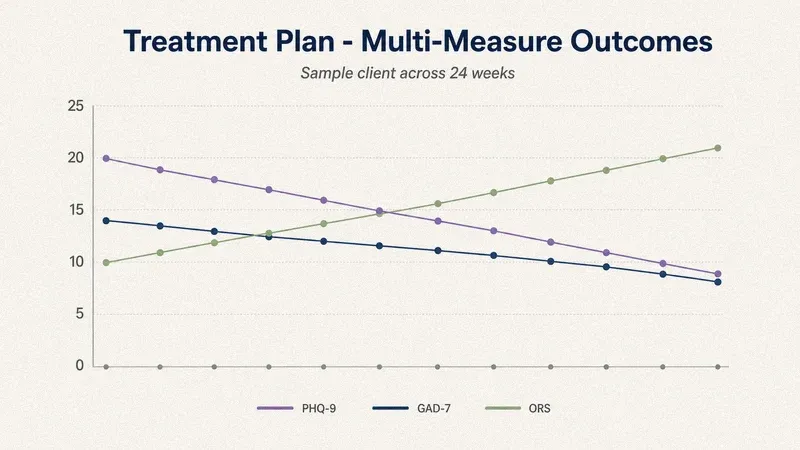
- Track outcomes over time: store and visualize measures (for example, PHQ-9, GAD-7, PCL-5, simple 0–10 ratings) alongside your plans and progress notes, so you can see patterns and adjust treatment more confidently.
You stay in charge of the goals, the formulation and the clinical decision-making. Emosapien’s role is to reduce the repetitive admin and help you see the story of change more clearly across intake, treatment plans, sessions and outcomes.
Emosapien links SMART objectives, session notes, outcome measures, and clinician sign-off in one treatment-planning workflow.
Emosapien drafts these notes while you stay with the client.