
Progress Note Template Hub: SOAP, DAP, BIRP, GIRP, PIE, and SIRP

Outline
A progress note template holds a client’s story between sessions. The right structure makes today’s clinical thread readable after a no-show, a covering clinician, or a long gap in care. Start with the format that fits today’s hour, lock presentation, intervention, response, risk, and next step on the page, then open the matching free generator when you want speed.
When the hour is multi-section, open SOAP, DAP, BIRP, or GIRP for a blank skeleton, a short completed example, and a continuity checkpoint. When one problem owned the hour, start with PIE below and move into the dedicated guide for full depth. When immediate context organizes the hour, use the SIRP note template in the format list below. For a deeper side-by-side choice guide, compare BIRP, SOAP and DAP.
Educational content for licensed mental health clinicians. Not legal or billing advice. Follow your licensing board, payer rules, and clinic policy.
Download the Note Formats Pack
Print six therapy progress-note structures, choose the right one for the session, and run the 60-second sign-off check before you close the chart.
- Side-by-side selector for SOAP, DAP, BIRP, GIRP, PIE, and SIRP
- Six printable format pages with intervention, response, risk, and next-step prompts
- DAP quick-reference card and intervention-language guide
- Process-versus-progress sorting card and 60-second sign-off checklist
Free. We'll email the PDF link right away and add you to the therapist toolkit, sent every two weeks. Unsubscribe any time.
Where should we send the link?
We'll email the PDF link right away. You'll also get the therapist toolkit every two weeks. Unsubscribe any time.
✓ Check your inbox
We've sent you the PDF
The download link is on its way to your inbox, usually within a minute or two. The email will come from Emosapien (hello@team.emosapien.com); check your spam folder if you don't see it.
You're also on the therapist toolkit list, sent every two weeks. Unsubscribe any time from the email footer.
What a progress note must carry
A mental health progress note is the shareable clinical record of the contact. It is not a transcript and it is not your private process journal. Write so another clinician can answer:
- Why was today’s contact clinically necessary?
- What did you do, and how did the client respond?
- What changed (even slightly), and what happens next?
- Is risk clear when it is relevant?
Those four questions are the continuity test. Format labels change; the clinical thread should not.
When you need the quick pre-sign surface rather than full skeletons, open the therapy progress notes cheat sheet. When the intervention line needs named clinician language, use the list of therapeutic interventions.
Progress notes vs psychotherapy notes
Keep private process material out of the shareable chart. 45 CFR § 164.501 defines psychotherapy notes as notes recorded (in any medium) by a health care provider who is a mental health professional documenting or analyzing the contents of conversation during a private counseling session or a group, joint, or family counseling session and that are separated from the rest of the individual’s medical record. See also the APA record-keeping guidelines.
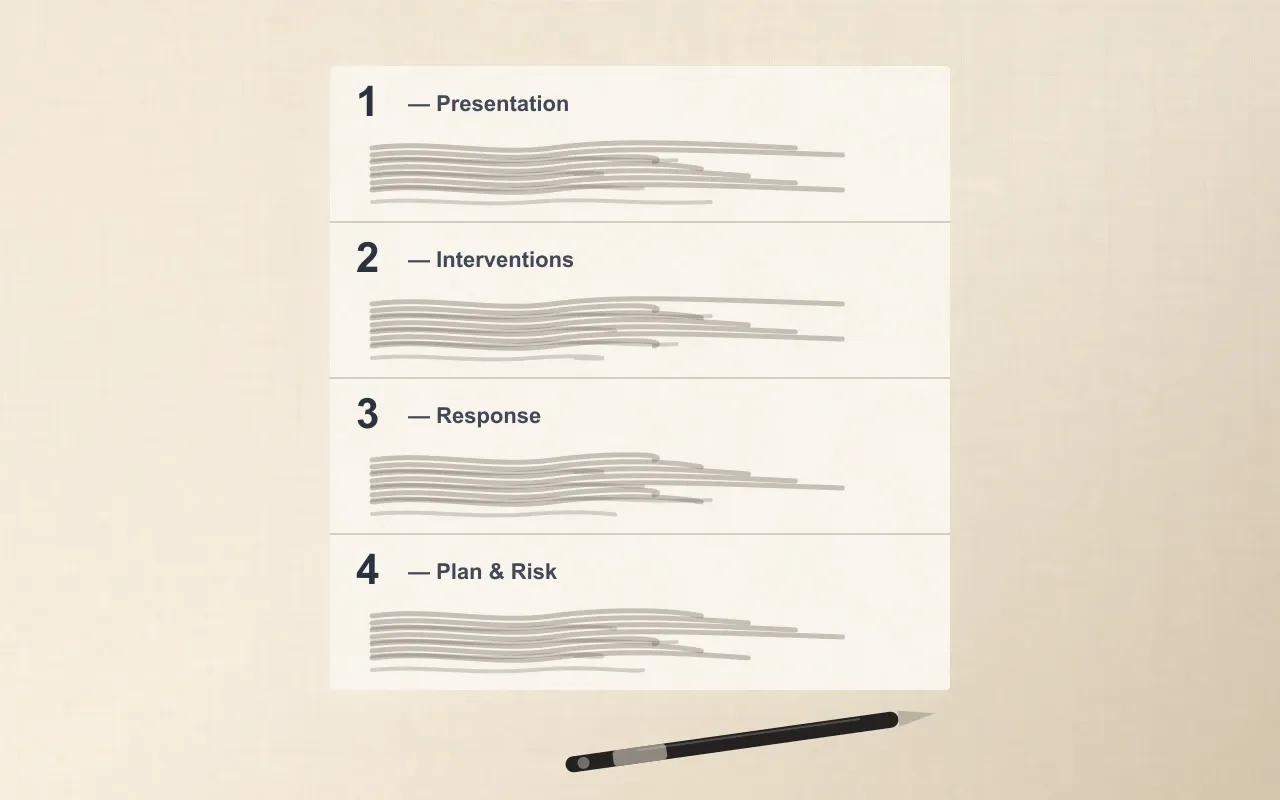
- 1 Presentation: what brought the client to this session, observable affect, and reported symptoms.
- 2 Interventions: what you did, named clearly enough that a covering clinician knows the modality and technique.
- 3 Response: how the client engaged, what shifted in session, and any measurable change.
- 4 Plan and risk: between-session task, next-session focus, and active safety considerations.
How to choose among the six formats
Most therapists keep one default progress note template and switch when the session shape changes. Match the setting and the documentation demand here, then open that guide. The skeletons further down are for drafting after you have already picked.
- Mixed caseload, or a chart other disciplines will read: SOAP notes guide.
- Mixed private-practice hour (check-in, skill, and planning): DAP notes template.
- Skills-led, IOP, or SUD hour that must show intervention and response: BIRP notes template.
- When you expect the note to be read against the treatment plan: GIRP notes format.
- One problem owned the hour: PIE notes template.
- Immediate situation or change since last contact organizes the hour: SIRP note template.
If you need the rest of the documentation set rather than a format, start with clinical documentation for therapists.
When the hour does not need a named format, start from a patient notes template and switch to SOAP, DAP, or BIRP only when the chart demands that shape. When the visit is a medication check, the note is psychiatry notes, not one of the six psychotherapy formats above.
When the affect line is thin, write the skill you used. A reflection of feeling is the four-line comparison that belongs in Response. The intervention line should be able to name one of the six counseling skills, from attending through immediacy.
Mental health progress notes examples
Copy one of these when the hour was a mood hour or a regulation hour. Each box is a finished note. Change the initials, the date, and the clinical facts before you sign. Then move the rewritten lines into the progress note template for that format.
SOAP, depressive symptoms, telehealth
Continuity checkpoint
Could a covering clinician see what changed since last contact, what you tried today, how A.L. responded, current risk, and the exact next step without opening older notes? If any of those five are missing, tighten Assessment and Plan before you sign.
BIRP, irritability and sleep disruption
Continuity checkpoint
BIRP protects continuity when Response is concrete. “Client engaged well” is not enough. Name the affect shift, the skill the client could restate, or the measurable change. That is what the next session opens on after a gap.
Progress notes examples
Use the DAP note when the hour mixed a check-in, a skill, and a plan. Use the GIRP note when today’s work has to match a goal already written in the treatment plan. Change the counts, the ratings, and the goal sentence before you sign. A copied goal that is not the active goal leaves the next clinician resuming the wrong thread.
DAP, performance anxiety follow-up
Continuity checkpoint
If J.S. cancels next week, does this note still tell you which skill landed, which exposure step is live, and what “progress” means in observable terms? DAP fails when Assessment is a restatement of Data. Write one sentence of judgment that another clinician can resume from.
GIRP, social anxiety progress
Continuity checkpoint
If the treatment plan goal changed, say so in Goal or Plan instead of retrofitting today’s work. Continuity fails when every GIRP note claims the same generic goal while the real clinical thread has already moved.
Sample progress notes
These two notes are the same client, five days apart. Copy the shape when one problem owns the hour and you need the next contact to open on what already happened, not on the plan you hoped for. Change every fact before you sign.
PIE, anniversary visit, planning session
PIE, anniversary visit, follow-up
Continuity checkpoint
Read the 03/09 note without the 03/04 note open. You should still know the stop rule, that it was used, that the graveside walk did not happen, and what you will decide next week. If the follow-up reads like the plan failed, you rewrote the client’s successful stop as noncompliance. Fix that before you sign. If one problem did not own the hour, leave PIE and use the progress note template in the SOAP, DAP, BIRP, or GIRP section.
SOAP template
When SOAP helps
Use SOAP when you need clear separation between what the client reported, what you observed, how you read it, and what comes next. It is a solid default for mixed caseloads and for notes that may be read by colleagues outside your modality.
SOAP skeleton
Draft in the free SOAP note generator when you want the same four-section flow from session material.
DAP template
When DAP helps
Use DAP when you want speed without dropping clinical thinking. Data holds presentation and observations together; Assessment holds your judgment; Plan holds the forward path. It is often the cleanest default when the session was a mix of check-in, skill work, and planning rather than a heavy intervention block.
DAP skeleton
Draft in the free DAP note generator when you want the three-part flow kept intact.
BIRP template
When BIRP helps
Use BIRP when the clinical story is what you did and how the client responded. Behavior opens on presentation; Intervention names the work; Response captures engagement and shift; Plan carries the thread forward. It is a strong fit for skills-led sessions, group and IOP contexts, and any hour where intervention clarity matters more than a long assessment essay.
BIRP skeleton
Draft in the free BIRP note generator when the hour was intervention-led.
GIRP template
When GIRP helps
Use GIRP when the chart is goal-anchored and notes will be read against the treatment plan. Goal leads; Intervention and Response show the work and the client’s movement; Plan updates the path. GIRP is only as strong as the goal language underneath it. Vague goals produce vague notes.
GIRP skeleton
Draft in the free GIRP note generator when the session is goal-mapped.
PIE at a glance
When PIE helps
Use PIE when one problem drove the session and you want a short scan path: Problem, Intervention, Evaluation. It fits focused follow-ups, problem-centered contacts, and hours where a long multi-section format would pad rather than clarify. If the hour spanned several unrelated themes, SOAP or DAP usually holds the thread better.
Continuity checkpoint
PIE keeps the client thread visible when Evaluation carries both response and next step. Do not end on Intervention alone. The next clinician needs to know whether the problem eased, stalled, or widened, and what experiment is already running between sessions.
Draft in the free PIE note generator when one problem owned the hour.
What to include and what to leave out
Include
- Enough context for continuity after a gap
- Named interventions and brief clinical reasoning
- Markers of change over time, even small ones
- Risk language when relevant
- A specific next step another clinician can follow
Leave out
- A word-for-word transcript
- Third-party detail that is not clinically necessary
- Judgmental or speculative wording; stay behavior-based and observable
- Private process material that belongs in a separate psychotherapy note, if you use that category
Any progress note template is only as good as the finished note three weeks later. If you cannot skim your own note in under a minute, cut description and keep judgment, response, risk, and plan.
60-second sign-off checklist
Before you sign, run this continuity pass against the progress note template you used:
- What brought the client in today, in plain language?
- What intervention did you use, named clearly enough to resume?
- How did the client respond, with at least one concrete marker?
- Is risk addressed when it is relevant?
- What is the next step, homework, or focus, written specifically enough to guide the next contact?
- Is there at least one signal of change over time (improved, unchanged, or worsened)?
If any answer is missing, the note may still look complete in your preferred format and still fail continuity. Fix the missing clinical thread before you close the chart.
Keeping the client thread intact
The best default is the structure your future self can open after a long gap and trust. SOAP, DAP, BIRP, GIRP, PIE, and SIRP are different containers for the same job: preserve presentation, intervention, response, risk, and next step so care does not restart from zero.
Use the skeletons above, and the dedicated PIE guide when you need full PIE depth, as your practice default. Keep one worked example nearby until the structure is automatic, and draft in the matching free generator when speed matters. When the question is which structure fits the case rather than how to write today’s note, return to the comparison page above and stay inside one default long enough for the chart to stay coherent.