
Measurement Based Care in Psychotherapy: A Practical Guide for Busy Therapists

Outline
You already track a lot in your head: mood shifts, risk changes, the moment a client sits a little straighter when something clicks. Measurement based care puts a small structured frame around that intuition so you and the client can both see the trend.
For many therapists, the phrase still means long questionnaires, extra paperwork, and clients rolling their eyes at another form. It does not have to look like that. With one brief measure, a fixed cadence, and a review habit you can keep on a full day, the scores support clinical judgment instead of replacing it.
This guide is the implementation version: what changes in the room, a workflow you can run this month, how to choose measures, how to review and document change, and the printable pack that keeps administration off sticky notes.
Free PDF: PHQ-9 and GAD-7 Administration Pack
A printable clinician pack for administering, scoring, trending, and following up on PHQ-9 and GAD-7 in outpatient therapy.
- Pre-session checklist and client-framing language for both measures
- Severity-band reference plus score logs for PHQ-9 and GAD-7
- Multi-session trend grid and trajectory read prompts
- Follow-up decision checks and chart note language stems
Free. We'll email the PDF link right away and add you to the therapist toolkit, sent every two weeks. Unsubscribe any time.
Where should we send the link?
We'll email the PDF link right away. You'll also get the therapist toolkit every two weeks. Unsubscribe any time.
✓ Check your inbox
We've sent you the PDF
The download link is on its way to your inbox, usually within a minute or two. The email will come from Emosapien (hello@team.emosapien.com); check your spam folder if you don't see it.
You're also on the therapist toolkit list, sent every two weeks. Unsubscribe any time from the email footer.
Educational content for licensed therapists, not clinical or legal advice. Adapt cadence, framing, and follow-up to presentation, risk, culture, setting, and supervision. Obtain free clinical instruments from legitimate sources and follow their terms of use.
What measurement based care changes in therapy
Measurement based care means using simple, repeated measures to inform therapy. You pick one or two brief tools that fit the client, collect them on a stable schedule, look at the scores together with your clinical judgment, and adjust treatment when the trend says something the room alone might miss.
The measures can be symptom scales, simple 0 to 10 ratings, or short wellbeing questionnaires. They do not replace formulation or the relationship. They add a comparable data point next to last month’s data point.
Research across settings and modalities has found that when therapists use routine outcome monitoring, review scores with clients, and adjust treatment from those scores, clients are more likely to improve and less likely to quietly deteriorate. You do not need a complex battery. One well-chosen measure, used consistently, is enough to catch non-response early.
What changes in practice is operational, not philosophical:
- The trend is visible before the hour ends. You are not reconstructing six sessions from memory at 9pm.
- Non-response gets a named conversation. Flat lines stop hiding behind good rapport.
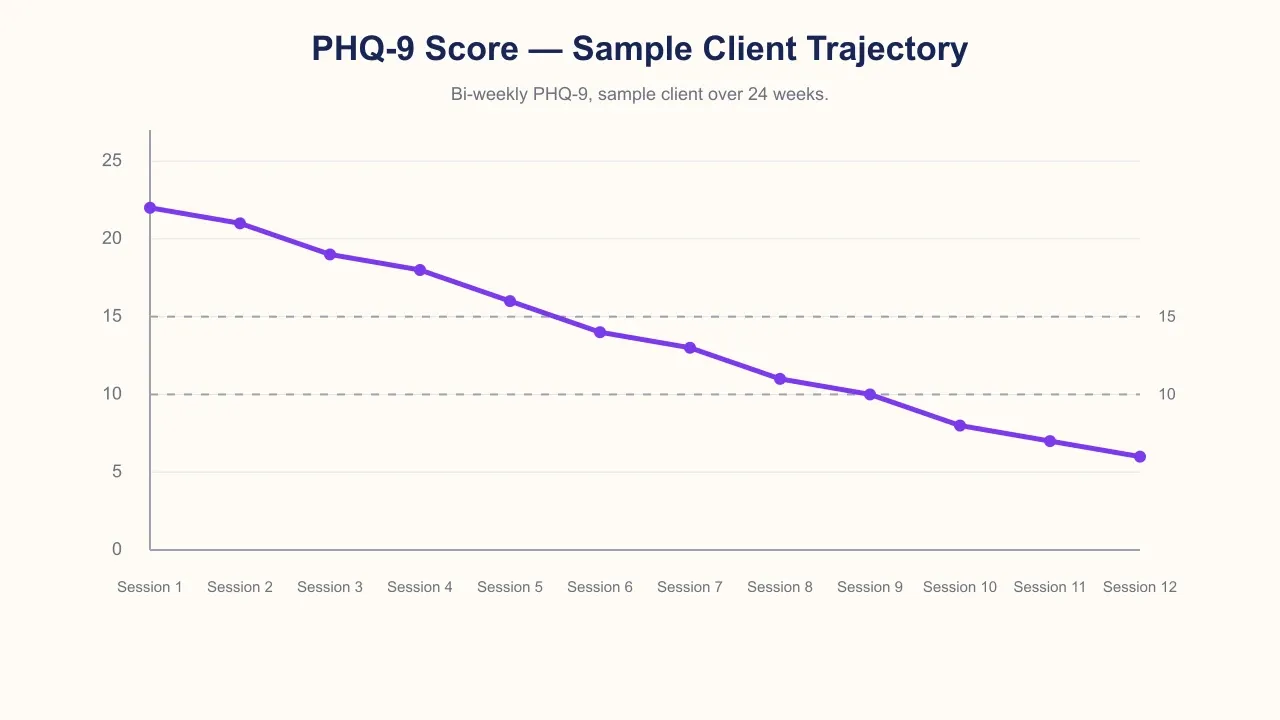
- The client can see movement. A drop from 18 to 11 on the PHQ-9 is clearer than “you seem better.”
- The chart carries a severity trajectory. Utilization review and future clinicians get more than narrative impression.
What does not change: you still choose the measure, interpret the score in context, and own the next clinical move. A GAD-7 of 11 after a divorce filing is not the same event as a GAD-7 of 11 after a quiet month.
Implementation workflow you can run this month
The habit sticks when it is built into routine rather than bolted on after a hard week.
Four-week starter loop
- Week 1: choose one core measure for your most common presentation (often PHQ-9 or GAD-7) and write the exact cadence on a sticky note you will throw away once the habit sticks: intake baseline, then every 2 to 4 sessions.
- Week 1: pick a delivery mode your chart can store reliably: waiting-room paper, secure portal, or first three minutes of telehealth. One mode only.
- Weeks 1 to 4: pilot on three to five clients, not the full caseload. Incomplete data across everyone discourages the work faster than a clean pilot.
- Every scored visit: review the number in session before the client leaves. Ask what stands out. Name whether the line is improving, flat, or rising.
- Every scored visit: write one chart line with measure name, date, total, severity band or change direction, and the clinical next step.
- Week 4: decide whether to expand. Keep the same measure if the loop ran. Only add a second measure after the first cadence is boringly reliable.
Solo practice pattern
- Send or collect the measure before or at session start.
- Score immediately (or use auto-scoring so you never hand-tally).
- Open the hour with the trend when clinically appropriate.
- Capture the number and meaning in the progress note the same day.
- Revisit measure fit every 4 to 8 weeks.
Small group pattern
- Agree on a core set for common presentations so cover clinicians can read each other’s charts.
- Build measures into intake so they are standard, not optional.
- Bring non-improving trajectories into supervision as case material, not as clinician grading.
- Protect privacy when you review aggregate trends for quality improvement.
Larger clinic pattern
- Embed measures in the EHR so scores sit beside notes and treatment plans.
- Standardize frequencies by program acuity.
- Train framing scripts so clients hear collaboration, not testing.
- Use aggregate data carefully. Never let dashboards override clinical judgment or client safety pathways.
Technology reduces friction. Change management still decides whether anyone uses the workflow on a Tuesday afternoon.
Selecting measures that fit the caseload
The best measures are the ones you will actually administer. Short, relevant, and easy to explain usually beats perfect but impractical.
Brief measures for common presentations
Depression
- PHQ-9: nine items, about one minute, widely accepted severity bands, item 9 as a same-day risk event.
- Or a simple 0 to 10 mood rating when a full scale is too much for this client right now.
For administration, scoring bands, item-9 handling, and chart stems, use the PHQ-9 administration guide. Perinatal depression is a different instrument. Score it on the Edinburgh Postnatal Depression Scale scoring sheet, not by stretching PHQ-9 bands onto a postpartum visit.
Anxiety
- GAD-7: seven items, about one minute, pairs cleanly with PHQ-9 on mixed presentations.
- Or a 0 to 10 “anxiety in the past week” rating for clients who resist formal forms.
For scoring bands, functional-impact language, and follow-up moves, use the GAD-7 administration guide. Child and parent anxiety is not a GAD-7 case. Put both informant totals on the SCARED child and parent anxiety screen before you treat one adult score as the picture.
Trauma / PTSD
- PCL-5 when DSM-5 PTSD clusters are primary and the client can tolerate the checklist.
- Targeted questions about nightmares, intrusions, avoidance, and hyperarousal when a full list is too activating.
General progress and alliance
- ORS and SRS: four items each, about thirty seconds, useful every session in integrative or brief work.
- WHO-5 when wellbeing language fits better than symptom language.
Substance use
- AUDIT at intake and on a longer monitoring cadence during sobriety-focused work.
You can expand later. Starting with one core area and one short measure is enough.
Measure comparison at a glance
| Measure | What it tracks | Items / time | Cadence | Best fit |
|---|---|---|---|---|
| PHQ-9 | Depression severity | 9 items / ~1 min | Every 2 to 4 sessions | MDD, persistent low mood, treatment monitoring |
| GAD-7 | Generalized anxiety | 7 items / ~1 min | Every 2 to 4 sessions | GAD, mixed anxiety, often paired with PHQ-9 |
| PCL-5 | PTSD symptoms | 20 items / ~5 min | Intake + every 6 to 8 sessions | Trauma-focused work when safe and indicated |
| AUDIT | Alcohol use | 10 items / ~2 min | Intake + every 8 weeks | Substance-use screening and monitoring |
| ORS / SRS | Progress + alliance | 4 items each / 30 sec | Every session | Integrative practice, brief therapy, alliance focus |
| WHO-5 | Wellbeing | 5 items / ~30 sec | Every 2 to 4 sessions | Recovery and wellness-focused work |
| DASS-21 | Depression / anxiety / stress | 21 items / ~3 min | Every 4 sessions | Mixed presentations where one combined tool beats stacking three |
Disorder-specific tools show whether the focal problem is moving. General wellbeing tools catch broader life change when the presentation is complex. A simple pair is one symptom measure plus one functioning or alliance measure only when complexity requires it.
Reviewing change with the client
Scores become clinical only when you look at them together.
Framing language that protects alliance
- “These short questions help us notice changes that are hard to see week to week.”
- “This is not a test you pass or fail. It is one way to track how things are going.”
- “Sometimes the number moves before you feel it, or the other way around. Both are useful.”
Keep the stance collaborative and curious. Avoid good-score / bad-score talk without context.
Using the number in the hour
- “Your score rose a bit this month. Does that match how the weeks have felt?”
- “Anxiety is lower on paper, and you are still avoiding that situation. Let’s talk about that gap.”
- “Depression dropped and you are back at work three days a week. What feels most real about that?”
Invite client-defined markers alongside formal measures: sleeping through most nights, attending one social event, less Sunday-evening dread. Formal scores and lived markers should inform each other.
When the line is flat or rising
A stalled trajectory is the highest-yield signal routine monitoring produces. Common clinical forks:
- Formulation is incomplete or wrong.
- Modality or dose does not match the maintaining cycle.
- Between-session practice is blocked or unsafe.
- Alliance rupture, avoidance, or therapy-interfering behavior needs direct work.
- Risk, substance use, medical factors, or social determinants are driving the score.
Name one adjustment and one review point. A flat line with no plan change is wasted data. When the next move depends on how ready the client is to change a target behavior, a stage-matched readiness worksheet keeps that adjustment matched to where they actually are.
Between-session completion only helps when the score reaches you before the visit and opens collaborative review. That same loop supports client engagement between sessions when measures, check-ins, and journal signals land in one pre-session view.
Documenting decisions in the chart
Weak notes say the measure was completed. Strong notes name the number and the next move.
Minimum chart elements for a scored visit:
- Measure name and date
- Total score and severity band when applicable
- Item-level risk flags (for example, PHQ-9 item 9)
- Direction versus baseline or last score
- Whether you reviewed the trend with the client
- The clinical response: continue, adjust modality or dose, increase supports, reassess diagnosis, or plan discharge
Example line:
PHQ-9 12 (moderate) on 2026-07-28, down from 16 at intake. Item 9 negative. Reviewed trajectory with client; continued behavioral activation and planned exposure hierarchy review next session.
That sentence is defensible medical-necessity language and usable supervision material. The score alone is not.
When you want baseline, measure, session date, change, and clinical review on one printable grid, use the progress monitoring template. Keep it beside the progress note, not as a substitute for the note. Inside NHS Talking Therapies, first and last paired scores follow the NHS Talking Therapies outcome measures collection map.
Shared administration and progress-monitoring pack
The operational barrier is rarely belief in outcomes. It is scoring by hand, losing last month’s number, and forgetting to close the loop in session.
The shared PHQ-9 and GAD-7 administration pack is the primary artifact for this guide. It is built for the chart desk:
- Pre-session checklist and client-framing language
- Severity-band reference plus score logs for both measures
- Multi-session trend grid and trajectory read prompts
- Follow-up decision checks and chart-note language stems
Use the official free clinical instruments for the item stems themselves. Use the pack to administer on cadence, score consistently, and turn the number into a next step. Subscribe above to receive the PDF.
Pair the pack with the progress monitoring template when you need one grid that travels across measures and sessions. Measure choice and tracking grid are separate decisions; both belong in the same weekly habit.
Using technology without losing clinical control
Technology should remove busywork: invitations, scoring, plotting, and pre-session surfacing. It should not interpret the client for you.
If you are comparing specific ways to collect and review that data, the tools for tracking client progress guide maps the options therapists actually use.
Useful workflow features:
- Automatic invitations before sessions within your privacy policies
- Auto-scoring with clear alerts for significant change or risk-related items
- Trends visible beside notes and treatment-plan goals
- Between-session delivery that still lands in the clinical record before the visit
If you want measures, check-ins, and journal signals to reach one pre-session view, the client engagement therapy workflow shows how those inputs stay connected. Keep the same rule: cadence, auto-scoring, and a pre-session trend you can open with the client beat another disconnected dashboard.
Emosapien supports that loop for therapists who want measures inside the wider engagement and documentation workflow: brief measures on a cadence you set, scores next to session context, and flags for clinician review when a trajectory stalls. You still choose the measure, read the meaning, and decide the next move. Session content is not used to train public models by default, and privacy boundaries stay with the rest of the clinical record.
Keep measures in the workflow
Emosapien helps you schedule brief measures, plot trends against treatment goals, and review change before the client sits down, without turning the hour into data entry.
Try EmosapienGetting started this week
You do not need a practice overhaul.
- Choose one simple measure for your most common presentation.
- Pilot the four-week loop with three to five clients.
- Review every score in session and write one chart line that names the next step.
- Download the administration pack so scoring and follow-up prompts live in one place.
- Expand only after the first cadence is stable.
Measurement based care earns its keep when the trend changes a conversation or a plan. Start small, stay consistent, and keep clinical judgment in charge of every number.
References
- American Psychological Association. (2019). Clinical Practice Guideline for the Treatment of Depression Across Three Age Cohorts. Depression clinical practice guideline
- American Psychological Association. (n.d.). Understanding Psychotherapy and How It Works. Understanding psychotherapy
- American Psychological Association. (2023). Measurement-based care is giving psychologists and their patients a better picture of treatment progress. Monitor on Psychology. Measurement-based care overview (APA Monitor)