
BIRP Notes Template, Examples, and Printable Guide

Outline
BIRP notes organize a therapy hour around Behavior, Intervention, Response, and Plan. The format fits intervention-led work: group, intensive outpatient, skills practice, and many addiction or recovery sessions. Clinic policy, payer contracts, and program rules still decide whether that container is required.
This BIRP notes guide gives you a copy-ready template, two completed therapy examples, and a printable BIRP page inside the Note Formats Pack. The pack also carries a six-format selector and a 60-second sign-off checklist. Prefer a first draft in the browser? Use the generator after you inspect the blank structure.
Educational content for licensed therapists and mental-health clinicians. Not legal, billing, or payer advice. Documentation rules vary by state board, payer contract, program, and clinic policy.
BIRP at a glance
Name the intervention. Record what the client did with it. Let that response determine the next step.
| Section | Put here | Keep out |
|---|---|---|
| Behavior | Presenting issue this session, observable affect and conduct, client report, risk when relevant | Interpretation, intervention narrative, next-session planning |
| Intervention | Modality plus the specific technique, exercises delivered, in-session coordination | ”Supportive therapy,” a restatement of the client’s story |
| Response | Engagement, skill demonstration, measurable change, the client’s own framing | Clinical interpretation, homework assignment, covering-clinician instructions |
| Plan | Homework, next-session focus, coordination, and the reason that next step follows today’s response | ”Continue weekly,” private process reflections, another member’s identifiers |
Continuity rule: Intervention, Response, and Plan are one thread. If the client could not use the skill, Plan does not pretend mastery. If the client demonstrated readiness, Plan can advance.
Pre-sign check
- Intervention names the modality and the technique.
- Response has observable, scored, or quoted evidence.
- Plan follows from Response.
- Risk appears in Behavior when the presentation warrants it.
- A group note records this client’s response and does not identify another member.
- Generated text, if any, is reviewed, corrected, and owned by you.
What BIRP notes are
BIRP stands for:
- Behavior - the client’s presenting issue this session, observable behavior and affect, and the symptoms or functional impact they report.
- Intervention - what you did, named clearly enough that a covering clinician or reviewer can identify the modality and the specific technique.
- Response - how the client engaged with the intervention, what shifted in session, and what they took away.
- Plan - between-session task, focus for next session, any coordination, and the clinical reasoning for the chosen direction.
The format collapses SOAP’s Subjective and Objective split into one Behavior block. It replaces a standalone Assessment with a reasoning thread that runs through Response and Plan. In skills-heavy or programmatic work, “what did we do, what happened, and what is next?” carries more load than a separate impression heading.
If the hour was insight-led or process-heavy, SOAP or DAP usually fits better. BIRP earns its keep when the intervention is the center of gravity.
When BIRP notes fit the session
BIRP maps onto hours that already run as intervention-and-response loops. Group therapy is a frequent fit: several interventions happen in one sitting, and the individual note has to surface this client’s piece. Skills-led individual work follows the same logic. DBT skills, ACT defusion, exposure ladders, behavioral rehearsal, and communication training already organize the hour around a technique. Addiction and recovery hours often use the same loop for craving response, relapse-prevention skill use, and contingency-management work.
That is a frequent fit, not a universal requirement. Do not treat BIRP as mandated in IOP, SUD, group, or community mental-health settings unless a cited local rule, funder contract, or clinic policy says so.
SOAP or DAP can carry insight-led or formulation-heavy individual work when the hour is not organized around a named technique. Clinic policy, the payer contract, and the program still decide the container. Copy blank SOAP, DAP, and related skeletons from the progress note templates when those containers fit the hour better than BIRP.
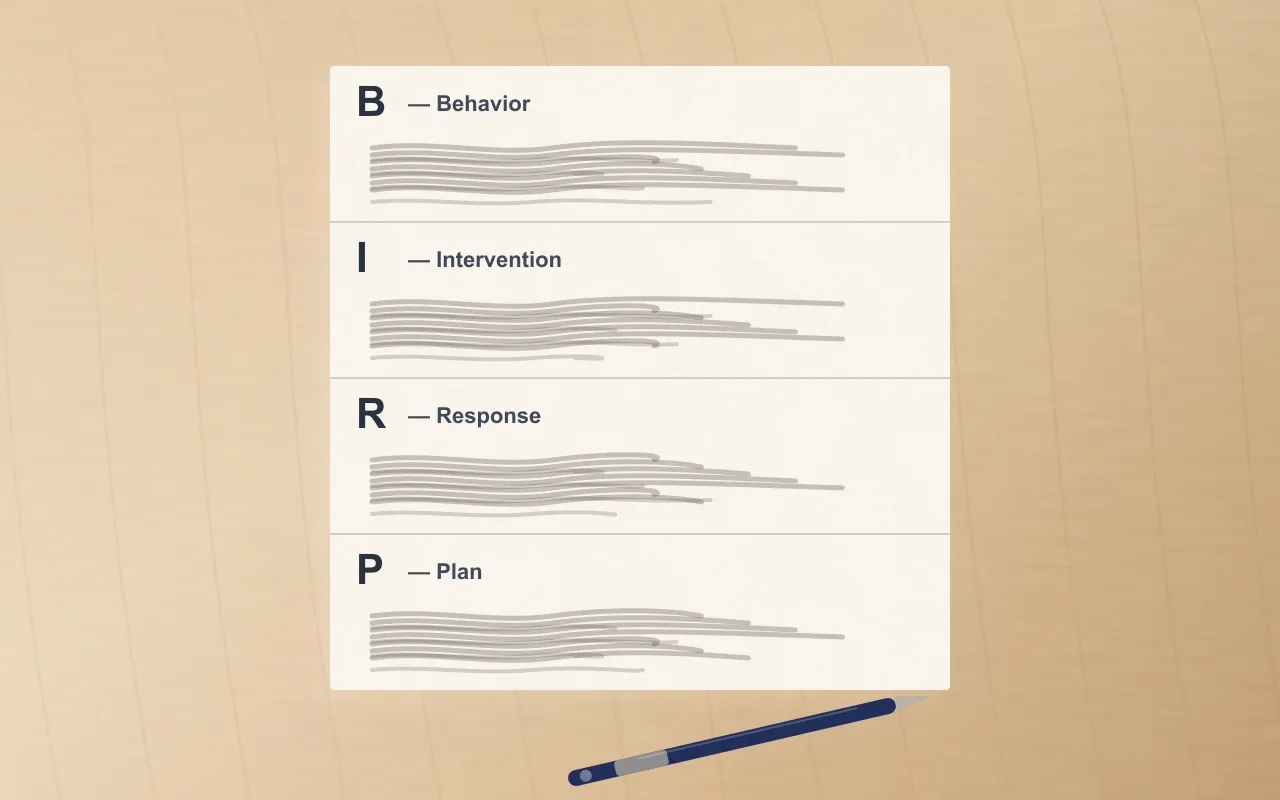
- 1 Behavior - presenting issue this session, observable affect, and reported symptoms. Replaces SOAP's Subjective + Objective in one block.
- 2 Intervention - what you did, named clearly enough that a covering clinician can identify the modality and the specific technique.
- 3 Response - how the client engaged with the intervention, what shifted in session, and any measurable change.
- 4 Plan - between-session task, focus for next session, coordination, and the clinical reasoning for the chosen direction.
BIRP template (copy-ready)
Paste the block into the clinical record or your EHR macro library. Keep the section headers so a reviewer or covering clinician can scan the note.
The printable blank BIRP page lives on page 5 of the Note Formats Pack. Page 2 is the six-format selector. Page 12 is the 60-second sign-off checklist.
Download the BIRP template and Note Formats Pack
Print the blank BIRP page, compare six note structures, and use the 60-second sign-off check before you close the chart.
- Side-by-side selector for SOAP, DAP, BIRP, GIRP, PIE, and SIRP
- Six printable format pages with intervention, response, risk, and next-step prompts
- DAP quick-reference card and intervention-language guide
- Process-versus-progress sorting card and 60-second sign-off checklist
Free. We'll email the PDF link right away. We may also send the occasional therapist toolkit. Unsubscribe any time.
Where should we send the link?
We'll email the PDF link right away. You'll also get the occasional therapist toolkit. Unsubscribe any time.
✓ Check your inbox
We've sent you the PDF
The download link is on its way to your inbox, usually within a minute or two. The email will come from Emosapien (hello@team.emosapien.com); check your spam folder if you don't see it.
You're also on the weekly therapist toolkit list. Unsubscribe any time from the email footer.
Want a first draft instead of a blank structure? The free BIRP note generator builds Behavior, Intervention, Response, and Plan text for you to review, correct, and sign. For a platform comparison, see the AI BIRP note generator roundup. The pack is the printable reference. The generator is the drafting path. Neither is a finished clinical record.
BIRP example: DBT skills group, distress tolerance
Fictional example. Minimal necessary detail. No identifiable client information.
Response carries the load an Assessment section would carry in SOAP. The skill demonstration, the distress-score change, and the reframe in skills language show what the client did with the intervention. Plan then carries the interpretive thread: the homework, the next-session focus, and the reason for both.
BIRP example: individual exposure work for social anxiety
Fictional example. The Behavior section stays short because the load-bearing data is the exposure work, not symptom severity.
BIRP allows that re-weighting. A SOAP note for the same hour would run longer in Subjective and Objective and shorter in Plan. Here the air sits in Intervention, Response, and Plan because that is where the session lived.
How to write each BIRP section well
Behavior
Treat Behavior as a tight orientation, not a transcript. Give enough context to read the rest of the note: what the client brought in, what you saw, and any safety or risk relevant to today.
- Lead with what the session will do clinical work on. If you are doing exposure, the relevant Behavior detail is this week’s exposure data, not last month’s mood scores.
- Use the client’s own words for self-report. A short direct quote preserves nuance and makes the note harder to dispute.
- Note what you observed, not what you inferred. Affect, speech, posture, and engagement are observable. “Client appeared anxious” is interpretation. If it matters, name the observable: “Client tapped foot continuously and shifted in the chair every 30 to 45 seconds.”
Intervention
Name the modality and the technique. “Used CBT” is too vague to audit. “Used CBT exposure planning to build a 4-step ladder for team meetings” is specific enough that a covering clinician can pick up next session. If you draw from more than one modality, name each: “ACT defusion exercise paired with CBT cognitive restructuring.”
For group sessions, name what you delivered to the group and any individualized piece. “Co-facilitated the distress-tolerance module, with a worked example from this client’s week (their consent, their framing)” reads as both group documentation and an individualized note.
Response
Response is where thin notes fail. Record what the client did with the intervention. Aim for observable data (skill demonstration, distress scores, exposure steps completed) and the client’s own framing of what shifted. Keep interpretation out. That load moves to Plan.
Capture a measurable change when one exists, and capture engagement. A client who completes the exercise mechanically is responding differently than one who asks two clarifying questions and offers a worked example. That difference belongs on the page.
Plan
Plan carries more interpretive weight than its SOAP counterpart because BIRP has no standalone Assessment. Tie each homework item and each next-session focus back to something in Response. If Response noted overestimation of peak anxiety, Plan leverages that: log predicted versus actual so the prediction-error data organizes the next hour.
A reviewer can read Plan and see clinical reasoning, not only task assignment. One sentence of “why this next” beats a longer list of “what next.”
Common BIRP mistakes
- A vague Intervention line. “Therapy” or “supportive psychotherapy” is not auditable. Name the modality and the technique.
- A thin or interpretive Response. “Client was engaged and seemed to benefit” paraphrases. Replace it with observable data and direct framing.
- A Plan disconnected from Response. If Response shows the intervention worked unevenly, Plan reflects that. It does not default to “continue weekly, same approach.”
- Missing relevant risk language. When the presentation warrants it, risk sits in Behavior, even if the line is “denied SI/HI.”
- A group note that identifies another member or omits this client’s response. Write Response in two layers: how the group responded, and how this client responded. Other members stay unnamed.
Choose BIRP versus another format
| Format | Section structure | Session shape it matches | Trade-off |
|---|---|---|---|
| BIRP | Behavior, Intervention, Response, Plan | Hours built around a named technique and the client’s response | Less natural for insight-led individual therapy |
| SOAP | Subjective, Objective, Assessment, Plan | Hours that split client report, observation, and a standalone assessment | More structure, slightly slower to write |
| DAP | Data, Assessment, Plan | Hours where formulation and trajectory carry more weight than per-session technique | Requires self-discipline to keep observation out of Data |
When the decision is mainly which container to pick, compare BIRP, SOAP, and DAP. Return here for the BIRP template, examples, and printable page.
Storage, amendments, and confidentiality
When HIPAA applies, BIRP-format progress notes are part of the clinical record. They are distinct from psychotherapy notes as defined at 45 CFR § 164.501. Keep only what your setting requires in the shareable chart.
- Access and BAAs. Use systems with role-based access and audit logs. Your vendor should sign a Business Associate Agreement before client data lands there. 45 CFR Part 164, Subpart C addresses access control, audit controls, integrity, authentication, and transmission security. Section 164.312 treats encryption as an addressable implementation specification and does not name a single required algorithm.
- Amendments. Follow your EHR, employer, and board rules when you correct a signed note. Many clinic policies require a dated, signed addendum rather than a silent overwrite.
- Group notes and identifiability. A group-session note belongs in one client’s record. Other members must not be identifiable. Use roles (“a peer in the group offered a reframe”), not names.
- Retention. There is no single US retention period. Follow the state board, employer policy, and payer contract that govern the chart. The APA record-keeping guidelines recommend seven years for adult records as a professional baseline when law is silent or shorter; HIPAA documentation duties and payer contracts can still run longer.
For product workflow that keeps progress notes separate from private process material, see HIPAA-compliant therapy notes. Read adjacent coding, retention, and charting guidance in clinical documentation for therapists.
Frequently asked questions
What does BIRP stand for in therapy notes?
BIRP stands for Behavior, Intervention, Response, Plan. Behavior captures the client’s presenting issue, observable behavior, and self-reported symptoms. Intervention names what you did in session. Response documents how the client engaged and what shifted. Plan covers homework and next-session focus.
Should I download a template or use the free BIRP note generator?
Use the blank BIRP template and Note Formats Pack when you want structure and a printable desk reference. Use the free BIRP note generator when you want a browser draft of Behavior, Intervention, Response, and Plan to review, correct, and sign. Neither replaces clinician judgment or local policy.
Are BIRP notes accepted by insurers and licensing boards?
A format acronym does not establish acceptance. Payers and boards review substance: medical necessity, the intervention provided, the client response, risk when relevant, and a forward plan. BIRP can carry those elements. Check the payer contract, state board, program, and clinic policy that govern the chart.
Can I use BIRP for individual therapy that is not skills-led?
Yes, though the container often feels like overhead when the hour was insight-led or process-heavy. SOAP or DAP usually fits that work better. Use BIRP when the intervention is the clinical center of gravity.
What is the difference between Response and Assessment?
Response documents the client’s behavior during and immediately after the intervention: what they did, said, and demonstrated. It is observation-led, not interpretation-led. SOAP and DAP put clinical interpretation in Assessment. BIRP folds that interpretive work into Plan, which states the clinical reason for what comes next.
Does the BIRP format work for telehealth sessions?
Yes. The template is identical. In Behavior, note the modality and any technical limits that changed what you could observe. In Intervention, note platform-specific adjustments such as a screen-shared exposure ladder or a group breakout-room exercise.
Can I use BIRP for the intake session?
SOAP or a longer intake-specific template usually carries the first session, because the intake load is data gathering and formulation, not intervention and response. Switch to BIRP from session two onward if the treatment is intervention-led.
How do I handle a session where the planned intervention did not happen?
Document the actual session. If you intended exposure work and the client arrived in crisis, Intervention is the safety-stabilization work you did, and Response is how the client engaged with that. Note in Plan that the planned exposure work moves to next session, with a brief reasoning line.
Does a template or generator make a note compliant?
No. A template is a container. A generator draft is unfinished until you review it against the session, correct errors, remove private process material, and sign under your license and local policy.
Next steps
Copy the BIRP notes template into your EHR macro library and write the next group, IOP, or skills-led session from it. Print the blank BIRP page, six-format selector, and sign-off checklist from the Note Formats Pack when you want paper beside the keyboard.
When session documentation is crowding the rest of the day, Emosapien drafts therapy-specific BIRP, SOAP, DAP, or GIRP progress notes from session audio for you to review, edit, and sign. The clinical voice stays yours.
References
- U.S. Department of Health and Human Services. 45 CFR § 164.501 (psychotherapy notes definition).
- U.S. Department of Health and Human Services. Sample Business Associate Agreement provisions.
- U.S. Department of Health and Human Services. 45 CFR Part 164, Subpart C (Security Rule technical safeguards).
- American Psychological Association. Record keeping guidelines.