
DAP Notes Template, Examples, and Printable Cheat Sheet

Outline
DAP notes are the Data, Assessment, Plan container many therapists use when SOAP’s Subjective and Objective split feels like overhead. The format still has to carry medical necessity, intervention, response, and a forward plan. It simply holds client report and clinician observation in one Data block.
This guide gives you a copy-ready template, two worked clinical examples, an on-page DAP cheat sheet, and a printable DAP template plus quick-reference card inside the Note Formats Pack. Prefer blank structure at the desk? Start here. Prefer a first draft in the browser? Use the free DAP note generator after you inspect the template.
Educational content for licensed therapists and mental-health clinicians. Not legal, billing, or payer advice. Documentation rules vary by state board, payer contract, employer template, and clinic policy.
DAP notes cheat sheet
Use this card while you write. Facts stay in Data. Clinical meaning stays in Assessment. Concrete next action stays in Plan.
| Section | Put here | Keep out |
|---|---|---|
| Data | Client quotes, reported symptoms, observable behavior, measure scores with date, modality, risk findings when relevant | Interpretation, progress verdicts, “seemed anxious,” treatment-plan rewriting |
| Assessment | Meaning against the active goal, response to prior intervention, change or plateau, risk level when assessed | A restatement of Data, unsupported diagnostic certainty, private process reflections |
| Plan | Named intervention used today, specific homework, next-session focus, coordination or frequency change | ”Continue therapy,” vague encouragement, material that belongs only in process notes |
Sentence-level fence: if a reviewer cannot tell whether a line is a fact or a judgment, move the judgment to Assessment.
30-second pre-sign check
- Data has only report, observation, measures, and risk facts.
- Assessment names change against a goal and response to intervention.
- Plan is specific enough that a covering clinician can open the next contact.
- No unnecessary third-party identifiers and no private process dump.
- Generated text, if any, is reviewed, corrected, and owned by you.
For a multi-format five-check card that is not DAP-specific, use the therapy progress notes cheat sheet.
What DAP notes are
DAP stands for:
- Data - what the client reports about their experience plus what you directly observe in the session.
- Assessment - your clinical interpretation of the data, tied to a treatment goal.
- Plan - interventions used in session, between-session tasks, and the focus for next session.
The format compresses what SOAP separates into Subjective and Objective. That shift frees attention for Assessment and Plan when your observation discipline is solid. It also raises the main risk of the format: observation can blur into interpretation inside Data, and the note loses its audit trail.
DAP works when you write Data as a record of facts and reserve interpretation for Assessment. If your notes routinely drift toward “client seemed anxious” inside Data, SOAP’s structural fence will serve you better.
When DAP is the right format
DAP is a strong fit when:
- You work in solo or small-group private practice and want a faster note that still holds payer- and board-facing content.
- The client’s presentation is stable enough that the Subjective and Objective split is not doing meaningful work.
- You document mostly individual psychotherapy with ongoing clients (CPT 90834 or 90837), where each note is one entry in a longer arc.
SOAP is often the better default when:
- Utilization reviewers are likely to read the chart, as in many community mental health or intensive settings.
- The client is in crisis, has a complex presentation, or is new to your caseload.
- Self-report and clinical observation diverge in ways you need to show explicitly.
Blank skeletons across formats live with the progress note templates hub.
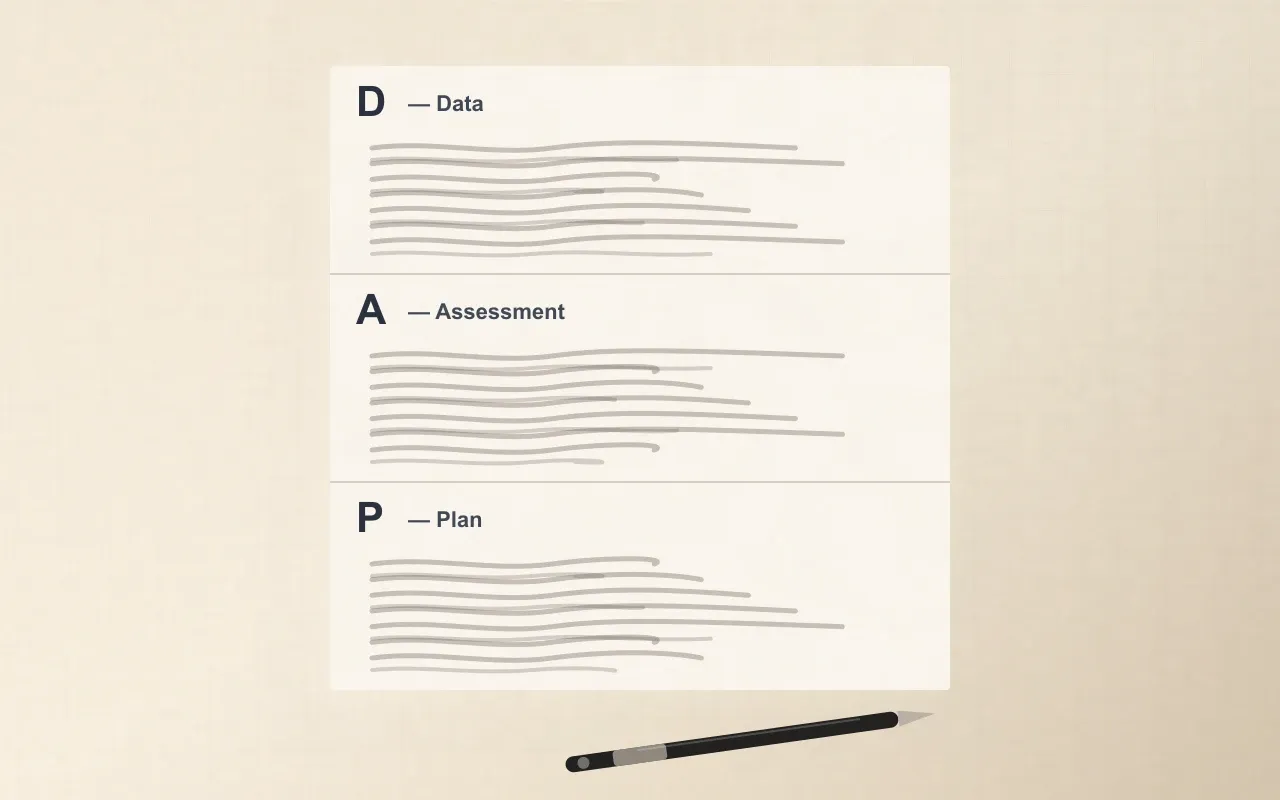
- 1 Data - what the client reports plus what you observe, in one block. Discipline matters here: facts only, no interpretation.
- 2 Assessment - clinical interpretation tied to the active treatment goal. The most important section in a DAP note.
- 3 Plan - interventions used, between-session task, focus for next session, and clinical reasoning for the chosen direction.
DAP notes template (copy-ready)
Paste the block into your clinical record. Keep the headers so a reviewer or covering clinician can scan the note.
Printable blank DAP structure and a one-page Data-versus-Assessment card live in the Note Formats Pack (pack page 4 for the blank note, page 9 for the quick-reference card). The pack also carries sibling formats and a 60-second sign-off checklist.
Download the DAP template and quick-reference card
Print the blank DAP page, keep the Data-versus-Assessment card beside the chart, and use the sign-off check before you close the note.
- Side-by-side selector for SOAP, DAP, BIRP, GIRP, PIE, and SIRP
- Six printable format pages with intervention, response, risk, and next-step prompts
- DAP quick-reference card and intervention-language guide
- Process-versus-progress sorting card and 60-second sign-off checklist
Free. We'll email the PDF link right away. We may also send the occasional therapist toolkit. Unsubscribe any time.
Where should we send the link?
We'll email the PDF link right away. You'll also get the occasional therapist toolkit. Unsubscribe any time.
✓ Check your inbox
We've sent you the PDF
The download link is on its way to your inbox, usually within a minute or two. The email will come from Emosapien (hello@team.emosapien.com); check your spam folder if you don't see it.
You're also on the weekly therapist toolkit list. Unsubscribe any time from the email footer.
Want a first draft instead of a blank structure? The free DAP note generator builds Data, Assessment, and Plan text for you to review, correct, and sign. The pack is the printable reference. The generator is the drafting path.
DAP example: anxiety with avoidance
Fictional example. Minimal necessary detail. No identifiable client information.
Assessment does three jobs: it ties the data to the active treatment goal, it flags what is working (skill use, attendance), and it names what is still open (anticipatory cognitive content). A reviewer who reads only that paragraph can still see clinical reasoning.
DAP example: depressive symptoms with mild functional impairment
Fictional example. Telehealth modality belongs in Data because it affects observation.
Data combines client self-report, direct observation, and the validated measure. A SOAP note would split those across two sections. The DAP note presents them as one record while keeping interpretation out.
How to write each DAP section well
Data
Keep Data a record, not a story.
- Use direct quotes for self-report. A short quote in the client’s words preserves nuance a paraphrase often loses. Reserve quotes for clinically load-bearing moments.
- Describe behavior; do not interpret it. “Client tapped foot continuously and made minimal eye contact” is observable. “Client appeared anxious” already interprets and belongs in Assessment.
- Record measures with date and score. Write the instrument, score, administration date, and direction versus the prior score. The trajectory is the data.
Assessment
Assessment is where clinical meaning lives: change against the goal, response to intervention, and risk when assessed. Common failure modes:
- Restating Data. “Client reports anxiety at work” is not interpretation. Name what the data means against the treatment goal: what changed, what held, what shifted.
- Generic diagnosis without session-specific reasoning. “Symptoms consistent with GAD” is a baseline, not an impression. Tie the impression to this session: symptom trajectory, response to last intervention, new avoidance, repaired ruptures.
- Missing progress notation. One sentence on improving, plateauing, or declining is enough. Absence is conspicuous.
Plan
Tie each Plan line back to Assessment. If Assessment notes persistent rumination, Plan should address it (“introduce thought record for rumination cycles”) rather than describing a generic continuation. Document homework in enough detail that a covering clinician can review it next session without a handoff conversation.
Common DAP mistakes
- Interpretation in Data. Re-read Data before you sign. Every sentence should be a fact the client said, something you observed, a measure score, or a risk finding. Move interpretation to Assessment.
- Assessment that repeats Data. If you can delete Assessment and lose no clinical meaning, rewrite it.
- Generic Plan. “Continue weekly therapy” does not open the next contact. Name the homework, next focus, and reason it follows from today’s response.
- Writing only for yourself. Three weeks later the texture of the hour fades. Assessment has to stand alone for a covering clinician or auditor.
- Unnecessary third-party detail. Partner full names and recognizable employer titles are usually out of scope. Use roles and initials when the chart needs them.
- Private process material in the shareable note. Formulation hypotheses and therapist reminders that meet the psychotherapy-notes definition belong outside the progress note when your setting separates them.
Choose DAP versus another format
| Format | Structure | Best fit | Trade-off |
|---|---|---|---|
| DAP | Data, Assessment, Plan | Solo private practice, stable ongoing clients, faster turnaround | Requires sentence-level discipline inside Data |
| SOAP | Subjective, Objective, Assessment, Plan | Higher-audit settings, complex or new presentations | More structure, slightly slower to write |
| BIRP | Behavior, Intervention, Response, Plan | Skills-heavy, IOP, group, and many addiction settings | Less natural for insight-led individual work |
When the decision is mainly which container to pick, compare BIRP, SOAP, and DAP, then return here for the DAP template, examples, and printable card.
Storage and documentation boundaries
When HIPAA applies, DAP notes are part of the clinical record. They are distinct from psychotherapy notes as defined at 45 CFR § 164.501. Keep only what your setting requires in the shareable chart.
- Access and BAAs. Use encrypted systems with role-based access. Your vendor should sign a Business Associate Agreement before client data lands there.
- Amendments. Follow your EHR, employer, and board rules when you need to correct a signed note. Many clinic policies require a dated addendum rather than silent overwrite; use the workflow your system and policy define.
- Retention. Check your state board language and employer policy for the required retention period. The 2007 APA Record Keeping Guidelines, archived by the APA Council in 2019, suggested psychologists may consider seven years after last service for adults when no superseding requirement applies; they are not current APA policy. Payer contracts can still run longer.
- Process versus progress. Private process reflections stay out of the progress note when your setting separates them under the HIPAA psychotherapy-notes definition.
For the broader documentation map, start from your clinical documentation workflow and local chart standards.
Frequently asked questions
Do I need a separate DAP note format for telehealth sessions?
No. Use the same template. Add modality and any technical limits to Data: “Session conducted via HIPAA-compliant video platform; brief audio-only segment between minutes 18 and 22 due to client connection issue.” Those facts belong in Data because they change what you could observe.
Can I switch between DAP and SOAP for the same client?
Yes, when the clinical situation warrants it. Add a brief justification in the first note of the new format so a chart reader understands the change. One Plan line is enough: “Transitioning to SOAP for clearer separation of self-report and observation as acuity rises.”
How do I document interventions when I draw from multiple modalities?
Name the modality with the action: “CBT behavioral activation,” “ACT values clarification,” “DBT distress-tolerance skills review.” Multi-modal practice is common. Plan should make the borrowing explicit.
Is the DAP format acceptable for billing?
Billing turns on the documented service and the content your payer requires, not on the DAP acronym alone. Common outpatient psychotherapy services are billed under CPT codes such as 90832, 90834, 90837, and 90847; whether a DAP-structured note is enough still depends on medical necessity, intervention, client response, and a forward plan under your contract and clinic policy.
Does a template or generator make a note compliant?
No. A template is a container. A generator draft is unfinished until you review it against the session, correct errors, remove private process material, and sign under your license and local policy.
Next steps
Copy the blank template into your EHR macro library and write the next note from it. Keep the on-page cheat sheet open while you draft. Print the blank DAP page and quick-reference card from the Note Formats Pack when you want paper beside the keyboard.
If you want less time on documentation after sessions, start free with Emosapien. Emosapien drafts therapy-specific DAP, SOAP, BIRP, or GIRP notes from session audio for you to review, edit, and sign. The clinical voice stays yours.