
SOAP Notes: Free Template and Examples for Therapists

Outline
SOAP notes organize a therapy progress note into four parts: what the client reports, what you observe, what those facts mean clinically, and what happens next. The format is a documentation structure, not a HIPAA mandate and not a guarantee that every payer will accept the note as written.
This guide is for licensed therapists, counselors, psychologists, and clinical social workers who need practical SOAP notes they can copy into an EHR. You get a copy-ready template, four de-identified therapy examples, section judgment that keeps report, observation, and assessment distinct, and a printable blank SOAP page plus sign-off checklist in the Note Formats Pack. Technical review by Dr. Sofia Reyes (clinical documentation and compliance editor).
Educational content for therapists, not legal, billing, or payer advice. Documentation requirements vary by state licensing board, payer, and setting; check your local rules and clinic policy.
What SOAP stands for
SOAP stands for:
- Subjective: the client’s personal account of their experiences, feelings, or symptoms.
- Objective: observable and measurable data such as behavior, appearance, speech patterns, and validated assessment scores.
- Assessment: the therapist’s clinical interpretation based on the subjective and objective data, tied to a treatment goal.
- Plan: the proposed treatment approach, including interventions, homework, and goals for future sessions.
Lawrence Weed developed the structure for medical records in the 1960s. Mental health practitioners adopted it because the four sections map onto clinical reasoning: report, observation, meaning, and next action.
Why therapists use this structure
This structure lets a care coordinator who receives a client mid-treatment read trajectory without a phone call when each section does one job. The same structure helps when a reviewer later needs the clinical impression without reconstructing the hour from memory.
The format also supports pattern recognition. Consistent separation makes it easier to notice when self-reported distress diverges from what you observe. That gap is clinically useful and often disappears in unstructured prose.
Billing documentation is a practical reason to keep a consistent container. The structure can organize facts that support the service, clinical reasoning, and next steps. The label alone does not establish coverage or payment. Check the payer’s policy and your jurisdiction’s recordkeeping rules for the content required in each note.
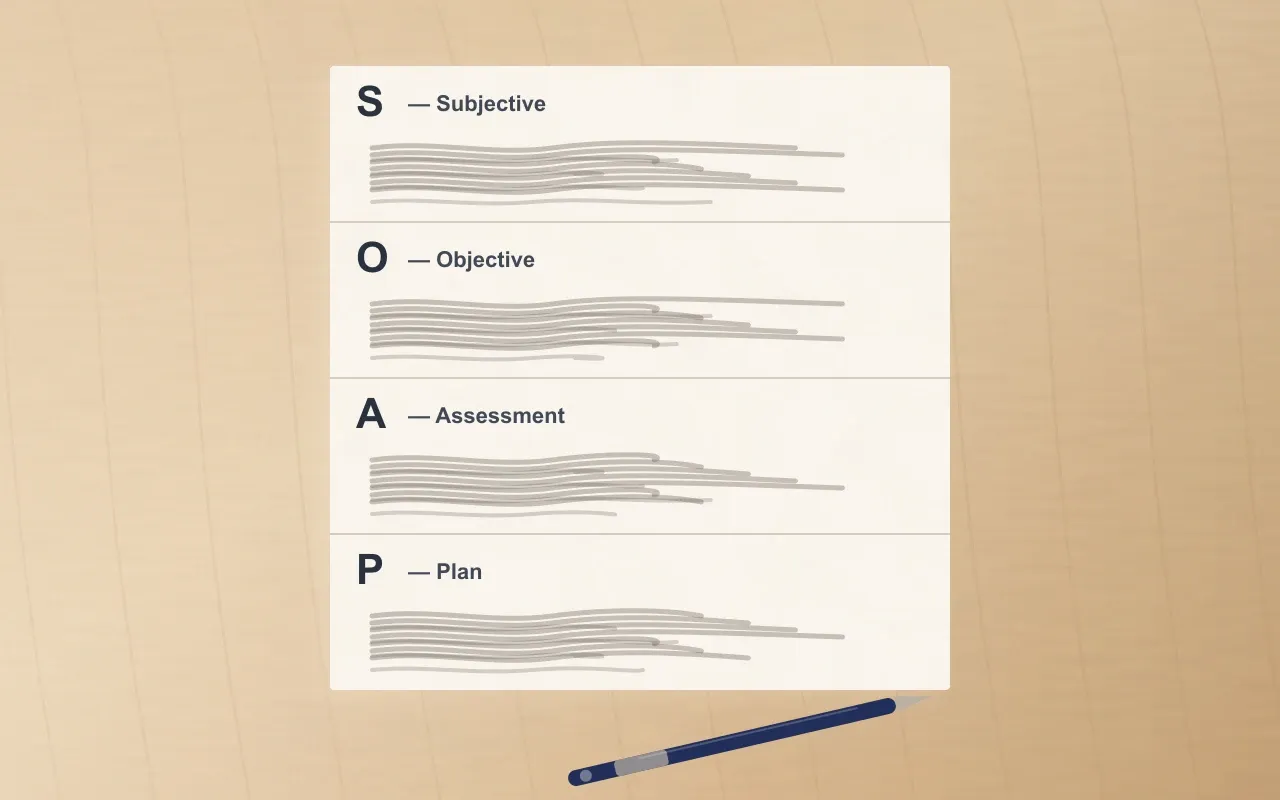
- 1 Subjective: the client's self-report in their own words. Direct quotes preserve nuance and reduce dispute risk.
- 2 Objective: what you observed and any validated measure scores. Factual record, no interpretation.
- 3 Assessment: clinical impression tied to the active treatment goal. Where reviewers and supervisors look first.
- 4 Plan: interventions used today, between-session tasks, and the focus for next session.
SOAP notes template (copy-ready)
Paste the block into a clinical record or your EHR macro library. Keep the section headers so a reviewer or covering clinician can scan the note.
Printable blank SOAP structure, a six-format selector, and a 60-second sign-off checklist live in the Note Formats Pack. The pack also carries sibling progress-note formats and an intervention-language reference. It does not include a SOAP-only quick-reference card.
Download the SOAP template and Note Formats Pack
Print the blank SOAP page, compare six progress-note formats, and use the 60-second sign-off checklist before you close the chart.
- Side-by-side selector for SOAP, DAP, BIRP, GIRP, PIE, and SIRP
- Six printable format pages with intervention, response, risk, and next-step prompts
- DAP quick-reference card and intervention-language guide
- Process-versus-progress sorting card and 60-second sign-off checklist
Free. We'll email the PDF link right away. We may also send the occasional therapist toolkit. Unsubscribe any time.
Where should we send the link?
We'll email the PDF link right away. You'll also get the occasional therapist toolkit. Unsubscribe any time.
✓ Check your inbox
We've sent you the PDF
The download link is on its way to your inbox, usually within a minute or two. The email will come from Emosapien (hello@team.emosapien.com); check your spam folder if you don't see it.
You're also on the weekly therapist toolkit list. Unsubscribe any time from the email footer.
Want a first draft instead of a blank structure? The free SOAP note generator builds Subjective, Objective, Assessment, and Plan text for you to review, correct, and sign. The pack is the printable reference. The generator is the drafting path.
Section-by-section judgment
1. Subjective
Capture the client’s self-reported experiences, emotions, and symptoms. Record their perspective in their own words, not your interpretation of what they said.
Example:
Client shared, “I’ve been feeling really anxious at work. My chest tightens, and I can’t focus on anything.” They also reported trouble sleeping and waking up feeling exhausted.
Write Subjective well:
- Use the client’s own words in quotation marks where the quote carries clinical weight. A direct quote is harder to dispute than a paraphrase.
- Note discrepancies between what the client says and how they rate distress. A client who says “I’m doing okay” but rates anxiety at 7/10 is giving useful data in that gap.
- Capture relevant history the client raises spontaneously rather than re-summarizing the full history every session.
2. Objective
Hold only what you can directly observe or measure: appearance, behavior, speech patterns, and validated assessment scores. This is a factual record, not an interpretation.
Example:
Client appeared visibly agitated, frequently tapping their foot and avoiding eye contact. Speech was pressured, and their posture was hunched.
Write Objective well:
- Describe what you see, not what you infer. “Client spoke in a flat monotone and avoided eye contact” is objective. “Client appeared depressed” already interprets and belongs in Assessment.
- If you administered a validated scale (PHQ-9, GAD-7, PCL-5), record the score here with the date administered.
- Document behaviors that contradict the client’s self-report. If a client rates distress at 3/10 but presents as visibly agitated, both facts belong in the record.
3. Assessment
Integrate Subjective and Objective data into a clinical impression. Show how the session evidence connects to the active treatment goal and the next clinical decision. Do not restate the earlier sections.
Example:
Client exhibits symptoms consistent with generalized anxiety disorder (GAD), including persistent worry, physical agitation, and difficulty concentrating. GAD-7 score of 12 reflects moderate severity, unchanged from last session. Progress is noted in the client’s ability to name specific workplace stressors rather than describing anxiety in global terms, which represents a measurable shift from intake presentation.
Write Assessment well:
Three errors appear most often in documentation reviews:
-
Restating the Subjective. Writing “Client reports anxiety at work” in Assessment is repetition, not clinical interpretation. Assessment explains what the data mean, not what they are.
-
Using a generic diagnosis without session-specific reasoning. “Consistent with GAD” is a baseline, not a clinical impression. Name what changed or held steady relative to the previous session: symptom trajectory, response to interventions, shifts in insight, new avoidance patterns.
-
Omitting progress notation. Record whether the client is improving, plateauing, or declining relative to treatment goals. A concise sentence on trajectory helps the next reader understand why the Plan follows.
4. Plan
Outline what happens next: interventions used today, assigned tasks, coordination, and the focus for the following session.
Example:
Continue cognitive-behavioral therapy (CBT) to address anxiety symptoms. Assign a daily journaling exercise to track triggers and coping strategies. Next session: review thought record and explore time-management techniques.
Write Plan well:
- Tie each intervention directly to the Assessment. If Assessment notes persistent concentration difficulties, Plan should address them rather than describing a generic continuation of treatment.
- Document between-session tasks when assigned. Recording homework creates accountability and a paper trail if a client later disputes whether self-monitoring was discussed.
- Specify the next-session focus concisely. A covering clinician reading your note should be able to start the next session without a handoff call.
Four therapy examples
The four samples below are fictional and de-identified. None is a claim that one note satisfies every payer, board, or employer template. For diagnosis-led depth beyond these scenarios, see the mental health SOAP note examples.
Full mental health session
Telehealth session
Intake / first session
Brief variant for a stable session
Brief SOAP notes fit stable, ongoing clients in a maintenance phase. The structure stays; the content tightens. Keep the brevity earned by clinical stability, not imposed by time pressure. A brief note for a destabilizing session is a documentation risk.
Common mistakes and pre-sign check
High-risk errors
- Assessment repeating Subjective. If you can delete Assessment and lose no clinical meaning, rewrite it.
- Unobservable language in Objective. “Client was upset” is not an observation. “Client’s voice broke while recounting the incident; they paused for about 30 seconds before continuing” is.
- Generic Plan with no reviewable next step. “Continue weekly therapy” does not open the next contact. Name the homework, next focus, and why it follows from today.
- Unsupported billing or compliance conclusions. Do not claim medical necessity or coverage from the SOAP label alone. Document the elements your payer and board require.
- Private process material in the chart. Formulation hypotheses and therapist reminders that meet the psychotherapy-notes definition belong outside the progress note when your setting separates them.
- Letting Assessment go stale. If Assessment reads identically across three consecutive sessions, update it or revise the treatment plan.
60-second pre-sign check
- Subjective holds client report and relevant quotes only.
- Objective holds observation and measures only; no interpretation.
- Assessment names change against a goal and does not restate S/O.
- Plan is specific enough that a covering clinician can open the next contact.
- No unnecessary third-party identifiers and no private process dump.
- Generated text, if any, is reviewed, corrected, and owned by you.
Choosing SOAP, DAP, or BIRP
When the container itself is still open, use this quick fit check. For deeper format trade-offs, jump to the comparison link after the table.
| Format | Structure | Best fit | Trade-off |
|---|---|---|---|
| SOAP | Subjective, Objective, Assessment, Plan | Higher-audit settings, complex or new presentations, clear report-versus-observation split | More structure, slightly slower to write |
| DAP | Data, Assessment, Plan | Solo private practice, stable ongoing clients, faster turnaround | Requires sentence-level discipline inside Data |
| BIRP | Behavior, Intervention, Response, Plan | Skills-heavy, IOP, group, and many addiction settings | Less natural for insight-led individual work |
SOAP is not always more defensible than another format. Fit depends on setting, payer, policy, and the clinical job of the session. When the decision is mainly which container to pick, compare SOAP, DAP, and BIRP. For the three-part container itself, use the DAP notes template and guide. Blank skeletons across formats live with the progress note templates hub.
Documentation boundaries that still apply
- Document promptly. Write notes soon after the session. Details that feel vivid in the moment are unreliable 48 hours later.
- Keep language professional and precise. Avoid hedges like “seems to” or “appears to” in Assessment unless the data are insufficient to be more specific.
- Protect confidentiality. If HIPAA applies, use safeguards appropriate to electronic protected health information and obtain a Business Associate Agreement (BAA) from any vendor that handles it.
- Keep record types separate. Private process reflections stay out of the progress note when your setting separates them under the HIPAA psychotherapy-notes definition.
- Write Assessment for a reviewer you may never meet. That section needs to stand alone if someone reads only that part of the record.
- Handle amendments correctly. If you need to correct a completed note, add a dated amendment rather than overwriting the original. Note the correction date, the reason, and sign the amendment.
- Review before closing. Confirm each section is complete, Plan follows Assessment, and no other client’s information was included.
When HIPAA applies, progress notes are part of the clinical record and are distinct from psychotherapy notes as defined at 45 CFR § 164.501. 45 CFR Part 164, Subpart C addresses access control, audit controls, integrity, authentication, and transmission security. Section 164.312 treats encryption as an addressable implementation specification and does not name AES-256. Select safeguards against the requirements that apply to your practice.
Retention timeframes also vary. Section 164.316’s six-year period applies to Security Rule documentation under that subpart, not as a universal retention period for therapy records. Confirm the medical-record retention requirements in state law, licensing-board rules, payer contracts, and organization policy before discarding a record. The 2007 APA Record Keeping Guidelines (archived by Council in 2019) said psychologists may consider retaining adult records for seven years after last service when no superseding requirement applies; they are not current APA policy.
For the broader documentation map, start from clinical documentation for therapists. Ontario RPs matching session fields to CRPO Standard 5.1 should use the Ontario psychotherapy progress notes guide.
Frequently asked questions
What does SOAP stand for in therapy notes?
SOAP stands for Subjective, Objective, Assessment, Plan. Subjective is the client’s self-report. Objective is what you observe and any validated measures administered. Assessment is your clinical interpretation tied to a treatment goal. Plan covers interventions, between-session tasks, and the focus for next session.
Should I download a template or use the free SOAP note generator?
Use the blank SOAP template and Note Formats Pack when you want structure and a printable desk reference. Use the free SOAP note generator when you want a browser draft of Subjective, Objective, Assessment, and Plan to review, correct, and sign. Neither replaces clinician judgment or local policy.
Are SOAP notes accepted for billing under psychotherapy CPT codes?
Acceptance depends on the payer and jurisdiction. Psychotherapy CPT codes identify billed services rather than mandating SOAP, DAP, or BIRP. Check the applicable payer policy, state board rules, and organization requirements before treating any note format as sufficient.
Do I need to write structured clinical notes for every session?
Whether you need a progress note for every session, and what it must contain, depends on the setting, payer contract, state law, and licensing-board rules that apply. SOAP is one way to organize the record, not a universal requirement. Check the controlling requirements before adopting a template for billed care.
How long should each SOAP section be?
There is no fixed length requirement. Assessment typically runs two to four sentences because it has to support clinical reasoning; Subjective and Objective can be shorter. What matters is that each section is complete enough to stand alone if a reviewer reads only that part of the record.
How do SOAP notes work for telehealth sessions?
The format is identical for in-person and telehealth, with two adjustments to Objective. First, note the modality (“Session conducted via HIPAA-compliant video platform”). Second, document any technical limitations that affected your observation, such as audio-only segments or poor lighting that prevented full visual assessment. Also verify that the platform has a signed BAA and note any session interruptions that affected continuity of care.
Can I use a SOAP template without notes sounding formulaic?
Yes. Templates enforce structure, not language. The fixed headings (S, O, A, P) keep you organized; everything inside them should still reflect the specific client and session. If your Assessment reads identically across three consecutive sessions, update the clinical content rather than blame the structure.
How do I handle confidentiality when storing these records?
Practices subject to HIPAA must apply the Security Rule’s safeguards to electronic protected health information, including access control, audit controls, integrity, authentication, and transmission security. Retention still follows state law, board rules, payer contracts, and organization policy rather than a single universal period.
Does a template or generator make a note compliant?
No. A template is a container. A generator draft is unfinished until you review it against the session, correct errors, remove private process material, and sign under your license and local policy.
Next steps
Copy the template above into your EHR or note macro library and write your next note from it. Keep the four-section fence when you practice the format on a recent session so report, observation, and assessment stay distinct. Print the blank SOAP page and sign-off checklist from the Note Formats Pack when you want paper beside the keyboard. Prefer a first draft in the browser? Open the free SOAP note generator after you inspect the template.
When session documentation is crowding the rest of the day, Emosapien drafts therapy-specific SOAP, DAP, BIRP, or GIRP progress notes from session audio for you to review, edit, and sign. The clinical voice stays yours.
References
- Weed LL. Medical records that guide and teach. N Engl J Med. 1968;278(11):593-600. doi:10.1056/NEJM196803142781105
- U.S. Department of Health and Human Services. Health Insurance Portability and Accountability Act (HIPAA).
- U.S. Department of Health and Human Services. 45 CFR § 164.501 (psychotherapy notes definition).
- U.S. Department of Health and Human Services. 45 CFR Part 164, Subpart C (Security Rule technical safeguards).
- American Psychological Association. Record keeping guidelines.