
Mental Health Progress Note Templates and Examples

Outline
This page is the side-by-side reference for common formats. For format-specific deep dives - section-by-section reasoning, a copy-ready template, and a fuller progress note example for each - see the SOAP notes guide, the DAP notes guide, the PIE note template, and the BIRP notes guide. All format guides sit together under the clinical documentation hub for therapists. UK clinicians writing inside NHS Talking Therapies pathways can also use the IAPT documentation guide for CBT session-note structure, measures, risk, and homework review.
Mental health progress note templates give you a reusable structure so documentation stays consistent, clinically defensible, and fast to write. A good note takes five to ten minutes and remains readable three weeks later - not a word-for-word transcript, but a clear record of clinical reasoning and next steps. Below you’ll find four copy-ready templates (SOAP, DAP, BIRP, GIRP), each paired with a completed progress note example you can adapt.
If you find yourself constantly battling the clock with documentation, read our guide on embracing the future of therapy and closing the gaps in AI tools, which explores how to automate this work without losing your clinical voice.
Educational content only, not legal advice. Follow your local laws, licensing standards, payer rules, and your clinic policy.
What a progress note is (and why it matters)
A mental health progress note is clinical documentation that records what happened in a session, your clinical impression, and what happens next. It typically becomes part of the client’s medical records, so it should be professional, relevant, and written with the assumption it may be read by others involved in care (or in audits, depending on your setting).
For more on what makes a note defensible in a payer audit, see how to write psychotherapy notes that stay useful months later. Progress notes are one category in the broader counselor forms stack a counseling practice maintains.
A good note answers three questions:
- Why was today’s session clinically necessary?
- What did you do (interventions) and how did the client respond?
- What changed (progress over time), and what’s the plan for future treatment?
Progress notes vs psychotherapy notes (quick, practical distinction)
In many settings, progress notes are the “shareable” clinical record, while psychotherapy notes (when used) are the clinician’s separate, more private process notes. If your practice uses psychotherapy notes, keep them clearly separated from the progress note to reduce accidental oversharing and to keep documentation clean. (Check your local requirements and organizational policy.)
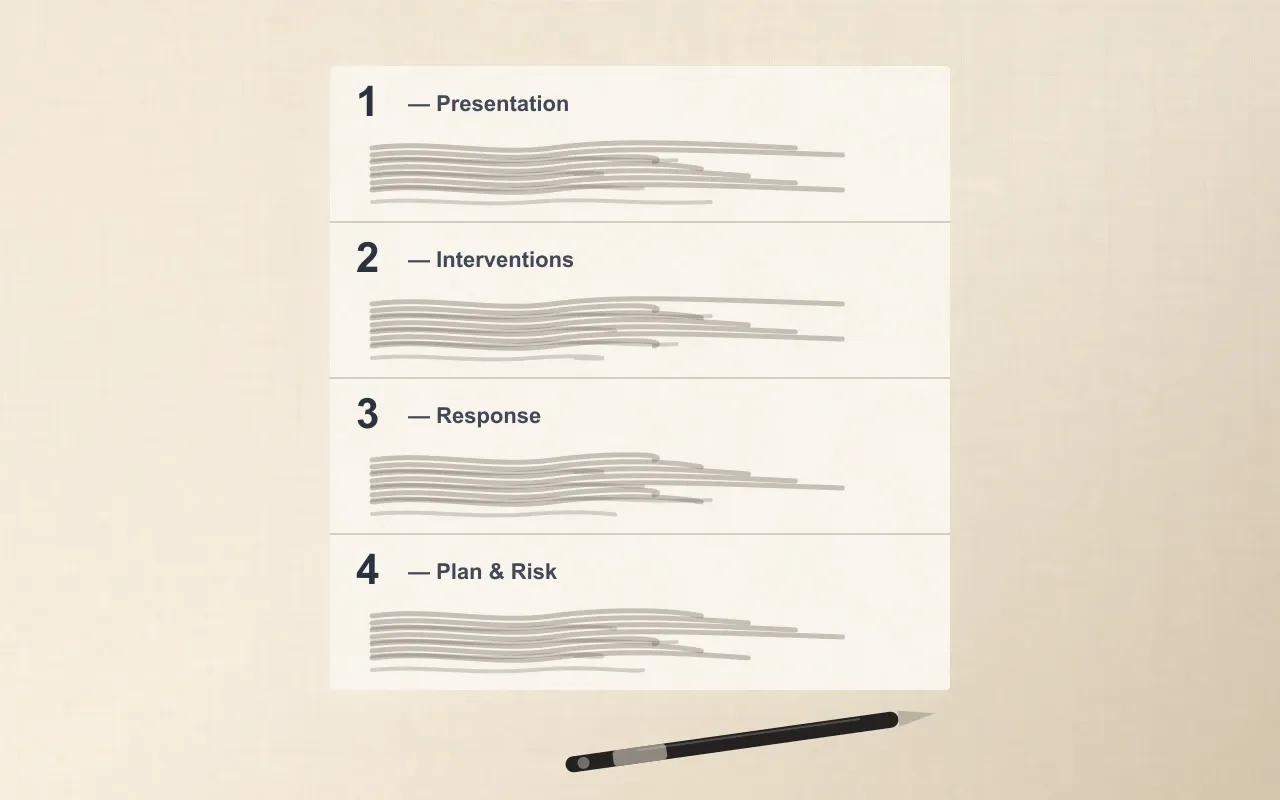
- 1 Presentation - what brought the client to this session: presenting issue, observable affect, reported symptoms.
- 2 Interventions - what you did, named clearly enough that a covering clinician or auditor knows the modality and technique.
- 3 Response - how the client engaged, what shifted in session, and any measurable change pre/post intervention.
- 4 Plan & Risk - between-session task, focus for next session, and any active safety/risk considerations.
Which mental health progress note templates fit your practice?
These mental health progress note templates cover SOAP, DAP, PIE, BIRP, and GIRP. Different formats fit different brains and different settings. Most therapists default to one format, then switch when a specific clinical or billing need calls for it. One practical note: your format should match the CPT code you’re billing. A 90837 (53-minute individual session) demands more clinical detail than a 90834 (45 minutes), and auditors will check the note against the code. DAP tends to be the fastest option for solo practitioners without EHR autofill; GIRP is worth the extra structure when insurers request goal-mapped documentation.
- SOAP notes: Best when you want a structured clinical flow from presentation → observation → clinical impression → plan. Works well in high-documentation environments like community mental health.
- DAP notes: Best when you want something slightly lighter than SOAP, but still clinically grounded. Common in private practice for individual therapy. For a live-session draft in this format, the DAP note generator keeps the same Data, Assessment, Plan structure.
- PIE notes: Best when one problem drove the session and you want the PIE note template to make intervention and client response easy to scan. For a live-session draft in this format, the PIE note generator keeps the same Problem, Intervention, Evaluation structure.
- BIRP notes: Best when the session is intervention-heavy and you want to clearly show what you did and the client’s response. Frequently expected in intensive outpatient programs. For a live-session draft in this format, the BIRP note generator keeps the same Behavior, Intervention, Response, Plan structure.
- GIRP notes: Best when you document closely against goals and need to map notes to your treatment plan templates. Preferred by many insurers for utilization review.
For live-session drafts across SOAP, DAP, BIRP, and GIRP, use the free AI progress note generator before choosing a default format.
Note documentation requirements vary by state licensing board and payer. The APA’s record-keeping guidelines provide a useful baseline, and the HIPAA Privacy Rule at 45 CFR § 164.501 draws the formal distinction between progress notes and psychotherapy notes for compliance purposes. If you are evaluating product controls for that split, see HIPAA-compliant therapy notes.
Template 1: SOAP (template + example)
When SOAP is a good fit
Use SOAP when you want strong structure, especially for documenting symptoms, clinical observations, and next steps. For a section-by-section breakdown and additional progress note examples (full session, telehealth, intake, brief), see the dedicated SOAP notes guide. If the Objective section needs a cleaner observation block, keep a free mental status exam template beside this SOAP skeleton.
SOAP Template (Copy-Ready)
SOAP Example (Depressive Symptoms)
Template 2: DAP (template + example)
When DAP is a good fit
Use DAP when you want concise notes that still include your clinical thinking. For a section-by-section breakdown of Data, Assessment, and Plan with two completed progress note examples, see the dedicated DAP notes guide.
DAP Template
DAP Example
Template 3: BIRP (template + example)
When BIRP is a good fit
BIRP notes can make your interventions and client response very clear, which is helpful in many clinical and supervisory contexts: IOP, group therapy, addictions work, and skills-led individual therapy. For a section-by-section breakdown and two completed progress note examples (DBT skills group, individual exposure work), see the dedicated BIRP notes guide.
BIRP Template
BIRP Example
Template 4: GIRP (template + example)
When GIRP is a good fit
Use GIRP when you want the note to line up tightly with treatment goals and outcomes. This format works well in any setting where insurers review notes against the treatment plan during utilization review.
GIRP Template
GIRP Example
What to include (and what to avoid) for cleaner notes
Include
- The minimum necessary context for continuity
- Interventions used and clinical reasoning (brief)
- Changes over time (even small ones)
- Clear next step (homework, follow-up, referrals)
Avoid
- A word-for-word transcript of the session
- Details that aren’t clinically relevant (especially third-party info)
- Judgmental or speculative language - keep it behavior-based and observable
A fast “good note” checklist (60 seconds)
Before you sign:
- Could another clinician understand what happened and what’s next?
- Does the note connect to a goal or treatment focus?
- Is risk addressed when relevant?
- Is the plan specific enough to guide future treatment?
- Did you capture at least one marker of progress over time?
If you want to spend less time writing, Emosapien can help draft mental health progress note templates in your preferred format (SOAP, DAP, BIRP, or GIRP) from session audio in under 60 seconds. You review, edit, and sign. If you’d rather have an AI co-therapist draft these notes while you focus on the client, see Emosapien’s AI Clinical Notes. Try Emosapien for free.