

From Isolated Sessions to Continuous Care: a better way to stay connected between sessions
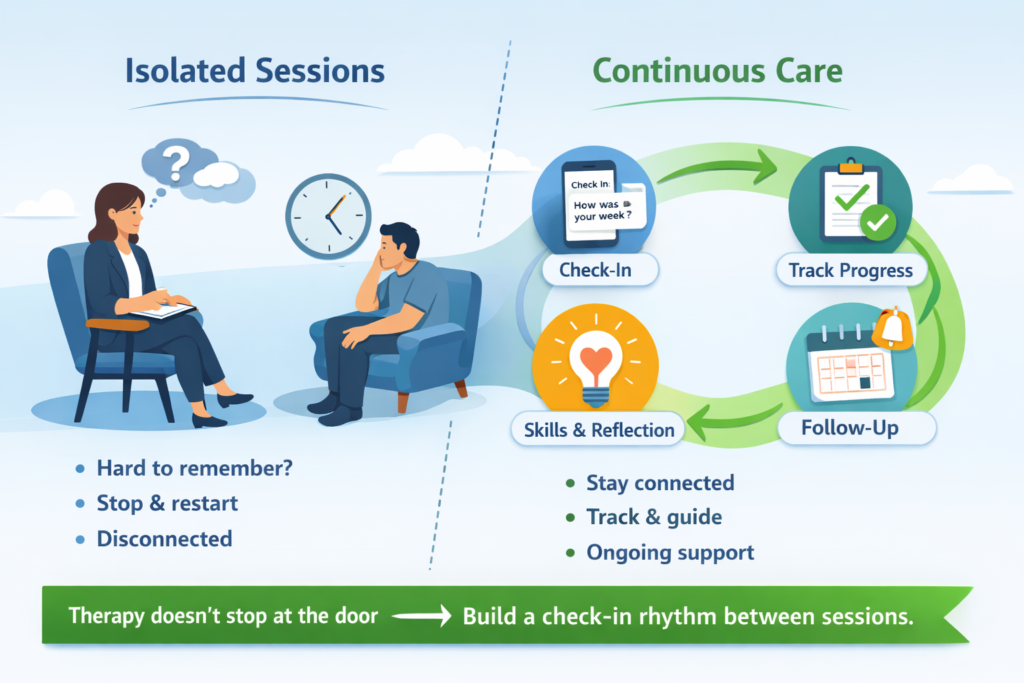
f you’re like most therapists, you’ve probably had this moment: a client walks in and says, “It’s been a rough week,” and you can feel the clock start ticking. You spend the first 10 to 15 minutes reconstructing what happened, what they tried, what worked, what didn’t, and what mattered most.
That catch-up is human, and it’s often necessary. It can also make therapy feel a bit like a weekly reset, rather than a continuous treatment process.
A simple shift helps: a consistent between-session connection loop, so clients stay engaged between appointments and you walk into sessions with clearer context. That loop can be as light as a short check-in prompt, a quick reflection, or a skills reminder that aligns with your treatment plan.
This is exactly where Emosapien can support your work.
Why between-session connection matters
Between sessions is where most life actually happens. That’s where:
- patterns repeat (triggers, avoidance, relationship dynamics),
- skills either get practiced or forgotten,
- motivation rises and falls,
- and clients decide whether change feels possible.
When you create a lightweight way to check in between sessions, you’re not “adding work.” You’re often reducing it, because sessions start with more clarity and less guessing.
Clients also tend to feel more held in the process. Not “on call” support, not constant messaging, just a steady sense that therapy is ongoing and connected.
The problem with “we’ll talk next week”
When check-ins only happen inside the session, a few common things show up:
- Memory gaps: clients forget key moments, or only remember the worst moment.
- Time drain: sessions begin with recap instead of movement.
- Skills drift: homework becomes “nice in theory,” not real in practice.
- Drop-off: clients disengage when therapy feels disconnected from daily life.
None of this is about effort or commitment. It’s about friction. The process needs a bridge.
What Emosapien adds, without replacing your clinical voice
Emosapien is designed to help you create that bridge, while keeping you firmly in control.
You can use it to:
- run structured therapy check-ins (in a consistent format that fits your modality),
- support between-session prompts that align with your treatment plan (skills, reflections, accountability),
- capture client reflections so the session starts with a clearer map,
- and reduce admin by drafting summaries you can review and edit (so you spend less time stitching context together).
It’s not about turning therapy into a chatbot. It’s about keeping the continuity of care intact, with gentle support between sessions.
Use these two resources to build your check-in rhythm
If you want to set up a check-in flow, it helps to have two things:
- strong “start-of-session” prompts (so group sessions begin smoothly), and
- a deeper library of check-in questions (so you can rotate without repeating yourself).
Here are two articles to support exactly that:
- Opening Prompts for Group Therapy: 10 Quick Ways to Start Sessions Smoothly
Use this when you want the first five minutes to feel calm, structured, and not awkward. - Check-In Questions for Group Therapy (75+ Prompts, Formats, and Addiction-Friendly Options)
Use this when you want a bigger menu, including fun prompts, clinically grounded prompts, and addiction group therapy check-ins.
Together, these two guides give you the content. Emosapien helps you turn that content into a repeatable system.
What “continuous treatment” can look like in practice
Here’s a simple, therapist-friendly rhythm that works for many group and individual settings:
Before the session (between sessions):
- one short check-in question (mood, stress, urge, or “one thing I need”),
- one reflection prompt (pattern, trigger, or values-aligned action),
- optional skills reminder (based on your modality).
At the start of session:
- one opening prompt (60 seconds each, pass allowed),
- one shared theme you choose to focus on.
After the session:
- one small commitment (a micro step),
- one supportive follow-up prompt later in the week.
Even this lightweight structure can make therapy feel less like isolated appointments and more like a connected pathway.

Start your journey with Emosapien
If you want your clients to feel supported between sessions, and you want sessions to start with more clarity and less recap, Emosapien is a practical next step.
Start your journey with Emosapien to:
- set up consistent between-session check-ins,
- keep your group therapy openings structured and smooth,
- and build a sense of continuous treatment, without adding more admin to your week.