
F43.10: A Therapist's Reference for Post-Traumatic Stress Disorder, Unspecified

Outline
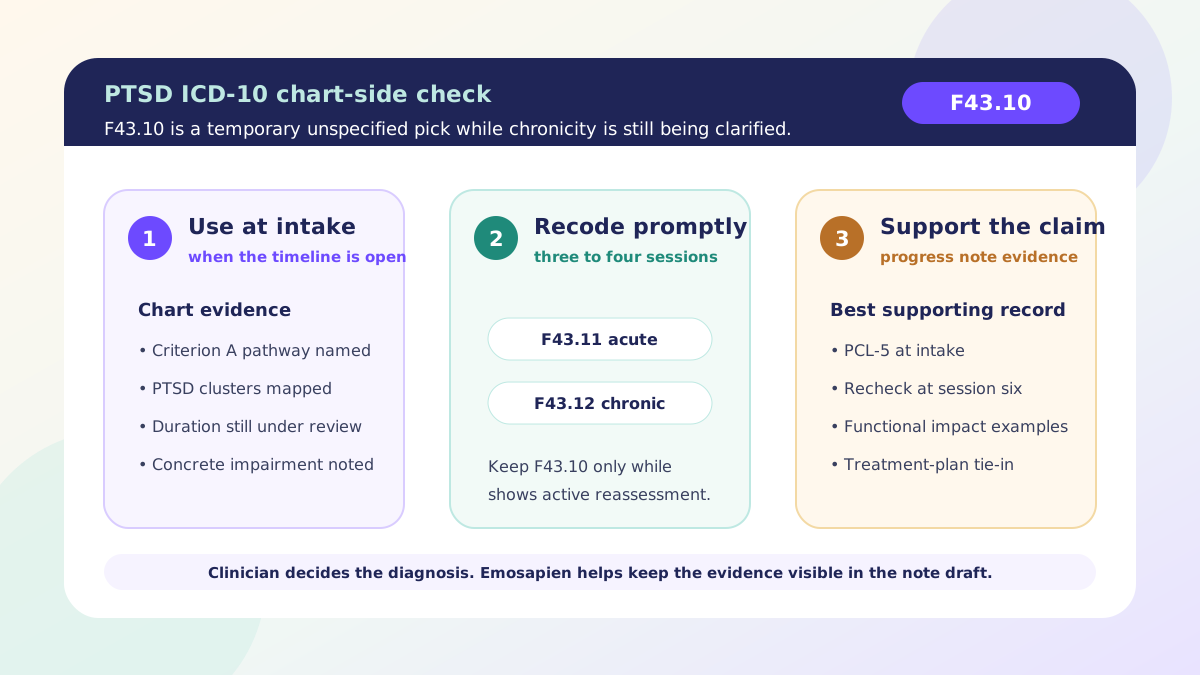
Post-traumatic stress disorder is one of the most-coded conditions in trauma-informed outpatient practice, and unspecified PTSD is the entry point most therapists reach for first. The unspecified specifier exists for the practical reality of clinical work: at intake, the chronicity question often cannot be answered yet. The client describes an index event, the symptom picture meets criteria, but the duration data needed to choose between acute (F43.11) and chronic (F43.12) is not on the page yet. The code holds the diagnosis in place until the chart can support a more specific specifier.
The unspecified specifier is also where audit risk concentrates. A chart that carries the unspecified code indefinitely, never resolving to .11 or .12 as the durational picture clarifies, is exactly the pattern that triggers payer take-back letters and licensing-board questions. What separates a defensible chart from a vulnerable one is the visible plan to revisit the specifier within the first few sessions and recode when the data supports it.
For licensed therapists, psychologists, counselors, and clinical social workers who diagnose and bill under ICD-10-CM, this page is part of the ICD-10 codes for therapists sub-hub. The DSM-5 criteria, the F43.1x family logic, the dissociative and delayed-expression specifiers, the audit-ready documentation pattern, and the CPT pairings each get their own section below. For the acute (F43.11) and chronic (F43.12) specifiers side by side with this one, see the PTSD ICD-10 codes guide. When the chart already supports PTSD and the next clinical job is protocol pacing rather than specifier recode, use the prolonged exposure therapy PTSD guide.
Educational reference for licensed mental health practitioners. Coding and documentation requirements vary by state, payer, and setting; verify against your state licensing board, payer contracts, and the current ICD-10-CM official guidelines for the year of service.
What the F43.10 unspecified PTSD code means
ICD-10-CM defines F43.10 as “Post-traumatic stress disorder, unspecified.” The code sits inside the same parent block as adjustment disorders. F40-F48 covers anxiety, dissociative, stress-related, somatoform, and other nonpsychotic mental disorders. Inside that block, F43 is the category for “Reaction to severe stress, and adjustment disorders,” which groups acute stress reactions, post-traumatic stress disorder, and the adjustment-disorder subtypes together because they share an identifiable precipitating stressor.
F43.1 narrows to “Post-traumatic stress disorder,” and the fifth-character specifier identifies the chronicity pattern. The three specifiers are F43.10 (unspecified), F43.11 (acute, symptoms have lasted less than three months), and F43.12 (chronic, symptoms have lasted three months or longer). The unspecified pick is appropriate when the index trauma and symptom picture meet PTSD criteria but the documentation does not yet establish whether the acute or chronic descriptor applies.
The official descriptor is published by the Centers for Medicare and Medicaid Services and mirrored at icd10data.com, with the broader CMS reference available at the CMS ICD-10 page. Use the descriptor wording as published; reviewers expect the specifier language to match the official text rather than a paraphrase.
DSM-5 criteria for PTSD
The DSM-5 criteria for PTSD in adults, adolescents, and children older than six are eight lettered criteria. The summary table below is intended for quick chart-side reference; the full descriptors live in the DSM-5 itself.
| Criterion | What it requires | Threshold for the chart |
|---|---|---|
| A: Exposure | Exposure to actual or threatened death, serious injury, or sexual violence in one of four ways: direct experience, in-person witnessing, learning of an event affecting a close family member or friend (with violent or accidental nature), or repeated/extreme exposure to aversive details (typically work-related, including first responders). | Name the index trauma and which Criterion A pathway applies. |
| B: Intrusion | Recurrent involuntary distressing memories, distressing dreams, dissociative reactions (flashbacks), intense psychological distress at trauma cues, or marked physiological reactions to cues. | At least one Cluster B symptom documented with concrete client report. |
| C: Avoidance | Avoidance of distressing memories, thoughts, or feelings about the event; or avoidance of external reminders. | At least one Cluster C symptom. |
| D: Negative cognitions/mood | Dissociative amnesia, persistent negative beliefs, distorted cognitions about cause/consequences, persistent negative emotional state, diminished interest, detachment from others, inability to experience positive emotions. | At least two Cluster D symptoms. |
| E: Arousal & reactivity | Irritable behavior or angry outbursts, reckless or self-destructive behavior, hypervigilance, exaggerated startle, concentration problems, sleep disturbance. | At least two Cluster E symptoms. |
| F: Duration | Disturbance lasts more than one month. | Symptom-onset date documented; reaches the one-month threshold. |
| G: Functional impairment | Clinically significant distress or impairment in social, occupational, or other important areas. | Concrete impacts on work, relationships, sleep, role function. |
| H: Differential | Disturbance not attributable to a substance or another medical condition. | Substance use, medication side-effects, and medical contributors ruled out. |
Two specifiers attach when applicable. The dissociative subtype applies when the client experiences persistent or recurrent depersonalization or derealization. The delayed-expression specifier applies when the full diagnostic criteria are not met until at least six months after the index event, even if some symptoms appear sooner. Both specifiers should be screened for at intake even when the chronicity pick is still open, because either one materially changes the treatment plan.
When unspecified PTSD is the right pick over F43.11 or F43.12
The choice between the three F43.1x specifiers is driven by the chronicity question and by how confident the chart is in answering it.
| Code | Specifier | When to use |
|---|---|---|
| F43.10 | PTSD, unspecified | Diagnostic criteria are met, but the symptom-duration data needed to choose acute vs chronic is not yet established or is unclear. Common at intake before the timeline is fully reconstructed, or when the index event is recent and the clinical picture is still consolidating. |
| F43.11 | PTSD, acute | Symptoms have lasted less than three months from criteria onset. Use when the timeline is documented and supports the acute picture. |
| F43.12 | PTSD, chronic | Symptoms have lasted three months or longer. Use when the timeline is documented and supports the chronic picture. The most common specifier in caseloads where clients present months or years after the index trauma. |
The clinical reality is that most clients who arrive in outpatient practice with a PTSD presentation already meet the chronic threshold, which makes F43.12 the eventual code on most charts. The unspecified pick has its place at the front of treatment, before the timeline is fully established, and during the assessment window when the dissociative subtype, the delayed-expression specifier, or the symptom duration requires more session time to clarify.
The audit objection most commonly raised is exactly the indefinite carry: a chart that codes the diagnosis at intake and stays there session after session without a recoded update is a chart that signals the clinician never resolved the specifier. A defensible chart shows the recode either to F43.11 or F43.12 within the first three to four sessions, alongside a brief note explaining the durational data that supported the move. If the chart never resolves to a more specific code, an auditor will read the unspecified specifier as a stand-in for incomplete assessment.
Adjacent codes in the F43 family
The F43 family contains several conditions that share a precipitating stressor with PTSD but differ on the symptom picture and on duration.
| Code | Condition | Differentiator from unspecified PTSD |
|---|---|---|
| F43.0 | Acute stress reaction | Symptoms last from three days to one month after exposure. PTSD requires duration longer than one month. A presentation in the first month after an index event that meets PTSD-style symptoms is acute stress disorder, not PTSD. |
| F43.20-29 | Adjustment disorders | Identifiable stressor is present but does not meet the Criterion A threshold for PTSD. Symptom picture is mood-or-anxiety predominant, not the four-cluster PTSD architecture. For the documentation patterns that distinguish adjustment-disorder codes, see the F43.23 adjustment disorder guide. |
| F43.89 | Other reactions to severe stress | Billable child for other reactions to severe stress when the documented presentation does not fit a more specific code. F43.81 is the separate child for prolonged grief disorder. Do not report F43.8, which is a category header. |
| F43.9 | Reaction to severe stress, unspecified | The stress reaction is documented but the type cannot be specified. Even more general than the F43.10 pick; reviewers expect resolution to a more specific code quickly. |
A common intake question is whether to code unspecified PTSD or F43.0 when the client presents within the first month of an index event. The Criterion F duration rule answers it: PTSD requires the disturbance to last more than one month, so the F43.10 specifier is not available in the first month. F43.0 is the right code in that window if symptoms otherwise meet the acute stress disorder picture. Recode to F43.10, F43.11, or F43.12 once the duration crosses the one-month threshold and the chronicity question can be addressed.
Comorbid mood, anxiety, and substance-use codes also commonly appear on the same claim line as PTSD. F33.1 major depressive disorder, recurrent, moderate is frequent in trauma caseloads where depressive symptoms predate or overlap the PTSD presentation; F41.1 (generalized anxiety disorder) appears when worry across multiple domains exists alongside the trauma-specific symptom picture. The F10–F19 substance-use family is also clinically common in PTSD caseloads (F10.20 alcohol dependence and F12.20 cannabis dependence are among the most-coded), and the substance-use comorbidity feeds directly into the Criterion H differential, since intoxication or withdrawal can mimic intrusion, arousal, and concentration symptoms. When the chart reflects two or more distinct disorders, all relevant ICD-10-CM codes can be carried; the diagnostic order on the claim line typically lists the focus-of-treatment code first, with comorbidities as additional pointers.
Documentation that holds up under audit
A defensible chart establishes five elements at intake and revisits them in subsequent sessions until the specifier resolves.
- Criterion A documented specifically. The chart names the index trauma in the level of detail clinically appropriate, identifies which of the four Criterion A exposure pathways applies (direct, witness, learning of, repeated exposure to aversive details), and notes the date or approximate timeframe. Vague language (“a traumatic event in childhood”) does not satisfy the criterion under review; the chart should establish what the criterion requires without re-traumatizing the client by demanding gratuitous detail.
- Symptoms mapped across all four PTSD clusters with concrete client report or observation. Intrusion symptoms (Cluster B), avoidance (Cluster C), negative alterations in cognitions and mood (Cluster D), and arousal-and-reactivity changes (Cluster E) each need supporting evidence in the assessment. The DSM-5 minimums are at least one Cluster B symptom, at least one Cluster C symptom, at least two Cluster D symptoms, and at least two Cluster E symptoms. A sample Assessment paragraph reads: “Client reports nightly intrusion imagery of the index MVA (Cluster B), avoids highway driving near the collision site (Cluster C), persistent belief that the accident was preventable on her end (Cluster D), exaggerated startle to sudden braking sounds (Cluster E).” A chart that lists the diagnosis without mapping the criteria to client report is the chart an auditor flags first.
- Durational picture under active assessment. A note that explicitly says the chronicity question requires more session data, with a planned re-evaluation point, signals to a reviewer that the unspecified pick was a deliberate choice rather than diagnostic shorthand.
- Functional impairment described concretely: missed work days, withdrawal from previously meaningful activities, sleep disruption, hypervigilance affecting daily routines. Generic language (“functioning impaired”) is weaker than specific, observable impacts.
- Treatment plan tied to a trauma-focused modality or an explicit pre-treatment phase (stabilization, psychoeducation, screening for the dissociative subtype), with the recode trigger to F43.11 or F43.12 identified.
Validated screeners and structured measures strengthen the chart further. The PCL-5 (PTSD Checklist for DSM-5) is the most commonly used self-report instrument and is published by the National Center for PTSD. The CAPS-5 (Clinician-Administered PTSD Scale for DSM-5) is the structured-interview gold standard. Administering the PCL-5 at intake and at a session-six re-evaluation creates the kind of repeatable measurement an auditor can read at a glance, and it pairs cleanly with the recode to F43.11 or F43.12 when the timeline supports the move.
The American Psychological Association’s record-keeping guidance and the HIPAA provisions at 45 CFR § 164.501 distinguish between psychotherapy notes, which are kept separate and receive heightened protection, and the progress notes that go into the medical record. Diagnostic justification belongs in the progress note and the treatment plan, not in psychotherapy notes, because the progress note is what supports the billed diagnosis under audit. For broader documentation patterns, the clinical documentation reference covers the structure of progress notes that consistently survive review. For the session-level consent and note-boundary practices that sit underneath this diagnostic detail, see the trauma-informed PTSD documentation guide.
CPT codes commonly paired with unspecified PTSD
The diagnostic code identifies the condition; the procedure code identifies the service rendered. The CPT codes most commonly paired with this diagnosis in outpatient therapy are 90791 for the diagnostic evaluation at intake (no medical services), 90834 for psychotherapy of approximately 45 minutes (the most common routine code), and 90837 for approximately 60 minutes. Trauma-focused work often runs at the higher end of the routine time bands because exposure-based interventions and stabilization work both require unhurried session time. Add-on code 90785 for interactive complexity may apply when communication factors complicate the session.
Psychological testing codes also appear when validated trauma instruments are administered as part of assessment. CPT 96130 (psychological testing evaluation services, first hour) and 96136 (test administration and scoring, first 30 minutes) are billed when the PCL-5 or CAPS-5 administration sits inside a structured assessment encounter rather than the routine intake. For the CPT 90791 documentation expectations on the diagnostic evaluation that often opens a PTSD chart, see the 99204 new patient evaluation reference, which compares 99204 to 90791 for therapists.
The diagnostic and procedure codes travel together on the claim line. The unspecified specifier should appear as the primary diagnosis pointer on each psychotherapy CPT line during the active treatment episode while the chronicity question is open. Once the recode to F43.11 or F43.12 is made, the new specifier replaces it on subsequent claim lines. Time-based CPT codes require time documentation in the note that supports the code billed; payers routinely deny 90837 when the note does not establish that the session ran to the time threshold.
How Emosapien handles unspecified PTSD during the session
Emosapien’s Scribe Agent works alongside the clinician as an active co-therapist during intake and ongoing sessions. When the conversation establishes a Criterion A exposure, symptoms across the four PTSD clusters, and a duration picture that has not yet resolved to acute or chronic, the agent surfaces F43.10 as the diagnostic candidate alongside the criteria checklist and a flag noting that the specifier should be revisited within the first three to four sessions. The clinician reviews the suggestion, accepts or revises it, and the Assessment section of the progress note populates with the criterion-by-criterion mapping and the timeline data that supports the unspecified pick.
When a later session establishes the durational threshold or surfaces the dissociative subtype, the agent flags the recode opportunity in the next note draft. The chart’s diagnostic trail shows the move to F43.11 or F43.12 with the supporting evidence inline, which is exactly the pattern auditors look for. This is not coding automation. The clinician makes the diagnosis. The agent surfaces the candidate, shows its work against the DSM-5 criteria and the ICD-10-CM descriptor, and produces an Assessment that is ready for chart review without retyping. See the AI clinical notes overview for how the Scribe Agent handles documentation across the rest of the note, or start a trial to see candidate diagnostic suggestions in your own intake workflow.