
Structured Client Check-Ins: 5-Step Therapist Guide

Outline
Most therapists notice drift before a client names it. Sessions that used to have direction start looping. Engagement flattens. The intake goal feels like a different case. The miss is often structural: nothing on the calendar creates a shared moment to step back and decide what care should do next.
Structured client check-ins are planned monthly or quarterly in-session course reviews. They cover progress, goal fit, alliance, barriers, and one next care decision. They are not the opening minute of every session, and they are not a mid-week message. Keep asynchronous mid-week pulses in between-session therapy check-ins. This page is for the fuller conversation in the room.
This guide is educational for licensed mental-health clinicians. It is not legal advice, supervision, or a substitute for clinical judgment. Adapt cadence, language, and next steps to formulation, risk, consent, culture, accessibility, and setting.
Why clinical impression alone is not enough
Clinical impression matters. Alone, it is an incomplete signal. Clients may say they are fine while goals drift, alliance thins, or scores move. Therapists may under-detect deterioration when the hour is full of active work and no dedicated review is scheduled.
Feedback-informed treatment research points in the same direction. Therapists who routinely collect structured client feedback tend to detect deterioration earlier and show better average outcomes than those who rely on impression alone (Lambert & Shimokawa, 2011). Brief systematic systems such as the Partners for Change Outcome Management System (PCOMS) have randomized-trial support and are built to bring the client’s frame of reference back into session decisions when the feedback actually returns to the conversation (Duncan & Reese, 2015).
That evidence does not mean every client improves, or that a monthly review prevents rupture by itself. It means complementary signals beat a single private read, which is why structured client check-ins put those signals on a shared agenda:
- Client narrative. How the work feels from inside the hour and the week.
- Behavioral evidence. Attendance, engagement, skill use, and what shows up in the room.
- Alliance feedback. What helps, what misses, and whether the relationship still feels workable.
- Measures. Symptom or outcome trends when they fit the case and the client consented to them.
Treat each channel as incomplete. The review is where you reconcile them without crowning one source as objective truth.
Prepare before the review
A useful structured review starts before either of you sits down.
Therapist brings
- The original goals and any later revisions
- Recent measures or trackers, if used
- Attendance and engagement patterns
- One discrepancy worth exploring (score vs story, story vs behavior, or progress vs alliance)
Client receives
- The agenda in plain language a week or a session ahead when possible
- A clear pass option for any prompt
- Time to bring examples, notes, or one moment from the period under review
Name the purpose out loud: this hour is for course correction, not a performance review of either person. If acute risk needs the full session, shrink or reschedule the review rather than forcing the script.
Five-step framework for structured client check-ins
Keep the sequence. Start with the shared baseline and progress before alliance friction. End with one decision and one return plan so the hour does not become diagnosis without direction. Adjust wording to your model; keep the spine.
Scroll the visual sideways to view the full diagram
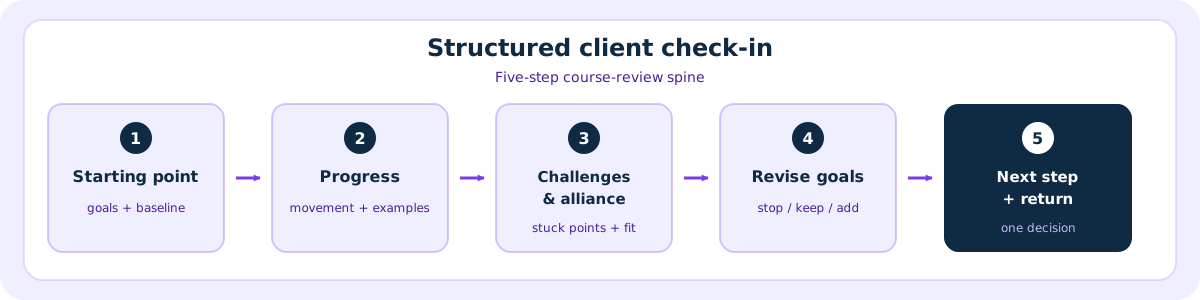
1. Revisit the starting point
Return to what brought the client in and what you both agreed to work on.
Prompts
- When we started, what felt most important to change?
- Looking at the original goals, what still fits?
- What baseline would future-you need in order to know whether this work helped?
If the intake baseline is thin, say so. A check-in cannot invent a missing starting line; it can only name what is known.
2. Review progress
Look at movement across the period, not only the last hard week.
Prompts
- Where have you noticed growth, even small?
- Which goals moved, stalled, or stopped mattering?
- Which sessions or moments felt useful enough to keep?
Invite concrete examples. Written client notes help when paired with the therapist summary, so change the client can already feel is not lost in chart language alone.
3. Explore current challenges and alliance fit
Name stuck points and how the collaboration is landing.
Prompts
- What has been harder than expected?
- Where do you feel like you are spinning your wheels?
- What has been helpful or unhelpful in how we work together?
- Are there topics or emotions you have been avoiding here?
Frame alliance questions as shared course correction, not a grade. A dedicated review gives a clean opening for dread, mismatch, or a dead goal that ordinary sessions may not surface.
4. Revise goals collaboratively
Goals are working agreements, not permanent contracts.
Prompts
- Are the goals we are working on still meaningful?
- What should we stop, keep, or add for the next phase?
- If we only protected one focus for the next month, what would it be?
Write the revision in language the client would recognize. A goal the client cannot repeat is still yours.
5. Agree one next step and how it returns
Close with a single clinical decision and a named follow-through plan.
Prompts
- What would useful progress look like in the next four to six weeks?
- What is one small thing worth trying between sessions?
- How will we reopen that next time, even if it is blank?
One next step beats a long task list. Decide how the step returns: a short reflection, a skill practice, a measure, a behavior experiment, or a supervision question for you. Name the return method before the client leaves.
For a wider bank of in-room prompts by session phase, use therapy check-in questions for individual sessions. Use this five-step framework for individual course review, not for group opening rounds.
Carry one decision into the week
Once you and the client choose one next action, shrink it until it can actually happen. The Between-Session Pack is a clinician planner for that handoff. It is not a structured client check-in form, a progress scale, an alliance measure, or a general mental-health check-in worksheet.
Use it to:
- Fit the action to the live goal
- Frame why it matters in one sentence the client can repeat
- Shrink the task and name the cue
- Anticipate the likely barrier
- Reopen complete, partial, or blank work by name next session
Use the pack only after you and the client have one next-step decision.
Carry one decision into the week
Download the Between-Session Pack to shrink one agreed activity, name the likely barrier, and reopen it by name next session.
- Fit, frame, shrink, cue, and review planner for one activity
- Barrier checklist and shrink-before-you-escalate prompts
- Worksheets and micro-activities menu by clinical goal
- Next-session review stems for complete, partial, or blank work
Free. We'll email the PDF link right away and add you to the therapist toolkit, sent every two weeks. Unsubscribe any time.
Where should we send the link?
We'll email the PDF link right away. You'll also get the therapist toolkit every two weeks. Unsubscribe any time.
✓ Check your inbox
We've sent you the PDF
The download link is on its way to your inbox, usually within a minute or two. The email will come from Emosapien (hello@team.emosapien.com); check your spam folder if you don't see it.
You're also on the therapist toolkit list, sent every two weeks. Unsubscribe any time from the email footer.
When the agreed next step is one short therapist-framed reflection or skill-practice prompt with a review plan, generate it with the free journal prompt generator. Do not use that tool for crisis instructions, unsupervised trauma processing, or exposure work that needs live clinical containment. When that next step is one emotion-mind and reason-mind overlap, assign a one-decision wise mind worksheet.
Use scores without letting scores run the conversation
Measures are inputs to structured client check-ins, not the meeting agenda by themselves. For selecting instruments, cadence, and implementation details, use the guide to measurement-based care in psychotherapy.
In the review hour:
- Prefer trends over single points
- Ask what a score misses when it diverges from the client’s story
- Note behavioral evidence scales will never capture
- Decide whether you will show the chart, the number, or only the pattern
If scores improve while the client feels worse, or scores worsen while life function improves, treat the gap as clinical material. Do not average it away. Do not let automated summaries revise a treatment plan without you.
Documentation, consent, privacy, culture, and risk
Write the decision, not a transcript.
Document
- Cadence and reason for the review
- Client view of progress and alliance
- Measure trends you relied on, with context
- Goal revisions in shared language
- The one next step and how it returns
- Risk, safety, or higher-care considerations raised
Consent and privacy
If digital tools store check-in content, goal summaries, or client reflections tied to an identifiable record, treat that material as protected health information in US covered settings. Prefer platforms with a signed Business Associate Agreement on the plan you actually use. HHS publishes sample BAA provisions that outline minimum expectations for vendor relationships. Confirm encryption, access, retention, export, and deletion before PHI leaves the room.
Culture, access, and development
How people define progress varies. Leave room for family, community, spiritual, and functional goals that a single symptom scale will not show. Adapt language, length, and pass options for literacy, disability access, telehealth constraints, and developmental stage. A teen, a parent-inclusive family case, and an adult individual case should not receive identical scripts by default.
Risk
A structured review is not a crisis protocol. If safety needs the hour, shift to the existing safety plan and higher-care pathways. Do not bury crisis instructions inside a progress template or a between-session worksheet.
Keep the cadence workable
Structured client check-ins earn their place when they stay predictable and light enough to repeat. Start with one client whose goals feel vague or whose engagement has flattened. Run the five steps once. Bring the written output back next session as a shared reference, not a therapist-authored verdict.
When you want the wider engagement workflow that sits around reviews, measures, and between-session continuity for therapy practices, see client engagement therapy. Technology can schedule reminders, hold consented measures, and surface patterns you already collected. It does not replace the conversation, the alliance work, or your clinical decision.
FAQ
How often should I run a structured client check-in?
Many outpatient caseloads use a monthly or quarterly cadence. Choose frequency from setting, presentation, treatment phase, risk, and client preference. Consistency matters more than a universal schedule.
How is this different from a regular session check-in?
A structured client check-in is a planned course-review conversation about progress, goal fit, alliance, barriers, and the next care decision. A routine opener is the first few minutes of an ordinary session, not a full treatment review.
What if the client and the scores disagree?
Treat scores, narrative, behavior, and alliance feedback as complementary signals. Ask what the number misses, what the room is showing, and what care decision that discrepancy supports. Do not crown any single signal as ground truth.
What is in the Between-Session Pack on this page?
A two-page clinician PDF with a fit-frame-shrink-cue-review planner, barrier checklist, worksheets and micro-activities by clinical goal, and next-session review stems for complete, partial, or blank work. It is not a monthly review form or a general check-in worksheet.
Should I document the whole check-in conversation?
Document the clinical decision and rationale, revised goals, risk notes, and the agreed next step with a named return plan. You do not need a transcript of every exchange.
When should I pause or shrink a structured review?
Pause or shorten when acute risk needs the hour, the client cannot consent clearly to the agenda, the format is a poor cultural or accessibility fit, or the review would force unsupervised trauma processing outside the room.
Can AI run the check-in or revise the plan for me?
No. Tools may organize measures, prompts, or pre-session notes you already collected. You still decide what to open, how to weigh signals, and what becomes the chart.
References
- Duncan, B. L., & Reese, R. J. (2015). The Partners for Change Outcome Management System (PCOMS) revisiting the client’s frame of reference. Psychotherapy, 52(4), 391-401.
- Lambert, M. J., & Shimokawa, K. (2011). Collecting client feedback. Psychotherapy, 48(1), 72-79.
- U.S. Department of Health & Human Services. Sample business associate agreement provisions.