
IFS Worksheets: A Clinician's Guide to Internal Family Systems Tools

Outline
Authored by Dr. Hannah Lin, counseling psychologist trained in CBT, ACT, and IFS, with over a decade of clinical practice in trauma and anxiety work.
IFS worksheets, sometimes called internal family systems worksheets, occupy a particular place in trauma-informed practice. Used carefully, they make space for parts to be heard, support the unblending work that the protocol relies on, and create a between-session continuity object that keeps the system in view. Used carelessly, they collapse the model into parts-labeling and skip the relational work that is the active ingredient. The difference between the two usually shows up not in the form itself but in how it is introduced, when it is introduced, and whether the therapist’s training matches what the form is asking the client to do.
This guide walks through the families of IFS forms that show up most reliably in practice (parts mapping, the 6 Fs check-in, protector dialogues, Self-energy logs, and trauma-informed adaptations), with explicit scope-of-practice notes on the prompts that should not be used without IFS Institute training. If you need the model refresher first, start with Internal Family Systems basics for therapists. If the take-home job is noticing one part already met in the hour, not mapping the system, use parts work therapy worksheets. It assumes you are a licensed therapist with at least exposure to the model; the therapy worksheets cornerstone covers worksheet ethics in more depth.
Educational content for therapists, not clinical or legal advice. Modality-faithful use of these tools assumes appropriate training; the form does not substitute for the protocol it implements.
What IFS worksheets are (and what they aren’t)
Internal Family Systems is a specific model developed by Richard Schwartz. It distinguishes parts (managers, firefighters, exiles) from Self (the calm, curious, compassionate observer at the center of the system that the protocol’s whole therapeutic stance leans on). An IFS worksheet, properly speaking, is a tool that supports one or more of the four core moves of the model: noticing parts, unblending from them, getting to know them, and supporting Self-led work with them.
A worksheet that asks the client to “label your parts” is not yet an IFS worksheet. It is a parts inventory, which is closer to a self-help artifact than to IFS practice. Internal family systems worksheets earn their distinctive clinical voice when they support the relational and experiential work that names protectors as having a role, exiles as carrying burdens, and Self as having capacity to lead. The vocabulary is shared widely; the practice that the vocabulary implements is more specific.
A pattern from supervision: a client who arrives with a tidy diagram listing six parts by name but no shift in their relationship to those parts is usually a client whose worksheet was a labeling exercise rather than a parts-mapping one. The fix is rarely to push for more detail on the labels. It is usually to slow down, return to the relational work, and let the diagram be a record of what is unfolding rather than a list of what is already known.
Parts mapping: the foundational diagram
Parts mapping is the entry point for most IFS-aligned work and the worksheet format most likely to be used outside formal IFS training. The aim is to externalize the system in a way the client can see and the therapist can refer back to.
The parts-mapping formats that translate the model most cleanly include:
- Open-page parts diagrams that ask the client to draw or write parts as they show up, with space for role, age, what they protect, and what they fear.
- Body-located parts maps, where parts are placed on a body outline based on where the client feels them (helpful for somatic-leaning clients and for clients who struggle with verbal disclosure).
- Protector / exile / firefighter category prompts, used carefully and only after the client has experiential familiarity with the categories. These should not be used as a checklist before the client has met the parts the categories describe.
- Parts-house formats, where each part has a room and the client maps proximity, relationship, and access to Self.
A common parts-mapping failure is treating the diagram as a destination rather than a working document. The map is updated as the work unfolds, not completed once and left static. Clients whose diagrams change across sessions are usually doing the work; clients whose diagrams stay frozen often need a different way in. For a clinician-facing parts mapping worksheet that keeps the map living across sessions, use the dedicated guide.
Download the IFS worksheets starter pack
Clinical guidance on this page is available without email signup. Use the printable pack when you want the four core forms beside the session plan: a parts map, a 6 Fs check-in, a protector dialogue log, and an 8 Cs Self-energy check-in, with therapist scope notes on the cover.
Download the IFS worksheets starter pack
Get a printable parts map, 6 Fs check-in, protector dialogue log, and 8 Cs Self-energy check-in, with therapist scope notes.
- Parts mapping page
- 6 Fs check-in
- Protector dialogue log
- 8 Cs Self-energy check-in
Free. We'll email the PDF link right away and add you to the therapist toolkit, sent every two weeks. Unsubscribe any time.
Where should we send the link?
We'll email the PDF link right away. You'll also get the therapist toolkit every two weeks. Unsubscribe any time.
✓ Check your inbox
We've sent you the PDF
The download link is on its way to your inbox, usually within a minute or two. The email will come from Emosapien (hello@team.emosapien.com); check your spam folder if you don't see it.
You're also on the therapist toolkit list, sent every two weeks. Unsubscribe any time from the email footer.
The 6 Fs check-in
The 6 Fs (Find, Focus, Flesh out, Feel toward, beFriend, Fear) is the canonical IFS sequence for getting to know a part. It is also the worksheet format that translates most cleanly into a between-session prompt for a stabilized client.
Scroll the visual sideways to view the full diagram
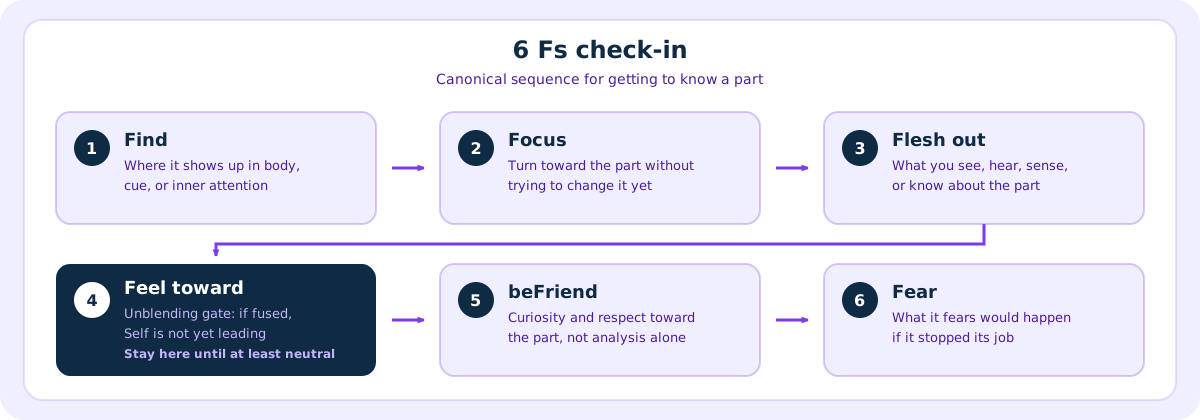
A 6 Fs worksheet typically asks the client to:
- Find the part (where it shows up, what triggers it, what they notice in the body).
- Focus attention on it without trying to change it.
- Flesh out what they see, hear, sense, or know about it.
- Notice how they Feel toward the part right now (this is the unblending check; if the client feels fused with the part, Self is not yet leading).
- BeFriend the part by treating it with curiosity and respect rather than analysis.
- Ask what it Fears would happen if it did not do its job.
The 6 Fs check-in is most useful as a between-session continuity object, not as a first encounter with a part. The first meeting belongs in session, with the therapist attending to the client’s capacity for Self-energy and unblending. Emosapien’s in-session co-therapy features are designed around exactly that priority: support the relational work in the room first, let the form record what unfolded.
After the clinical decision and in-session rehearsal already exist, you may want one short reflection or skill-practice line without opening another full form. Use the free journal prompt generator for one therapist-framed prompt. Keep three jobs separate: this guide and the pack select and structure the IFS tool; the generator only drafts a low-intensity, reviewable prompt after that work is set. Do not use the generator for direct exile dialogue, unburdening, crisis instructions, or unsupervised trauma processing.
Working with protector parts
Protectors (both managers and firefighters in the IFS taxonomy) are the parts most accessible early in the work and the parts where structured prompts most reliably help. The protector-focused formats that earn their place include:
- Protector dialogue logs that record what a part has to say when given space, and what it asks of the system in return.
- Role / fear / hope prompts that ask the client to articulate what the part is trying to protect against and what it is hoping for if its job were to change.
- Polarization maps for clients with two protectors that pull in opposite directions (the perfectionist manager and the rebellious firefighter, for example).
- Permission-to-step-back logs that track moments when a protector was willing to soften and Self took the lead.
Protector work is where many therapists who are familiar with the model but still building formal IFS training can do useful work with structured prompts. The forms support a relational stance that is recognizable as IFS-aligned even when the clinician’s training is still early.
Working with exiled parts and unburdening
This is the territory where scope of practice matters most. Exile work and unburdening are protocol-specific clinical procedures that assume IFS training and supervision matched to that depth (often begun in Level 1 and deepened through later levels and consultation), and prompts that ask the client to surface, befriend, or unburden exiles outside that container can be unsafe.
This is not a how-to for exile contact or unburdening. Between-session prompts that stay inside scope include:
- Exile-related grounding prompts that support the client between sessions when exile material has been touched, distinct from prompts that ask the client to do the exile work themselves at home.
- Self-presence check-ins that help the client notice when exile material is close to the surface and when it might be wise to step back into protector-led functioning until the next session.
- Containment maps that record what has been touched and what has been put back into a safe space for next time.
If you do not yet have IFS training and supervision appropriate to exile and unburdening work, that work belongs with a colleague who does, or with consultation that covers it. Completing a training level is not the same as IFS Certification. The form does not change the scope question.
Self-energy: the 8 Cs
Self-energy is the stance the IFS protocol depends on, characterized by the 8 Cs (calm, curiosity, compassion, courage, confidence, clarity, creativity, connectedness) that Richard Schwartz uses as a clinical reference. Tools in this family help the client notice and track the conditions that support Self-led functioning.
In Self-energy work, the formats that earn their place include:
- 8 Cs check-ins that ask the client to rate the presence of each C across the week and notice what supports or interrupts them.
- Self-led-moment journals that record specific moments when the client could feel the parts without being run by them.
- Resource maps that identify the conditions, contexts, and relationships that increase Self-energy availability.
These tools are particularly useful in late-stage IFS-aligned work, when the therapeutic question shifts from individual parts to the system’s capacity for Self-leadership over time.
IFS in trauma-informed practice
In trauma-affected populations, these forms earn their place when stabilization is in place and the client has the affective regulation needed to stay in contact with parts material without being overwhelmed by it. Earlier in the work, structured trauma-informed forms (window of tolerance, grounding, dual-awareness prompts) usually need to come before parts-mapping work.
When the work is staged appropriately, IFS-aligned prompts often integrate well with somatic and polyvagal-informed approaches. Body-located parts maps in particular tend to translate the IFS framework into a register that trauma-affected clients can engage with without re-activating the experiences the parts are protecting them from. For therapists who want a structured approach to the somatic layer, the somatic experiencing basics guide covers body tracking, titration, and pacing that can complement IFS parts work in trauma-aware sessions.
Adapting these tools across populations
The model holds across the lifespan; the format does not.
For adolescents, somatic, drawn, and metaphor-led prompts usually outperform reflective writing. Drawing parts as figures, naming them with characters or animals, and using color-coded parts wheels translate the model into a register that adolescents engage with. The clinical work is the same; the form differs.
For under-twelves, the relational and play-based work is the active ingredient. Parts work for younger children is often delivered through puppets, sand-tray, or drawing-led sessions, with the worksheet functioning as a record of the play rather than a separate task.
For couples and family work, IFS-informed adaptations (Intimacy from the Inside Out, for example) translate the model into relational forms that map parts within a relational system rather than within an individual. These adaptations have their own training requirements and should not be improvised.
Where IFS-aligned prompts go wrong
Five failure modes I have seen repeatedly in supervision and consultation, with the cleanest move I know for each.
Parts as labels, not relationships. A supervisee once brought me a client’s diagram listing six parts by name. The client could describe each part in detail. They had no working relationship with any of them. The diagram had become a personality test rather than a parts map. Slowing down and returning to the relational stance was the move; the diagram updated itself once the relationship was real.
6 Fs run as a checklist. When a client ticks each F of the canonical sequence without ever feeling toward the part, the form has become procedure. The protocol’s clinical center is the fourth F (Feel toward), and if the client cannot reach at least neutral toward the part, the unblending work is incomplete. Treat the form as a record of an experiential process, not as the process itself.
Exile-focused prompts outside training scope. This is the one I see most consistently in early-career trauma-trained therapists who are familiar with IFS but do not yet have training and supervision at the depth the work requires. The client surfaces material the therapist does not have the preparation to hold. The form does not solve the scope problem. Refer or pause until you have the consultation the work requires.
Bypassed unblending. When a client analyzes a part from a fused state, the analysis strengthens the fusion. Felt-toward is the gate. If it is not at least neutral, the next move is more unblending, not more analysis.
Form-as-homework rather than form-as-continuity. Some clients come to perform IFS for the worksheet, particularly clients with manager parts that latch onto structured tasks. The form becomes a substitute for the work it was designed to support. Clarifying the purpose, and making the prompt optional when between-session continuity is already strong, usually returns the form to its proper role. When continuity is the job and the form is optional, one short line from the free journal prompt generator can carry the review better than another full worksheet.
The internal family systems worksheets PDF
The printable set is the IFS Worksheets Starter Pack: a parts map, a 6 Fs check-in, a protector dialogue log, and an 8 Cs Self-energy check-in. The cover is a scope note for your folder. The about page is not a worksheet. Exile contact and unburdening are not in the file. If a client asks for the trauma page from this pack, you do not have one to send.
Email that PDF here. It is the same pack as the form above, not a second file.
Email the internal family systems worksheets PDF
Parts map, 6 Fs check-in, protector dialogue log, and 8 Cs Self-energy check-in. Scope notes on the cover.
Free. We'll email the PDF link right away and add you to the therapist toolkit, sent every two weeks. Unsubscribe any time.
Where should we send the link?
We'll email the PDF link right away. You'll also get the therapist toolkit every two weeks. Unsubscribe any time.
✓ Check your inbox
We've sent you the PDF
The download link is on its way to your inbox, usually within a minute or two. The email will come from Emosapien (hello@team.emosapien.com); check your spam folder if you don't see it.
You're also on the therapist toolkit list, sent every two weeks. Unsubscribe any time from the email footer.
Hand one sheet from it. Sending all four at once teaches the client that blank rows are unfinished work.
Internal family systems worksheets you walk in the hour
These are the lines on the internal family systems worksheets in the starter pack. Walk them with the client before you assign any sheet home.
Parts map
The sheet is a table. Columns, in order: part name or nickname, role, age, where it feels, protects against, hopes for. Eight rows. The note under the table tells you to treat the map as a living record of the relationship to parts, not a personality inventory, and to come back when a protector softens or a new part appears.
Write one row with them. Leave the rest blank. A page of six names and no felt sense is a labeling exercise. More columns will not fix that.
6 Fs check-in
Read the prompts as they are written on the sheet. If Feel toward is not at least neutral, stop on that prompt. Do not send the six boxes home as the first meeting.
Find: Where does this part show up? What triggers it? Where do I feel it in the body?
Focus: What happens when I bring my attention to it without trying to change it?
Flesh out: What do I see, hear, sense, or know about it?
Feel toward: How do I feel toward this part right now? If the answer is not curious, open, or compassionate, work with the part that has feelings about this one before continuing.
beFriend: Treat the part with curiosity. What would it like me to know?
Fear: What does this part fear would happen if it stopped doing its job?
The first meeting stays in the room. The sheet records that meeting. It does not replace it.
Protector dialogue log
Fill the fields in this order. If you write your offer before the protector has spoken, the log is a speech you hoped to give.
- Protector identified.
- Manager or firefighter.
- What it has to say, verbatim if useful.
- What it is protecting against.
- What it would ask of the system if it stepped back.
- What you, from Self, would offer in return.
- What permission, if any, the protector granted today.
Skip the manager-or-firefighter line if the client does not have those words yet. Write “the one that showed up.” Teach the taxonomy later, or not this month.
8 Cs check-in
Rows: calm, curiosity, compassion, courage, confidence, clarity, creativity, connectedness. Columns: today from 0 to 10, what supported it, what interrupted it.
Ask for the one C that moved this week. A grid with every cell filled usually means a manager completed the form. Ask which row they actually felt. Do not praise the full page.
The IFS therapy worksheet to hand first
Of the IFS worksheets in the pack, start with the parts map. One row, written with them before they leave. The 6 Fs sheet waits until you have already met that part and Feel toward can be at least neutral.
- Ask where they notice something that is not all of them. A tightness, a younger age, a voice that edits the sentence before it leaves.
- Write one row in their words: name or nickname, role, age, where it feels, what it protects against, what it hopes for.
- Read the row back. Ask whether that part would recognize itself in the line.
- Stop. Do not open a second sheet in the same handoff.
If they are already speaking as the part, and you cannot get a neutral glance toward it, do not start the map. Stay with unblending. The sheet can wait until the next session.
One prompt, one scope boundary, one next-session review
Leave the session with three named items: one therapist-chosen IFS prompt from the map, 6 Fs, protector log, or Self-energy check-in; one explicit scope boundary (especially if exile material is near the surface); and one next-session review question. That triad keeps IFS worksheets as clinical scaffolding rather than a labeling project.
If you want the printable four-form pack beside the plan, use the offer above. For the model overview, start with Internal Family Systems basics for therapists. For a living map, use the parts mapping worksheet. For one low-intensity between-session line after the clinical decision is already set, use the free journal prompt generator. When the between-session job is a present-day childhood-trauma stem rather than a generator line, assign journaling for childhood trauma.