Between-Session Therapy Check-Ins That Leave the Next Session Ready

Outline
Most therapists know the pattern. A client arrives after a rough week and the first ten minutes go to reconstruction: what happened, how they feel, what they remember from last time. By the time the real work starts, a third of the hour is already gone.
A consistent set of between-session therapy check-ins changes that open. Clients arrive with a short, recent map of the week. You start from current context instead of rebuilding it from memory. This guide is for licensed therapists who want an asynchronous check-in workflow that stays brief, boundaried, and reviewable. Use the downloadable Between-Session Pack to plan the send, name the barrier, and reopen the reply next session. It is educational, not clinical or legal advice. Adapt every prompt to formulation, risk, consent, culture, and setting.
Free PDF: Between-Session Pack
A printable clinician pack for choosing one small between-session activity: selection loop, barrier repair, worksheets by goal, and next-session review stems.
- Fit, frame, shrink, cue, and review planner for one activity
- Barrier checklist and shrink-before-you-escalate prompts
- Worksheets and micro-activities menu by clinical goal
- Next-session review stems for complete, partial, or blank work
Free. We'll email the PDF link right away. We may also send the occasional therapist toolkit. Unsubscribe any time.
Where should we send the link?
We'll email the PDF link right away. You'll also get the occasional therapist toolkit. Unsubscribe any time.
✓ Check your inbox
We've sent you the PDF
The download link is on its way to your inbox, usually within a minute or two. The email will come from Emosapien (hello@team.emosapien.com); check your spam folder if you don't see it.
You're also on the weekly therapist toolkit list. Unsubscribe any time from the email footer.
Why the mid-week check-in matters
Most of a client’s life happens outside the hour you share. That is where hard conversations land, where skills get used or quietly dropped, and where Tuesday’s insight meets Monday morning. A short mid-week pulse creates a low-effort path back to the work without requiring the client to initiate contact.
For a broader AI-assisted version of that same continuity problem, see continuous therapy engagement with an AI co-therapist.
Lambert and Shimokawa’s meta-analysis of feedback-informed treatment found that capturing client experience between sessions was associated with better outcomes and lower dropout, especially for clients who begin to disengage early (Lambert and Shimokawa, 2011). The same continuity problem shows up in homework research: quality of between-session engagement matters more than dumping more tasks on the client (Kazantzis et al., 2016).
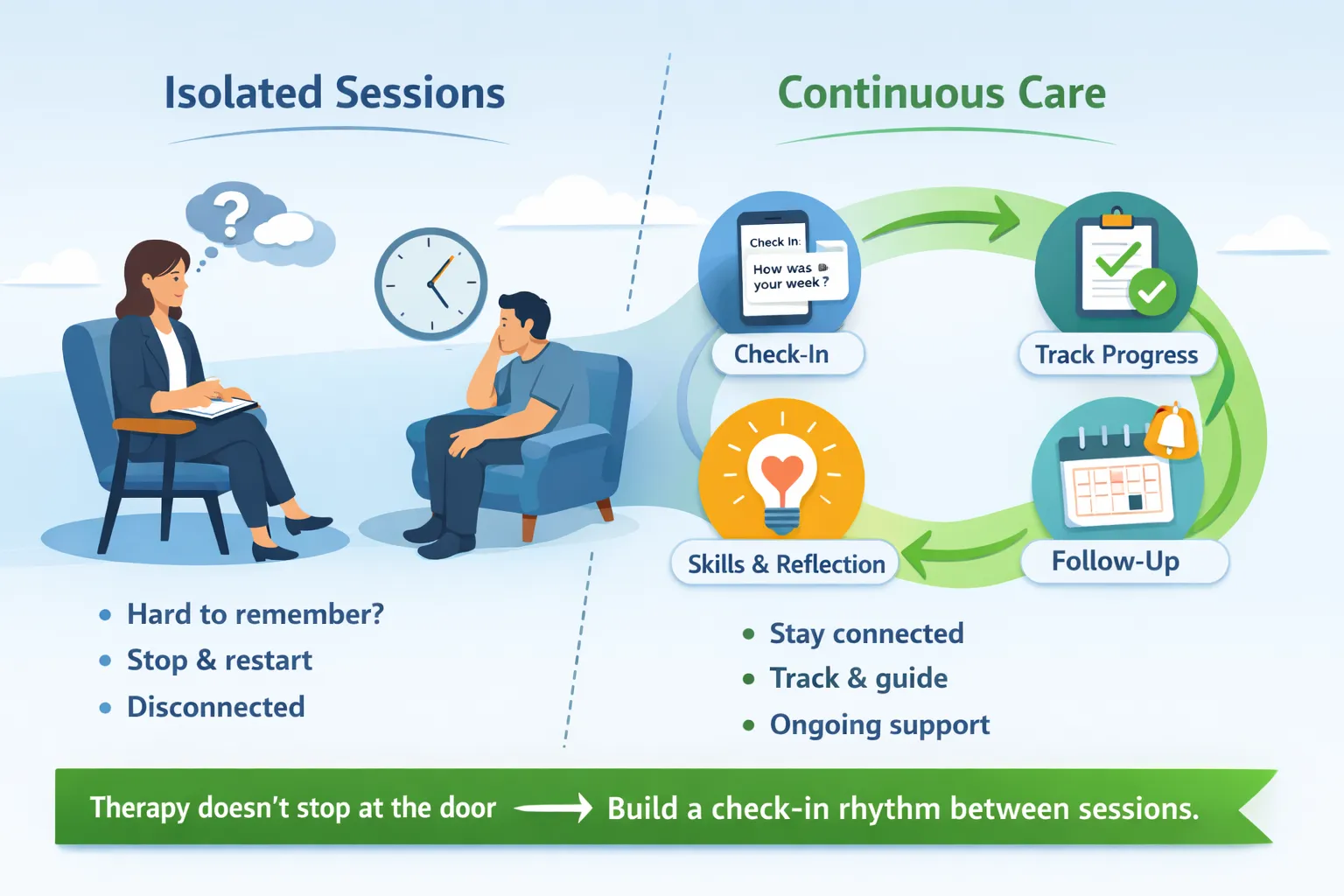
Without a check-in habit, four costs show up week after week:
- Memory gaps. Clients recall the worst moment or the most recent one, not the arc of the week.
- Session time drain. The open becomes recap instead of work.
- Skills drift. What was practiced in session becomes theoretical once life intervenes.
- Quiet drop-off. Clients who feel no continuity start canceling before either of you has named the disconnect.
The fix is not more motivation. It is a short, repeated path that keeps the treatment thread visible between appointments.
What belongs in an asynchronous check-in
Effective between-session therapy check-ins are consistent, brief, and tied to something specific from the last session. Aim for under five minutes to complete. Three fields usually beat a long form:
- One rating. Mood, stress, urge, sleep, or another scale that matches the live target.
- One standout moment. Positive or difficult. One concrete scene beats a full week diary.
- One skills or agenda note. Did they try the agreed move? Is there anything they want named next time?
That is enough to open the next hour with material instead of reconstruction. Optional fourth field: a short alliance or usefulness rating when you want a feedback signal without turning the form into a survey.
When a client needs more room than a pulse check, AI journaling for therapy covers a longer client-controlled writing workflow with pattern summaries and optional therapist sharing. For a longer fixed assignment rather than adaptive AI, choose one stem from the therapist-selected journal prompt bank. When the writing job is activation versus avoidance on one day, use journal prompts for depression instead of a longer pulse.
These prompts are for the days between appointments, not the opening minutes in the room. Keep in-session arrival questions for the hour you share; keep this workflow for the mid-week pulse. Monthly or quarterly course-correction conversations belong in the therapist guide to structured client check-ins. For longer practice tasks and worksheets, use between-session therapy activities. When the between-session support might live in a third-party app rather than your check-in form, use the client app recommendation sheet for between-session practice to choose one container and set the review plan.
Workflow and boundaries
Build between-session therapy check-ins the same way every time so neither of you has to reinvent the send.
Before the client leaves the room
- Name the check-in target in one sentence the client can repeat.
- Agree the channel, day, and time.
- Agree what happens if they skip it (you will ask, not grade).
- Confirm privacy: who else might see the phone, and what they should never type into a consumer app.
Mid-week send
- One short form or message, not a stack.
- Keep crisis language out of the form. Safety stays on the existing plan, not inside a mood slider.
- If the platform supports it, schedule the send once and leave it alone.
After a reply arrives
- Skim for risk language first, then for clinical utility.
- Do not treat every answer as an emergency contact. Define what warrants outreach versus what waits for session.
- Draft a one-line pre-session note for yourself: rating, standout moment, skills status, open agenda item.
Privacy and secure messaging
If you collect between-session information digitally, HIPAA applies to US covered entities. Use encrypted tools with a Business Associate Agreement. Standard SMS, WhatsApp, and consumer email do not meet that bar for clinical content in most US jurisdictions. Confirm the platform encrypts data in transit and at rest, does not use client data to train models, and lets you remove records when treatment ends.
Boundaries matter clinically as well as legally. A check-in is not on-call therapy. Set response windows. Say what you will and will not reply to between sessions. Pause or shrink the workflow when acute risk is active, home is not private enough, dissociation or flooding exceeds the home frame, or the client cannot consent clearly to the format.
Prompts and response handling
These are starting points for asynchronous use. Adjust language, scale, and count to modality and client. Pass is always allowed.
Individual weekly check-in (async)
Send before the next session on a HIPAA-ready channel:
- On a scale of 1 to 10, how would you rate your overall mood this week?
- What is one moment from the past week that stands out, positive or difficult?
- Did you practice any skills or strategies from our last session? If so, what happened?
- Is there anything you want to make sure we cover next time?
- Optional: How useful has the work felt this week, on a scale of 1 to 10?
Lightweight mid-week pulse
When a full form is too much, send one field only:
- “One number for stress today, and three words about what is driving it.”
- “Did the plan we named get a real try? Yes / partial / no.”
- “Anything you want me to know before we meet, in one sentence.”
How to handle what comes back
| Reply pattern | First clinical move |
|---|---|
| Complete and concrete | Open session with the standout moment and skills note by name |
| Partial or one-word | Ask what the short answer is protecting or simplifying |
| Blank or missed | Shrink the form; ask about channel, privacy, or fit |
| High distress language | Follow your risk protocol; do not leave safety to the next appointment alone |
| Over-complete essay | Thank the effort, then narrow the next send so writing does not become performance |
Never let a reply disappear into an unread folder. If you will not review it, do not collect it.
Next-session continuity
The check-in only works when the content returns to the room.
At the start of session:
- Review what the client shared, by name, in the first few minutes.
- Ask one clarifying question before you leave the check-in behind.
- Use the agenda item they named, or name why you are choosing a different focus.
After the session:
- Leave with one carry-forward intention tied to what just happened.
- Optional: schedule the next mid-week pulse while the intention is still clear.
After a month of consistent between-session therapy check-ins, a week-by-week picture emerges that session recall alone cannot produce. The Sunday-night anxiety spike that once appeared as a throwaway comment becomes a recurring data point. A week with no skills practice shows up in the record, not only as a vague sense that things were flat. That is a different quality of material to work with.
When you want the wider engagement loop around homework, journaling, and measures, see client engagement therapy. Emosapien keeps agreed check-ins visible for the next appointment. It does not choose the clinical target, monitor crisis risk for you, or replace judgment.
Keep check-ins ready for session
Emosapien’s Engagement Agent sends structured between-session therapy check-ins, captures client reflections, and drafts a pre-session summary you review before the hour starts.
Try EmosapienDownload the Between-Session Pack
The Between-Session Pack is the printable planner for this workflow: fit the last session, shrink the burden, name the barrier, pick one small check-in or micro-activity, and reopen the result next time. Use it when you want one clear send leaving the room rather than another unfinished form on a phone.
It includes:
- Fit, frame, shrink, cue, and review planner for one activity
- Barrier checklist and shrink-before-you-escalate prompts
- Worksheets and micro-activities menu by clinical goal
- Next-session review stems for complete, partial, or blank work
Free PDF: Between-Session Pack
A printable clinician pack for choosing one small between-session activity: selection loop, barrier repair, worksheets by goal, and next-session review stems.
- Fit, frame, shrink, cue, and review planner for one activity
- Barrier checklist and shrink-before-you-escalate prompts
- Worksheets and micro-activities menu by clinical goal
- Next-session review stems for complete, partial, or blank work
Free. We'll email the PDF link right away. We may also send the occasional therapist toolkit. Unsubscribe any time.
Where should we send the link?
We'll email the PDF link right away. You'll also get the occasional therapist toolkit. Unsubscribe any time.
✓ Check your inbox
We've sent you the PDF
The download link is on its way to your inbox, usually within a minute or two. The email will come from Emosapien (hello@team.emosapien.com); check your spam folder if you don't see it.
You're also on the weekly therapist toolkit list. Unsubscribe any time from the email footer.
References
- Lambert, M. J., and Shimokawa, K. (2011). Collecting client feedback. Psychotherapy, 48(1), 72-79.
- Kazantzis, N., Whittington, C., Zelencich, L., Kyrios, M., Norton, P. J., and Hofmann, S. G. (2016). Quantity and quality of homework compliance: A meta-analysis of relations with outcome in cognitive behavior therapy. Behavior Therapy, 47(5), 755-772.