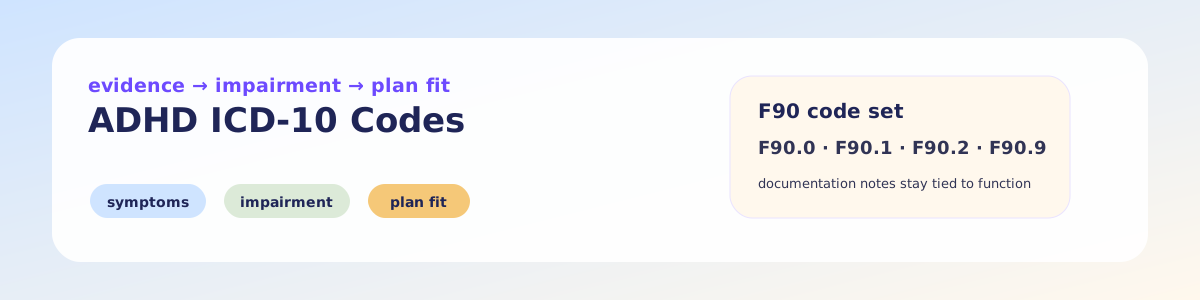
ADHD ICD-10 Codes: F90.0, F90.1, F90.2 for Therapists

Outline
ADHD ICD-10 codes belong inside a documentation workflow, not beside the chart as a lookup table. The code line is defensible only when the note shows symptoms, impairment, developmental course, differential reasoning, and treatment-plan fit.
For adults, the chart usually has to connect attention, organization, emotional regulation, relationships, work, and daily functioning. For children and adolescents, it also has to hold home, school, caregiver, and developmental evidence without treating one reporter as the whole truth.
This guide gives therapists a code table, documentation crosswalk, subtype notes for F90.0 and F90.2, and a downloadable cheat sheet for intake and payer review. For the broader diagnostic-code map, use the ICD-10 codes for therapists hub.
Free PDF: ADHD ICD-10 Cheat Sheet
A printable F90 code table and documentation crosswalk for ADHD intake, subtype selection, and payer review.
- F90.0, F90.1, F90.2, F90.8, and F90.9 descriptors with the chart support each code needs
- Documentation crosswalk for presenting pattern, impairment, developmental course, cross-setting evidence, and differential
- Subtype and pediatric or family checks for intake and reassessment
- Safer assessment language and a before-signing checklist
Free. We'll email the PDF link right away and add you to the therapist toolkit, sent every two weeks. Unsubscribe any time.
Where should we send the link?
We'll email the PDF link right away. You'll also get the therapist toolkit every two weeks. Unsubscribe any time.
✓ Check your inbox
We've sent you the PDF
The download link is on its way to your inbox, usually within a minute or two. The email will come from Emosapien (hello@team.emosapien.com); check your spam folder if you don't see it.
You're also on the therapist toolkit list, sent every two weeks. Unsubscribe any time from the email footer.
Educational resource for licensed US mental-health clinicians. ICD-10-CM descriptors, DSM criteria, payer rules, school documentation, and state scope rules change. Verify current requirements before diagnosing, coding, or billing.
Use official code sources first
Use the CDC ICD-10-CM files for the official US diagnosis-code set and guideline updates. Use the AAP ADHD clinical practice guideline when the evaluation involves children or adolescents.
Those sources do not replace state scope rules or payer policy. They keep the practice from building a billing habit around memory, old templates, or a one-line code list.
ADHD ICD-10 codes table
| Code | Official ICD-10-CM descriptor | Use when the chart supports |
|---|---|---|
| F90.0 | Attention-deficit hyperactivity disorder, predominantly inattentive type | Inattention is the primary presentation, with impairment and differential reasoning documented. |
| F90.1 | Attention-deficit hyperactivity disorder, predominantly hyperactive type | Hyperactivity or impulsivity is primary, with functional impact and alternative explanations assessed. |
| F90.2 | Attention-deficit hyperactivity disorder, combined type | Both inattentive and hyperactive or impulsive features are clinically meaningful. |
| F90.8 | Attention-deficit hyperactivity disorder, other type | ADHD is supported, but the documented presentation fits another specified form. |
| F90.9 | Attention-deficit hyperactivity disorder, unspecified type | ADHD is supported, but the record does not yet support a more specific subtype. |
The table is a starting point. The record still has to show why this code fits this client at this point in care.
Documentation crosswalk
Use the code only after the note can answer the reviewer’s basic questions.
| Chart element | What to document | Why it matters |
|---|---|---|
| Presenting pattern | Inattention, disorganization, impulsivity, restlessness, time blindness, task avoidance, emotional reactivity, or school/work disruption | Shows the clinical problem beyond the label. |
| Impairment | Missed deadlines, academic underperformance, relationship conflict, unsafe driving, lost items, financial disruption, or home-routine failure | Supports medical necessity. |
| Developmental course | Childhood onset, school history, caregiver report, report cards, or adult retrospective history | Separates ADHD from new-onset stress, mood, sleep, or substance factors. |
| Cross-setting evidence | Home, school, work, relationships, or therapy engagement | Reduces overreliance on one setting or one reporter. |
| Differential | Anxiety, trauma, depression, bipolar disorder, sleep disorder, substance use, learning disorder, autism, medical contributors, medication effects | Shows why ADHD is the best supported formulation. |
| Treatment-plan link | Executive-function support, behavioral systems, parent coaching, school coordination, emotional-regulation work, or referral for medication evaluation | Connects the diagnosis to active care. |
A concise code entry is stronger when the supporting facts sit in the same note. “F90.2” alone does not show combined presentation. A chart that names inattentive symptoms, impulsive behavior, impairment, course, and differential reasoning does.
F90.0: predominantly inattentive type
F90.0 fits when inattentive symptoms organize the presentation. The therapy record should not rely on the client’s phrase “I am scattered.” It should document observable functional patterns.
Adult examples include missed deadlines despite effort, losing key items, time-estimation errors, unfinished tasks, avoidance of paperwork, and strain in relationships because follow-through breaks down. Pediatric examples include incomplete classwork, caregiver reports of repeated prompting, teacher reports of drifting, and difficulty sustaining effort across routine tasks.
A defensible Assessment sentence might read: “Presentation supports F90.0: longstanding inattentive pattern with missed assignments, frequent loss of materials, difficulty sustaining task effort, and impairment across school and home; no current evidence that symptoms are better explained by depression, trauma avoidance, substance use, or sleep disruption.”
F90.2: combined type
F90.2 requires more than “ADHD with a lot going on.” The chart should support both inattentive and hyperactive or impulsive features.
For children and adolescents, combined presentation often appears across settings: incomplete work, leaving seat, interrupting, difficulty waiting, emotional outbursts, and caregiver-school mismatch. The therapist documents the mismatch instead of flattening it. A teen may look regulated in session and still show significant impairment at school or home.
For adults, combined presentation may look quieter than the childhood stereotype. The note can describe internal restlessness, rapid task switching, interrupting, impulsive spending, driving risk, or conflict after blurting out comments.
When F90.9 is too thin
F90.9 may be appropriate at intake when ADHD is clinically supported but the subtype is not yet clear. It becomes weak when it stays in the chart after the record has enough detail to specify the presentation.
If the therapist uses F90.9, the plan should name what will clarify the code: rating scales, collateral history, school records, caregiver interview, prior evaluation, medication history, or coordination with a prescriber or psychologist.
The chart should also state what remains uncertain. “Unspecified” is not a shortcut for incomplete assessment. It is a temporary description of the evidence available today.
Differential diagnosis therapists should document
ADHD can overlap with many therapy presentations. The differential section is where the documentation matters most.
| Differential | Documentation question | Safer chart language |
|---|---|---|
| Anxiety | Is the inattention driven by worry and threat scanning? | “Attention worsens under evaluation pressure, but inattentive pattern predates current anxiety episode and appears across low-threat settings.” |
| Depression | Is low motivation, sleep disruption, or slowed cognition driving the picture? | “Low mood contributes to task avoidance, but caregiver and school history show persistent attentional impairment before depressive symptoms.” |
| Trauma | Is distractibility tied to hypervigilance or trauma reminders? | “Client reports distractibility across non-trauma contexts; trauma cues reviewed separately.” |
| Bipolar disorder | Are impulsivity and activity episodic with mood elevation? | “Restlessness and impulsive speech appear chronically rather than in discrete elevated-mood episodes.” |
| Substance or medication effects | Could stimulants, cannabis, alcohol, withdrawal, or medication explain symptoms? | “Substance and medication contributors reviewed; no pattern explains longstanding cross-setting impairment.” |
| Autism or learning disorder | Are executive-function concerns part of a broader developmental or learning profile? | “Social-communication and learning-history questions reviewed; referral considered for full neurodevelopmental testing.” |
The differential does not have to be long. It has to show that the therapist considered the likely alternatives and documented why the ADHD formulation remains supported.
Pediatric and family documentation
A young client’s ADHD record lives across home, school, and clinic. The therapist should document whose report is being used and where the reports diverge.
A caregiver may describe chaos at home while a teacher sees quiet inattention. A teen may report shame and avoidance while a parent sees defiance. Those differences are clinical data, not noise.
For adolescent intake, pair this guide with the adolescent therapy intake form. The form structure helps the therapist gather caregiver report, teen self-report, school context, confidentiality limits, and risk screening before the first session.
90791 and treatment-plan fit
An ADHD diagnosis often begins with a diagnostic evaluation. The intake note supports the service code while the ICD-10-CM code supports medical necessity.
The treatment plan should translate the diagnosis into therapy work. That may include executive-function systems, emotion-regulation practice, parent coaching, school coordination, habit scaffolding, or referral for medication evaluation when indicated. For the adult or general outpatient SMART rewrite, use the treatment plan goals and objectives for ADHD PDF.
How Emosapien supports the workflow
Emosapien organizes intake history, session context, impairment language, differential reasoning, and treatment-plan targets in one clinician-reviewed note. The therapist stays responsible for diagnosis and final sign-off.
For ADHD care, Emosapien also carries homework, rating-scale notes, caregiver or client check-ins, and next-session tasks forward. The practice does not have to rebuild the executive-function story from memory each week.
See the AI clinical notes for therapists overview for the Scribe Agent workflow, clinician review, and signed progress-note path.
Use the downloadable cheat sheet
Use the ADHD ICD-10 codes cheat sheet during intake review, supervision, or template cleanup. It keeps the F90 table beside the evidence a reviewer expects to see: symptoms, impairment, developmental course, cross-setting detail, differential reasoning, and treatment-plan link.
The strongest ADHD chart is specific, current, and humble about uncertainty. It uses the most supported code today and records what the therapist will clarify next.
References
- Centers for Disease Control and Prevention. ICD-10-CM official code set and guidelines.
- American Academy of Pediatrics. Clinical practice guideline for the diagnosis, evaluation, and treatment of ADHD in children and adolescents.