Emosapien vs Upheal
Both tools take therapy seriously. Both run during the session. The difference is what happens around the session: between-session client engagement, outcome measurement workflows, treatment-plan continuity, and pricing posture. This is the scored comparison.
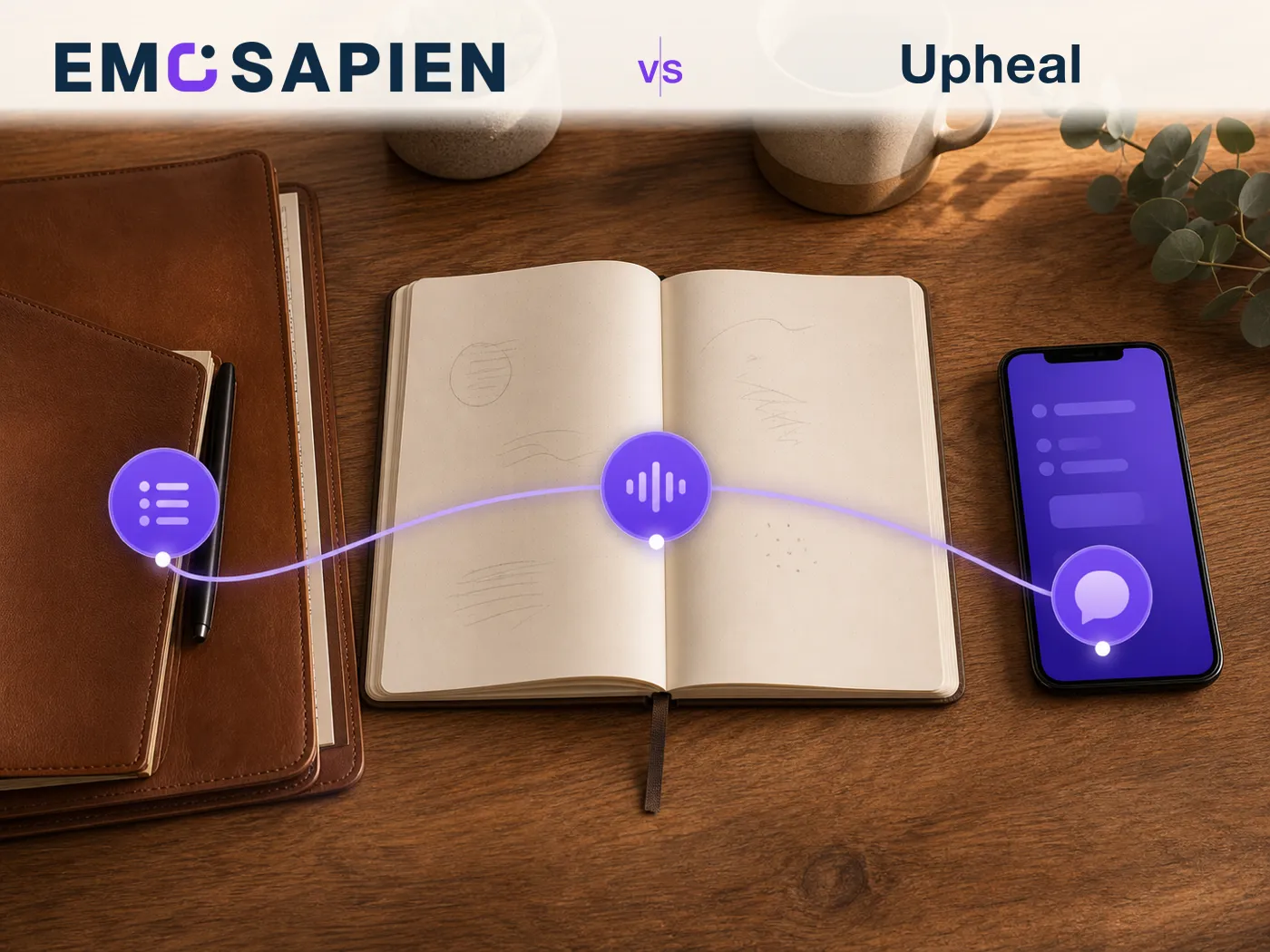
Three workflow stages, side by side
Where Emosapien goes further at every stage of the therapy week
Therapy work happens in three distinct stages: pre-session intake and planning, the session itself, and the days between sessions. Upheal is built for one of those stages. Emosapien is built for all three.
Intake and planning before the first appointment
Intake Agent collects history and presenting concerns before the client sits down. Planning Agent drafts the treatment plan and threads goals forward into every session that follows.
No structured pre-session surface. Intake forms and treatment-plan drafting sit with the clinician between appointments.
Active co-therapy during the appointment
Therapy Agent surfaces modality-aligned cues (CBT, ACT, DBT, IFS, EMDR) tied to the active treatment goal. Scribe Agent drafts the note from that clinical context, not transcript alone.
Transcribes the session and surfaces generic "what to ask next" suggestions. The note draft works from transcript pattern rather than modality + goal context.
Continuous care across the week
Engagement Agent runs guided check-ins, AI-assisted journaling, modality-aligned homework, and outcome scheduling. The pre-session brief opens with what changed during the week.
Client portal with forms and post-session summaries. No AI-assisted journaling, no modality-aligned homework, no structured between-session engagement workflow.
The scoreboard
Where Emosapien and Upheal each fit therapy work
Each dimension is scored against the way a working therapy practice would actually feel the difference: in-session behavior, note quality, between-session engagement, outcome measurement, treatment-plan continuity, pricing, telehealth fit, and EHR integration depth. Notes for each row are below the table.
Dimension by dimension
Each score reflects how a working therapy practice would feel the difference week to week. The notes underneath each dimension explain it. If you currently run TherapyNotes and only want to replace the AI add-on, compare therapyfuel alternatives before you move the chart.
In-session AI behavior
How the AI participates while the session is running
Upheal listens and transcribes, then surfaces generic "what to ask next" suggestions. Emosapien surfaces modality-aligned prompts (CBT, ACT, DBT, IFS, EMDR) that are tied to the active treatment goal, which is a meaningfully different level of clinical participation.
Note generation quality
SOAP, DAP, BIRP, GIRP output across modalities
Both produce clean structured notes; Upheal's note quality is good. Emosapien drafts the Assessment from clinical context (modality used + treatment goal touched) rather than transcript alone, which tends to need fewer edits at sign-off.
Between-session client engagement
Check-ins, AI-assisted journaling, homework, MBC scheduling
Emosapien runs a first-class Engagement Agent that handles the week between sessions with AI-assisted journaling, modality-aligned homework, and outcome scheduling. Upheal has a client portal with forms and post-session summaries, but no AI-deep journaling or modality-aligned homework surface.
Outcome measurement workflow
PHQ-9, GAD-7, ORS scheduling and trend plotting
Emosapien schedules measures between sessions, auto-scores them, and plots trends against treatment-plan goals. Upheal delivers assessments and tracks scores, but the workflow is closer to assessment delivery than to a measurement-based-care program that drives session-by-session decisions.
Treatment-plan continuity
Goal carry-forward and Planning Agent involvement
Emosapien has a dedicated Planning Agent that maintains goal and formulation continuity across sessions. Upheal generates treatment plans and supports a "Golden Thread" view across notes, but cross-session goal-linking is lighter than a dedicated planning agent.
Pre-session intake and planning
Intake handoff, treatment plan draft, and goal continuity before the first session
Emosapien runs structured pre-session work through two dedicated agents: the Intake Agent collects history and presenting concerns before the first appointment, and the Planning Agent drafts the treatment plan and carries goals forward into every session that follows. Upheal does not have a comparable pre-session surface; intake and planning sit with the clinician.
Telehealth fit
Browser-based capture for video sessions
Even. Either tool drops into Zoom, Google Meet, or a dedicated telehealth platform without extra hardware.
EHR integrations
Native connectors to therapy-practice EHRs
Roughly even. Both tools support structured note export to the major therapy EHRs (SimplePractice, TherapyNotes, Jane) and HL7/FHIR for anything else. Check each vendor's integrations page for current native-connector status before committing.
Scoring verified May 2026. Verify current pricing and feature claims on both vendor sites before committing.
Best fit by practice profile
Which tool fits which practice

Pick Emosapien if
- →You want structured pre-session work (intake handoff, treatment-plan draft, goal continuity) handled by AI agents, not by you between appointments.
- →You want AI to participate clinically during the session with modality-aligned prompts (CBT, ACT, DBT, IFS, EMDR) tied to the active treatment goal, not generic "what to ask next" cues.
- →You need a continuous-care surface between sessions: guided check-ins, AI-assisted journaling, modality-aligned homework, and outcome measurement that feeds the next session brief.
- →Your practice runs measurement-based care (PHQ-9, GAD-7, ORS) and wants scores tied to treatment-plan goals automatically.
- →You want a forever-free tier to evaluate the tool without procurement friction.
Pick Upheal if
- →Your sole need is a post-session AI scribe with high-quality structured notes, and pre-session intake plus between-session engagement live elsewhere in your stack.
- →You already have a separate engagement and measurement workflow you do not want to consolidate.
- →You are happy with generic in-session prompts and do not want modality-specific guidance.
Migration in practice
Switching from Upheal in an afternoon
The practical question for therapists already on Upheal is whether their existing notes come with them. The migration scope depends on how much historical record you carry forward: notes export and import via PDF or text; treatment plans and client metadata are recreated at intake.
- 1 Export existing notes as PDF or text from the Upheal dashboard.
- 2 Upload through the Emosapien bulk-import flow. Recreate treatment plans and client metadata at intake, or arrange a one-off CSV with support for larger practices.
- 3 Set your default note format, modality, and an outcome measure (PHQ-9, GAD-7, or ORS).
- 4 Run your next session. The Therapy Agent and Scribe Agent ship the first note within minutes of close.
Frequently asked questions
Depends on what you need. Upheal is a competent active scribe with reliable transcription and clean structured notes; if your entire AI workflow is post-session documentation, Upheal covers that. Emosapien wins decisively if you want any of: modality-aligned in-session prompts (CBT, ACT, DBT, IFS, EMDR), a between-session Engagement Agent for clients, structured measurement-based-care workflows, cross-session treatment-plan continuity, or a forever-free tier. For most practices buying for more than just notes, Emosapien is the broader pick.
Between-session work. Upheal is built around the session itself, meaning what happens during and immediately after. Emosapien is built around the whole week: a structured Engagement Agent workflow for guided check-ins, AI-assisted journaling, modality-aligned homework, and outcome scheduling that feeds the next session brief. If your practice wants a continuous-care surface rather than a faster way to write the chart, that is the deciding feature.
Upheal's prompts are generic: "what to ask next" suggestions surfaced from the transcript pattern. Emosapien's in-session Therapy Agent surfaces modality-aligned cues tied to the active treatment goal: a CBT cognitive-restructuring prompt when the client describes a thinking trap, an ACT defusion question when affect shifts around values, a DBT distress-tolerance move when emotional intensity spikes. The Scribe Agent then drafts the Assessment from that clinical context, which is why the note tends to need less editing at sign-off.
Emosapien Starter is $39 per month on annual billing; Professional is $99 per month and includes the in-session Therapy Agent and the full Engagement Agent. The Free plan is permanent and covers 10 AI-generated sessions per month with no credit card. Upheal updates pricing periodically and is paid-only with no permanent free tier; their entry plans historically sit higher than Emosapien Starter. Verify both vendors' current published pricing before deciding, and see Emosapien pricing for full plan details.
Emosapien. The Engagement Agent auto-schedules PHQ-9, GAD-7, and ORS between sessions, scores them the moment the client submits, plots trends against the treatment-plan goal, and surfaces the change in your pre-session brief. Upheal supports assessment delivery but does not run measurement-based care as a structured continuous workflow. For the full picture of what AI-driven MBC looks like, see the MBC-with-AI article and the practical MBC guide.
Yes for notes. Export from the Upheal dashboard as PDF or plain text and upload through the Emosapien bulk-import flow at setup. Imported notes become the historical record. Treatment plans and client metadata are recreated in Emosapien at intake (which usually takes a session anyway) or imported once via CSV with support for larger practices. The Scribe Agent reformats imported notes into your preferred Emosapien template so the chart looks consistent across the historical record.
Yes. Both tools are HIPAA-aligned per the HIPAA Security Rule. Emosapien is additionally SOC 2 Type II audited and ISO 27001 certified, with a Business Associate Agreement (BAA) available on Professional and Enterprise plans. Session content is never used to train public models. The Safety and Compliance Agent layers consent management and audit logging on top.
Related comparison
Comparing two vendors first?
Mentalyc vs Upheal comparison
A direct scorecard for notes, treatment plans, pricing, and practice fit before you compare either vendor to Emosapien.
Upheal vs Blueprint
A direct scorecard for notes, assessments, EHR coverage, pricing, and practice fit before you compare either vendor to Emosapien.
Try Emosapien free
Start free. 10 sessions per month, no credit card. Upgrade only when you are sure.