Emosapien
Therapy workflow comparison

Emosapien vs Heidi for therapy sessions, notes, and continuity

Emosapien carries therapy work from the live session into the signed note, the week between appointments, and measurement tied to goals. Heidi positions its platform as a broad AI care partner for clinicians.

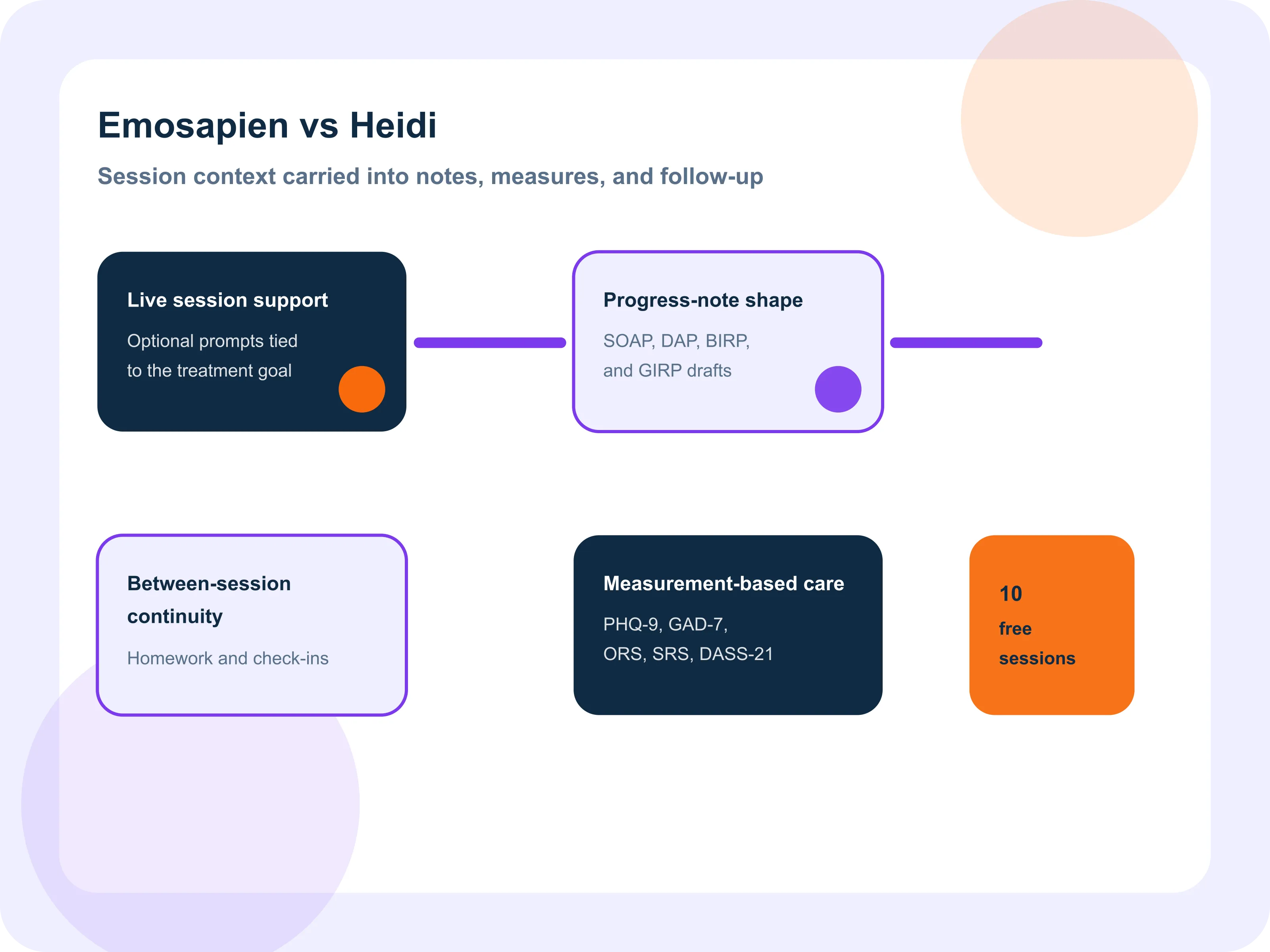
A split therapy workflow diagram showing session support, reviewed notes, between-session continuity, measurement-based care, and 10 free sessions

Built for therapists comparing a broad AI care partner with a therapy-only workflow.

Therapy workflow comparison

Emosapien vs Heidi starts with scope

The decision starts with scope. Emosapien focuses on psychotherapy continuity. Heidi presents a broader documentation and care-team workflow.

Therapists who want a broader shortlist before this head-to-head can start with the therapy AI alternatives hub.

Clinical audience

Broad clinical positioning

A therapy practice documents sessions, goals, client response, and care continuity across a caseload.

Emosapien

Emosapien serves licensed mental-health clinicians, so the workflow stays centered on psychotherapy.

Heidi

Heidi positions itself as an AI care partner for clinicians across specialties.

Live session support

Broad clinical positioning

The therapist reviews optional prompts tied to the active goal and chooses whether to use them.

Emosapien

Emosapien surfaces optional CBT, ACT, or DBT prompts while the clinician keeps judgment and sign-off.

Heidi

Heidi emphasizes ambient capture, notes, evidence, codes, and downstream clinical tasks.

Progress-note shape

Broad clinical positioning

The therapist reviews intervention, client response, plan, and risk wording before sign-off.

Emosapien

Emosapien drafts SOAP, DAP, BIRP, and GIRP notes from session context for clinician sign-off.

Heidi

Heidi positions its templates and structured documentation for broad clinical settings.

Between-session continuity

Public therapy detail limited

The therapist brings goals, homework, journaling, check-ins, and measures into the next appointment.

Emosapien

Emosapien carries check-ins, journaling, homework, and client mobile-app activity into the workflow.

Heidi

Heidi centers documentation and care-team tasks rather than between-session continuity.

Measurement-based care

Public therapy detail limited

The practice tracks change against goals instead of leaving scores in a separate silo.

Emosapien

Emosapien schedules, scores, and plots PHQ-9, GAD-7, ORS, SRS, DASS-21, WHOQOL-BREF, and custom measures against goals.

Heidi

Heidi focuses on clinical evidence and operational tasks, not a therapy measurement workflow.

Low-risk trial

Broad clinical positioning

A clinician tries a therapy workflow on real sessions before the practice switches systems.

Emosapien

Emosapien gives clinicians 10 AI-generated therapy sessions per month, no credit card and no countdown.

Heidi

Heidi publishes a free plan and paid Evidence, Clinician, and Practice tiers.

Vendor facts are based on public US pages checked June 2026, including the homepage and pricing page. Functionality and terms can change after publication.

Continuity inside the workflow

Emosapien returns the last session before the next

Emosapien carries session context into the reviewed note, homework, outcome measure, and next-session plan. Before the follow-up, the therapist sees assigned homework, recent journaling, check-in response, and the PHQ-9 or GAD-7 trend in one workflow.

What Emosapien carries forward

  1. Emosapien surfaces optional CBT, ACT, or DBT prompts tied to the active treatment goal.
  2. Emosapien drafts a SOAP, DAP, BIRP, or GIRP note with intervention, response, plan, and risk language.
  3. Emosapien carries homework, journaling, and PHQ-9 or GAD-7 results into the next-session plan.

For the human-in-the-loop documentation posture, see the AI clinical notes overview.

Choose Emosapien when

Emosapien brings the last session into the next

A therapist ends a CBT session with homework, a PHQ-9 follow-up, and a risk note. Emosapien drafts the note, carries the homework and measure into the client's week, and returns that context before the next visit.

Choose Heidi when

Heidi centers broad clinical operations

Heidi positions its platform around ambient documentation, evidence, codes, referrals, prescriptions, and task flow across mixed clinical services.

Try the therapy-only workflow before switching tools

Emosapien gives clinicians 10 AI-generated therapy sessions a month, no credit card, so a therapist reviews notes, measures, homework, and follow-up context on real sessions first.

See free plan and pricing

Frequently asked questions

Emosapien gives therapists a therapy-only workflow: live sessions, reviewed notes, goals, homework, journaling, measures, and the next appointment. Heidi positions its platform as a broader AI care partner for clinicians across specialties.

No. Heidi positions itself as a broad AI care partner across clinical specialties. Emosapien is built specifically for licensed therapists and mental-health clinicians.

Use this Emosapien vs Heidi head-to-head once the shortlist narrows to a broad AI care partner and a therapy-only workflow. For a broader shortlist, read the Heidi alternative page for therapists.

Yes. Emosapien encrypts client data in transit and at rest, keeps note sign-off with the licensed clinician, and never trains public models on session content. Enterprise plans add SSO, role-based access, retention controls, and audit exports.

Yes. Emosapien gives clinicians 10 AI-generated therapy sessions per month, no credit card, so a therapist tries the workflow on real sessions before buying.

Emosapien drafts SOAP, DAP, BIRP, and GIRP notes from session context, capturing intervention, client response, risk wording, and plan, with the licensed clinician in sign-off.

Therapy-only support starts free

Start free with 10 AI-generated sessions per month, no credit card, no countdown. The therapist keeps clinical judgment while Emosapien drafts, organizes, and carries the workflow around the session.