
ACT Therapy Worksheets: A Clinician's Guide to Acceptance and Commitment Therapy Tools

Outline
Authored by Dr. Hannah Lin, counseling psychologist trained in CBT, ACT, and IFS, with over a decade of clinical practice in anxiety and complex trauma.
ACT therapy worksheets occupy a particular position in modern clinical practice. They are widely downloaded, widely adapted, and frequently misused, often by clinicians who are nominally ACT-aligned but treating the forms as CBT in different language. The misuse is rarely deliberate. It happens because ACT and CBT worksheets can look superficially similar (both involve writing thoughts down, both involve some kind of analysis), but they operate through fundamentally different mechanisms of change. A defusion exercise is not a thought record. A values bull’s-eye is not a goal-setting worksheet. Treating them as if they were is one of the most reliable ways to dilute the model.
This guide walks through forms organized by the six core processes of the hexaflex (the model of psychological flexibility that Steven Hayes and colleagues developed and that the Association for Contextual Behavioral Science maintains as the field’s central organizing framework). If you need the clinical frame before choosing forms, start with the ACT therapy basics refresher. It assumes you are a licensed therapist with at least some ACT training; the therapy worksheets cornerstone covers worksheet ethics in more depth.
Educational content for therapists, not clinical or legal advice. Modality-faithful use of these tools assumes appropriate training; the worksheet does not substitute for the protocol it implements.
ACT therapy worksheets in clinical practice
The clinical purpose of these forms is to support one or more of the six core processes that constitute psychological flexibility: defusion, acceptance, present-moment contact, self-as-context, values, and committed action. A form that does not target one of these processes is either implementing a different model or doing nothing in particular.
The hexaflex matters as a clinician’s check on whether a given worksheet is doing ACT work or doing something else with ACT-flavored language. A “values list” that asks the client to rank twenty values and pick the top five is closer to a self-help inventory than to ACT-aligned values clarification. A defusion exercise that asks the client to “challenge” the thought is doing CBT, regardless of what it is called. The labels do not protect modality fidelity; the underlying process does.
A pattern from supervision: a client who arrives with a stack of completed ACT worksheets but no shift in psychological flexibility is usually a client whose forms were CBT in disguise, or who was running the worksheets cognitively rather than experientially. The fix is rarely to push harder on the homework. It is usually to move the work back into session, do the experiential rehearsal there, and use the form as a between-session continuity object rather than as a standalone intervention. Emosapien’s in-session support follows the same stance: the work happens in the room, and the documentation follows from it.
The hexaflex: six processes the form has to support
A short reference for what each process does and what a faithful worksheet looks like.
Scroll the visual sideways to view the full diagram
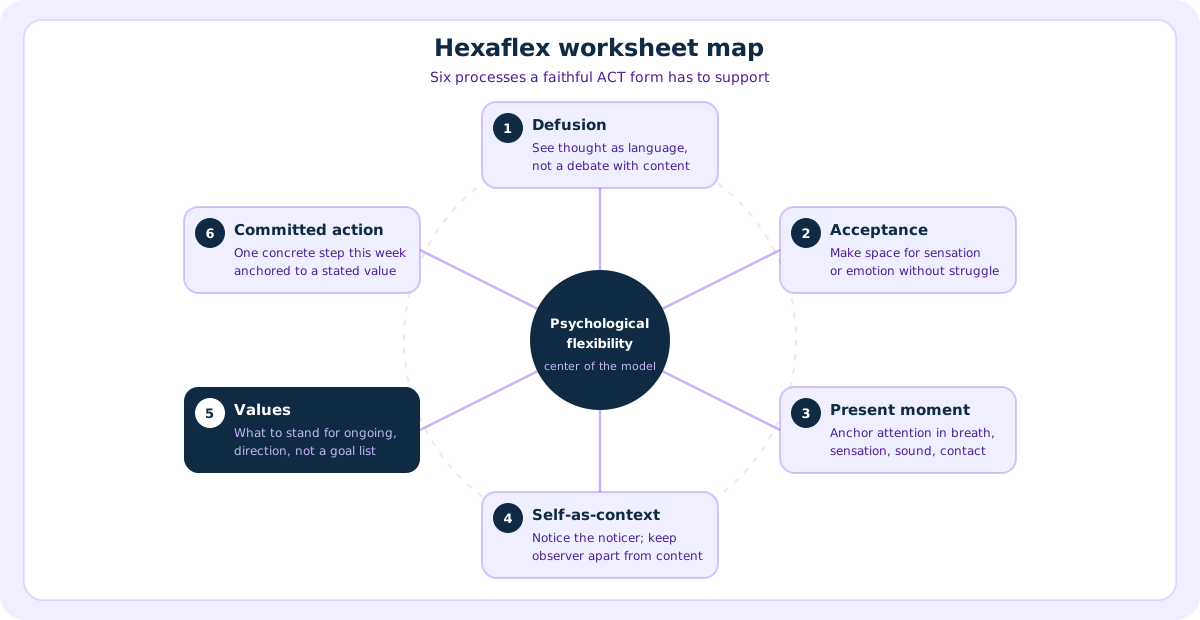
- Defusion. Changes the client’s relationship to thoughts and stories rather than the thoughts themselves. Faithful prompts ask the client to notice the thought, name it, observe its movement, or treat it as language behavior rather than literal truth.
- Acceptance and willingness. Opens contact with internal experience the client has been working to avoid. Faithful prompts invite the client to notice and stay with sensation, emotion, or memory rather than analyze it.
- Present-moment contact. Anchors attention to immediate experience. Faithful prompts ground the client in current sensation, breath, sound, or contact.
- Self-as-context. Distinguishes the observing self from the content the self is observing. Faithful prompts invite the client to notice the noticer, often through metaphors like the chessboard, the sky, or the observer.
- Values. Articulates the directional quality the client wants their behavior to embody, regardless of outcome. Faithful prompts ask what the client wants to stand for, not what they want to achieve.
- Committed action. Translates values into specific, behaviorally concrete steps. Faithful prompts ask what behavior, when, in service of which value.
The remaining sections walk through the families of forms that support each process.
Download the ACT therapy worksheets starter pack
Clinical guidance on this page is available without email signup. Email the printable pack when you want four process-organized forms beside the session plan: a defusion observation log, a values bull’s-eye, a committed-action plan, and a willingness check-in paired with valued action, with modality-fidelity notes on the cover.
Download the ACT therapy worksheets starter pack
Get four printable therapist worksheets for defusion, values, committed action, and willingness, with modality-fidelity notes for clinical use.
- Defusion observation log
- Values bull's-eye across six life domains
- Committed-action plan
- Willingness check-in paired with valued action
Free. We'll email the PDF link right away and add you to the therapist toolkit, sent every two weeks. Unsubscribe any time.
Where should we send the link?
We'll email the PDF link right away. You'll also get the therapist toolkit every two weeks. Unsubscribe any time.
✓ Check your inbox
We've sent you the PDF
The download link is on its way to your inbox, usually within a minute or two. The email will come from Emosapien (hello@team.emosapien.com); check your spam folder if you don't see it.
You're also on the therapist toolkit list, sent every two weeks. Unsubscribe any time from the email footer.
Defusion: changing the relationship to the cognition
Defusion is the process most commonly mistaken for cognitive restructuring, and the place where modality fidelity usually breaks down. The aim is to change the client’s relationship to a thought (so the thought has less behavioral pull) without arguing with the thought’s content.
The most clinically reliable defusion prompts are:
- “I’m having the thought that…” prefix prompts, which insert linguistic distance between the client and the thought.
- Leaves on a stream visualization logs, which track how long the client could observe thoughts moving past without engaging with them.
- “Milk milk milk” semantic-satiation exercises adapted into a brief written log, useful with clients who fuse strongly with verbal labels.
- Treating-the-mind-as-language-behavior observation logs, which ask the client to notice when the mind is producing cognitions and what those cognitions seem to be doing.
A defusion worksheet that asks the client to “examine the evidence for and against” the thought is not a defusion worksheet. It is a thought record with a defusion label. The mechanism is restructuring; the experience for the client is debate; and the result is a strengthened relationship to the cognitive content rather than a loosened one.
See ACT defusion techniques for use and avoid cues, selection by fusion pattern, and compact therapist scripts.
Values clarification: directional, not evaluative
Values work is where ACT therapy worksheets earn their distinctive clinical voice. The aim is not to identify values in the abstract but to articulate the directional quality the client wants their behavior to embody, in concrete domains and on a timescale they can act within.
In values work, the prompts that earn their place include:
- The values bull’s-eye, which maps the client’s current behavior against their stated values across life domains (work, relationships, health, leisure, growth, community).
- Domain-specific values prompts, which break the abstract question of “what matters” into life areas the client can engage with one at a time.
- Russ Harris’s values exercises (the dartboard, the sweet spot, and the values-by-domain worksheets), which constrain the response space helpfully without flattening the work.
- Eulogy and 80th-birthday-speech prompts, used carefully and only with clients whose existential bandwidth can hold them.
The most common values-worksheet failure is the values list. Asking a client to rank twenty values from a checklist is not values clarification. It is a self-help artifact dressed in ACT language. Faithful values work is generative, not evaluative, and the form has to leave space for the client to articulate something specific to them.
Committed action: from value to specific behavior
Committed action translates values into behaviorally specific steps that the client can take this week, not in the abstract future. In this stage of the work, the practical formats that hold up include:
- Valued-action plans that pair a single value with a single time-bounded behavior (“this Tuesday at 4pm, I will…”).
- SMART goals reframed in service of a stated value, where the goal sits inside a directional value rather than replacing it.
- Behavioral-experiment logs that test what happens when the client acts in service of a value while the unhelpful internal experience is present.
- Implementation-intention prompts (“when X happens, I will do Y”) with an explicit values anchor.
A committed-action worksheet that asks the client to “set a goal” without anchoring it to a value is doing goal-setting work, not ACT work. The clinical distinction matters because a goal achieved is not the same as a value lived. A client can complete every goal on the worksheet and still be moving away from what they want their behavior to stand for.
When a client struggles to hold values and committed action as separate steps, the ACT matrix worksheet can help by sorting the same material into away moves and toward moves live in session, before it goes on paper. When the job is an image-based identity or resource prompt rather than a values bull’s-eye, use art therapy worksheets instead of stretching this ACT pack.
Acceptance and willingness: pacing is the clinical question
Acceptance work is where ACT therapy worksheets are most often unsafe in inexperienced hands. The aim is to open contact with internal experience the client has been working to avoid, which means the prompt has to be paced to the client’s current capacity to stay in contact without being overwhelmed.
The acceptance-aligned formats that fit this carefully-paced work include:
- The struggle switch metaphor as a self-monitoring log, where the client tracks moments when they were able to set the switch to “off” (not struggling with the experience) versus “on”.
- Tug-of-war-with-the-monster prompts, which ask the client to notice when they are pulling on the rope (struggling against the experience) and what would happen if they put it down.
- Willingness logs that pair willingness ratings (0–10) with what the client was willing to make space for during the day.
- Brief acceptance prompts paired with a behavioral step (“today I am willing to feel anxious while I do X”).
These forms do not belong in early acceptance work. Pacing is the entire clinical question with acceptance, and a worksheet that asks the client to “be willing” to feel something they have not yet built tolerance for is asking them to perform willingness rather than develop it.
Self-as-context: noticing the noticer
Self-as-context distinguishes the observing self (the part of the client that has thoughts, feelings, and memories) from the content of those thoughts, feelings, and memories. The observing self is not another part to be analyzed; it is the vantage point from which everything else can be observed without being defined by it.
Self-as-context work is most often delivered through experiential exercises rather than written forms. The prompt then becomes a record of what was noticed in session, not a standalone task. Useful formats include:
- Observer-self check-ins that ask the client to notice who is doing the noticing during a difficult moment.
- Chessboard-metaphor reflection logs, where the client tracks moments when they could shift between identifying with the pieces (thoughts, feelings) and identifying with the board (the observing self).
- Sky-and-weather metaphor prompts that name the client’s attention as the sky and the changing internal experience as the weather.
These exercises work best when they document an in-session experiential rehearsal, not when they are introduced cold as homework.
Present-moment contact: anchoring attention
Present-moment contact anchors the client’s attention to immediate sensory or somatic experience and is one of the load-bearing processes for anxiety and chronic-pain work. The format is usually short, repetitive, and behaviorally simple.
The reliable present-moment formats include:
- Mindful-breathing or contact-with-the-present logs, particularly useful in chronic-pain and anxiety work. For one present-moment writing stem rather than a log, assign journal prompts for mindfulness.
- Drop-anchor prompts, which combine present-moment contact with values-anchored action and tend to translate well when integrated with somatic interventions.
- Five-senses brief check-ins that anchor attention quickly without requiring extended practice.
Present-moment exercises pair naturally with self-as-context work; the two processes often co-emerge in the same in-session moment, even when the worksheets that record them are separate.
Where ACT-aligned forms go wrong
Five failure modes I see most often in ACT-aligned practice with structured prompts, with the cleanest move I know for each.
Defusion treated as restructuring. A supervisee once brought me a client running the leaves-on-a-stream exercise, but the client was debating each leaf rather than watching it pass. The form said defusion; the practice was restructuring. The repair was experiential: rehearsing leaves-on-a-stream in session as observation rather than analysis, and using the worksheet only to record what was noticed afterwards.
Values mistaken for goals. Most often this shows up as a “values” worksheet that asks the client to “set a goal in line with your value”, but the goal is the entire content of the form and the value sits as a one-line label. The client articulates what they want to achieve and not what they want to stand for. The repair is to slow down at the values-clarification stage and let the value be specific enough to act under, before introducing any committed-action work.
Acceptance pushed too early. The client’s “willingness” reads as performance because the regulatory capacity to actually stay in contact with the difficult experience is not yet built. Pacing is the entire clinical question with acceptance work. When in doubt, return to present-moment contact and self-as-context exercises before pushing toward willingness.
Form run cognitively rather than experientially. A client who completes every prompt with a tidy hand can still be doing CBT in their head while the form says ACT on the page. The artifact in the file is not the practice in the moment. Move the rehearsal back into session, and let the worksheet be a record of an experience the client actually had.
Third-party “ACT” forms that are not ACT. Worksheet directories sometimes label CBT forms as ACT, particularly in cognitive-restructuring or thought-record formats with values-language stickers. Before using a third-party form, audit it against the hexaflex: which of the six processes does this prompt support, and does the mechanism it implements match the process named in the title? If the answer is unclear, the ACBS resources library is closer to source-of-truth than most third-party collections.
After the clinical decision and in-session rehearsal already exist, you may want one short reflection or skill-practice line without opening another full form. Keep this guide and the pack as the ACT selector. Do not use a prompt tool as an ACT worksheet maker, for unsupervised exposure or trauma processing, for crisis instructions, or as a substitute for formulation and live containment.
Adapting these tools across populations
The six core processes hold across populations. The format does not.
For adolescents, somatic and metaphor-led prompts usually outperform reflective writing. The DNA-V model (Discoverer, Noticer, Advisor, Values) is purpose-built for this group and translates well into worksheet formats.
For chronic-pain and chronic-illness clients, acceptance and committed action are typically the load-bearing processes. Defusion can help with pain-catastrophizing thoughts; values work supports the pivot from “fighting the body” to “living alongside it”.
For trauma-affected clients, acceptance and willingness work belongs after stabilization. Earlier in the work, present-moment contact and self-as-context prompts tend to be safer than acceptance-focused forms.
For substance-use and recovery work, values clarification and committed action overlap helpfully with relapse-prevention planning. Defusion supports the noticing of urge-related cognitions without engaging with their content.