
Biopsychosocial Template for Mental Health: 90791 Intake Sections

Outline
A biopsychosocial template for mental health is the intake skeleton most therapists need before the first progress note. It pulls biological, psychological, and social contributors into one place, then carries the assessment through MSE, risk, diagnostic impression, formulation, and initial treatment recommendations. Without that spine, first-session notes scatter across forms and the chart has nothing solid for later sessions to reference.
The biopsychosocial assessment example shows one completed fictional case. The free biopsychosocial template is the printable blank PDF. Use the section-by-section map below for mental health intake. The same structure supports a 90791 psychiatric diagnostic evaluation. It is not billing advice.
Educational reference for licensed mental health practitioners. Documentation requirements vary by state, payer, license, and setting. Verify against your board, payer contracts, and clinic policy before adopting any template wholesale.
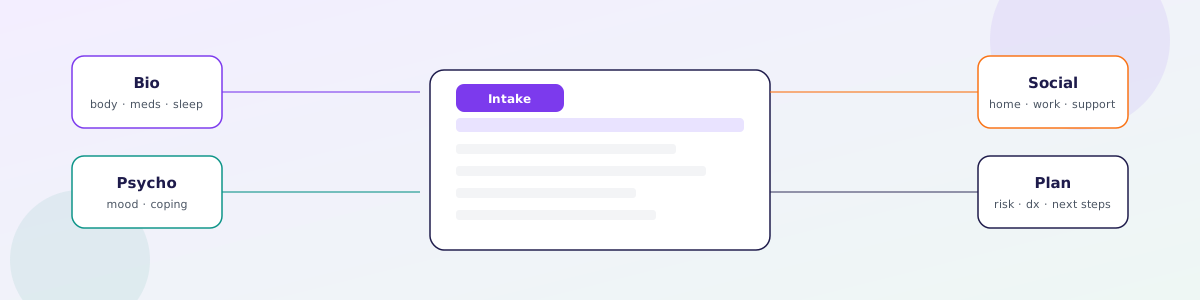
What a biopsychosocial template for mental health includes
The model traces to George Engel’s 1977 paper in Science. Every presentation has biological, psychological, and social contributors, and any pillar alone produces an incomplete formulation. A therapy-ready template adds the chart sections US boards and payers expect on a new-patient encounter: identifying information, history, MSE, risk, diagnosis, formulation, and plan. That recordkeeping posture aligns with the principles in the APA record-keeping guidelines.
| Section | What to ask | What to document | Why it matters |
|---|---|---|---|
| Identifying information | Who is the client, who referred, current level of care | Name or ID, age, pronouns, living situation, insurance, referral source | Anchors every later note and supports continuity |
| Presenting concern | Why now, in the client’s words | Onset, severity, functional impact, prior coping attempts | Sets diagnostic frame and medical-necessity language |
| History of the problem | Course, prior episodes, what helped or failed | Timeline, prior treatment, partial response, gaps | Criterion-level evidence for the diagnosis |
| Biological factors | Sleep, appetite, pain, medical history, meds, substances | Medical conditions, medications, substance use, family psychiatric history | Rules in or out body-level drivers of the presentation |
| Psychological factors | Mood, trauma, attention, coping, strengths | Developmental history, cognitive style, coping repertoire, trauma history | Grounds modality fit and formulation |
| Social context | Home, work, school, money, legal, culture, support | Relationships, housing, finances, identity, community supports | Surfaces barriers and resources that shape the plan |
| Mental status exam | What you observe today | Appearance, behavior, speech, mood, affect, thought, cognition, insight, judgment | Baseline snapshot for intake and later change |
| Risk and safety | SI, self-harm, HI, abuse or neglect, access to means | Screen results, protective factors, safety plan, actions taken | Required on every intake; highest-read section under audit |
| Diagnostic impression | What code the evidence supports | ICD-10-CM diagnosis, differentials considered, provisional language | Links formulation to the billed diagnosis |
| Formulation and plan | How the pillars interact and what you will do | Working formulation, modality, frequency, measures, next steps | Makes the treatment plan defensible |
For progress notes, treatment plans, and related note formats, use the clinical documentation reference.
Before the first session: form data versus clinical interview
Not every field should wait for the live hour. Demographics, emergency contacts, consents, medication lists, and validated screening scores (PHQ-9, GAD-7, AUDIT-C) can arrive on the client-completed form. History of the problem, MSE observations, risk formulation, diagnosis, and the treatment plan usually need the interview.
A clean split protects time. The form gathers administrative and self-report facts. The template captures clinical reasoning. If the form already captured substance use or medical history, confirm and expand those fields rather than re-asking every line from scratch.
The template: section-by-section fields
Copy the skeleton below into your EHR, a Word template, or a printed worksheet. Brackets mark writeable areas. Leave irrelevant fields blank rather than inventing content.
Using the template for a 90791 evaluation
A psychiatric diagnostic evaluation is an integrated assessment service. The template above is not a fee-schedule guide. It is the clinical structure that usually appears in a complete evaluation note: history, MSE, risk, diagnostic impression, and treatment recommendations.
Use the template to show the work was done. Do not treat every blank as mandatory content for every client. Document clinical uncertainty when a diagnosis is provisional. Keep medical services out of the note if you are not billing a medical evaluation code. For CPT descriptor language and code boundaries, use the dedicated 90791 guide linked above rather than this template page.
Worked mini-example: one line per section
Use the biopsychosocial assessment example when you want the full worked case. Here is a compact adult outpatient sketch so each field has a tone target. Names and details are fictional.
| Section | Sample line |
|---|---|
| Identifying | J.L., 29, she/her, referred by PCP after PHQ-9 of 13; outpatient individual therapy. |
| Presenting | ”I can’t stop second-guessing everything at work.” Onset 3 months; missed two deadlines; sleep cut to 5 hours. |
| History | Gradual escalation after promotion; no prior therapy; brief counseling in college for test anxiety. |
| Biological | No chronic illness; melatonin as needed; alcohol 1 to 2 drinks on weekends; denies other substances. |
| Psychological | High self-criticism, perfectionistic standards, denies trauma history, motivated for CBT skills. |
| Social | Lives with partner; supportive manager; limited peer contact since workload rose. |
| MSE | Cooperative, tense posture, mood “wound up,” affect congruent, thought linear, denies SI/HI/AVH. |
| Risk | C-SSRS negative; protective factors include partner support and future-oriented goals; low risk. |
| Diagnosis | F41.1 Generalized anxiety disorder provisional; rule out adjustment with anxiety. |
| Plan | Weekly CBT, GAD-7 baseline 14, review at session 6, PCP coordination as needed. |
For MSE descriptor vocabulary, keep the mental status exam cheat sheet open while you write.
Common template mistakes
These patterns fail audits more often than disagreement with a formulation:
- Checkbox-only intake. A checked box without client language or functional impact does not support diagnosis or medical necessity.
- Missing risk section. Risk belongs on every intake, even when the presentation looks low risk. Name the screen, the result, and protective factors.
- “MSE WNL” without observation. Write a short concrete line. Mood in the client’s words and affect as observed are stronger than a generic normal.
- Diagnosis without evidence. If the note cannot show criteria, duration, impairment, and differentials considered, the code is not ready.
- Plan that ignores the formulation. Goals and interventions should follow the pillars you documented, not a default modality list.
- Copy-forward without a new interview. Templates save structure, not last month’s facts. Update what changed.
A biopsychosocial template for mental health should slow you down at those points. It should not encourage filler.
Download the blank intake form
Use this page when you need the clinical map: what each section is for, how it supports intake and 90791 documentation, and how mistakes show up under review.
Use the free PDF when you want a printable blank form for session, supervision, or house-style adaptation. Use the assessment example when you want full section wording for one fictional case before you write your own.
Free PDF: Free Biopsychosocial Template
A printable biopsychosocial intake template for therapists documenting biological, psychological, social, risk, diagnostic, and initial-plan sections.
- Client context, presenting concern, and functional impairment fields
- Biological, psychological, social, and cultural formulation sections
- Risk, safety, MSE, diagnostic impression, and initial plan prompts
- A quick review checklist before the clinician signs the intake
Free. We'll email the PDF link right away and add you to the therapist toolkit, sent every two weeks. Unsubscribe any time.
Where should we send the link?
We'll email the PDF link right away. You'll also get the therapist toolkit every two weeks. Unsubscribe any time.
✓ Check your inbox
We've sent you the PDF
The download link is on its way to your inbox, usually within a minute or two. The email will come from Emosapien (hello@team.emosapien.com); check your spam folder if you don't see it.
You're also on the therapist toolkit list, sent every two weeks. Unsubscribe any time from the email footer.
From template to continuous chart
A static form is useful when your practice needs a shared intake shape. A reviewed documentation workflow is useful when you want the same structure carried into progress notes and treatment-plan updates. Emosapien drafts intake and note language from session context for clinician review. The therapist edits risk wording, confirms diagnosis and plan, and signs before anything becomes the chart of record.
If you want to test that workflow after you settle your intake structure, start a free Emosapien trial and keep the template sections above as your review checklist.