
ICD-11 for Mental Health: Transition Guide for Therapists

Outline
Your clinic just received a software update email with three words in the subject line: “ICD-11 field support.” Nobody asked for a classification project this quarter. Open cases still need notes. Referral letters still need language a GP will accept. Someone will paste a new label into a template without checking whether your service, insurer, or EHR actually wants it.
That is the real work of icd-11 for mental health: not memorizing a definition, but deciding what changes in templates, intake wording, referral letters, software fields, and team training before any live chart moves.
This guide is for therapists, counseling psychologists, clinical psychologists, practice leads, and supervisors in UK and EU settings who need a practical transition workflow for icd-11 for mental health. It is educational guidance, not legal advice and not a national implementation mandate. Confirm current local requirements before you change production templates.
Free PDF: ICD-11 Mental Health Transition Checklist
A printable checklist for ICD-11 mental health transition: local adoption checks, template audit, diagnosis-language rows, software questions, and team sign-off.
- Source and local-adoption checks with dated owner
- Template and form audit across intake, notes, referrals, and exports
- Top diagnosis-language review rows for clinic presentations
- Software, export, AI, and supervision sign-off prompts
Free. We'll email the PDF link right away and add you to the therapist toolkit, sent every two weeks. Unsubscribe any time.
Where should we send the link?
We'll email the PDF link right away. You'll also get the therapist toolkit every two weeks. Unsubscribe any time.
✓ Check your inbox
We've sent you the PDF
The download link is on its way to your inbox, usually within a minute or two. The email will come from Emosapien (hello@team.emosapien.com); check your spam folder if you don't see it.
You're also on the therapist toolkit list, sent every two weeks. Unsubscribe any time from the email footer.
Educational resource for registered and licensed mental-health clinicians. WHO classifications, national implementation, payer rules, and professional standards change. Verify official sources and local policy before diagnosing, coding, or rewriting records.
What ICD-11 is, and what it is not for therapists
WHO’s International Classification of Diseases, 11th Revision (ICD-11) is the current international classification system for health conditions. For mental-health clinicians, the chapter that matters most is mental, behavioral, and neurodevelopmental disorders, supported by WHO’s Clinical descriptions and diagnostic requirements (CDDR).
Three boundaries keep this useful:
- WHO status is not clinic policy. ICD-11 came into effect internationally on 1 January 2022. National systems, NHS pathways, private insurers, and EHR vendors adopt on their own clocks.
- Classification is not formulation. A category label does not replace presentation, impairment, differential reasoning, risk, or plan.
- ICD-11 is not DSM-5-TR. DSM remains a common clinical manual. ICD remains a classification system used for records, reporting, and many administrative pathways. Similarity of names does not make them interchangeable.
If you need the broader UK note map (progress vs private process notes, GDPR, AI sign-off), use the UK therapy documentation guide. Format-level templates sit under the clinical documentation hub.
Where therapists should check local adoption first
Before you edit a single form field, answer four source questions:
| Check | Why it matters |
|---|---|
| National or service guidance | NHS, ministry, professional body, or commissioner rules may still expect ICD-10, free-text DSM language, or a dual approach |
| Insurer / referral pathway | Private referral letters and some payers still use older code sets or non-coded clinical language |
| EHR / practice software | A “supports ICD-11” banner may mean a hidden field, a future flag, or a partial export map |
| Research / audit protocols | Active studies and service audits can freeze classification choices mid-year |
Write the date you checked and who owns the decision. An ad-hoc clinician rewrite of one template is how mixed ICD-10 and ICD-11 language ends up in the same open episode.
When policy names a psychologist role, verify the title and register layer through the BPS and HCPC guide for UK psychologists. That check establishes the professional standard that applies; it does not decide which classification the service should use.
ICD-11 vs ICD-10 vs DSM-5-TR in therapy notes
Therapists usually meet three systems in the same week:
- DSM-5-TR: clinical diagnostic language and criteria many clinicians use in formulation and supervision
- ICD-10 / ICD-10-CM: still common in legacy EHRs, US claims (ICD-10-CM), and many local pathways
- ICD-11: WHO’s successor classification, with updated mental-health structure and CDDR clinical guidance
In a therapy note, the durable content is the clinical evidence, not the code version number. Document:
- Presenting problem and functional impact
- Duration, course, and relevant history
- Differential reasoning and ruling-outs that matter clinically
- Risk and safeguarding status
- Treatment target and plan
Then attach the classification language your setting requires. For US ICD-10-CM crosswalk habits that remain current for many charts, see the DSM-5 to ICD-10 crosswalk. Do not treat that US claims workflow as UK or EU ICD-11 policy.
The therapist transition workflow
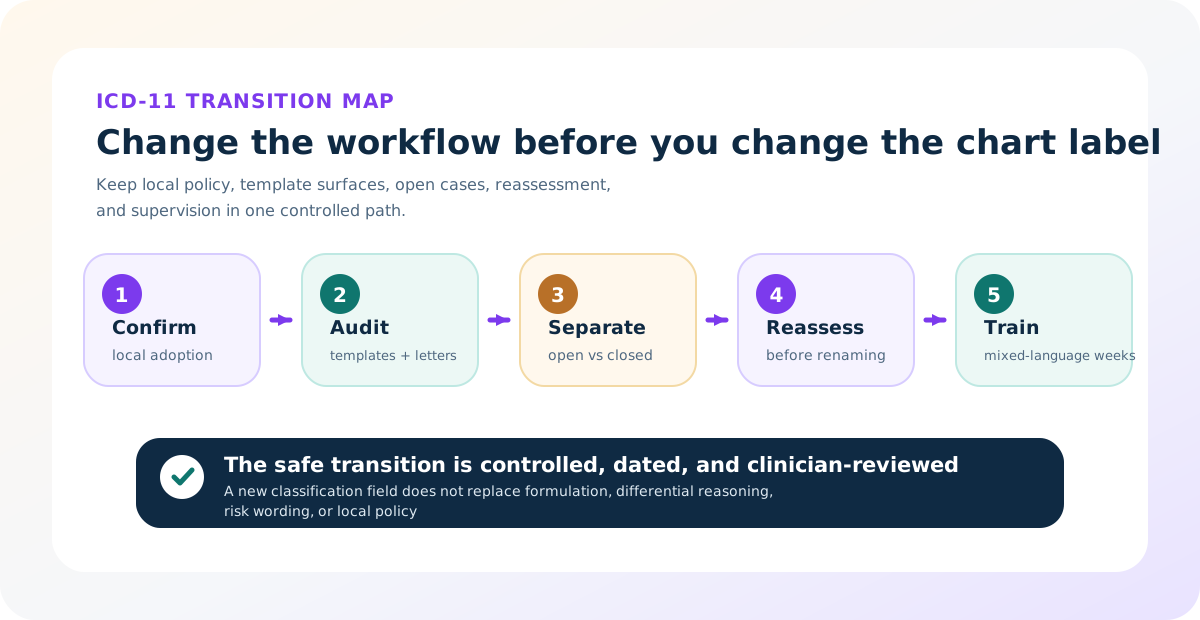
Use this sequence. Skip steps only when local policy is already written down.
1. Source-check before template-check
Bookmark the WHO ICD-11 browser and the CDDR materials for the categories your service uses most. Confirm whether your clinic is still on ICD-10 language, free-text clinical descriptors, ICD-11 fields, or a dual-label period.
2. Audit the places labels actually live
Most clinics do not need a full chart rewrite. They need a short list of surfaces:
- Intake and assessment templates
- Progress-note diagnostic fields
- Referral-letter boilerplates
- Discharge summaries
- Outcome and reporting exports
- Supervision forms that hard-code problem lists
3. Separate open cases from closed archives
Change open-case language only when policy requires it. Leave closed historical episodes alone unless a commissioner, research protocol, court process, or access request forces retrospective work. Recoding old notes “because ICD-11 exists” is busywork that creates inconsistency.
4. Reassess before you rename
If a client’s formulation no longer matches the label on the chart header, that is a clinical review, not a search-and-replace job. New ICD-11 language without fresh evidence is a quality failure.
5. Train the team on mixed-language weeks
Transition periods create charts with ICD-10 in one field and ICD-11 free text in another. Supervision should catch that early. One owner should approve template changes.
Common documentation mistakes
- New label, old evidence: pasting an ICD-11 category without current criteria-level documentation
- Mixed code sets in one episode: ICD-10 on the claim, ICD-11 in free text, DSM phrasing in the plan, with no owner for consistency
- Crosswalk worship: treating a mapping table as clinical judgment
- Ignoring local rules: changing private-practice templates because a WHO page updated
- Software overclaim: assuming an AI note tool “codes ICD-11 correctly” without audit trail, processor contract, and human sign-off
- Rewriting closed charts: retrospective mass recoding without a legal or service reason
Practice checklist: five steps before templates change
- Local adoption confirmed with a dated source (service policy, insurer, national guidance, or professional instruction).
- Template inventory complete for intake, session notes, referral letters, discharge, and exports.
- Top ten diagnosis-language rows reviewed for the presentations your clinic actually sees.
- Software questions answered (supported code set, export format, clinician sign-off, data residency).
- Team briefed, with a supervision owner for mixed-language open cases.
Download the printable version below if you want a desk-side form with sign-off lines.
Software and AI questions to ask vendors
Ask for plain answers, not marketing slides:
- Which code set does the chart support today: ICD-10, ICD-11, both, free text, or a custom map?
- What appears in exports, reports, and referral letters when a clinician selects a category?
- Can clinicians review and sign before any AI-suggested diagnostic language is filed?
- Is there an audit trail for code or label changes?
- Where is special-category health data processed and stored, and is a data processing agreement in place?
Verify vendor claims about accurate auto-coding of icd-11 for mental health through clinician review. Emosapien helps with structured clinical drafting; you remain the author of the signed record.
Download the ICD-11 transition checklist
Use the one-page checklist for source checks, template audit, diagnosis-language rows, software questions, and team sign-off.
Before you change a live form
- Local adoption status confirmed and dated
- Template inventory complete
- Open-case policy decided (what changes now vs later)
- Top diagnosis-language rows reviewed with evidence rules
- Vendor code-set and export answers written down
- Supervision owner named for mixed-language charts
Before you rename a client’s chart language
- Current presentation still supports the label
- Differential and risk documentation are current
- Plan language matches the active treatment target
- No silent mix of ICD-10 and ICD-11 in the same episode
Free PDF: ICD-11 Mental Health Transition Checklist
A printable checklist for ICD-11 mental health transition: local adoption checks, template audit, diagnosis-language rows, software questions, and team sign-off.
- Source and local-adoption checks with dated owner
- Template and form audit across intake, notes, referrals, and exports
- Top diagnosis-language review rows for clinic presentations
- Software, export, AI, and supervision sign-off prompts
Free. We'll email the PDF link right away and add you to the therapist toolkit, sent every two weeks. Unsubscribe any time.
Where should we send the link?
We'll email the PDF link right away. You'll also get the therapist toolkit every two weeks. Unsubscribe any time.
✓ Check your inbox
We've sent you the PDF
The download link is on its way to your inbox, usually within a minute or two. The email will come from Emosapien (hello@team.emosapien.com); check your spam folder if you don't see it.
You're also on the therapist toolkit list, sent every two weeks. Unsubscribe any time from the email footer.
Closing
Work on icd-11 for mental health succeeds when clinics treat classification as a controlled change, not a Friday-night template edit. Confirm local requirements. Audit the surfaces where labels live. Keep formulation stronger than any crosswalk. Train the team for mixed-language weeks. Leave closed charts alone unless a real requirement says otherwise.
If you want structured note drafting with clinician review before anything is signed, start a free trial of Emosapien. Classification policy, lawful processing, and clinical sign-off still sit with your practice.
References
- World Health Organization. International Classification of Diseases 11th Revision (ICD-11).
- World Health Organization. ICD-11 browser.
- World Health Organization. ICD-11 2022 release and implementation context.
- World Health Organization. Clinical descriptions and diagnostic requirements for ICD-11 mental, behavioral and neurodevelopmental disorders (CDDR).
- Health and Care Professions Council. Standards of conduct, performance and ethics.
- Health and Care Professions Council. Standards of proficiency for practitioner psychologists.
- British Psychological Society. Code of Ethics and Conduct.
- Information Commissioner’s Office. UK GDPR guidance hub.