

NHS Talking Therapies Overview for Therapists: IAPT, Outcomes, and Notes

Outline
It is Monday morning in a mixed NHS and private week. A client self-referred to the local talking-therapies service six weeks ago. Another client is paying privately and asks whether “NHS CBT notes” would help their insurer. A trainee wants one map that explains the service without turning into a patient leaflet.
That is the real job of an NHS Talking Therapies overview for therapists: not “how do I book an appointment,” but what the service model means for stepped care, measures, documentation, and what private practice should copy.
This guide is for CBT therapists, counseling psychologists, PWPs, high-intensity practitioners, supervisors, practice leads, and private clinicians working next to NHS pathways. It covers the service model (and why IAPT still appears), who it is for, stepped care, the episode documentation map, routine outcome monitoring, digital and AI note boundaries, and a clear copy-versus-leave-behind list for private notes. It is educational guidance, not legal advice and not an NHS-approved form. Follow service manuals, local information governance, NICE guidance, and your professional body when they conflict with any example here.
Free PDF: NHS Talking Therapies Episode Documentation Map
A printable episode map for NHS Talking Therapies (formerly IAPT): referral, problem descriptor, pathway, step, measures, risk, review, and ending.
- Episode entry fields: referral source, problem descriptor, assessment summary
- Step/intensity, session care, and NICE-aligned pathway prompts
- Measures, risk/safeguarding, supervision, and step-up checks
- Ending checklist plus a private-practice borrow-and-leave list
Free. We'll email the PDF link right away. We may also send the occasional therapist toolkit. Unsubscribe any time.
Where should we send the link?
We'll email the PDF link right away. You'll also get the occasional therapist toolkit. Unsubscribe any time.
✓ Check your inbox
We've sent you the PDF
The download link is on its way to your inbox, usually within a minute or two. The email will come from Emosapien (hello@team.emosapien.com); check your spam folder if you don't see it.
You're also on the weekly therapist toolkit list. Unsubscribe any time from the email footer.
Educational resource for registered and licensed mental-health clinicians working in or alongside UK adult psychological-therapy pathways. Service manuals, NICE guidance, and local policy change over time. Verify current requirements against official sources before you rely on any workflow.
What the service is (and why IAPT still shows up)
NHS Talking Therapies for anxiety and depression is the current name of the adult NHS psychological therapies service for common mental health presentations. NHS England describes a service that delivers NICE-recommended treatments, uses trained and supervised clinicians, applies stepped care, and monitors outcomes as part of routine care.
IAPT (Improving Access to Psychological Therapies) is the older label. You will still see it in older documents, local speech, job titles, and clinician search. The rename did not erase the model. When a colleague says “IAPT,” they usually mean the same pathway family that now sits under this service brand.
This page is a clinician map. It is not a patient access explainer and not a substitute for your local service manual. For CBT-specific note wording inside the pathway, use the IAPT CBT documentation guide. When you collect PHQ-9, GAD-7, ADSM, and WSAS each session, use the NHS Talking Therapies outcome measures map. For broader UK record-keeping outside the service, use the UK therapy documentation guide. Format templates that travel across settings sit under the clinical documentation hub. NHS client workbooks and guided self-help PDFs are service materials on this pathway; a US outpatient therapist-paced adult workbook is a different job and lives on therapy workbooks for adults.
Who the service is for
At a high level, the service serves adults with common anxiety and depression presentations, with many areas also supporting people who have long-term physical health conditions alongside those presentations. Local inclusion and exclusion criteria still decide who is accepted, how quickly, and at which step.
The pathway is usually a poor fit when needs sit outside common-mental-health routes, for example:
- Active high risk that needs urgent crisis or secondary-care response first
- Severe, complex, or specialist presentations better served by community mental-health teams or specialist services
- Presentations that need a different primary intervention (for example some neurodevelopmental, psychosis, or forensic pathways)
Write the clinical judgment, not a slogan. “Suitable for this pathway” and “needs secondary care” are care decisions with documentation consequences. If you are private and the client may need NHS stepped care, document the discussion, the advice given, and any liaison you agreed.
Self-referral and GP referral both appear in public service design. Employment advisers and related support can sit alongside therapy in some pathways. Those access details matter for service operations; for your note, capture the referral source and the presenting problem the episode is treating.
Stepped care without turning it into a ladder slogan
Stepped care is the organizing idea: offer the least intensive effective treatment first where that fits, then increase intensity when response, measures, risk, or clinical judgment show more is needed.
In practice that usually means:
- Assessment and problem descriptor that names what the episode is treating
- Low-intensity options where appropriate (guided self-help, groups, shorter structured contacts)
- High-intensity therapy when the presentation, severity, or non-response calls for it
- Review points where step-up, step-down, discharge, or liaison is decided with evidence
It is not “everyone starts at the bottom.” NICE-aligned pathways and local manuals still shape modality and dose. A panic presentation with marked avoidance may need a different entry intensity than mild low-mood symptoms that respond to guided behavioral activation.
If you supervise trainees, ask for the step decision in the note, not only the session count. “Session 4 of low-intensity guided self-help for social anxiety; GAD-7 rising; plan step-up discussion” is usable. “Ongoing CBT” is not.
For step language and episode pacing inside high-intensity CBT notes, use the IAPT CBT documentation guide. This overview stays at the service-model level.
What gets documented across an episode
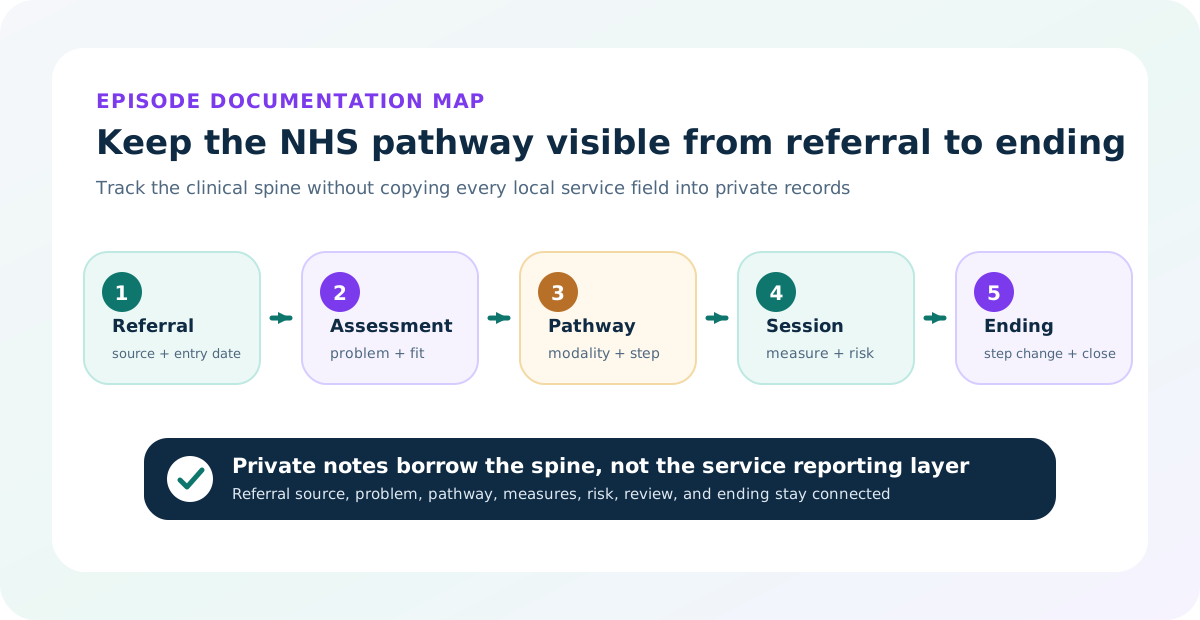
Treat pathway documentation as an episode map, not a single free-text essay. Local EPRs rename fields. Keep the clinical spine even when the UI changes.
| Episode field | What to capture | Why it matters |
|---|---|---|
| Referral / source | Self-referral, GP, other service; date | Anchors entry into care |
| Presenting problem / problem descriptor | Agreed problem language for this episode | Connects sessions over time |
| Assessment summary | Onset, goals, suitability, exclusions screened | Explains why this pathway |
| NICE-aligned therapy pathway | Modality matched to presentation | Shows evidence-based plan |
| Step / intensity | Low or high intensity; planned dose | Explains expectations and review |
| Risk / safeguarding | Status, change, actions | Safety and accountability |
| Measures | Tools, scores, clinical meaning | Outcome monitoring inside care |
| Session notes | Intervention, response, homework, plan | Continuity of the hour |
| Supervision / review | Decisions that change care | Handoff without guessing |
| Step-up / step-down / discharge | Ending reason, next support, measures at end | Closes the episode cleanly |
You do not need a novel in every field. You need enough that a covering clinician and a service review can follow the care without inventing missing links.
Download the episode documentation map below if you want the same spine as a printable checklist. Keep the table above as the screen-side version while you write.
Routine outcome monitoring as clinical signal
Routine outcome monitoring is part of NHS Talking Therapies design, not decoration for auditors. NHS England materials emphasize session-by-session monitoring and beginning and end-of-treatment measures so services can talk honestly about recovery and reliable improvement.
Inside the clinical note:
- Name the measure (for example PHQ-9, GAD-7, or a problem-specific tool your pathway uses)
- Record the score and comparison point (baseline, last session, or assessment)
- Add one clinical sentence: improved, stable, deteriorated, or incomplete, and what that means for today’s plan
- Note refusal, incomplete forms, or access barriers when they affect interpretation
Private therapists should still treat measures as clinical signals rather than admin burden. You may not report national recovery metrics, but you can still use session-by-session scores to catch non-response earlier, structure supervision, and make step-up or ending decisions with less guesswork.
Do not paste scores without meaning. Do not let a questionnaire replace risk assessment or formulation. National recovery metrics sit at the service layer. In the clinical note, keep measures as signals for today’s plan and review, not as a dashboard dump.
Digital and AI documentation in this context
Clinical notes on this pathway remain special-category health data under UK GDPR and the Data Protection Act 2018. Employment context decides who the controller is. Software vendors are processors when they handle the record for you.
If you draft notes with AI:
- Confirm service or practice approval before any client material leaves the approved environment
- Confirm a data processing agreement, residency expectations, and training-use rules for client data
- Review and sign every note yourself; you remain the clinical author
- Keep private process reflections out of shared fields when they do not change care
For the full UK GDPR checklist on lawful basis, privacy notices, access requests, and AI vendors, use GDPR for therapists in the UK. No documentation tool makes a UK workflow automatically compliant. Policy, contracts, and clinical sign-off stay yours.
What private therapists should copy (and what they should not)
Copy these habits into private practice notes when they improve care:
- A clear problem descriptor for the episode of care
- Named modality and intensity (even if you do not use NHS step labels)
- Measures interpreted in one sentence, not dumped as bare numbers
- Risk and safeguarding status written even when low or unchanged
- Review points: what would make you change plan, dose, or refer on
- An ending summary when care finishes: progress, residual risk, next support
Leave these behind unless your system truly needs them:
- Local EPR mandatory fields and national dataset codes that only serve service reporting
- Recovery targets written as if your private chart is a national dashboard
- Service marketing language about access times or waiting lists inside the clinical note
- Full service manuals pasted into private templates “just in case”
The goal is a defensible private record that borrows clinical discipline from NHS Talking Therapies without pretending every private case is a service episode.
Download the episode documentation map
Use the one-page map for referral source, presenting problem, NICE therapy pathway, step or intensity, measures, risk, review or step-up, and ending fields. Keep the abbreviated version below if you need a screen-side prompt before the download lands.
Episode spine
- Referral source and entry date are clear
- Presenting problem / problem descriptor is agreed and written
- Assessment suitability and exclusions are summarized
- Therapy pathway and NICE-aligned modality are named
- Step or intensity and planned dose are explicit
- Risk / safeguarding status and actions are recorded
- Measures are named, scored, and interpreted
- Session notes cover intervention, response, homework, and plan
- Supervision or review decisions that change care are captured
- Ending or step-change reason and next support are documented
Before you leave the desk
- A covering clinician could continue care without guessing
- Local required fields (if you work in the service) are complete
- Private charts only carry fields that serve continuity, safety, or accountability
- AI drafts, if any, were reviewed and signed by the clinician
Free PDF: NHS Talking Therapies Episode Documentation Map
A printable episode map for NHS Talking Therapies (formerly IAPT): referral, problem descriptor, pathway, step, measures, risk, review, and ending.
- Episode entry fields: referral source, problem descriptor, assessment summary
- Step/intensity, session care, and NICE-aligned pathway prompts
- Measures, risk/safeguarding, supervision, and step-up checks
- Ending checklist plus a private-practice borrow-and-leave list
Free. We'll email the PDF link right away. We may also send the occasional therapist toolkit. Unsubscribe any time.
Where should we send the link?
We'll email the PDF link right away. You'll also get the occasional therapist toolkit. Unsubscribe any time.
✓ Check your inbox
We've sent you the PDF
The download link is on its way to your inbox, usually within a minute or two. The email will come from Emosapien (hello@team.emosapien.com); check your spam folder if you don't see it.
You're also on the weekly therapist toolkit list. Unsubscribe any time from the email footer.
Closing
A useful service overview does not compete with the official patient page. It gives therapists a working model: stepped care, measures with meaning, an episode documentation spine, and a clear boundary between service reporting and private-practice notes. Keep that NHS Talking Therapies map close when you write notes next to the pathway.
If you want structured drafting with clinician review before anything is signed, start a free trial of Emosapien. NHS and private UK practices still own service policy, lawful-basis documentation, contracts, and clinical sign-off. No software removes that work.
References
- NHS England. NHS Talking Therapies for anxiety and depression.
- NHS England. The Improving Access to Psychological Therapies Manual (confirm the live manual version at publish time; current service branding sits under NHS Talking Therapies).
- National Institute for Health and Care Excellence. NG222 Depression in adults: treatment and management.
- National Institute for Health and Care Excellence. CG113 Generalized anxiety disorder and panic disorder in adults.
- National Institute for Health and Care Excellence. CG123 Common mental health problems: identification and pathways to care.
- Health and Care Professions Council. Standards of conduct, performance and ethics.
- British Psychological Society. Code of Ethics and Conduct.
- Information Commissioner’s Office. UK GDPR guidance hub.