Case Conceptualization Example for Therapists

Outline
A case conceptualization is most useful when it changes what you do next. You are not writing a polished biography of your client. You are making your clinical reasoning visible enough to review with the client, a supervisor, or your future self.
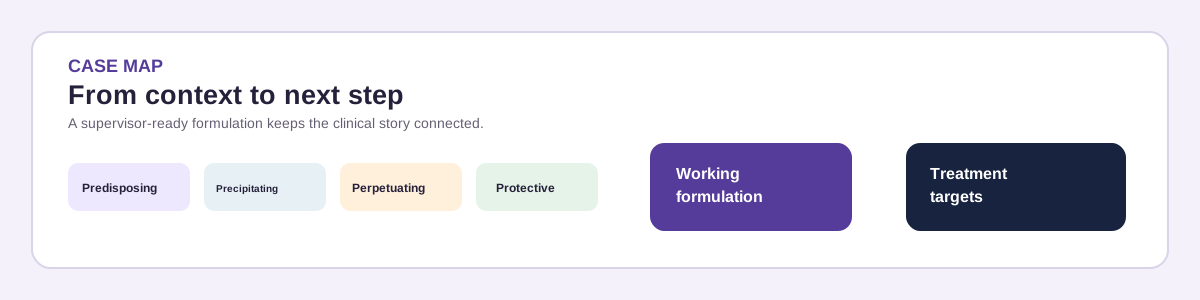
Use the example above as a supervision artifact, not as a copy-and-paste diagnosis. Maya is fictional. Keep identifying details out of teaching examples and follow your practice’s privacy policy for real records.
Get the free biopsychosocial template
Download a printable structure for presenting, predisposing, precipitating, perpetuating, and protective factors, plus formulation and treatment targets.
- Client context, presenting concern, and functional impairment fields
- Biological, psychological, social, and cultural formulation sections
- Risk, safety, MSE, diagnostic impression, and initial plan prompts
- A quick review checklist before the clinician signs the intake
Free. We'll email the PDF link right away and add you to the therapist toolkit, sent every two weeks. Unsubscribe any time.
Where should we send the link?
We'll email the PDF link right away. You'll also get the therapist toolkit every two weeks. Unsubscribe any time.
✓ Check your inbox
We've sent you the PDF
The download link is on its way to your inbox, usually within a minute or two. The email will come from Emosapien (hello@team.emosapien.com); check your spam folder if you don't see it.
You're also on the therapist toolkit list, sent every two weeks. Unsubscribe any time from the email footer.
Educational content for licensed clinicians. This guide supports clinical reasoning and supervision; it does not diagnose, direct emergency care, or replace your assessment, consent process, supervision, or local requirements.
What a case conceptualization does
A case conceptualization gives you a bridge between assessment and treatment planning. In this guide, case formulation means a working hypothesis about the factors that shape a person’s current concerns, the resources that may support change, and the treatment targets that follow. The point is to connect information, state your hypothesis, and keep it open to revision.
Your conceptualization should answer four practical questions:
- What is happening now, in the client’s own words and in observable terms?
- What context or learning history may shape the pattern?
- What appears to trigger or maintain it?
- What strengths, relationships, skills, or conditions can support change?
If the document only repeats a diagnosis or symptom list, it has not yet earned the name case conceptualization. If it claims certainty you do not have, it is no longer a safe working hypothesis.
The five factors
The five-P structure gives you a compact way to sort information. It follows the “Five Ps” case formulation approach that Macneil and colleagues describe in BMC Medicine, running from the presenting problem to protective factors. You can use it within CBT, a biopsychosocial assessment, a trauma-informed formulation, or another approach that fits your training and the client’s goals.
Presenting problem
Describe what brings the client in now. Include the client’s words, the effect on daily functioning, the time course, and relevant risk information. Prefer observable descriptions such as “checks work email six times after getting into bed” over labels such as “is avoidant.”
Ask yourself: what would your client recognize as an accurate description of the problem this week?
Predisposing factors
Record earlier experiences, vulnerabilities, health context, learning history, social position, and patterns that may make the current concern more likely. Do not turn a factor into a cause simply because it appears earlier in the story. Use language such as “may have shaped” or “is worth exploring” when your evidence is limited.
Precipitating factors
Name the recent event, transition, loss, conflict, health change, or environmental demand associated with the current increase in distress. A precipitant is not always a single event. You may need a short sequence and a date range.
Perpetuating factors
This is where your formulation becomes actionable. Describe the thoughts, behaviors, relationships, body responses, environmental contingencies, and barriers that keep the problem going. Be specific about short-term relief and longer-term cost. The pattern may be understandable and protective in the moment while still carrying a cost you and your client want to change.
Protective factors
Do not leave strengths until the final sentence. Record relationships, values, skills, routines, access to care, cultural resources, reasons for living, and prior successes that can support the next step. Ask your client what has helped them get through hard periods before you decide what counts as a resource.
Turn the map into a working formulation
Your working formulation should be short enough to discuss in the room. One useful pattern is:
When [trigger or context] activates [meaning, memory, body response, or vulnerability], you tend to [observable response]. That brings [short-term effect] but maintains [longer-term problem]. Your [protective factor] gives us a place to start.
Use plain language with your client. A clinical version can include modality-specific terms, but jargon should not hide the link between the pattern and the plan. Invite correction: “What part of that map fits, and what part misses?”
A formulation is not a verdict. You should revise it when the client’s account changes, when a new medical or social factor matters, when risk changes, or when an intervention does not produce the expected result. Use the information available to you, interpret it in context, and avoid treating one data point as the whole picture.
A blank structure for supervision
The template is deliberately open. You may need a separate risk assessment, mental status examination, medical evaluation, trauma history, substance-use assessment, or cultural formulation. Do not force every detail into the five Ps.
Connect treatment targets to the formulation
A treatment target should name a change you can observe and review. “Improve anxiety” is too broad to guide a session. “Move from unplanned bedtime email checking to a 20-minute scheduled review, then leave the phone outside the bedroom on four nights this week” gives you a behavior, a context, and a review point.
For each target, write four lines:
- The maintaining pattern it addresses.
- The client’s preferred outcome.
- The first intervention or experiment you will review.
- The measure or observation that tells you whether the target needs adjustment.
Keep the targets collaborative. Treatment planning is an ongoing process: let the person’s needs, strengths, goals, and progress shape what you review next. Your formulation should make that process easier to see, not turn it into a static form.
Use supervision to test the map
Bring the formulation to supervision when you feel stuck, when the client is not responding as expected, or when your emotional response is becoming part of the treatment pattern. Ask your supervisor to mark up the links, not just the wording.
Useful supervision questions include:
- Which factor am I treating as a fact when it is still an inference?
- What evidence would make this formulation less likely?
- What protective factor have I overlooked?
- Does the proposed intervention actually address a perpetuating factor?
- What risk, cultural, medical, or systems context needs a separate assessment?
- What would the client disagree with, and have I asked?
If your treatment target does not follow from the formulation, slow down. You may be using a familiar intervention because it is available, not because it fits this client’s pattern.
Document the revision trail
In your clinical record, follow your organization’s documentation policy and only include the level of detail appropriate to that record. At minimum, make the clinical reasoning traceable: the information reviewed, the current working hypothesis, the client’s response, the selected targets, and the next review point.
Date meaningful revisions. Write what changed and why. A short note such as “Revised perpetuating-factor section after client identified reassurance seeking as the primary bedtime loop; shifted target from general sleep hygiene to response prevention and scheduled review” is more useful than silently replacing an old paragraph.
Protect the client’s privacy in supervision examples. Use the minimum necessary information for the purpose, follow your organizational controls, and do not paste identifiable case detail into an unapproved tool. Your clinical documentation guide covers the broader difference between useful clinical reasoning and unnecessary detail.
A case conceptualization is not a behavior chain
A behavior chain analysis follows one episode in fine-grained sequence: prompting event, links, vulnerabilities, consequences, and possible skillful alternatives. A case conceptualization works at a wider level. It connects the current presenting problem to history, context, maintaining factors, protective factors, and treatment direction.
You may use both. Start with the case conceptualization when you need a treatment map. Add a behavior chain when one recurring episode needs closer analysis for skills practice.
Where Emosapien fits
Your formulation remains your clinical judgment. Emosapien can help you keep the chain from session context to a draft treatment target visible, but you review every suggestion, remove unsupported inferences, and decide what belongs in the record. It does not diagnose, choose a modality, or replace supervision.
If you want a documentation workflow that keeps treatment targets connected to session notes, start for free and review the draft before it enters your practice system.
Download the biopsychosocial template
Use the free biopsychosocial template when you want a printable page for presenting, predisposing, precipitating, perpetuating, and protective factors, plus your working formulation and treatment targets. Bring the filled page to supervision and ask your supervisor to challenge the links, not polish the prose.
Download the free biopsychosocial template
Keep the five factors, formulation, and treatment targets on one reviewable page.
- Client context, presenting concern, and functional impairment fields
- Biological, psychological, social, and cultural formulation sections
- Risk, safety, MSE, diagnostic impression, and initial plan prompts
- A quick review checklist before the clinician signs the intake
Free. We'll email the PDF link right away and add you to the therapist toolkit, sent every two weeks. Unsubscribe any time.
Where should we send the link?
We'll email the PDF link right away. You'll also get the therapist toolkit every two weeks. Unsubscribe any time.
✓ Check your inbox
We've sent you the PDF
The download link is on its way to your inbox, usually within a minute or two. The email will come from Emosapien (hello@team.emosapien.com); check your spam folder if you don't see it.
You're also on the therapist toolkit list, sent every two weeks. Unsubscribe any time from the email footer.