How to Bill Therapy Add-On Services With the CPT 25 Modifier

Outline
The CPT 25 modifier is one of the easiest same-day claim details to get denied in integrated therapy billing, and almost never because the underlying service was wrong. It is denied because the modifier was missing, misplaced, or unsupported by a note that never separated the two services it is supposed to distinguish.
This guide walks through when a therapy practice actually needs modifier 25, three worked claim examples covering a clean approval, a higher-acuity visit, and a common denial, the documentation split that supports the modifier under audit, and a downloadable billing checklist to run before the claim leaves the practice.
Free PDF: CPT 25 Modifier Billing Checklist
A printable pre-claim checklist for billing the CPT 25 modifier with psychotherapy add-on codes in an integrated therapy practice.
- Add-on code pairing table for 90833, 90836, and 90838
- Eight-point before-the-claim checklist for the modifier and the documentation split
- The most common denial pattern to check for before submitting
- One-page reference for prescribers and billing staff
Free. We'll email the PDF link right away and add you to the therapist toolkit, sent every two weeks. Unsubscribe any time.
Where should we send the link?
We'll email the PDF link right away. You'll also get the therapist toolkit every two weeks. Unsubscribe any time.
✓ Check your inbox
We've sent you the PDF
The download link is on its way to your inbox, usually within a minute or two. The email will come from Emosapien (hello@team.emosapien.com); check your spam folder if you don't see it.
You're also on the therapist toolkit list, sent every two weeks. Unsubscribe any time from the email footer.
Educational resource for licensed US mental-health clinicians and the billing staff who support them. CPT descriptors, payer policy, and reimbursement rules change. Verify current requirements against official coding guidance and your specific payer contracts before submitting claims.
What the CPT 25 modifier does
Modifier 25 is the AMA CPT modifier for a “significant, separately identifiable evaluation and management service by the same physician or other qualified health care professional on the same day of the procedure or other service.” Full descriptors live in the AMA CPT code set and the CMS Evaluation and Management Services guide.
In a mental-health context, the “procedure” the E/M service has to be distinguished from is almost always a psychotherapy add-on code. The modifier does not describe extra work. It flags that two distinct, medically necessary services happened in the same visit, and that the claim is not double-billing a single encounter.
When mental-health billing needs the CPT 25 modifier
The core scenario is an integrated visit: a prescriber, such as a psychiatrist or psychiatric nurse practitioner, provides medication management and a genuine, separately documented psychotherapy service in the same appointment. Three add-on codes carry the psychotherapy time:
| Add-on code | Psychotherapy time | Billed with |
|---|---|---|
| 90833 | About 30 minutes | 99202-99205, 99212-99215 |
| 90836 | About 45 minutes | 99202-99205, 99212-99215 |
| 90838 | About 60 minutes | 99202-99205, 99212-99215 |
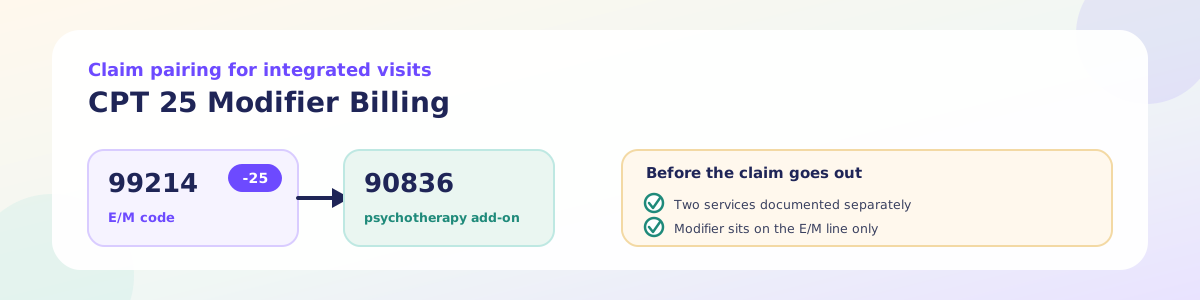
Modifier 25 attaches to the E/M code on that claim, not to the add-on code. The add-on code is never billed with modifier 25, and it is never billed on its own. For the full E/M side of this pairing, see the CPT 99214 established-patient guide, and for the psychotherapy-time side, compare the CPT 90834 and CPT 90837 guides.
Non-prescribing therapists, licensed clinical social workers, licensed professional counselors, licensed marriage and family therapists, and most psychologists, do not bill E/M codes, so modifier 25 rarely applies to their claims. It belongs to the prescribing side of an integrated practice. It still matters for the whole care team to understand, since the billing pattern shows up on shared charts and practice-level claim reports.
Worked claim example 1: a clean, approvable claim
An established patient with recurrent moderate major depressive disorder returns for a follow-up. The psychiatric nurse practitioner reviews medication response, adjusts a dosage, and separately spends about 30 minutes on psychotherapy addressing a recent work stressor.
- E/M line: 99214-25, Moderate medical decision making, dosage adjustment for an existing diagnosis with a new clinical question.
- Add-on line: 90833, approximately 30 minutes of documented psychotherapy time.
- Diagnosis pointer: F33.1, major depressive disorder, recurrent, moderate.
- Why it holds up: the note has a medication-management section describing the dose change and clinical reasoning, and a separate psychotherapy section naming the intervention and the client’s response. Two distinct, medically necessary services, clearly documented.
Worked claim example 2: a higher-acuity visit
An established patient with bipolar disorder presents with an escalating mood episode. The psychiatrist reviews a complex medication regimen, orders a lab, and spends a full clinical hour, including 60 minutes of separately documented psychotherapy stabilizing the client between the medication review and a safety check.
- E/M line: 99215-25 only if the chart documents two of three High MDM elements, such as a severe problem plus drug therapy requiring intensive monitoring for toxicity or a hospitalization decision; escalating acuity and one lab order alone do not establish High MDM.
- Add-on line: 90838, approximately 60 minutes of documented psychotherapy time.
- Diagnosis pointer: F31.13, bipolar disorder, current episode manic, severe without psychotic features (or the specifier the chart supports; F31.2 is severe with psychotic features).
- Why it holds up: psychotherapy time does not select the E/M level. The claim must document two of three High MDM elements; a lab order is not extensive data, and routine prescription drug management is Moderate risk. The psychotherapy section stands separately, with its own intervention and response language, so the two services do not blur into one long visit note.
Worked claim example 3: a denial, and the fix
An established patient’s claim comes back denied, with the payer’s remark code indicating the E/M service is considered part of the same-day procedure. The original claim submitted 99214 and 90836 with no modifier on the E/M line.
- What went wrong: the E/M code needed modifier 25 to tell the payer it was a distinct, billable service alongside the psychotherapy add-on. Without it, the payer’s system bundled the two into one line and denied the E/M charge.
- The fix: resubmit a corrected claim as 99214-25 with 90836 on the second line, unchanged. Before resubmitting, confirm the chart note actually documents two separable services; a corrected modifier does not help if the note itself reads as one undifferentiated visit.
- The pattern to watch: a practice that sees this denial repeatedly usually has a template or habit issue upstream, not a one-off coding mistake. Check whether the E/M and psychotherapy sections are collapsing into a single narrative block across multiple charts.
Documentation that supports the modifier under audit
A note that supports the CPT 25 modifier separates two things the reviewer needs to verify independently.
- The E/M component, with the medical decision making elements or total time that support the billed E/M level: history, medication review, exam findings, orders, and the medical decision making summary.
- The psychotherapy component, with the modality, the intervention used, the client’s response, and the time spent, distinct from the E/M narrative.
- A total-time statement when the E/M level is time-based, covering the encounter date as a whole, separate from the psychotherapy time counted for the add-on code.
- A diagnosis pointer on each claim line that the assessment and treatment record support, not one carried forward from a prior visit without re-evaluation.
A single paragraph that mixes medication talk and therapeutic conversation without headers or clear breaks is the most common reason a modifier 25 claim fails review, even when both services genuinely happened.
Common denial reasons and how to prevent them
- Missing modifier 25 on the E/M line. The claim bundles automatically without it. Build the modifier into the billing template for any visit coded with a psychotherapy add-on.
- Undifferentiated documentation. The note has to read as two services, not one long conversation. Use separate headers or sections for the E/M and psychotherapy content.
- Modifier 25 on every visit regardless of content. Payers track modifier-25 utilization rates. A practice that appends it to every E/M-plus-add-on claim without variance in acuity or time invites review.
- Add-on code time mismatch. Billing 90838 when the note supports only 30 minutes of psychotherapy time is a documentation-to-code mismatch that a reviewer will catch.
- Diagnosis pointer inconsistency. Each line should point to a diagnosis the current note supports, not a stale code copied forward from an old claim.
A missing modifier is a corrected-claim problem. When the remark instead says the service was not medically necessary, the response is a denial appeal letter for medical necessity that quotes the signed note.
Use the downloadable billing checklist
The CPT 25 modifier billing checklist puts the code pairing table, the three worked claim patterns, and the pre-submission documentation checks on one page for billing staff and prescribers to run before a claim goes out. Pair it with the therapy CPT code hub for the surrounding code family and the CPT 95 modifier telehealth billing guide when the same visit happens by live video.
How Emosapien supports this workflow
Emosapien’s Scribe Agent keeps the medication-management and psychotherapy portions of an integrated visit in separate, labeled sections of the draft note as the conversation happens, rather than one blended narrative. When both a substantial E/M component and a substantial psychotherapy component are present, the agent surfaces the add-on code pairing and the modifier 25 flag as a documentation prompt, not an automatic billing decision. The prescriber confirms the code, the modifier, and the diagnosis pointer before the claim goes out. See the AI clinical notes overview for how the Scribe Agent handles documentation across the rest of the note.
The CPT 25 modifier is not a hard billing question. It is a documentation habit: keep the two services visibly separate, and the modifier follows naturally from the note.
References
- American Medical Association. Current Procedural Terminology (CPT) code set and modifier guidance.
- Centers for Medicare & Medicaid Services. Evaluation and Management Services guide.