How to Bill Telehealth Therapy With the CPT 95 Modifier

Outline
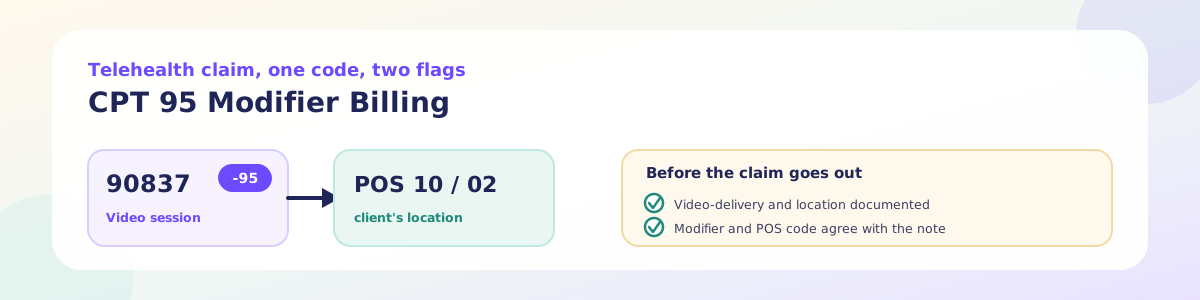
The CPT 95 modifier is the line item that tells a payer a therapy session happened over live video instead of in person, and it is one of the easiest telehealth claims to get wrong. Not because the clinical work was any different, but because the modifier, the place-of-service code, and the note have to agree with each other, and payer rules on all three keep shifting.
This guide walks through what the CPT 95 modifier actually flags, three worked claim examples covering a clean commercial approval, a Medicare claim built on a different rule, and a common denial, the documentation a telehealth session needs on top of the usual clinical note, and a downloadable billing checklist to run before the claim leaves the practice.
Free PDF: CPT 95 Modifier Telehealth Billing Checklist
A printable pre-claim checklist for billing the CPT 95 modifier and place-of-service code on telehealth therapy claims.
- Common telehealth codes and typical place-of-service pairing
- Eight-point before-the-claim checklist for the modifier, POS code, and documentation
- The most common denial pattern to check for before submitting
- One-page reference for clinicians and billing staff
Free. We'll email the PDF link right away and add you to the therapist toolkit, sent every two weeks. Unsubscribe any time.
Where should we send the link?
We'll email the PDF link right away. You'll also get the therapist toolkit every two weeks. Unsubscribe any time.
✓ Check your inbox
We've sent you the PDF
The download link is on its way to your inbox, usually within a minute or two. The email will come from Emosapien (hello@team.emosapien.com); check your spam folder if you don't see it.
You're also on the therapist toolkit list, sent every two weeks. Unsubscribe any time from the email footer.
Educational resource for licensed US mental-health clinicians and the billing staff who support them. CPT descriptors, place-of-service rules, and payer telehealth policy change frequently. Verify current requirements against official coding guidance, your state’s telehealth rules, and your specific payer contracts before submitting claims.
What the CPT 95 modifier does
Modifier 95 is the AMA CPT modifier for “synchronous telemedicine service rendered via a real-time interactive audio and video telecommunications system.” Full descriptors live in the AMA CPT code set and current telehealth billing policy is published in the CMS Medicare telehealth services guide.
Unlike the CPT 25 modifier, which attaches only to an E/M code billed alongside a separate psychotherapy add-on (see the CPT 25 modifier billing guide for that pairing), modifier 95 attaches directly to the procedure code that was actually delivered by video: the psychotherapy code, the intake code, or the E/M code itself. It does not describe a second service. It describes how the one billed service was delivered.
When mental-health telehealth billing needs modifier 95
Modifier 95 applies whenever a covered service is delivered synchronously, in real time, over an audio-and-video connection rather than in person. In a therapy practice that most often means:
| Code | Service | Typical telehealth use |
|---|---|---|
| 90791 | Psychiatric diagnostic evaluation | Intake conducted entirely by video |
| 90834 / 90837 | Individual psychotherapy | Routine or extended session by video |
| 90847 | Family psychotherapy with patient present | Family session by video with all participants visible |
| 90853 | Group psychotherapy | Group session conducted by video |
| 99212-99215 | Established-patient E/M | Medication-management visit by video |
Modifier 95 pairs with a place-of-service code that identifies where the client was physically located during the session: POS 10 for telehealth provided while the client is in their home, or POS 02 for telehealth provided while the client is somewhere else. Payer and Medicare rules on exactly when modifier 95 is required alongside the POS code have moved more than once in recent years, so a practice cannot assume the pairing used last year still applies without checking the current payer policy. For the individual psychotherapy codes most affected by this pairing, see the CPT 90834 guide and the CPT 90837 guide.
95 modifier description for a therapy claim
For a biller, the 95 modifier description is a delivery-method flag, not a second therapy service. CMS telehealth guidance describes modifier 95 as “Synchronous telemedicine service rendered via real-time interactive audio and video telecommunications system.” Apply it to the procedure code that was delivered by live audio and video, such as 90834 or 90837, when the payer’s current policy calls for modifier 95. Do not use it to turn an audio-only session into a video claim. CMS’s telehealth billing guidance states that modifier 95 is for synchronous audio and video and modifier 93 is for synchronous audio-only service; read the cited guidance on September 25, 2026.
Use this three-part check before you release the claim:
- Confirm the billed procedure code describes the service you actually delivered.
- Confirm the session used real-time, interactive audio and video.
- Confirm the POS code and the clinical note describe the client’s actual location and delivery method.
Telehealth place of service code 02 or 10
The telehealth place of service code tells the payer where the client was physically located, while modifier 95 tells the payer that the covered service was delivered by synchronous audio and video. Use POS 10 when the client is in a private residence. Use POS 02 when the client is receiving telehealth somewhere other than their home. CMS’s Place of Service Code Set defines POS 02 as “Telehealth Provided Other than in Patient’s Home” and POS 10 as “Telehealth Provided in Patient’s Home”; the page was read on September 25, 2026.
For Medicare professional claims, CMS’s Medicare Claims Processing Manual, section 190.6.1 says to submit the appropriate procedure code with POS 02 or POS 10. The same section says that, as appropriate, POS 02 or POS 10 is paired with modifier 93 for audio-only or modifier 95 for audio-video. Confirm the current payer policy for commercial claims before you copy a Medicare pairing into another payer’s claim.
Modifier 95 vs 93 for audio-video and audio-only visits
Modifier 95 vs 93 turns on the presence of video. Modifier 95 describes a synchronous service delivered through real-time interactive audio and video. Modifier 93 describes a synchronous service delivered by telephone or another real-time interactive audio-only system. CMS states both descriptors in its telehealth billing guidance, which was read on September 25, 2026.
Do not choose between 95 and 93 from the appointment type alone. Check what actually happened:
| What happened in the session | Modality flag to review | What you should document |
|---|---|---|
| Client and clinician communicated by live audio and video | 95 | Real-time audio-video delivery and the client’s location |
| Client and clinician communicated by live audio only | 93 | Audio-only delivery and the client’s location |
| Connection failed and the encounter continued by phone | 93, if the payer covers and permits the service | The interruption, the change to audio-only, and the payer-specific rule |
The modifier does not replace the documentation requirements that apply to the underlying code, payer, and setting. As an operational check, make sure the record supports the service delivered, intervention, client response, time or medical decision making as applicable, consent where required, and the client’s location. If your note says “audio only,” a 95 modifier creates a contradiction that the biller should resolve before submission.
Where modifier GQ still applies
Modifier GQ is the narrow asynchronous telehealth path, not the replacement for modifier 95 on a routine live video session. CMS’s MLN Telehealth Services guide says to add GQ when telehealth is performed asynchronously and that the clinician is certifying the medical file was collected and sent from a federal telemedicine demonstration conducted in Alaska or Hawaii; the guide was read on September 25, 2026.
CMS’s Medicare Claims Processing Manual likewise says claims with GQ are payable only when the clinician is affiliated with a federal telemedicine demonstration conducted in Alaska or Hawaii, and that the contractor may request documentation of that participation. That means you should not use GQ for a live video psychotherapy session, an audio-only telephone session, or an ordinary portal message unless the specific Medicare demonstration and covered service make the modifier applicable.
Licensure is a separate, non-negotiable gate that sits underneath the modifier question. A therapist bills for a telehealth session only when licensed, or otherwise authorized through a compact or a specific state telehealth allowance, in the state where the client is physically located at the time of the session, regardless of where the therapist is sitting. For the profession-first preflight across license types, use the interstate telehealth rules for therapists guide. Psychologists evaluating compact authority should start with PSYPACT for psychologists before they touch modifier 95.
Worked claim example 1: a clean, approvable commercial claim
An established patient in ongoing individual therapy has a routine video session from home, for a commercial payer that requires modifier 95 on telehealth claims.
- Claim line: 90834-95, individual psychotherapy, approximately 45 minutes, delivered by real-time interactive audio and video.
- Place of service: POS 10, telehealth provided while the client was in their home.
- Diagnosis pointer: F41.1, generalized anxiety disorder.
- Why it holds up: the note states the session was conducted by video, documents the client’s location as their home, and carries the same modality and intervention content a routine 90834 note would need in person. The modifier and the POS code agree with each other and with the note.
Worked claim example 2: a Medicare telehealth claim
An established Medicare patient has a video medication-management visit with a psychiatric nurse practitioner, from a location that is not the patient’s home. The claim follows Medicare’s current telehealth billing rule for this visit type, which the practice confirmed with the Medicare Administrative Contractor before submitting.
- Claim line: 99214, established-patient E/M, moderate medical decision making.
- Place of service: POS 02, telehealth provided somewhere other than the client’s home.
- Modifier: applied only if the current Medicare rule for this service and place of service still calls for it alongside the POS code; the practice checked the applicable Medicare telehealth billing guidance for the year of service before deciding.
- Diagnosis pointer: F33.1, major depressive disorder, recurrent, moderate.
- Why it holds up: the note documents the video modality, the client’s location, and the medical decision making that supports the E/M level, and the claim’s modifier decision follows the payer-specific rule that was actually current on the date of service rather than a rule carried forward from a prior year.
Worked claim example 3: a denial, and the fix
An established patient’s telehealth claim comes back denied, with the payer’s remark code indicating the service was not identified as telehealth. The original claim submitted 90837 with POS 11 (office) and no modifier 95, even though the session was conducted entirely by video.
- What went wrong: the place-of-service code described an in-person office visit, and the procedure code carried no modifier flagging synchronous audio-video delivery. The payer’s system had no way to recognize the claim as a telehealth encounter.
- The fix: resubmit a corrected claim as 90837-95 with the POS code matching the client’s actual location during the session, POS 10 for home or POS 02 otherwise. Before resubmitting, confirm the note documents the video delivery and the client’s location; a corrected code and modifier do not help if the note itself never mentions telehealth.
- The pattern to watch: a practice that sees this denial repeatedly usually has a scheduling or template default set to in-person, not a one-off submission error. Check whether the telehealth visit type is actually flagged at intake and carried through to the billing template.
Documentation that supports modifier 95 under audit
A note that supports modifier 95 carries the same clinical content an in-person note of that code needs, plus telehealth-specific elements a reviewer will look for separately.
- Confirmation of synchronous audio-video delivery. A brief statement that the session was conducted by real-time interactive audio and video, not audio only.
- The client’s location during the session. Supports the POS code choice and confirms the therapist held an active license, compact authorization, or state telehealth allowance covering that location.
- Telehealth consent, where the payer or the client’s state requires a documented consent to receive care by video.
- The same modality and clinical content the code would need in person: intervention used, client response, time where the code is time-based, and medical decision making for E/M codes.
- A contingency note for any technology interruption that affected session length or content, if one occurred.
A note that documents the clinical work but never mentions that the session happened by video is the most common reason a modifier 95 claim fails review, even when the underlying therapy was delivered correctly.
Common denial reasons and how to prevent them
- Missing modifier 95 on a code the payer requires it for. Build the modifier into the telehealth visit-type template so it is not a manual add every time.
- Place-of-service mismatch. POS 11 (office) on a claim for a session that was actually conducted by video is an automatic telehealth-identification failure.
- Modifier 95 used for an audio-only session. If the session had no video component, modifier 93 applies instead; modifier 95 requires both audio and video.
- No documentation of the client’s location. Without it, neither the POS code nor the therapist’s licensure coverage for that session can be verified.
- Consent gap. Some states and payers require documented telehealth consent before the first video visit; a missing consent note is a compliance issue even when the billing codes are otherwise correct.
Use the downloadable billing checklist
The CPT 95 modifier billing checklist puts the code-and-POS pairing table, the three worked claim patterns, and the pre-submission documentation checks on one page for billing staff and clinicians to run before a telehealth claim goes out. Pair it with the therapy CPT code hub for the surrounding code family. Australian video and phone Better Access items are a different family; use the MBS psychology item numbers guide rather than attaching modifier 95.
How Emosapien supports this workflow
Emosapien’s Scribe Agent works the same way in a video session as it does in person: it identifies the modality and the time-on-encounter from the session content and drafts the supporting note in the format the practice uses. For telehealth visits, the agent surfaces the video-delivery and client-location prompts as documentation reminders, not automatic billing decisions, so the clinician confirms the modifier, the place-of-service code, and the licensure coverage for that session before the claim goes out. Start a trial to see this documentation support in your own telehealth sessions.
Modifier 95 is not a hard billing question once the habit is built: confirm the video delivery, match the place-of-service code to the client’s real location, and the modifier follows naturally from the note.
References
- American Medical Association. Current Procedural Terminology (CPT) code set and modifier guidance.
- Centers for Medicare & Medicaid Services. Medicare Telehealth Services guide.