Family Therapy Billing Guide for US Therapists

Outline
A family session ends cleanly, then the claim bounces. The denial is rarely about whether the family talked. It is about who was in the room, which service frame was billed, whether the payer covers that service under this plan, and whether the note proves psychotherapy for the identified patient.
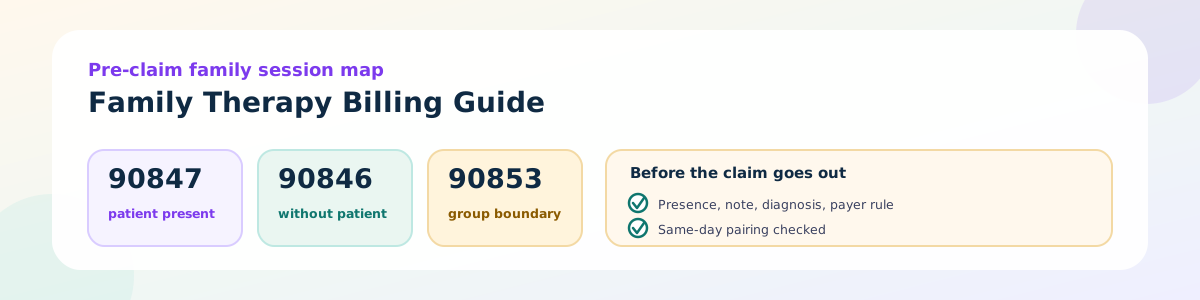
This family therapy billing guide is the service-to-claim workflow for US outpatient therapists and billing staff. Choose the service first. Separate 90846, 90847, and the 90853 group boundary. Verify the payer before the claim leaves. Keep each billed encounter on its own medically necessary note.
Free PDF: Family Therapy Billing Pre-Claim Checklist
A printable two-page pre-claim checklist for 90846, 90847, and the 90853 group boundary: service-first decision, payer verification, same-day checks, and denial watches.
- Service facts and 90846 / 90847 / 90853 code-family decision
- Patient-present versus multi-patient group boundary
- Payer, eligibility, authorization, and same-day verification checks
- Denial-watch list and final clinician or billing-team review fields
Free. We'll email the PDF link right away. We may also send the occasional therapist toolkit. Unsubscribe any time.
Where should we send the link?
We'll email the PDF link right away. You'll also get the occasional therapist toolkit. Unsubscribe any time.
✓ Check your inbox
We've sent you the PDF
The download link is on its way to your inbox, usually within a minute or two. The email will come from Emosapien (hello@team.emosapien.com); check your spam folder if you don't see it.
You're also on the weekly therapist toolkit list. Unsubscribe any time from the email footer.
Educational resource for licensed US mental-health clinicians and the billing staff who support them. CPT descriptors, ICD-10-CM guidance, payer policy, and reimbursement rules change. Verify current requirements against official coding guidance and your specific payer contracts before submitting claims. This is not legal, billing, or reimbursement advice.
Three layers before the code
A clean claim keeps three layers separate:
- Service: what psychotherapy was delivered, and for whom
- Coverage: what this payer and plan will reimburse under this clinician contract
- Evidence: what the signed note and claim fields prove
CPT names a service definition. It does not invent payer coverage. Documentation cannot rescue a service that was not delivered. Start with the facts of the encounter, then choose a code family, then verify the plan.
Use the CPT codes for therapists hub when you need the wider psychotherapy code family. Use this family therapy billing guide when one family session has to become a claim-ready decision.
Service-first decision tree
Do not open the claim software at a code number. Answer the participant and treatment-unit questions first:
- Is one person the identified patient whose treatment goals organize the service?
- Is the identified patient present for the family work?
- Are family members or caregivers participating in that patient’s psychotherapy?
- Are multiple patients receiving interactive psychotherapy as a group?
- Was the encounter actually individual psychotherapy with only a brief collateral update?
| Service facts | Likely code family | What still must be true |
|---|---|---|
| One identified patient present; family or caregivers join the psychotherapy | 90847 | Patient response and family interaction both documented; payer covers family psychotherapy |
| Family or caregivers meet for that patient’s care; patient is not present | 90846 | Note stays oriented to the identified patient treatment; not billed as 90847 because the patient was “discussed” |
| Multiple patients receive group psychotherapy (other than a multiple-family group) | 90853 | Member-specific notes; group frame, not family-of-one-patient frame |
| Patient alone for psychotherapy; short collateral update only | Individual timed code (90832 / 90834 / 90837) | Do not stretch a check-in into family psychotherapy |
Several relatives in one room do not automatically create a group. 90853 is a multi-patient service boundary, not another family code.
90846 versus 90847 without the full lookup
Keep the presence rule short:
- 90847 is family psychotherapy with the identified patient present
- 90846 is family psychotherapy without the identified patient present
- The session topic does not override who participated and what service was delivered
If the identified patient leaves halfway through, document who was present for which work and follow the payer rule for split sessions. Do not invent a hybrid code.
For descriptor-level detail, documentation examples, and the single-code FAQ, use the CPT code 90847 family psychotherapy guide. This family therapy billing guide owns the cross-code workflow, not a second 90847 encyclopedia.
When 90853 becomes the boundary
Use the 90853 group psychotherapy billing guide when the service is group psychotherapy (other than a multiple-family group) for multiple patients. Common frames:
- One-patient family psychotherapy: relatives or caregivers participate in one identified patient care (usually 90846 or 90847 after payer check)
- Multi-patient group: several patients receive psychotherapy as a group (usually 90853 with per-member documentation)
- Class or psychoeducation: may not meet the psychotherapy service definition at all; verify before billing a psychotherapy code
Do not bill a family code for multi-client group work because the room felt “family-like.” Do not bill 90853 for one family unit with one identified patient just because several people attended. A caregiver psychoeducation group with several identified patients is that multi-patient frame. Plan the weeks with the eight-week parenting group curriculum and keep the claim on the group path.
Payer verification before the claim leaves
After the service frame is clear, run a compact verification sequence. Where you check each item:
- Current CPT service definition (AMA CPT guidance)
- Clinician scope, credential, and contract
- Member eligibility and plan benefit
- Authorization or referral requirement
- Family, couples, or group coverage limitation
- Telehealth place-of-service and modifier requirement where relevant
- Same-day claim-edit rule (including NCCI-related edits when Medicare applies)
- Diagnosis and medical-necessity requirement
- Claim frequency or unit rule
- Documentation and signature requirement
Verify against official CPT guidance, CMS resources when Medicare applies, and the contracted payer’s current provider manual or portal. Do not treat one commercial payer rule as national policy. Medicare and commercial manuals are not interchangeable.
Same-day combinations as a decision path
Family and individual psychotherapy can appear on the same date only when they are genuinely separate encounters.
Ask five questions for every pairing:
- Were there two separate encounters?
- Did each service have separate medical necessity?
- Does each service have its own note?
- Does the payer allow the combination?
- Does the payer require a modifier or extra documentation?
Useful pairings to test, never promise:
- Individual psychotherapy plus 90847
- Individual psychotherapy plus 90846
- Individual psychotherapy plus 90853
- Caregiver-only and patient-present family work on one date
A modifier such as -59 or -XE reports that services were distinct when the payer requires that fact. It does not create a second service. One continuous meeting with the patient and parents cannot become both 90837 and 90847.
Four worked claim scenarios
1. Patient-present family psychotherapy
An identified adolescent and both parents attend a 55-minute session. The note records the patient’s engagement in a structured communication rehearsal, parent responses, the therapist intervention, the patient’s affect shift, and the next-session plan tied to an existing treatment goal.
- Service facts: one identified patient present; family psychotherapy
- Likely code family: 90847 after payer verification
- Documentation proof: attendance by role, patient response, treatment-goal link
- Stop condition: if the note never states the patient attended or responded, do not submit 90847
2. Caregiver-only family psychotherapy
Parents attend without the adolescent for a 45-minute session on limit-setting and school coordination. The patient is not in the room. The note names the identified patient, the clinical purpose of the collateral work, and how the plan feeds the next patient-present session.
- Service facts: family psychotherapy without patient present
- Likely code family: 90846 after payer verification
- Documentation proof: patient-oriented purpose despite patient absence
- Stop condition: if the note is only a school logistics meeting with no treatment link, reassess medical necessity before billing
3. Interactive group boundary
Four adult outpatients, each with their own chart, attend a process group. The clinician facilitates interactive psychotherapy among members. Each member has a note about that member response.
- Service facts: multi-patient group psychotherapy
- Likely code family: 90853, not 90846 or 90847
- Documentation proof: member-specific response, not a single family-unit note
- Stop condition: if the room is one family with one identified patient, do not force a group code
4. Same-day denial prevention
Morning: 90834 with the adolescent alone. Afternoon: 90847 with the adolescent and both parents. Each encounter has its own start context, medical necessity, and note. The payer contract is checked for same-day family plus individual rules.
- Service facts: two separate encounters
- Likely path: individual timed code plus 90847 if the payer allows and documentation separates the work
- Unsafe twin: one 60-minute meeting billed as both 90837 and 90847
- Stop condition: if there was only one continuous session, bill one defensible service, not two
Documentation proof that survives review
A defensible note is not a transcript. It makes the claim legible to a reviewer who was not in the room.
Include:
- Date, service format, and relevant duration or timing
- Identified patient and participant roles
- Treatment goal or diagnosis-supported need
- Intervention and participant response
- Patient-specific response for family psychotherapy
- Member-specific response for group psychotherapy
- Risk or safety content when clinically relevant
- Plan and next service
- Clinician review and signature
- Separate note for each separately billed encounter
If a family note could describe any household without naming what this patient did and how they responded, it does not support 90847. Capture who may attend, consent limits, and identified-patient framing at intake with the family therapy intake form so the session note inherits those facts.
When family structure is complex, the family therapy genogram template can stabilize who is in the system before the claim path starts. Structure context is not a substitute for attendance language on the service date.
Common denials to prevent
Organize denials by mismatch, not by blame:
- Service and code mismatch
- Patient-presence mismatch (90847 without the patient; 90846 when the patient was present and billed wrong)
- Family versus group mismatch
- One encounter billed as two services
- Payer coverage or authorization never checked
- Generic note without patient or member response
- Inconsistent telehealth fields
- Missing or unsupported modifier
- Claim frequency or unit error
- Code selected from an old reference rather than current guidance
Not every denial should be appealed. Prevent the error when you can. Correct only with truthful documentation of what was delivered.
Use the printable pre-claim checklist
Use this family therapy billing guide’s printable checklist so the service frame, code family, payer checks, same-day tests, and denial watches sit on two pages for clinicians and billing staff. Run it before the claim is submitted, not after the remittance advice arrives.
Free PDF: Family Therapy Billing Pre-Claim Checklist
A printable two-page pre-claim checklist for 90846, 90847, and the 90853 group boundary: service-first decision, payer verification, same-day checks, and denial watches.
- Service facts and 90846 / 90847 / 90853 code-family decision
- Patient-present versus multi-patient group boundary
- Payer, eligibility, authorization, and same-day verification checks
- Denial-watch list and final clinician or billing-team review fields
Free. We'll email the PDF link right away. We may also send the occasional therapist toolkit. Unsubscribe any time.
Where should we send the link?
We'll email the PDF link right away. You'll also get the occasional therapist toolkit. Unsubscribe any time.
✓ Check your inbox
We've sent you the PDF
The download link is on its way to your inbox, usually within a minute or two. The email will come from Emosapien (hello@team.emosapien.com); check your spam folder if you don't see it.
You're also on the weekly therapist toolkit list. Unsubscribe any time from the email footer.
How Emosapien supports family-session claims
Emosapien keeps identified-patient participation, family context, interventions, and plan language in labeled sections of the draft note so the chart still reads as psychotherapy for the patient of record. Code suggestions remain clinician-confirmed prompts, not automatic billing decisions.
The workflow does not replace payer policy. It makes the policy enforceable at the note desk: what service was delivered, who was present, and why that service was medically necessary on that date.
References
- American Medical Association. Current Procedural Terminology (CPT) code set.
- Centers for Medicare & Medicaid Services. Physician Fee Schedule search.
- Centers for Medicare & Medicaid Services. National Correct Coding Initiative (NCCI) edits.
- Centers for Disease Control and Prevention. ICD-10-CM.