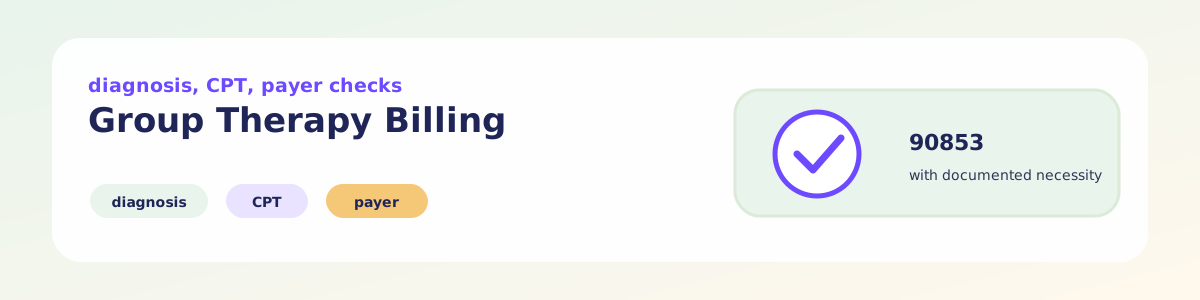
Group Therapy ICD-10 CPT Billing Guide for Therapists

Outline
Group therapy ICD-10 CPT billing starts with one separation: CPT describes the service, and ICD-10-CM supports why the service was medically necessary for that member.
A group can share one room, one theme, and one time block. The billing record still belongs to each person in the group.
This guide gives therapists a practical crosswalk for 90853, ICD-10-CM support, individual group notes, risk language, payer checks, and the documentation trail behind the claim.
Free PDF: Group Therapy ICD-10 CPT Billing Crosswalk
A printable billing crosswalk for pairing CPT 90853 with ICD-10-CM support, individual group notes, risk language, and payer checks.
- CPT 90853 documentation anchors for date, time, group type, and therapist role
- ICD-10-CM diagnosis-support fields separate from the group topic
- Individual participation, intervention, and clinical-response prompts per member
- Payer-check column for group-size, same-day, modifier, and authorization rules
Free. We'll email the PDF link right away and add you to the therapist toolkit, sent every two weeks. Unsubscribe any time.
Where should we send the link?
We'll email the PDF link right away. You'll also get the therapist toolkit every two weeks. Unsubscribe any time.
✓ Check your inbox
We've sent you the PDF
The download link is on its way to your inbox, usually within a minute or two. The email will come from Emosapien (hello@team.emosapien.com); check your spam folder if you don't see it.
You're also on the therapist toolkit list, sent every two weeks. Unsubscribe any time from the email footer.
Educational resource for licensed US mental-health clinicians. CPT descriptors, ICD-10-CM guidance, payer rules, state rules, and plan benefits change. Verify current requirements before billing.
The split that keeps the record clean
A group therapy ICD-10 CPT billing workflow separates five things before the claim leaves the practice:
- The service delivered
- The member’s diagnosis-supported need for that service
- The group process and therapist intervention
- The member’s participation and clinical response
- The payer-specific billing rule
The service side usually starts with the 90853 group psychotherapy code. That code does not turn a class, roster, or skills lecture into psychotherapy. The record has to show interactive therapeutic work.
The diagnosis side comes from ICD-10-CM and the treatment record. The group topic can guide documentation, but it does not assign the diagnosis. A depression group, trauma group, or relapse-prevention group may contain members with different diagnoses and different medical-necessity facts.
Use official code sources first
Use the CDC ICD-10-CM page for official diagnosis-code updates and guidelines. Use the AMA CPT guidance for CPT code-set authority. Use the CMS Physician Fee Schedule search to check Medicare locality pricing and payment policy signals, then verify commercial payer contracts separately.
Those sources do not replace payer policy. They keep the practice from building billing habits around memory, forum advice, or old templates.
For group facilitation structure, pair this billing workflow with the group therapy resource hub. The clinical container and the billing record reinforce each other when the therapist documents the group process clearly.
Group therapy ICD-10 CPT billing crosswalk
Use this group therapy ICD-10 CPT billing crosswalk as a charting and claim-prep checklist. It is not a code book. It shows what each part of the record has to prove.
| Billing element | What it proves | Documentation anchor |
|---|---|---|
| CPT 90853 | Interactive group psychotherapy occurred | Date, start and stop time, group type, therapist role, interactive intervention |
| ICD-10-CM diagnosis | The member had a diagnosis-supported reason for treatment | Diagnosis from assessment, current symptoms, functional impact, treatment-plan target |
| Group focus | The session had a clinical purpose | Shared topic, skill, process theme, relapse-prevention target, or interpersonal pattern |
| Individual participation | This member received psychotherapy, not only attendance | What the member shared, practiced, avoided, processed, or responded to |
| Therapist intervention | The clinician did therapeutic work | Prompt, reflection, role rehearsal, containment, skills coaching, risk assessment, or redirection |
| Clinical response | The member’s response changed the plan or confirmed continuity | Affect, insight, behavior rehearsal, feedback tolerance, symptom shift, risk update |
| Plan | The work connects to the next step | Next group, homework, individual follow-up, measure, safety plan, or referral |
| Payer check | The claim follows the payer rule | Group-size limit, same-day rule, modifier rule, credentialing rule, authorization requirement |
A good note is not necessarily long. It is specific enough that the patient’s name cannot be swapped with another group member’s name without making the note false.
ICD-10-CM in group therapy notes
ICD-10-CM coding documents the condition addressed. In group therapy, the same session may support different diagnosis narratives for different members.
For example, one member in a relapse-prevention group may receive care for alcohol use disorder. Another may attend the same group while the record also tracks generalized anxiety, trauma symptoms, or depressive symptoms. The group title does not decide the code.
The note ties the diagnosis to the member’s work. For depression, that may include withdrawal, low motivation, hopelessness, or behavioral activation. For anxiety, it may include avoidance, panic cues, worry loops, or exposure rehearsal. For substance-use work, it may include cravings, triggers, refusal skills, repair, accountability, or relapse-prevention planning.
Avoid coding from the worksheet. Code from the assessment, treatment plan, session content, and current clinical picture.
CPT 90853 in the same record
CPT 90853 describes the group psychotherapy service. The group has to involve therapeutic interaction, not only education.
The shared group frame can stay similar across notes. The individual paragraph cannot. A payer reviewer looks for the member’s own participation, response, and plan.
For group therapy ICD-10 CPT billing, the cleanest record separates shared context from member-specific content:
- Shared frame: group type, duration, theme, interventions used across the room
- Member content: participation, response, diagnosis-supported goal, risk change, next step
- Claim check: payer rule, authorization, same-day service separation, credential, modifier if required
That structure helps the therapist avoid two common errors: submitting one global note for the whole group, or copying the same clinical paragraph into every chart.
The sample group therapy notes show one shared frame beside fictional member records with different participation, response, progress, risk, and plan entries. Use this billing guide for ICD-10-CM, CPT, medical-necessity, and payer-check decisions.
Same-day individual and group therapy
A member may attend group therapy and individual therapy on the same date. The record has to show two separate services when both are billed.
Separate means more than two note headings. It means different encounters, different clinical purpose, distinct interventions, and a documented reason both services were medically necessary that day.
A morning individual session about acute relapse risk and an afternoon recovery group about peer accountability may be separate. A single extended conversation split into two claims is not separate.
Payers differ on modifiers and same-day edit rules. The billing workflow records the payer check before submission, not after a denial arrives.
Common denial risks
Attendance-only notes. Attendance proves the member was present. It does not prove psychotherapy.
Shared paragraphs pasted into every chart. Shared context is fine. Member response has to be individual.
Class-style documentation. Psychoeducation can support therapy, but a note that reads like a lecture summary may not support 90853.
Diagnosis drift. A diagnosis code that no longer matches the treatment plan or session content weakens medical necessity.
Same-day bundling confusion. Group and individual services require separate records when both are billed.
Missing payer checks. Group size, authorization, telehealth, credentialing, and modifier rules can change by plan.
How Emosapien supports the workflow
Group facilitators track the room and the record at the same time. That creates cognitive load at exactly the moment the therapist is also watching cohesion, avoidance, risk, and member-to-member feedback.
Emosapien separates shared group context from member-specific participation, clinical response, risk language, homework, and follow-up. The therapist reviews each note before signing.
The platform also carries homework, measures, and between-session check-ins into the next appointment. The practice keeps the clinical thread visible instead of rebuilding it from memory.
How to use the downloadable crosswalk
Download the crosswalk before a billing workflow review, supervision meeting, or template refresh. Use it to compare the current group note against the claim elements above.
Start with one group type. Review three recent member notes from the same session. If the notes only differ by name, rebuild the template so the therapist captures individual participation and response before the claim is prepared.
Group therapy ICD-10 CPT billing works best when the note is specific, the diagnosis support is current, and the payer check happens before submission.
References
- American Medical Association. CPT code-set guidance.
- Centers for Disease Control and Prevention. ICD-10-CM official code set and guidelines.
- Centers for Medicare & Medicaid Services. Physician Fee Schedule search.