
Open-Ended Questions for Therapy: A Clinician Guide

Outline
Start with the therapy questions guide when you need the broader map of when to ask, check in, or close. Practice formulation and calibration so each open prompt matches the moment, not just a longer shelf of stems.
A useful open question is rarely the cleverest one on a list. It is the one that matches what this client can use in this minute, asked once, then held long enough for a real answer to arrive. That is the job of open ended questions for therapy: turn a clinical intention into one neutral prompt, then know what to do if the prompt lands badly.
Fast rewrite: “You must be exhausted after all of that, right?” becomes “What has this week taken out of you?” The first confirms your story. The second invites theirs.
Open form is not automatically better. Closed and direct questions are often safer for risk, consent, medication, timeline, and factual clarification. Licensed therapists, counselors, psychologists, and clinical social workers sharpen judgment about form, timing, and repair here, rather than stockpiling more prompts.
Educational content for licensed clinicians. Adapt every prompt to formulation, culture, developmental stage, risk, and scope of practice. This is not a substitute for supervision, crisis protocol, or local clinical policy.
What open-ended questions for therapy are meant to do
Open questions explore. Closed questions confirm or collect. Reflective stems communicate understanding and invite correction. Scaling questions track state, confidence, or change. Clarifying questions resolve ambiguity before you go deeper. Form follows clinical purpose. When you treat open form as a virtue on its own, you get broad prompts that overwhelm, stall, or quietly pressure the client to perform insight.
The harder skill is choosing the right form for the moment, then staying with the response. When the scale is about what already worked this week, not a state rating, the filled stems are on the solution-focused question cards.
Open, closed, reflective, scaling, or clarifying?
Scroll the table sideways to view every column
| Form | Best use | Risk if misused | Example |
|---|---|---|---|
| Open | Exploration and client meaning | Too broad or overwhelming | "What stood out from the moment you walked into the room?" |
| Closed | Fact, consent, risk, time, medication | Premature narrowing | "Have you had thoughts of ending your life this week?" |
| Reflective | Communicate understanding and invite correction | Disguised interpretation | "It sounds like the silence at dinner felt heavier than the argument. Did I get that right?" |
| Scaling | State, confidence, readiness, change over time | False precision | "On a zero to ten scale, how workable does today feel in your body?" |
| Clarifying | Resolve ambiguity before going deeper | Interrogation rhythm | "When you say 'checked out,' do you mean distracted, numb, or somewhere else?" |
A six-check calibration before you ask
Before the next exploratory prompt, run a short internal check:
Scroll the visual sideways to view the full diagram
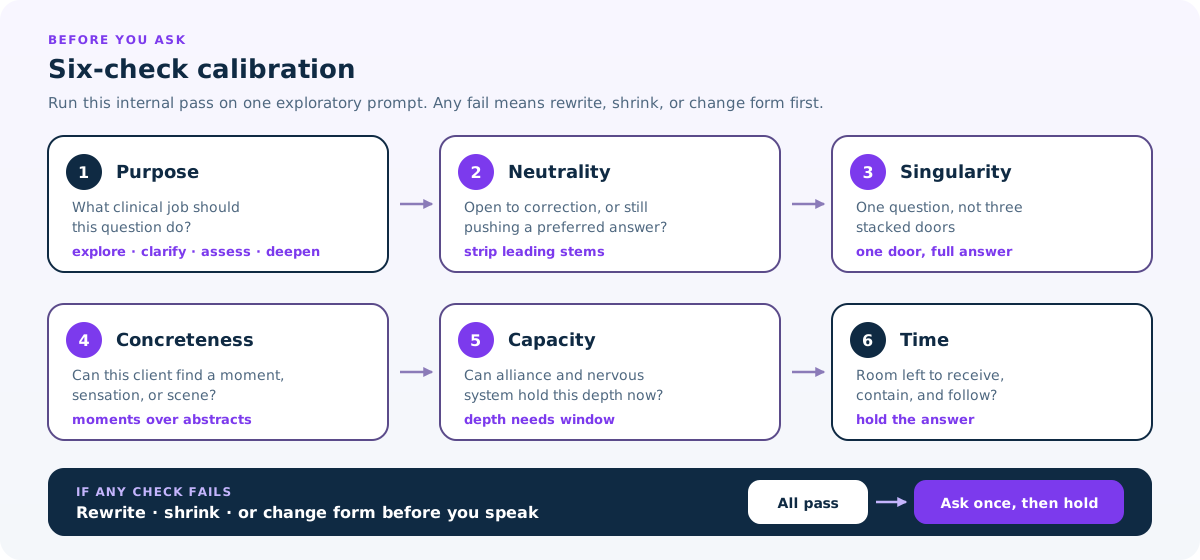
- Purpose. What clinical job should this question do: explore, clarify, assess, deepen, consolidate, or close?
- Neutrality. Is the wording open to disconfirmation, or does it push a preferred answer?
- Singularity. Is this one question rather than three stacked doors?
- Concreteness. Can this client locate a moment, sensation, or scene from the stem?
- Capacity. Can the alliance and nervous system hold this depth right now?
- Time. Is there enough room left to receive, contain, and follow the answer?
If any check fails, rewrite, shrink, or change form before you speak. That calibration is the heart of open ended questions for therapy in live sessions.
Free PDF: Therapy Questions Practice Pack
A printable three-page clinician pack for calibrating open, closed, reflective, scaling, and clarifying questions before and after you ask them.
- Purpose selector and open/closed choice grid
- Six-check calibration and rewrite worksheet
- Timing and state checks with repair stems
- Supervision audit for recurring question habits
Free. We'll email the PDF link right away and add you to the therapist toolkit, sent every two weeks. Unsubscribe any time.
Where should we send the link?
We'll email the PDF link right away. You'll also get the therapist toolkit every two weeks. Unsubscribe any time.
✓ Check your inbox
We've sent you the PDF
The download link is on its way to your inbox, usually within a minute or two. The email will come from Emosapien (hello@team.emosapien.com); check your spam folder if you don't see it.
You're also on the therapist toolkit list, sent every two weeks. Unsubscribe any time from the email footer.
Rewrite questions that lead, stack, or shut the client down
Each pair below keeps the same clinical aim and changes only the delivery.
Leading to neutral
Before: “Didn’t your partner’s comment make you feel dismissed?”
After: “What landed for you when your partner said that?”
Why better: The client can name dismissal, sadness, numbness, or nothing at all without disagreeing with you first.
Yes/no to exploratory
Before: “Was the weekend hard?”
After: “What part of the weekend is still with you?”
Why better: You learn the scene, not only a binary rating.
Stacked to single
Before: “How did that feel, was it like last time, and what did you do next?”
After: “Walk me through what happened right after the call ended.”
Why better: One door invites a full answer; three doors invite the easiest answer.
Abstract to concrete
Before: “How is your self-esteem these days?”
After: “When did you most notice yourself shrinking or standing taller this week?”
Why better: Abstract nouns stall many clients. Moments give them somewhere to stand.
Accusatory “why” to process language
Before: “Why did you cancel again?”
After: “What got in the way of making it here today?”
Why better: “What got in the way” still names the pattern without putting the client on trial.
Therapist jargon to client language
Before: “Where do you notice the rupture in the attachment system?”
After: “When things got tense between us just now, what did you notice in yourself?”
Why better: The client can correct you in ordinary words.
Advice disguised as a question
Before: “Have you thought about just telling your boss no?”
After: “What options feel available if you imagine speaking up, and which ones do not?”
Why better: Curiosity leaves room for constraints you cannot see yet.
Depth scaled back after activation rises
Before: “What does this remind you of from childhood?”
After: “We can go older later. For now, what is happening in your body as we talk about this?”
Why better: Timing is part of the question. Depth without capacity is not depth.
For a larger shelf of ready prompts once your form is clean, use the 100 therapy questions bank. Use that list for volume, and use the calibration steps here to assess form, timing, and repair.
When the client is a child roughly ages 4-12 and adult open prompts are too abstract, use the 100 therapy questions for kids bank organized by developmental level and session phase.
Match the question to the session phase
Think in jobs, not libraries:
- Arrival and agenda. Land the client, surface what is live, and agree what the hour is for.
- Exploration. Open one scene or pattern with room for the client’s language.
- Clarification. Tighten meaning before you deepen or intervene.
- Deepening. Move from event to experience, body, relationship, or values when capacity allows.
- Integration and close. Consolidate one usable takeaway and name the bridge to next time.
If you need a fuller arrival bench, use therapy check-in questions for individual sessions. In group rooms, keep stems shorter and turns equitable rather than running the same 1:1 depth prompt around the circle.
What to do after the question lands
The question is only half the intervention. The other half is your response to the response.
- Silence. When silence fits the moment, allow it and follow the client’s cues rather than filling the gap automatically.
- One-word or “I don’t know.” Shrink the stem, offer a scale, or name two possible directions the client can correct.
- Intellectualizing or narrative drift. Reflect the pattern gently and invite one concrete moment: “Can we freeze one scene from that story?”
- Flooding or dissociation. Stop deepening. Orient, ground, and return to a smaller present-tense question or a closed safety check.
- Client corrects your assumption. Thank them and follow their correction. That repair often matters more than the original prompt.
- Rupture. Own the miss in plain language: “I may have asked that badly. Would a more specific question be easier, or would you rather pause?”
- Need for assessment. When risk, consent, or factual clarity appears, move from open exploration to direct structured questions without apology for the shift.
No question form produces outcomes on its own. Alliance, pacing, and what you do next still carry the hour.
When not to use an open question
Safety takes precedence over conversational style.
Prefer direct, closed, or protocol-guided questions when you are assessing:
- acute suicide or violence risk;
- abuse and immediate safety;
- consent and limits of confidentiality;
- medication and substance facts;
- orientation, severe dissociation, or cognitive overload;
- time-sensitive factual clarification.
Structured validated tools and local clinical policy take precedence over conversational elegance. The Columbia Suicide Severity Rating Scale and similar protocols exist because direct questions save time and reduce ambiguity when safety is on the table. Intake, risk, medication, and consent domains often need that same directness; for structured intake banks, use intake questions for therapy rather than forcing every domain into open form.
Trauma-aware pacing still applies after the facts are clear. Choice, collaboration, and the option to slow down remain part of the frame once immediate safety is addressed.
Review your questioning pattern in supervision
Bring the pattern, not only the clever miss:
- Which prompts recur across clients even when the formulations differ?
- How quickly do you rescue silence, and what are you protecting yourself from?
- How often do your questions confirm a story you already hold?
- Do you ask more when you feel anxious, behind, or unsure of the next intervention?
- Which client responses are hard for you to tolerate: anger, blankness, praise, erotic material, “I don’t know”?
- Whose agenda did the last key question serve?
When a response matters for continuity, capture it in the client’s words and tie the next step to treatment goals. The BIRP notes template is a clean place to land intervention, response, and plan without turning the note into a transcript of every prompt.
Where Emosapien fits
When you use open ended questions for therapy well, you still hold the clinical thread: the intention behind each prompt, the form you chose, how the client used it, and what you will reopen next time. Across a full caseload, that thread is easy to lose between sessions.
Emosapien keeps those session-to-session threads visible so you can reopen what mattered last time. You stay responsible for formulation, risk, and every signed note. It does not choose questions for you, diagnose, or replace clinical judgment.
Start free with Emosapien if you want between-session continuity and note support that stays under therapist control.
References
- Miller, W. R., & Rollnick, S. (2023). Motivational Interviewing: Helping People Change and Grow (4th ed.). Guilford Press.
- Substance Abuse and Mental Health Services Administration. (2021). Using Motivational Interviewing in Substance Use Disorder Treatment.
- Norcross, J. C., & Lambert, M. J. (Eds.). (2019). Psychotherapy Relationships That Work, Volume 1. Oxford University Press.
- Beck Institute. Socratic Questioning in CBT (professional training overview).
- The Columbia Lighthouse Project. About the Columbia Suicide Severity Rating Scale (C-SSRS).
- Substance Abuse and Mental Health Services Administration. (2014). SAMHSA’s Concept of Trauma and Guidance for a Trauma-Informed Approach (via NCTSN resource page).