
PTSD ICD-10 Codes: F43.10, F43.11, and F43.12 for Therapists

Outline
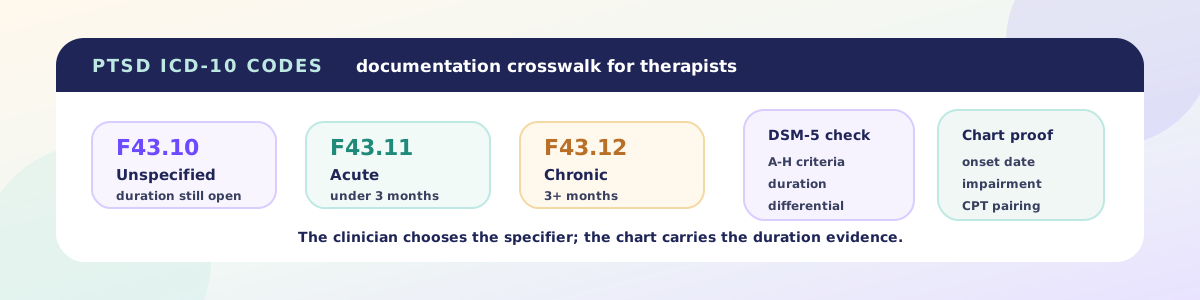
PTSD ICD-10 codes are not one code. They are a family of three specifiers under F43.1, and picking the right one depends on evidence the chart either has or does not have yet. A therapist coding PTSD at intake usually has the symptom picture. What is often missing is the durational data that separates unspecified from acute from chronic, and that gap is where audit risk concentrates.
This guide gives therapists the full set of PTSD ICD-10 codes, the DSM-5 criteria behind the diagnosis, a section on each of the three F43.1x specifiers, the recode workflow that keeps a chart defensible, and a downloadable cheat sheet for intake and payer review. For the broader diagnosis map, use the ICD-10 codes for therapists hub.
Free PDF: PTSD ICD-10 Cheat Sheet and Documentation Crosswalk
A printable PTSD code table for F43.10, F43.11, and F43.12, the DSM-5 criteria, the recode workflow, and CPT pairings for payer review.
- F43.10, F43.11, and F43.12 code cards with the documentation each specifier needs
- DSM-5 criteria mapped to chart-side thresholds
- The recode workflow from unspecified to acute or chronic
- Adjacent codes and CPT pairings for the claim line
Free. We'll email the PDF link right away. We may also send the occasional therapist toolkit. Unsubscribe any time.
Where should we send the link?
We'll email the PDF link right away. You'll also get the occasional therapist toolkit. Unsubscribe any time.
✓ Check your inbox
We've sent you the PDF
The download link is on its way to your inbox, usually within a minute or two. The email will come from Emosapien (hello@team.emosapien.com); check your spam folder if you don't see it.
You're also on the weekly therapist toolkit list. Unsubscribe any time from the email footer.
Educational resource for licensed US mental-health clinicians. ICD-10-CM descriptors, DSM criteria, payer rules, and state scope rules change. Verify current requirements before diagnosing, coding, or billing.
Use official code sources first
Use the CDC ICD-10-CM page for the official US diagnosis-code files and guideline updates. Use the CMS ICD-10 page for Medicare coding resources and transition guidance. The DSM-5, published by the American Psychiatric Association, supplies the diagnostic criteria that the ICD-10-CM code represents.
None of those sources replace payer policy or your state licensing board’s scope rules. They keep the chart from coding PTSD from memory or from an outdated internet table.
PTSD ICD-10 codes table
Use this table as a documentation prompt, not a substitute for the current ICD-10-CM manual, DSM-5 criteria, or payer policy.
| Code | ICD-10-CM descriptor | Use when the chart supports |
|---|---|---|
| F43.10 | Post-traumatic stress disorder, unspecified | PTSD criteria are met, but symptom duration has not yet been established as acute or chronic. Common at intake or early in the treatment episode. |
| F43.11 | Post-traumatic stress disorder, acute | Symptoms have lasted less than three months from criteria onset, and the timeline is documented. |
| F43.12 | Post-traumatic stress disorder, chronic | Symptoms have lasted three months or longer, and the timeline is documented. The most common specifier once a full trauma history is on the chart. |
| F43.0 | Acute stress reaction | Symptoms last from three days to one month after exposure. Not PTSD; PTSD requires duration longer than one month. |
| F43.9 | Reaction to severe stress, unspecified | A stress reaction is documented, but the type cannot yet be specified. More general than F43.10; reviewers expect quick resolution to a more specific code. |
The code is the index entry. The chart still has to show why that specifier fits this client today.
DSM-5 criteria for PTSD
PTSD in adults, adolescents, and children older than six carries eight lettered DSM-5 criteria. The table below is a chart-side summary; the full descriptors live in the DSM-5 itself.
| Criterion | What it requires | Threshold for the chart |
|---|---|---|
| A: Exposure | Direct experience, witnessing, learning of an event affecting a close family member or friend, or repeated exposure to aversive details of trauma. | Name the index trauma and which exposure pathway applies. |
| B: Intrusion | Recurrent distressing memories, dreams, flashbacks, or physiological reactions to trauma cues. | At least one Cluster B symptom documented. |
| C: Avoidance | Avoidance of trauma-related thoughts, feelings, or external reminders. | At least one Cluster C symptom. |
| D: Negative cognitions and mood | Distorted blame, persistent negative emotional state, detachment, or loss of interest. | At least two Cluster D symptoms. |
| E: Arousal and reactivity | Irritability, hypervigilance, exaggerated startle, concentration or sleep problems. | At least two Cluster E symptoms. |
| F: Duration | Disturbance lasts more than one month. | Onset date documented; passes the one-month threshold. |
| G: Functional impairment | Clinically significant distress or impairment in social, occupational, or other important areas. | Concrete impacts on work, relationships, or sleep. |
| H: Differential | Not attributable to a substance or medical condition. | Substance use and medical contributors reviewed. |
The dissociative subtype (persistent depersonalization or derealization) and the delayed-expression specifier (full criteria not met until six months or more after the index event) both attach when the evidence supports them. Screen for both at intake, even while the acute-versus-chronic question stays open.
F43.10: unspecified PTSD
F43.10 is the right pick when the diagnostic criteria are met but the durational data needed to choose acute or chronic is not yet on the chart. It is common at intake, before the trauma timeline is fully reconstructed, or when the index event is recent and the clinical picture is still consolidating.
The audit objection raised most often is the indefinite carry: a chart that codes F43.10 at intake and never resolves to F43.11 or F43.12 reads as a clinician who never finished the assessment. A defensible chart states the plan to revisit the specifier and recodes once the timeline supports the move. For the full documentation-audit treatment of this specifier, see the F43.10 unspecified PTSD reference.
F43.11: acute PTSD
F43.11 fits when the chart documents that symptoms have lasted less than three months since criteria onset. The trauma date, the criteria-onset date, and today’s date should all appear close enough together in the record that a reviewer can do the arithmetic without guessing.
Acute PTSD is less common in outpatient practice than the chronic specifier, because most clients present well after the three-month window. When F43.11 is used, the treatment plan should name the recheck point where the chart moves either to F43.12 (if symptoms persist past three months) or toward remission documentation (if the clinical picture resolves).
F43.12: chronic PTSD
F43.12 fits when symptoms have lasted three months or longer, and it is the specifier most caseloads carry, since clients frequently present months or years after the index trauma. The chart documents the same eight criteria as any PTSD diagnosis; what F43.12 adds is a durational statement that the three-month threshold has been crossed and is supported by the trauma history.
A chronic-PTSD chart benefits from periodic re-assessment language, even though the specifier itself does not change session to session. Noting current symptom severity, treatment response, and any shift in the dissociative or delayed-expression specifiers keeps the record active rather than static.
Recoding workflow: unspecified to acute or chronic
- Code F43.10 at intake if the durational picture is not yet established.
- Name the planned recheck point, typically within three to four sessions.
- Collect a validated measure. The PCL-5 (PTSD Checklist for DSM-5), published by the National Center for PTSD, is the most common self-report instrument; the CAPS-5 is the structured-interview standard.
- When the durational threshold is confirmed, recode to F43.11 or F43.12 on the next claim line.
- Document the durational evidence that supported the recode in the same progress note where the code changes.
- Continue reassessing the dissociative and delayed-expression specifiers as new evidence arrives.
The recode is not paperwork for its own sake. Getting the PTSD ICD-10 codes right at each step is the evidence that the clinician resolved the diagnostic question instead of leaving it open indefinitely.
Differential and adjacent codes
PTSD sits inside the F43 family with several conditions that share a precipitating stressor but differ on timing or symptom picture.
| Code | Condition | How it differs from PTSD |
|---|---|---|
| F43.0 | Acute stress reaction | Symptoms last three days to one month. PTSD is not available before the one-month mark. |
| F43.9 | Reaction to severe stress, unspecified | The stress reaction is documented, but not specified as PTSD or another F43 subtype. |
| F43.22 / F43.23 | Adjustment disorder with anxiety, or with mixed anxiety and depressed mood | An identifiable stressor is present, but Criterion A trauma exposure and the four-cluster PTSD symptom architecture are not met. See the F43.23 adjustment disorder guide for that documentation pattern. |
Comorbid mood, anxiety, and substance-use codes commonly appear on the same claim line as PTSD. Substance intoxication or withdrawal can mimic intrusion, arousal, or concentration symptoms, which feeds directly into the Criterion H differential. When two or more distinct disorders are supported, all relevant codes can be carried, with the focus-of-treatment code listed first.
Documentation that holds up under audit
Documenting PTSD ICD-10 codes well means a defensible chart establishes five elements at intake and revisits them as the specifier resolves.
- Criterion A named specifically. Identify the index trauma and which exposure pathway applies, at the level of detail clinically appropriate without demanding gratuitous recounting.
- Symptom clusters mapped to client report. Intrusion, avoidance, negative cognitions and mood, and arousal each need at least the DSM-5 minimum count, tied to concrete client language or observation.
- Durational picture stated explicitly. Either the unspecified code with a planned recheck, or the acute/chronic specifier with the supporting timeline.
- Functional impairment described concretely. Missed work, withdrawal from activities, sleep disruption, or hypervigilance affecting daily routines, not a generic “functioning impaired” note.
- Treatment plan tied to a trauma-focused modality, with the recode trigger identified when F43.10 is the current code.
The American Psychological Association’s record-keeping guidance and the HIPAA provisions at 45 CFR § 164.501 keep diagnostic justification in the progress note and treatment plan rather than in psychotherapy notes, since the progress note is what supports the billed diagnosis under review. The clinical documentation reference covers the broader structure of progress notes that consistently hold up under review.
CPT codes commonly paired with PTSD
The diagnostic code identifies the condition; the procedure code identifies the service. CPT 90791 pairs with the diagnostic evaluation at intake. CPT 90834 (approximately 45 minutes) and 90837 (approximately 60 minutes) are the routine psychotherapy codes, and trauma-focused work often runs at the higher end of the time bands because exposure-based interventions and stabilization both need unhurried session time. Add-on code 90785 for interactive complexity may apply when communication factors complicate the session.
Psychological testing codes 96130 (evaluation services, first hour) and 96136 (test administration and scoring, first 30 minutes) apply when the PCL-5 or CAPS-5 is administered inside a structured assessment encounter rather than the routine intake. Time-based CPT codes require the note to document that the session ran to the billed time threshold; payers routinely deny 90837 when that documentation is missing.
How Emosapien supports this workflow
Emosapien’s Scribe Agent works alongside the clinician during intake and ongoing sessions. When the conversation establishes a Criterion A exposure, symptoms across the four PTSD clusters, and a duration picture that has not yet resolved, the agent surfaces F43.10 as the diagnostic candidate alongside the criteria checklist and a flag noting that the specifier should be revisited within three to four sessions.
When a later session establishes the durational threshold, the agent flags the recode opportunity in the next note draft, with the supporting evidence shown inline. The clinician makes the diagnosis; the agent shows its work against the DSM-5 criteria and produces an Assessment ready for chart review. See the AI clinical notes overview for how the Scribe Agent handles documentation across the rest of the note, or start a trial to see candidate diagnostic suggestions in your own intake workflow.
Use the downloadable cheat sheet
The PTSD ICD-10 cheat sheet keeps the F43.10, F43.11, and F43.12 table beside the DSM-5 criteria, the recode workflow, and the CPT pairings a reviewer expects to see. Use it during intake review, supervision, or template cleanup, alongside the full DSM-5 to ICD-10 crosswalk for adjacent diagnoses.
The strongest PTSD chart is not the longest one. It is the one that names the evidence it has today and the recode it plans once more evidence arrives.
References
- Centers for Disease Control and Prevention. ICD-10-CM official code set and guidelines.
- American Psychiatric Association. Diagnostic and Statistical Manual of Mental Disorders, Fifth Edition (DSM-5).
- National Center for PTSD. PTSD Checklist for DSM-5 (PCL-5).