Self-Esteem Worksheets for Teens in Clinician-Led Care

Outline
Authored by Dr. Elena Vasquez, licensed psychologist (PsyD), play-therapy and child-and-family-therapy trained, with a family-systems lens across home, school, and clinic.
Self-esteem worksheets for teens belong in a licensed session after the target is already in view. The therapist chooses one short page, says what it is for, names who will see it, and keeps the result inside treatment. This is not a consumer confidence pack, a parenting homework packet, or a school assignment that promises to raise worth.
Licensed therapists and supervised adolescent-care clinicians keep the broader worksheet rules from the therapy worksheets clinical guide. Then they come here for age-qualified selection, not for the broad adult form.
Educational content for licensed therapists, not clinical or legal advice. Worksheet selection sits inside formulation, consent, and risk review. What follows is developmental scaffolding, not a protocol, diagnosis tool, or crisis procedure.
Clinician scope and age boundary
These formats are for adolescents roughly ages 13 to 19. Developmental level takes precedence over birthday. A thirteen-year-old who can manage abstract thinking and who has a stable privacy contract can use a short written form. A seventeen-year-old with heavy executive load, language barriers, or an unsafe record may need spoken answers, a scribe, or no paper at all.
The therapist selects and introduces one page. The young person can pass. Completion is not engagement, and a blank line can be clinical data.
This page does not:
- Promise to raise, build, improve, or fix a teenager’s self-esteem
- Diagnose from a worksheet or treat a score as a diagnosis
- Treat low self-worth as proof of depression, an eating disorder, trauma, or suicide risk
- Prescribe a generic digital detox or turn social media into a moral panic
- Frame caregivers as the enemy or promise confidentiality that local law cannot keep
A post you publish is not the teen’s homework. The stop rule for that post is in social posting rules for therapists.
The same age-qualified job holds for self-esteem worksheets for teenagers who are still moving across home, school, peers, and clinic. If the useful next move is still “which technique fits this stage and this room,” start with choose an adolescent technique by stage and safety. When the job is naming 1-3 skills the teen will actually try, use a coping skills checklist for teens.
Fit check before paper
Do not hand over a form to discover the problem. Formulation, alliance, and a live target come first.
Check, in plain language:
- Target. Is the hour about a harsh self-judgment that can be named, or about regulation, avoidance, family conflict, or risk?
- Alliance and privacy. What has the young person been told about who can know what they write?
- Literacy, language, and load. Can they complete a short field without it becoming a test?
- Neurodivergence and access. Would writing, timing, or sensory demand of the page get in the way?
- Culture and family context. Whose voice will be assumed if a caregiver later asks to see the sheet?
- Risk. Is the room stable enough for reflective paper, or does safety work come first?
Stop if the worksheet is about to become surveillance, an evaluation, compliance performance, or forced disclosure. A page that only works when the teen performs insight for adults is the wrong page.
Developmental adaptation across adolescence
Treat early, middle, and late adolescence as flexible bands. Disability, neurodivergence, culture, trauma load, and context can move a young person off the chronological line. APA’s developing-adolescents reference is useful here as a reminder that physical, cognitive, emotional, and social development do not travel in lockstep. It is not a protocol for any worksheet.
| Band | What the hour can usually hold | How the form should shrink | Stop cue |
|---|---|---|---|
| Early adolescence | Concrete scenes, short steps, more caregiver scaffolding when privacy allows | Two or three fields, spoken or drawn answers, teen-owned wording | Adult essay prompts or a demand to merge every setting into one identity |
| Middle adolescence | Peer salience, privacy testing, comparison in rooms and feeds | Name the trigger and the imagined audience; keep selected fields private | Using the page to audit a friend group or a parent’s portal |
| Late adolescence | More collaborative goal ownership when executive function allows | Teen chooses the field order; therapist still holds storage and sharing | Over-scaffolding as if the young person cannot own a next step |
Do not adultomorphize a younger teen into a miniature insight machine. Do not under-scaffold an older adolescent who still needs a scribe, a pass option, or a smaller field.
Shorter fields, concrete anchors, visual or spoken response options, and optional privacy on selected lines are the default adaptations. Extra boxes are not more clinical care.
Six field blueprints for session use
Scroll the visual sideways to view the full diagram
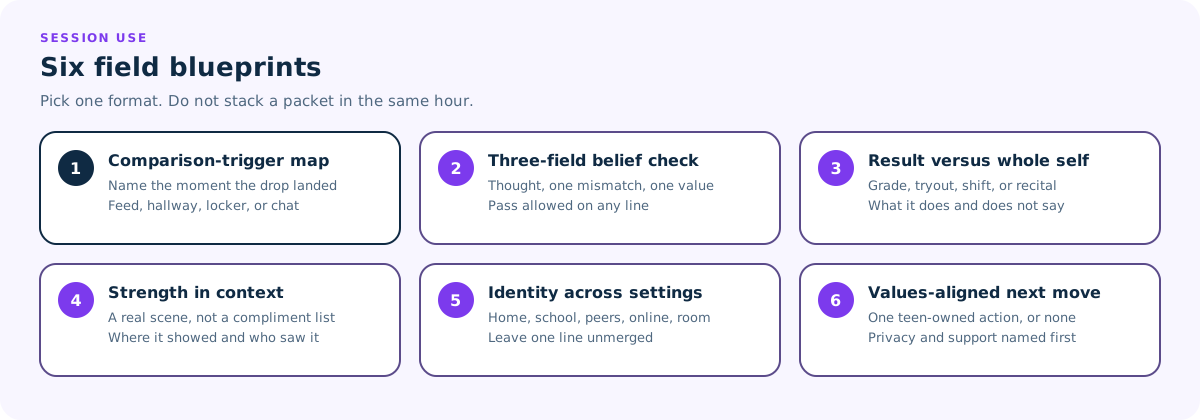
The six formats below are field blueprints you adapt in the room. Self-esteem worksheets for teens stay short on purpose. They are not a downloadable teen pack, and they are not an evidence-based treatment on their own. Structured CBT for low self-esteem in adolescents has a cautious research base. Taylor and Montgomery’s systematic review of two small trials found limited evidence in depressed adolescents: global self-esteem versus wait-list was not statistically significant at post-treatment, and a later academic self-concept signal appeared in one short-term follow-up. Berg and colleagues’ pilot randomized trial of therapist-supported internet CBT reported gains on a self-esteem measure in 15-to-19-year-olds. Neither study validates these six sheets or the printable download on this page.
Use one format. Switching mid-session because the first sheet felt incomplete usually means the job was never named.
1. Comparison-trigger map
Job. Slow a worth drop that arrived through a feed, a hallway, a locker room, or a group chat, without turning the hour into a lecture about phones.
Minimum fields. The event, platform, or room. The imagined audience. The harsh message. One body cue. One alternative context that the comparison ignored.
Introduce. “We are mapping the moment the comparison landed, not grading your feed.”
Adaptation. Early adolescence may point to a place rather than name a platform. Later adolescence can add who they think was watching.
Stop. The page becomes a demand to delete apps, confess every account, or produce private images as evidence.
Return. Carry one trigger and one alternative context into the next hour. Do not carry the teen’s social graph into the chart.
2. Three-field belief check
Job. Test one harsh thought without a six-column adult thought record.
Minimum fields. The harsh thought in the teen’s words. One piece of disconfirming evidence. One value or relationship the thought ignores.
Introduce. “Three lines. You can pass on any of them.”
Adaptation. Scribe if writing is the shame. Keep evidence concrete: a scene, a message, a class, a person who stayed.
Stop. The therapist supplies the “better” thought and waits for the teen to agree.
Return. Revisit whether conviction in that one thought shifted, not whether the teen now likes themselves.
If the hour still needs the five-field adult sequence of situation, core belief, evidence for, evidence against, and values-based reappraisal, hand off to the general self-esteem belief-testing worksheet.
3. Performance-versus-whole-self separator
Job. Keep a grade, a tryout, a shift, or a recital from becoming a verdict on the person.
Minimum fields. The outcome. The standard used. What the outcome does say. What it does not say about the person.
Introduce. “We are separating the result from the whole of you.”
Adaptation. Name whose standard is on the page: teacher, coach, parent, or the teen’s own bar. Perfectionistic standards belong in the “standard used” field, not in the evidence-for column of an adult worksheet.
Stop. The page is used to argue the teen into positivity, or to collect proof they did not try.
Return. One sentence the teen is willing to reuse the next time a result arrives.
4. Strength-in-context evidence
Job. Locate a strength as a situated event, not as a compliment the teen is asked to believe.
Minimum fields. A strength. Where it appeared. Who observed it. What conditions helped it show up.
Introduce. “We are looking for a real scene, not a list of qualities.”
Adaptation. A younger teen may need the therapist to offer two scenes to choose from. Do not require a public speech.
Stop. The page becomes a gratitude lecture, a school character report, or pressure to perform confidence for the adults. For an adult or mixed-age strengths, three-good-things, meaning, or best-possible-self pack, use positive psychology worksheets instead of stretching this teen form.
Return. Thicken one condition that helped the strength show up. Do not paper over risk.
5. Identity-across-settings map
Job. Hold home, school, peers, online, and clinic descriptions without forcing them into one label.
Minimum fields. How I am at home. At school. With peers. Online. In this room. One line I do not want merged.
Introduce. “These can disagree. We are not voting on the real you.”
Adaptation. Keep the “online” and “home” lines private when a caregiver or school team will later ask to see the sheet. Do not require disclosure of private identity, body, or family material.
Stop. The page is used to catch inconsistency, out someone, or produce a single identity for a record.
Return. Notice which setting the harsh thought lives in. Leave the unmerged line unmerged.
6. Values-aligned next move
Job. Close the hour with one small action that belongs to the teen, not a self-improvement plan.
Minimum fields. Chosen direction. Smallest next action. Privacy or support needed. What returns next session.
Introduce. “One move that can actually happen before we meet again.”
Adaptation. If between-session work is unsafe or impossible, the next move stays in the room.
Stop. A list of goals the teen did not choose, or a task that requires them to disclose the worksheet at home or school.
Return. Start the next session from that one move, including if it did not happen.
Introduce one sheet without making it schoolwork
Keep the loop small enough to finish inside the hour.
Permission. Say the page is optional. A pass is allowed.
Purpose. One sentence on the job: map a comparison, test a thought, separate a result, locate a strength, hold several selves, or pick one next move.
One live example. Do the first line together from a moment already in the room. Do not send a blank packet home and hope.
Pass option. Name which fields may stay blank or private.
Stop cue. Agree in advance what “this is costing too much” looks like: shutdown, self-attack, panic, or a request to stop.
Use one format, not a packet. Between-session use is optional and only after storage and sharing are known. If the sheet will sit in a backpack, a shared printer, or a parent portal, it is already the wrong homework.
Caregiver, school, and record boundary
State, custody, setting, and record-access rules vary. Do not invent a universal parent-access rule, and do not promise a privacy the chart cannot keep.
The AAP policy on confidentiality in adolescent care treats confidentiality as part of high-quality adolescent care, asks clinicians to respect a young person’s request when legally required or permitted, and still prioritizes safety when disclosure is required. Caregivers remain part of the system. They are not automatically the audience for the page.
Agree, before writing:
- What may be shared with a caregiver, and in what words
- What may be shared with a school team
- Where the paper or photo of the paper will live
- What belongs in the progress note
The progress note records the intervention and the response: the format used, observable engagement or refusal, any shame spike, and the next-session review question. It does not paste private worksheet content into the chart by default. Private identity, body-image, bullying, trauma, or family material should not go on paper until that storage and sharing boundary is known.
Do not send a completed sheet into a family chat, a teacher email, or a shared drive “so everyone is on the same page.”
When to stop or hand off
Hold self-esteem worksheets for teens, or never take them out, when:
- Active suicide or self-harm risk. Assessment and safety planning take precedence.
- Acute eating-disorder or abuse concern. The page is not an assessment instrument and is not a substitute for indicated care.
- High activation. If the teen is outside a workable range, paper is too slow. Use coping skills worksheets for teen regulation when the first job is regulation, not reflection.
- Shame escalation or self-attack. Stop. Do not finish the form as proof of effort.
- Coercion. A parent, coach, or school cannot launder compliance into clinical engagement.
- Literacy, language, or access mismatch. Scribe, translate, enlarge, or drop it.
- Unsafe record access. If the likely reader is someone the teen cannot refuse, keep the work oral or stop.
These holds are clinical. They are not a ranking of teens who “are not ready to work on self-esteem.” Low self-worth on a worksheet does not identify depression, an eating disorder, trauma, or suicide risk by itself. When those concerns are in view, treat them through the indicated path, not through a confidence form.
Where Emosapien fits
A teen hour leaves a thin thread that is easy to lose: which of the six formats you used, whether the young person passed or wrote, the privacy line you restated, and the one comparison, thought, result, or next move that should open the next session. Reconstructing that from a packed chart is often harder than choosing the sheet.
Emosapien drafts a SOAP, BIRP, or GIRP note from that hour. You review the intervention, the observed response, and the next-session cue before anything enters the chart.
The therapist stays with formulation, consent, and the stop rule. Emosapien organizes the format you used, the shame or pass you saw, and the keep-or-stop decision so the next hour starts from the work that stayed within privacy boundaries the young person can rely on.
Start free with Emosapien and keep the chosen teen format tied to the note you sign.
Group use and regulation
This is not a group curriculum. A short caution is enough: a comparison-trigger map or identity map in a group can expose a young person to peers, a school, or a family system they cannot control. Do not run these six formats as a facilitator activity list.
If activation makes reflection the wrong first move, hand off to regulation work rather than pushing a belief field.
Download the general worksheet, not a teen pack
The downloadable PDF contains the general five-field belief-testing worksheet, not the six teen-specific blueprints above. Introduce it only when that longer sequence fits, usually with later adolescence, a stable privacy contract, and a belief the teen can already name.
Download the Self-Esteem Worksheet
Five fields for situation, core belief, evidence for and against, and a values-based reappraisal. It does not contain the six teen session formats above.
- Situation and core-belief fields in the client’s own words
- Evidence-for and evidence-against columns for testing the belief
- Values-based reappraisal field, not a generic affirmation
- Before-you-close-the-note prompts for protective function and distortion pattern
Free. We'll email the PDF link right away and add you to the therapist toolkit, sent every two weeks. Unsubscribe any time.
Where should we send the link?
We'll email the PDF link right away. You'll also get the therapist toolkit every two weeks. Unsubscribe any time.
✓ Check your inbox
We've sent you the PDF
The download link is on its way to your inbox, usually within a minute or two. The email will come from Emosapien (hello@team.emosapien.com); check your spam folder if you don't see it.
You're also on the therapist toolkit list, sent every two weeks. Unsubscribe any time from the email footer.
Self-esteem worksheets for teens earn a place when the next hour is clearer because one comparison, one thought, one result, or one next move stayed within privacy boundaries the young person can rely on. Keep the job small, the paper optional, and the promise off the page.
References
- American Academy of Pediatrics. Confidentiality in the Care of Adolescents: Policy Statement. Pediatrics, 153(5), e2024066326.
- American Psychological Association. Developing Adolescents: A Reference for Professionals.
- Taylor, T. L., & Montgomery, P. (2007). Can cognitive-behavioral therapy increase self-esteem among depressed adolescents? A systematic review. Children and Youth Services Review, 29(7), 823-839.
- Berg, M., Lindegaard, T., Flygare, A., Sjöbrink, J., Hagvall, L., Palmebäck, S., Klemetz, H., Ludvigsson, M., & Andersson, G. (2022). Internet-based CBT for adolescents with low self-esteem: a pilot randomized controlled trial. Cogn Behav Ther, 51(5), 388-407.