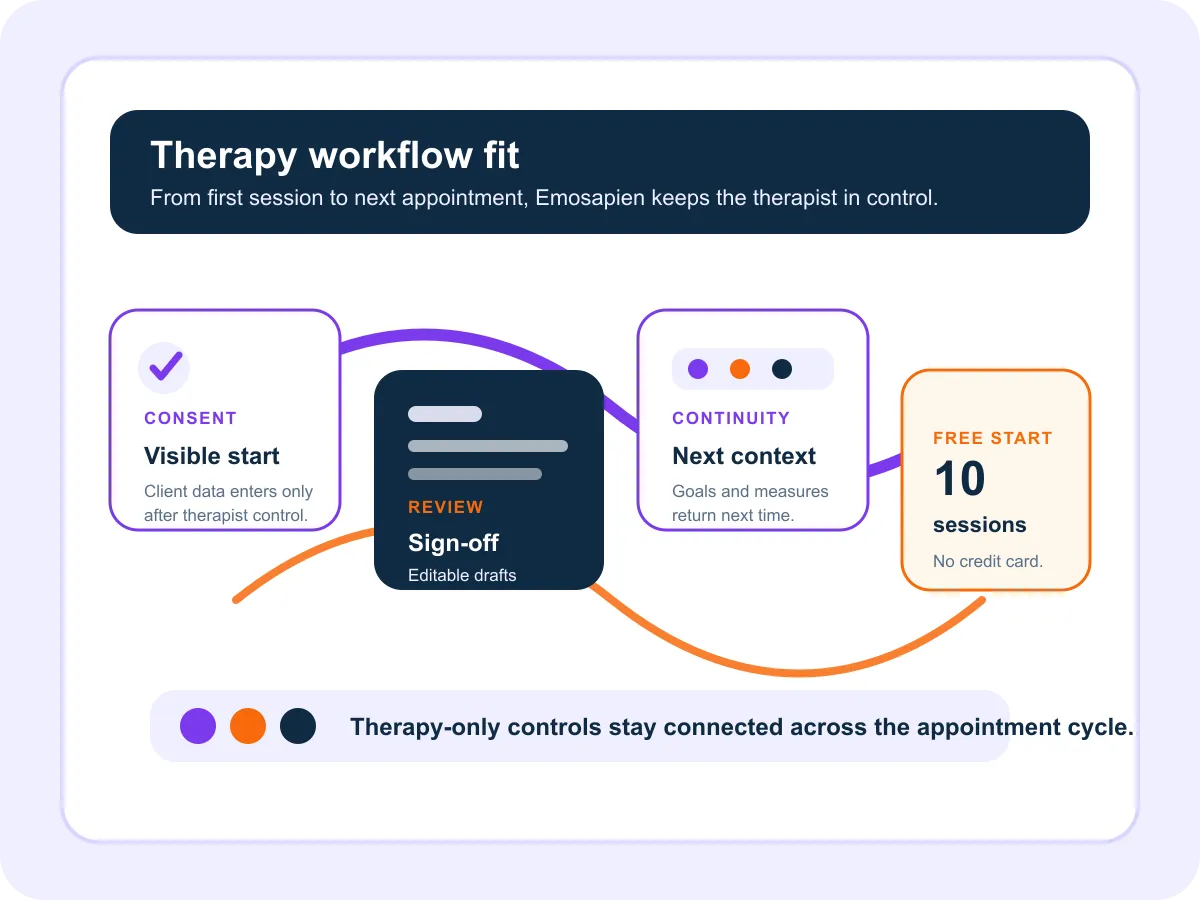
1 Emosapien shows consent, note review, and sign-off before client data enters the workflow.
Therapy workflow comparison
Heidi for therapists alternatives that keep therapy moving after the note
Heidi supports broad clinical work. Emosapien serves licensed therapists with clinician-controlled notes, quiet in-session prompts, goals, measures, homework, and client follow-up in one workflow.
Test Emosapien with 10 AI-generated therapy sessions each month, no credit card required. See free plan and pricing
Therapy workflow fit
Emosapien keeps the room, the note, and the next session together
Heidi supports broad clinical work: documentation, coding, care-gap outreach, referrals, prescriptions, and care-team tasks. That scope suits mixed clinical operations.
Emosapien narrows the workflow for licensed therapists. It drafts therapy notes, surfaces optional modality prompts, carries goals and homework forward, and gives the clinician final review and sign-off.
A therapist ends a CBT session with assigned homework, a PHQ-9 follow-up, and risk wording to review. Emosapien drafts the SOAP, DAP, BIRP, or GIRP note, keeps the treatment-plan goal attached, and returns the homework and measure trend before the next appointment.
Four connected controls
2 Emosapien drafts notes with intervention language, client response, risk wording, plan details, and modality logic for review.
3 Emosapien carries goals, homework, measures, journaling, and session context into the next appointment.
4 Emosapien gives enterprise teams SSO, role-based access, retention controls, and audit exports.
Therapy workflow signals
Emosapien turns session context into signed notes and next-step care
The therapist stays in control. Emosapien links the session, documentation, treatment goals, client exercises, and measures back to the next appointment.
Therapy scope Therapy workflow
Emosapien serves psychotherapy; Heidi spans broader clinical work
Heidi: Heidi supports notes, coding, referrals, prescriptions, and care-team tasks across settings.
Emosapien workflow: Emosapien serves licensed mental-health clinicians: SOAP/DAP/BIRP/GIRP notes, treatment-plan context, and between-session client work.
Clinician control Therapy workflow
Emosapien keeps prompts, drafts, and sign-off with the therapist
Heidi: Heidi offers broad clinical AI workflows for clinicians and teams.
Emosapien workflow: The Therapy Agent surfaces optional CBT, ACT, and DBT prompts tied to active goals. The therapist reviews, edits, and signs the record.
Care continuity Therapy workflow
Emosapien connects session context to the next appointment
Heidi: Heidi emphasizes documentation and care-team support across medical settings.
Emosapien workflow: Planning, Scribe, Engagement, and Insight Agents carry each session's goals and notes forward with measures, journal summaries, and homework.
Low-friction start Therapy workflow
Therapists start Emosapien without a credit card
Heidi: Heidi offers free and paid tiers across care settings.
Emosapien workflow: The free plan includes 10 AI-generated therapy sessions per month, no credit card and no countdown.
Comparison reflects therapy-workflow fit, verified June 2026. Verify Heidi's current plans directly before deciding.
Therapist-control workflow
Emosapien keeps clinical judgment in the therapist's hands
Emosapien's AI clinical notes workflow drafts SOAP, DAP, BIRP, and GIRP notes from session context. The therapist reviews, edits the wording, and decides what gets signed.
The client engagement workflow ties check-ins, journaling, homework, and measures to the next appointment, keeping the week between sessions visible.
Best-fit signal
Emosapien supports practices built on psychotherapy continuity
A practice that mainly wants broad documentation across many services may prefer a horizontal clinical AI product.
A therapy practice that protects therapist control, treatment-plan continuity, and between-session care can use Emosapien as its psychotherapy workflow.
Heidi supports broad clinical work. Emosapien narrows around psychotherapy: clinician-controlled notes, optional modality prompts, treatment-plan continuity, measures, journaling, homework, and client follow-up.
No. Emosapien makes no safety claim about Heidi. It compares positioning, therapy focus, clinician control, privacy terms, and current plans.
The Heidi alternatives guide covers fit for therapy practices. The Heidi vs Emosapien comparison covers feature differences.
Yes. Emosapien encrypts client data in transit and at rest, keeps note review and sign-off with the clinician, and never trains public models on session content. Enterprise plans add SSO, role-based access, retention controls, and audit exports.
In session, the Therapy Agent surfaces optional CBT, ACT, or DBT prompts tied to the active goal. After, Emosapien drafts the note for review and sign-off, then carries goals, homework, journaling, and measures into the next appointment.
Try the therapy workflow before changing your practice
Emosapien gives therapists 10 free AI-generated sessions each month, no credit card required.