Beyond Notes: How AI Co-Therapist Engagement Supports Continuous Care

Outline
It’s Thursday at 5:40pm. You close the chart on a solid session, then realize you still have two notes and almost no picture of what your 10am client did with last week’s homework. The hour went well. The six days after it are a black box.
That gap is where most therapy actually lives. Clients sit with what was uncovered, face old habits, and either practice a skill or quietly drop it. Insights fade. Motivation dips. You lose visibility until the next appointment.
Passive note tools only solve the documentation half of that problem. They listen, transcribe, and draft a note: useful after the hour, silent for the rest of the week. AI co-therapist engagement is a different design choice. It keeps structured support during the session and light continuity after it, without turning you into a between-session message center.
What breaks between sessions
Weekly therapy is often one connected hour and six disconnected days. Clients need a way to reflect and stay accountable without that work landing in your inbox every night. You need a short, clinical picture of what happened before you open the door again.
Without structure, three things tend to slip:
- Homework becomes a vague intention instead of a completed exercise.
- Mood and trigger patterns never reach the next session in usable form.
- You spend the first ten minutes reconstructing the week instead of treating it.
None of that is a motivation failure. It is a continuity design problem. Clients often care about the work; the week simply lacks a container that makes the next small step obvious.
In-session support that stays therapist-controlled
Documentation-only tools stop at the note. A co-therapist style agent works during the hour as well: it can flag tone, affect, and repeated language, then offer short, modality-grounded prompts for you to accept, edit, or ignore.
Examples look like micro-reflections, not scripts:
“Can we pause on that word? What does it mean for you right now?” “You mentioned that situation twice. What’s changed since then?”
Those prompts draw from models such as CBT, ACT, or DBT. They stay therapist-controlled and never client-facing. In the background, the same agent can handle live transcription, key-moment tagging, and structuring into SOAP, DAP, or BIRP notes. The draft is editable. Clinical judgment stays with you.
For the boundary between a passive scribe and active support, the AI co-therapy vs AI scribes comparison is the cleaner reference point.
Between-session structure without extra admin
AI co-therapist engagement only works if the week after the hour has a light frame. That usually means guided check-ins, short journaling prompts, or a skill exercise tied to the last session’s goals. Each entry should collapse into a concise digest: mood trends, triggers, completed tasks, and open questions.
When the next session starts, a 90-second pre-read is enough: what happened since you last met, what was practiced, and what may need follow-up. Clients arrive having already reflected. You arrive with a picture instead of a blank week.
If you are building that layer by hand, start with one consistent check-in format and one note structure. For a note-only tool beside that continuity workflow, Heidi alternatives shows where the two approaches differ. Guided check-ins are a continuity container; a regulated digital therapeutics depression program is a different class and belongs on the due-diligence matrix.
Continuity across the care journey
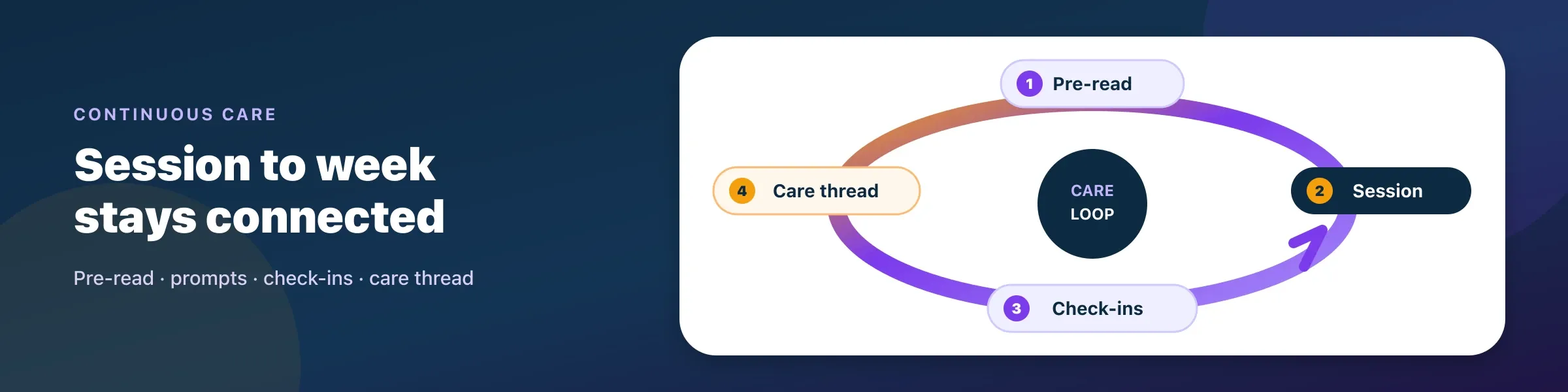
Put the pieces together and the week stops going dark:
- Before the session: a short pre-read from notes, check-ins, and plans.
- During the session: optional prompts plus automatic note structure.
- After the session: light reflection and skill practice tied to goals.
- Across care: a thread that links problems, goals, interventions, and outcomes so the chart tells one story.
For clinicians, that usually means less time reconstructing the week and more time thinking clinically. Many therapists still spend three to four hours each week on documentation alone. Time that could go to supervision, private craft reflection, or leaving on time. The Supanote vs Emosapien comparison separates note-first automation from the broader continuity workflow described here.
For clients, it means feeling held between appointments, not only in the room.
That is the practical meaning of AI co-therapist engagement: fewer gaps between appointments, and a documentation trail that keeps up with the work. Privacy still matters. Any system that holds session context and between-session entries needs clear security controls under HIPAA. For how those obligations apply when AI holds that context, see HIPAA regulations for AI therapy.
What continuous support actually changes
In the traditional model, therapy is an hour of connection followed by six days of silence. Continuous support replaces that silence with a feedback loop: what clients do between sessions shapes what you focus on next. AI co-therapist engagement is one name for that loop when technology carries the admin pieces and you keep the clinical ones.
You do not need every feature on day one. Start with one between-session check-in format and one pre-read habit. Write down the exact question the client will answer mid-week, and the two fields you want on your pre-read (for example: completed homework, and any new risk signal). If the workflow holds for a few clients, add in-session drafting. Keep prompts optional. Keep notes editable. Keep judgment with the clinician.
When you want the product-shaped version of this workflow, AI Clinical Notes shows how SOAP, DAP, and BIRP drafts land during the hour rather than after it.