AI Co-Therapy vs AI Scribes: What Therapists Need to Know

Outline
A therapist does not usually need another label for note automation. They need to know what a tool will do inside a real therapy workflow, what it will not do, and where clinical responsibility remains.
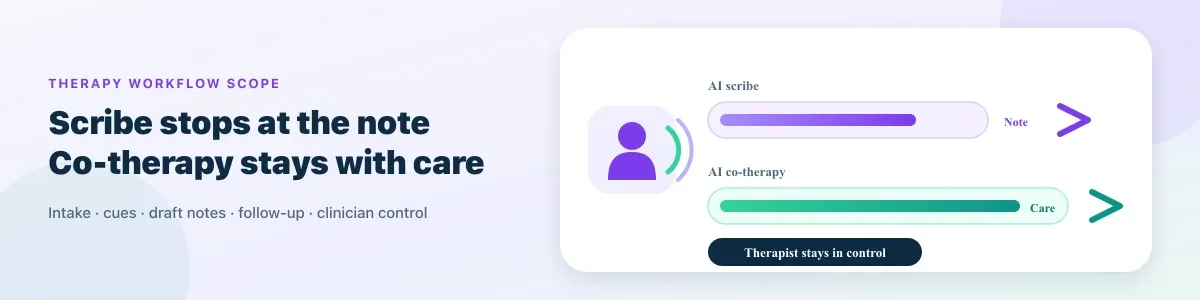
That is why AI co-therapy vs AI scribes needs a careful answer. A scribe can be genuinely useful when the main problem is late notes. A co-therapy model is different. It is not a replacement clinician, and it should not pretend to be one. It is a wider support layer that can connect intake, in-session context, draft documentation, treatment goals, and between-session follow-up while the therapist stays in control.
The distinction matters because mental health work is not a series of short medical encounters. Therapy depends on formulation, timing, modality fit, privacy, consent, and the therapeutic alliance. Documentation is part of that system, but it is not the whole system.
What an AI scribe does well
A therapy scribe listens to or processes session material and turns it into a structured draft note. For many clinicians, that is already a meaningful change. Instead of finishing the day with a blank page, the therapist reviews a SOAP, DAP, BIRP, or GIRP draft while the session is still fresh.
That can reduce cognitive load. It can make notes more timely. It can help a clinician stop reconstructing key moments hours later.
The best scribes are also clear about their boundary. They organize material. They do not decide what the material means. They should not make independent risk judgments, diagnose, or decide the plan of care. The therapist still edits, signs, and owns the clinical record. If the next question is whether those drafts live in the EHR or in a second tool, run the ehr ai notes vs standalone worksheet before you shop co-therapy features.
If the practice problem is mainly documentation backlog, our AI scribe for therapists guide explains the scribe layer in more detail. For a note-first product comparison, see Supanote vs Emosapien. Therapists comparing a hospital ambient product to therapy-only support can start with the therapy-specific alternative to DAX or the therapy-specific alternative to Abridge.
What AI co-therapy adds
Emosapien carries support beyond note drafting. A scribe usually works after the conversation: it creates the note, summarizes the transcript, and prepares a draft. Co-therapy can bring intake context forward, support the session itself, and keep treatment goals and follow-up connected after the note is signed.
In practical buying conversations, AI co-therapy vs AI scribes is a scope question before it is a product label.
In Emosapien, that wider workflow can include:
- intake context before the session
- quiet in-session listening with therapist-visible pattern cues
- modality-aligned prompts the clinician can ignore, adapt, or use
- progress-note drafting tied to treatment goals
- between-session check-ins, journaling, homework, and measures
- a therapist-reviewed record that keeps the client story coherent across sessions
This is active co-therapy with documentation built in, not an autonomous therapist. The point is not to make clinical decisions for the clinician. The point is to reduce the amount of administrative reconstruction needed before the clinician can make those decisions well.
That continuity matters across appointments. Emosapien keeps treatment goals, check-ins, and follow-up context available to the therapist instead of leaving each signed note as an isolated record.
How therapists keep clinical control
Control in AI co-therapy vs AI scribes stays with the licensed clinician.
Emosapien keeps prompts therapist-facing and optional. Clinicians can ignore or adapt them, review every draft note before it becomes part of the record, and retain responsibility for diagnosis, risk, and the plan of care.
With a scribe, the draft remains editable until the therapist reviews it. Co-therapy works closer to the session, so prompts stay contextual and goal, measure, and check-in links support formulation without replacing it.
Emosapien sits beside the clinician, not between the clinician and the client.
How privacy and consent stay visible
A therapy tool may handle session audio, transcripts, progress notes, treatment plans, client check-ins, and outcome measures. Before session content enters the tool, the practice documents consent and confirms how the vendor handles retention, access controls, and model training. For US clinicians, the practice also determines when a Business Associate Agreement is required and how the vendor processes protected health information.
The American Psychological Association’s artificial intelligence guidance is a useful reminder that AI use in psychological practice needs attention to transparency, bias, privacy, and professional judgment. Those are not side issues. They are part of whether the tool belongs in the room at all.
Clinicians explain the tool to clients in plain language, including what it hears, what it drafts, and where human review begins. EU and cross-border practices document their data-protection basis before session content enters a vendor system.
How the two workflows feel at the end of a session
Imagine a session where a client moves from a cognitive reframe into a difficult discussion about avoidance, then agrees to a small between-session practice task.
With a scribe-only workflow, the transcript becomes a draft note. The therapist reviews the Assessment and Plan, adds nuance, and signs. That may be enough, especially if the main aim is faster documentation.
With a co-therapy workflow, the system can also connect the moment to the active treatment goal, keep the suggested homework visible for follow-up, and prepare a concise pre-read before the next appointment. The draft note is still reviewed by the therapist, but the workflow does not stop once the note is signed.
That difference is subtle but important. The value is not a louder AI presence. It is quieter continuity.
Where Emosapien fits
Emosapien is built around active co-therapy with a human-in-the-loop record. The Therapy Agent can listen alongside the clinician and surface optional, modality-aware cues. The Scribe Agent drafts SOAP, DAP, BIRP, or GIRP notes from session context. The Planning and Engagement Agents help keep treatment goals, check-ins, journaling, homework, and measures connected across the client journey.
Alongside those client-facing agents, Emo Mentor is a private, self-only AI coach for the clinician. It reads your own recent AI-drafted session summaries and names a small set of development themes with one warm explanation each. It supports professional growth for the therapist, not scoring, and remains invisible to clients and practice owners.
The therapist still reviews and signs the note. The therapist still decides what matters clinically. The therapist still manages consent, risk, and the relationship.
That is the difference we want therapists to notice. Emosapien is not trying to make therapy automatic. It is trying to make the surrounding workflow less fragmented, so clinicians can stay more present and spend less time repairing the record after the fact.
Our guide to Freed alternatives for therapists follows the same distinction: note speed matters, but workflow position changes what the clinician can carry forward.
The result is a product workflow that keeps notes, treatment goals, and between-session context inside one therapist-controlled system.
Which workflow fits each practice
When documentation backlog is the main problem, a scribe-first tool gives the practice a narrow note-drafting assistant.
When notes, treatment-plan continuity, between-session follow-through, and listening all compete for the clinician’s attention, co-therapy provides a wider support layer.
Both workflows leave clinical responsibility with the therapist. The useful answer to AI co-therapy vs AI scribes is not that one category is always better. The scope of support changes while privacy, consent, and judgment remain in human hands.