
Coping Skills Group Activities You Can Run This Hour

Outline
Authored by Amara Collins, a clinical psychologist trained in attachment-informed and trauma-aware approaches, with work in private practice and community mental health.
Someone names a skill they “should” use. The circle nods. Nobody tries it. The hour becomes a list of ideas nobody rehearsed, and next week the same names return as if the group had practiced.
Coping skills group activities are in-room rehearsals of one shared skill this hour, with timing, a pass option, and a next-week reopen. They are not a take-home list. Licensed therapists run them in mixed adult outpatient, IOP, or community groups.
The pack holds twelve timed tasks across four mechanisms, plus a facilitator worksheet.
Educational resource for licensed mental-health clinicians facilitating mixed adult groups. Activity selection sits inside formulation, consent, and risk review. This is not a treatment, not a crisis service, and not a substitute for the agreed safety plan.
Coping skills group activities versus worksheets and games
Name the job before you pick a tool.
Use this hour when the clinical job is one shared coping rehearsal. For the wider facilitation frame, start with the group therapy resource hub, and to choose by clinical job and room state, use group therapy activities. If bodies still need a brief shared mechanic before that rehearsal, run group therapy warm up activities first, then start the coping task.
It is not:
- Individual mechanism sheets. Assign coping skills worksheets for that job.
- Adult-role fit, rupture, and continuity that is not a coping menu. Use therapeutic group activities for adults for that job.
- Mindfulness-only attention cards, fun icebreakers, or game-show formats. No Pictionary. No Jeopardy. No 101-item list.
- Trauma-informed process work with titration and opt-out. Use trauma informed group facilitation for that job.
- A 50-session coping curriculum.
Folkman’s 1984 analysis shows that perceived control has complex relationships with stress, coping, and outcomes, and distinguishes generalized beliefs from situational appraisals (PubMed). Rehearsal in group is one try, not proof of mastery.
Email me the facilitator pack
Get the twelve-activity menu, timing and pass language, debrief prompts, and a one-page facilitator worksheet.
- Twelve timed in-room rehearsals across four mechanisms
- Pass language, stop conditions, and next-week reopen prompts
- One-page facilitator worksheet for room state, backup, and documentation
Free. We'll email the PDF link right away and add you to the therapist toolkit, sent every two weeks. Unsubscribe any time.
Where should we send the link?
We'll email the PDF link right away. You'll also get the therapist toolkit every two weeks. Unsubscribe any time.
✓ Check your inbox
We've sent you the PDF
The download link is on its way to your inbox, usually within a minute or two. The email will come from Emosapien (hello@team.emosapien.com); check your spam folder if you don't see it.
You're also on the therapist toolkit list, sent every two weeks. Unsubscribe any time from the email footer.
When a shared rehearsal fits
Use this hour when the room can hold one shared task. Mixed adult outpatient, IOP, or community groups. Enough cohesion that a pass is respected and not mocked. Coping skills group activities fit when the clinical job is skill practice, not process, check-in, or topic selection.
Forcing a skill can create or deepen a rupture. Breathing on command, a gratitude close, or a round of “what I will use” can cost the alliance when the body is already flooded. Sitting it out is data. A blank page is data. Continuity means you bring the rehearsal back next week whether the member used it, mixed it, or left it on the chair.
Association for Specialists in Group Work best practice guidelines still apply: purpose, preparation, active facilitation. SAMHSA TIP 41, written for substance-use treatment groups, still places screening, structure, and safety with the group leader even when peers do part of the work. Trauma-informed care asks for choice and collaboration, not surprise performance (SAMHSA six guiding principles).
When to pause
Stop, shrink, or switch when:
- Acute risk is in the room
- Flooding, dissociation, or a skill used as self-punishment
- Trauma material arrives without a container
- The room needs opening prompts or a check-in more than a task
- Members need private sheets instead of a shared rehearsal
- Temperature or intense-exercise options in a TIPP-style demo would be medically unsafe
These are clinical holds. They are not a ranking of people who “will not cope.”
Four mechanisms, twelve timed rehearsals
Distress tolerance and emotion regulation are mechanism labels from Linehan’s DBT skills training, not a license to teach a full module. One distress-tolerance rehearsal may appear. Keep TIPP worksheets, thought records, and Somatic Experiencing titration off this hour. Those are different jobs.
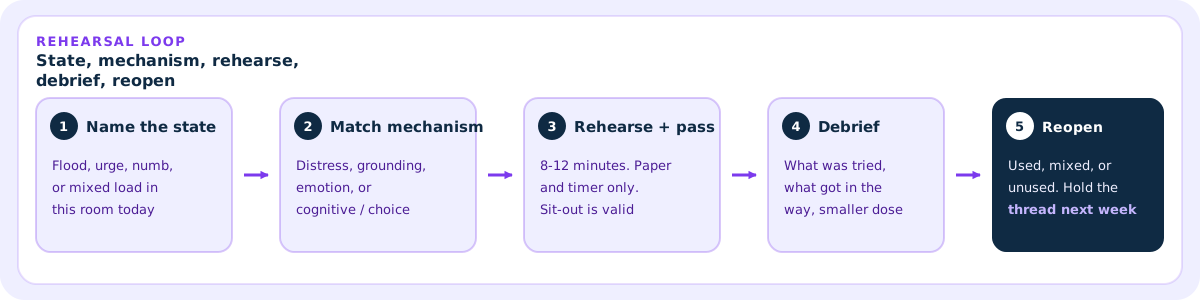
Materials for every card: paper, a timer, the chairs you already have. Eight to twelve minutes for the task, then debrief. One activity per hour. Name a backup before you start.
Scroll the visual sideways to view the full diagram
Distress tolerance
Shared TIPP demo (8-10 min). Purpose: show four option names (temperature, intense exercise, paced breathing, paired muscle relaxation) without forcing a dive. Set-up: facilitator names each option; the room watches one safe demo (paced breathing or paired muscle relaxation). Pass: watch only. Stop temperature and intense exercise for medical or flooding risk. Debrief: which option stayed possible, which felt like a demand, what would make a pass safer, what to try privately if anything. Continuity: reopen whether the named option was used, mixed, or refused.
Urge-surf as group observation (8-12 min). Purpose: watch an urge rise and fall without acting it out. Set-up: members pick a mild current urge or a remembered 4/10 urge, not a trauma peak. Eyes open. Pass: keep the urge unnamed. Debrief: where it peaked, what helped it fall, what almost became action, what support would be needed outside. Continuity: one observation to check next week, including “I did not surf.”
STOP as a spoken interrupt (8-10 min). Purpose: a spoken beat (stop, take a step back, observe, proceed mindfully) as an in-room interrupt, not a worksheet. Set-up: practice on a low-stakes cue from this hour. Pass: say “pass” instead of the four words. Debrief: which beat was usable, where shame showed up, whether the room rushed “proceed mindfully,” what the interrupt protects. Continuity: one cue the member might meet before next group.
Grounding
External 5-4-3-2-1, eyes-open option (8-10 min). Purpose: present orientation through sight, sound, touch, smell, taste without closing the room’s eyes. Set-up: count from the actual room. Pass: name one sense only, or none. Debrief: which sense held, which became searching, whether eyes-closed would have cost contact, what to reuse if anything. Continuity: one external cue to notice on the way out, not a homework scan.
Object orienting (8-10 min). Purpose: rest attention on one object already in the room. Set-up: each person chooses a chair rail, cup, floor tile, or similar. No sharing objects. Pass: keep hands still and watch. Debrief: what the object did for contact, when attention left, whether naming it out loud supported contact or felt performative, what would be too much. Continuity: the same object class next week, including unused.
Paced breathing with opt-out (8-10 min). Purpose: optional slow exhale, never a test of calm. Set-up: offer a count; invite people to keep their own breath. Pass: sit with feet on the floor and skip the count. Debrief: did the count help, did it spike, what the opt-out protected, what a smaller dose would be. Continuity: reopen breath only if the member wants it, not as a group loyalty ritual.
Emotion regulation
Private emotion mapping (10-12 min). Purpose: name one feeling on paper. No forced read-aloud. Set-up: one word or one body location. Pass: a blank page. Debrief: what made mapping possible, what would have been exposure, whether privacy held, what the blank page said. Continuity: same map next week, filled or still blank.
0-10 intensity with a pass (8-10 min). Purpose: rate intensity without explaining the story. Set-up: write a number, or pass. Do not collect numbers aloud unless someone offers. Debrief: what the number did, whether comparison entered the room, who needed not to rate, what a two-point shift would mean. Continuity: the number, the pass, or the refusal as next week’s starting data.
Opposite-action micro-step inside the room (8-12 min). Purpose: after naming one emotion and its action urge, try one opposite move that stays in this hour, only if the emotion does not fit the facts or acting on the urge would not help. Example: if shame is pulling the gaze to the floor, lift the eyes to a neutral point in the room for one breath. Set-up: the member names the urge first, then chooses the move. Pass: no move. Debrief: was it opposite to the urge or self-punishment, did the room applaud too fast, what would be smaller, what to leave here. Continuity: only reopen a move the member named.
Cognitive and choice
One-thought pause (8-10 min). Purpose: catch one thought without a thought record. Set-up: write the thought in six words or fewer. Pass: skip writing. Debrief: did naming it shrink it or glue it, what appraisal sat under it, whether the pause stayed kind, what not to analyze. Continuity: one thought to notice, not a log.
Helpful-versus-unhelpful sort with nuance (10-12 min). Purpose: sort one recent move without moral ranking. Set-up: isolation can be rest or avoidance; the member says which it was this time. Pass: no sort. Debrief: where nuance got lost, who was performing “helpful,” what context changed the label, what to keep messy. Continuity: the same move next week, possibly relabeled.
One next action that reopens next week (8-10 min). Purpose: one action small enough to report as used, mixed, or unused. Set-up: write it in one line. Pass: no action. Debrief: is it actually doable, is it a performance for the circle, what support it needs, what unused would mean. Continuity: that line is the first review item next hour.
One shared task is enough. If you stack three, you are running a list again.
Debrief and next-week reopen
Used, mixed, or unused. All three belong in the reopen. Do not grade sincerity when you bring coping skills group activities back next week. Do not make the unused skill a public confession.
Ask four questions, then stop:
- What did you actually try, if anything?
- What got in the way without turning it into character?
- What would a smaller dose look like?
- What do you want me to ask next week?
A pass this week is still a thread. Continuity is holding the story across the gap, not insisting the skill “worked.”
Privacy, documentation, and safety
Record the shared intervention once, then each member’s response pattern: rehearsed, mixed, sat out, flooded, needed a smaller dose. Do not paste the circle’s speech into every chart.
Nobody photographs anyone else’s page. A shared table does not make private writing communal. No PHI through consumer email or SMS. This pack is not monitored in real time.
This pack is not a crisis service and not a substitute for the agreed safety plan.
How Emosapien carries the skill between groups
Emosapien keeps the skill the member agreed to try visible for the next group, so the clinician reopens what actually happened instead of a reconstructed circle summary. Between-session check-ins, journaling, and homework sit with the Engagement Agent. Notes still need human sign-off.
The therapist chooses the activity, the pass language, and whether a member belongs in the room. Emosapien does not run the hour, score skills, or monitor crisis.
After the pack, keep the named skill visible between groups.
Use the printable facilitator pack
Keep the menu on paper at the desk. The printable pack for coping skills group activities is four US Letter pages: twelve activities by mechanism, timing and pass options, debrief prompts, and a one-page facilitator worksheet (room state, primary and backup, pass language, what to document, next-week reopen).
The PDF is a printed facilitation plan for the hour, not client homework.
Email me the facilitator pack
Get the twelve-activity menu, timing and pass language, debrief prompts, and a one-page facilitator worksheet.
- Twelve timed in-room rehearsals across four mechanisms
- Pass language, stop conditions, and next-week reopen prompts
- One-page facilitator worksheet for room state, backup, and documentation
Free. We'll email the PDF link right away and add you to the therapist toolkit, sent every two weeks. Unsubscribe any time.
Where should we send the link?
We'll email the PDF link right away. You'll also get the therapist toolkit every two weeks. Unsubscribe any time.
✓ Check your inbox
We've sent you the PDF
The download link is on its way to your inbox, usually within a minute or two. The email will come from Emosapien (hello@team.emosapien.com); check your spam folder if you don't see it.
You're also on the therapist toolkit list, sent every two weeks. Unsubscribe any time from the email footer.
References
- Folkman, S. (1984). Personal control and stress and coping processes. Journal of Personality and Social Psychology.
- Linehan, M. M. (2025). DBT Skills Training Manual (Revised Edition). Guilford.
- Substance Abuse and Mental Health Services Administration. TIP 41: Substance Abuse Treatment and Group Therapy.
- Substance Abuse and Mental Health Services Administration. Six guiding principles for a trauma-informed approach.
- Association for Specialists in Group Work. Guiding group work.