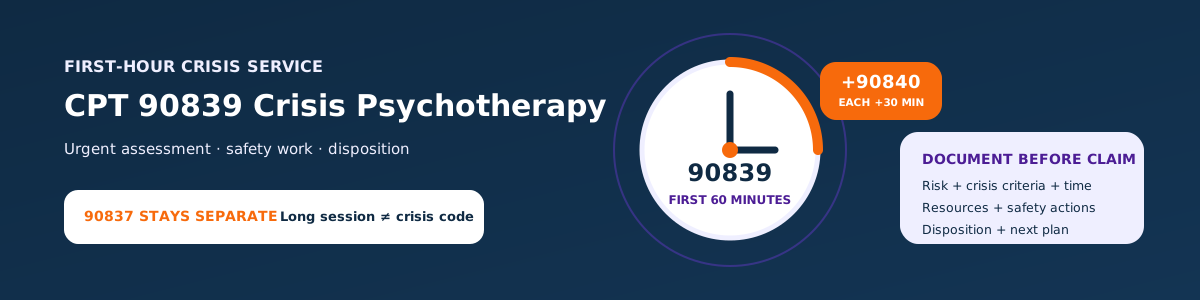
CPT 90839 Crisis Psychotherapy: Time, 90840, and Notes

Outline
A routine 60-minute template is the wrong default when the client arrives in acute distress, imminent risk, or a life-threatening bind that cannot wait for next week’s slot. CPT 90839 crisis psychotherapy exists for that encounter: urgent assessment, safety work, and disposition, timed and documented as crisis care rather than a longer ordinary session.
This guide covers when the crisis family applies, first-hour and 90840 add-on timing, same-day exclusions against routine psychotherapy and diagnostic-evaluation codes, the crisis-note elements reviewers expect, and a printable crisis-session time log with a documentation checklist. Use the CPT codes for therapists hub for the wider map when you need adjacent psychotherapy and E/M context. Out-of-network clients still need a superbill template that shows 90839, not 90837.
Free PDF: CPT 90839 Crisis Session Time Log and Documentation Checklist
A printable crisis-session time log for CPT 90839 and 90840: crisis-criteria gate, non-continuous minute rows, risk and resource fields, disposition, and a pre-claim checklist.
- Crisis-versus-routine gate and encounter identity block
- Non-continuous face-to-face crisis time rows for 90839 and 90840
- Risk, resources mobilized, and disposition fields
- Pre-claim documentation checklist with three worked unit patterns
Free. We'll email the PDF link right away and add you to the therapist toolkit, sent every two weeks. Unsubscribe any time.
Where should we send the link?
We'll email the PDF link right away. You'll also get the therapist toolkit every two weeks. Unsubscribe any time.
✓ Check your inbox
We've sent you the PDF
The download link is on its way to your inbox, usually within a minute or two. The email will come from Emosapien (hello@team.emosapien.com); check your spam folder if you don't see it.
You're also on the therapist toolkit list, sent every two weeks. Unsubscribe any time from the email footer.
Educational reference for licensed US mental-health clinicians and the billing staff who support them. CPT descriptors, credentialing, place-of-service rules, and payer coverage vary. Verify current rules against official AMA CPT guidance, CMS Physician Fee Schedule materials, and your local coverage determinations before billing. This page is not legal, coding, or clinical advice for a specific case.
Crisis disposition can include a board complaint later. Prescribing clinicians should keep psychiatric malpractice insurance next to the crisis log, not inside it.
What CPT 90839 actually covers
In AMA CPT structure, 90839 is psychotherapy for crisis, first 60 minutes. 90840 is each additional 30 minutes and must be used with 90839.
CMS describes Medicare-covered psychotherapy for crisis as work that helps reduce a patient’s mental health crisis through:
- An urgent assessment and history of a crisis state
- A mental status exam and psychotherapy
- Mobilizing resources to defuse the crisis and restore safety
- Interventions that minimize the potential for psychological trauma
CMS also states these services are appropriate for patients in high distress with life-threatening, complex problems that require immediate attention. That clinical bar is the point of CPT 90839 crisis psychotherapy. Intensity alone is not enough if the presentation is a difficult but non-crisis therapy hour.
90839 is not a synonym for “the session ran long.” It is not automatic whenever you complete a risk screen. It is the timed crisis service when the encounter meets crisis criteria and you deliver and document that service.
Crisis versus routine psychotherapy
Keep two lanes clear.
| Code path | What it is | Typical clock | Clinical signal |
|---|---|---|---|
| 90832 / 90834 / 90837 | Individual psychotherapy | Face-to-face bands under ordinary psychotherapy time rules | Planned or routine therapy work |
| 90839 / 90840 | Psychotherapy for crisis | First 60 minutes, then each additional 30 minutes | Urgent crisis assessment, safety work, resource mobilization, disposition |
| 90791 / 90792 | Psychiatric diagnostic evaluation | Untimed diagnostic evaluation service | New or reopened diagnostic evaluation, not the crisis add-on path |
If the encounter was a standard hour that reached 53 minutes or more without a true crisis presentation, stay on the 90837 individual psychotherapy path. If the encounter was crisis care, use 90839 with 90840 when time supports the add-on. Do not convert a long trauma-processing session into 90839 only because the work was emotionally intense.
When risk is the clinical question and you need a structured assessment tool, pair the clinical workflow with your suicide risk assessment template process. The template supports assessment content. The CPT family still follows the service you delivered. The sequence for the hour, once you have decided it is crisis care, is the crisis intervention model.
Unit logic for 90839 and 90840
CMS instructs clinicians to report the time spent with the patient furnishing psychotherapy for crisis services, even when that time on the date of service is not continuous. Total the face-to-face crisis blocks on that date.
Use one clock for qualifying crisis work on a CPT 90839 crisis psychotherapy claim:
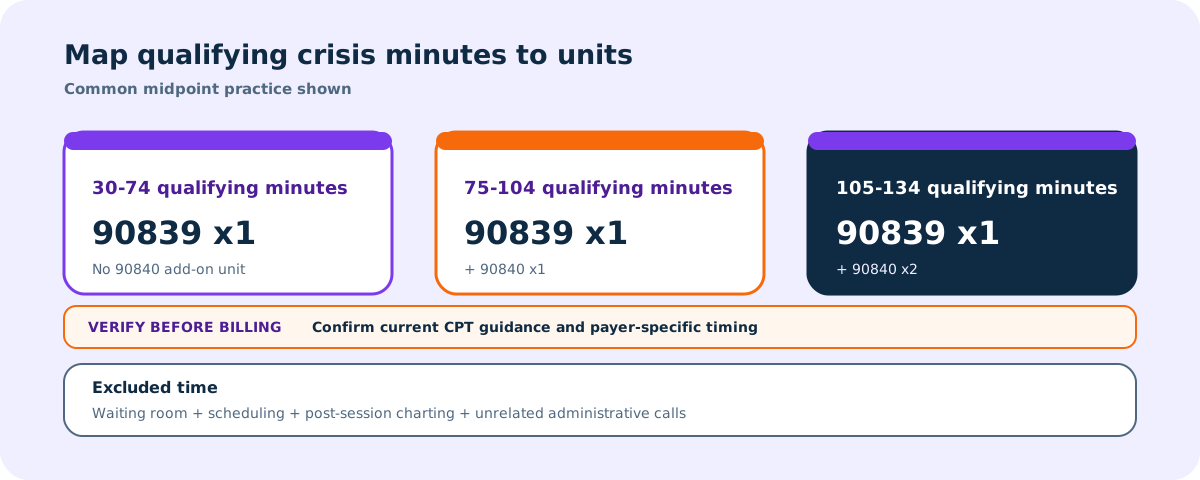
- Count crisis face-to-face time. Urgent assessment and history of the crisis state, mental status exam, psychotherapy directed at the crisis, resource mobilization, and safety-focused intervention with the patient.
- Exclude non-qualifying minutes. Waiting-room time, pure scheduling, charting after the patient leaves, and unrelated administrative calls do not extend the crisis clock.
- Apply midpoint timing carefully. Common CPT midpoint practice for a 60-minute first unit treats roughly 30 to 74 minutes as the first-hour band. 90840 typically attaches once total crisis time reaches about 75 minutes, then each additional 30-minute block. Verify the active CPT timing rule and payer policy before claim submission.
- Report 90839 once per date of service when the crisis service is the path you are on, then add 90840 units the total minutes support.
- Stop when the crisis service ends. A later same-day routine therapy hour is a different coding problem, not free 90840 time, and CMS exclusion language keeps crisis and routine psychotherapy families from stacking on the same crisis claim path.
Worked unit example 1: single continuous crisis hour
A client presents after an acute suicidal crisis with active ideation, recent attempt planning, and no reliable safety plan. The clinician completes urgent history and mental status, conducts risk-focused psychotherapy, contacts emergency supports with the client, and documents disposition over 68 continuous face-to-face minutes. Qualifying crisis time is 68 minutes. Claim pattern under common midpoint math: 90839 x 1, no 90840. The note names the crisis, risk findings, interventions, resources mobilized, total time, and next-step disposition.
Worked unit example 2: non-continuous same-day crisis blocks
Morning block: 40 minutes of face-to-face crisis assessment and safety work after an emergency walk-in. Afternoon return the same day: 45 more minutes completing safety planning, collateral contact with consent, and disposition. Qualifying crisis time is 85 minutes across non-continuous blocks. Claim pattern under common midpoint math: 90839 x 1 and 90840 x 1. The chart ties both blocks to the same crisis date of service and lists start/stop or minutes for each block.
Worked unit example 3: the denial pattern to avoid
A therapist bills 90839 for a scheduled 60-minute session that covered ordinary anxiety exposure work, with a brief PHQ-9 score comment and no imminent-risk narrative, no resource mobilization, and no crisis disposition. The claim is vulnerable because the service reads as routine psychotherapy. Fix the coding path: keep 90834 or 90837 when that is the service delivered, or build a true crisis encounter with crisis criteria, interventions, resources, time, and disposition when that is the service delivered.
Same-day exclusions and adjacent codes
CMS is explicit about codes that do not pair with psychotherapy for crisis on the crisis billing path. Do not bill crisis codes with:
- 90791 psychiatric diagnostic evaluation
- 90792 psychiatric diagnostic evaluation with medical services
- The psychiatric services and procedures range that includes interactive complexity and other listed psychiatric procedure codes in CMS guidance
- Routine psychotherapy codes 90832 through 90838
That means a same-day claim cannot treat the encounter as both a full crisis service and a routine 90837, or as both crisis psychotherapy and a fresh 90791 diagnostic evaluation, under the CMS exclusion list. Choose the service that matches the work, and write the note to that service.
Adjacent facts to keep straight:
- 90840 never stands alone. It always rides with 90839.
- Telehealth is allowed when requirements are met. CMS states crisis psychotherapy may be furnished via telehealth if all telehealth rules are satisfied. Document modality, place of service, and any required modifier.
- Site-of-service nuances exist. CMS discusses facility and non-facility locations and separate HCPCS G0017 and G0018 pathways for certain non-office non-facility sites with different payment percentages. Confirm current CMS and MAC instructions before using those G-codes.
- Who may furnish the service depends on credentialing. Medicare lists physicians and specified non-physician practitioners who can diagnose and treat mental illness. Scope, state law, and payer enrollment still control your practice.
Documentation components reviewers look for
A defensible crisis chart answers six questions without hunting through free text.
- Why crisis now. High distress, life-threatening or complex problems, and the need for immediate attention, stated in clinical language.
- Urgent assessment and mental status. Focused history of the crisis state and MSE findings that support acuity.
- Risk picture. Ideation, intent, plan, means, protective factors, aggression risk, or other imminent concerns when relevant, with enough detail to support medical necessity without dumping unnecessary graphic detail.
- Interventions and resources mobilized. What you did in session and which supports, emergency services, collaterals, or higher levels of care you activated.
- Time. Total qualifying face-to-face crisis minutes, or start and stop blocks, limited to this service family on this date.
- Disposition. What happens next for the patient: safety plan actions, emergency evaluation, hospitalization pathway, follow-up timing, or return precautions.
Pair the procedure code with ICD-10-CM diagnoses the encounter supports. A vague adjustment code with no crisis narrative weakens both the clinical chart and the claim.
Common denial and audit patterns
- Long routine session coded as crisis. Emotional intensity is not the CMS crisis bar. Keep ordinary hours on 90834 or 90837.
- Crisis content with no time log. Reviewers cannot defend 90839 or 90840 without minutes.
- Time log with no crisis elements. Minutes alone do not create medical necessity for crisis psychotherapy.
- Stacked families on the same encounter. Crisis codes plus 90837 or 90791 on the excluded path invite denial.
- 90840 without 90839, or 90840 before the time threshold. Add-on rules are strict.
- Missing disposition. Crisis work without a next-step plan reads incomplete.
- Credential or site mismatch. Rendering provider and place-of-service rules must match who furnished the service and where.
A code-family stack is fixed by taking the wrong code off the claim. A medical-necessity denial of a service you did deliver needs an appeal letter that quotes the crisis note.
Use the crisis-session time log and checklist
The printable crisis-session time log puts crisis-versus-routine decision checks, non-continuous time rows for 90839 and 90840, risk and resource fields, disposition lines, and a pre-claim documentation checklist on one page with the three worked patterns above. Run it before any crisis psychotherapy claim leaves the practice, then store the completed log with the encounter workpapers if your compliance process keeps billing checklists.
Free PDF: CPT 90839 Crisis Session Time Log and Documentation Checklist
A printable crisis-session time log for CPT 90839 and 90840: crisis-criteria gate, non-continuous minute rows, risk and resource fields, disposition, and a pre-claim checklist.
- Crisis-versus-routine gate and encounter identity block
- Non-continuous face-to-face crisis time rows for 90839 and 90840
- Risk, resources mobilized, and disposition fields
- Pre-claim documentation checklist with three worked unit patterns
Free. We'll email the PDF link right away and add you to the therapist toolkit, sent every two weeks. Unsubscribe any time.
Where should we send the link?
We'll email the PDF link right away. You'll also get the therapist toolkit every two weeks. Unsubscribe any time.
✓ Check your inbox
We've sent you the PDF
The download link is on its way to your inbox, usually within a minute or two. The email will come from Emosapien (hello@team.emosapien.com); check your spam folder if you don't see it.
You're also on the therapist toolkit list, sent every two weeks. Unsubscribe any time from the email footer.
How Emosapien supports crisis-adjacent documentation
Emosapien structures therapy notes around presentation, intervention, client response, risk, and plan so high-acuity content does not disappear into unstructured free text. The clinician still owns code selection, crisis-versus-routine judgment, unit math, and the final signed note. The product helps the surrounding chart stay complete so risk wording, safety actions, and follow-up plans remain readable for the next session and for audit review. Create a free clinician account to review the session-documentation workflow on your own cases.
Used well, CPT 90839 crisis psychotherapy is a clinical-criteria and documentation problem more than a mystery code. Meet the crisis bar, count only crisis face-to-face time, keep excluded code families off the claim, write the disposition, and the claim has a chart behind it.
References
- American Medical Association. Current Procedural Terminology (CPT) code set.
- Centers for Medicare & Medicaid Services. Psychotherapy for Crisis.
- Centers for Medicare & Medicaid Services. Physician Fee Schedule lookup.