
Superbill Template for Out-of-Network Therapy

Outline
A superbill template is an itemized out-of-network (OON) statement a licensed US therapist gives a client so the client can seek reimbursement. The client has already paid the practice. Give the client a completed superbill template after they have paid, not a second invoice. Licensed US mental-health clinicians and the billing staff who support them complete this document. Clients ask their plan how and when to file.
The pack names every required box, shows one fictional outpatient example, and keeps psychotherapy notes off the statement. Use the CPT codes for therapists guide to choose the service family. The statement only records the service you already chose. A couples hour is still an itemized statement if the client paid you and will file the claim. Whether the plan treats that hour as covered is a different question: insurance coverage for couples therapy.
Email me the OON statement pack
Get the fillable statement, required-field checklist, worked therapy example, and short client instruction sheet.
- Fillable therapy superbill with practice, provider, client, and service-row fields
- Required-field checklist for NPI, tax ID, POS, modifier, CPT, ICD-10, and amount paid
- Fictional in-office 90837 and telehealth 90834 worked example
- Short client instruction sheet that does not promise reimbursement
Free. We'll email the PDF link right away and add you to the therapist toolkit, sent every two weeks. Unsubscribe any time.
Where should we send the link?
We'll email the PDF link right away. You'll also get the therapist toolkit every two weeks. Unsubscribe any time.
✓ Check your inbox
We've sent you the PDF
The download link is on its way to your inbox, usually within a minute or two. The email will come from Emosapien (hello@team.emosapien.com); check your spam folder if you don't see it.
You're also on the therapist toolkit list, sent every two weeks. Unsubscribe any time from the email footer.
Educational resource for licensed US mental-health clinicians and the billing staff who support them. CPT descriptors, place-of-service rules, NPI enumeration, and payer OON benefits change. Verify current requirements before you issue a statement. This is not a claim form, not legal advice, and not a reimbursement guarantee.
Superbill versus invoice versus CMS-1500
Define the document before you fill it.
| Document | Who it is for | What it is |
|---|---|---|
| Superbill | The client, then the client’s plan | Itemized OON statement after payment |
| Invoice or receipt | The client | What they owe or already paid you |
| CMS-1500 / 837P | The payer | A practice-to-payer claim |
The client already paid. This is not a bill and not a practice-to-payer claim. Use insurance billing for therapists for in-network eligibility, clearinghouse submission, remittance, and denials. Give an OON client the completed statement after payment.
What belongs on a superbill template
Walk the blocks in order. Identity, NPI, tax ID, POS, CPT, and amount paid have to match the chart and payer records.
What is a superbill for therapy
A superbill for therapy is a client-facing, itemized out-of-network statement that records the care you provided and the amount the client paid. It is not the same as a CMS-1500 claim, which the National Uniform Claim Committee identifies as a health insurance claim form for payer submission (CMS, CMS-1500 form). Use the completed statement to give the client the information their plan asks for; keep psychotherapy notes and extra clinical narrative in the chart.
How does a superbill work for insurance
When a client seeks out-of-network reimbursement, the client checks the plan’s current instructions, completes the plan’s member claim form if required, and submits the completed superbill with proof of payment. UnitedHealthcare’s current member reimbursement page says its form is only for out-of-network claims and asks for the amount charged and date for each service, an easy-to-read claim, record, or receipt, and proof of payment with procedure or service codes or a service description when applicable. Plans differ, so tell the client to confirm the filing method, deadline, required attachments, and out-of-network benefits with the plan before filing.
Practice block. Legal practice name, the official practice or service address that matches enrollment and payer records, phone, EIN or tax ID, and the organization NPI-2 when the practice uses one. A home-based practice may list that home address when it is the enrolled location.
Provider block. Rendering clinician name, credentials, license number plus state, and the individual NPI-1. NPI-1 is the Type 1 enumeration for an individual. NPI-2 is the Type 2 enumeration for an organization. Confirm the NPI and provider or entity match in the NPPES NPI Registry. CMS describes Type 1 and Type 2 in its NPI fact sheet.
Client block. Legal name as it appears on the plan, date of birth, member ID, and payer name. List the diagnosis as an ICD-10 code. A short diagnosis title is optional. Do not paste the clinical formulation.
Service table. One row per date of service: date, place of service (POS), CPT, modifier, ICD-10 pointer, fee, amount paid.
Close. Totals, provider signature, date, and a one-line statement that this is not a bill and not a guarantee of payment.
Scroll the visual sideways to view the full diagram
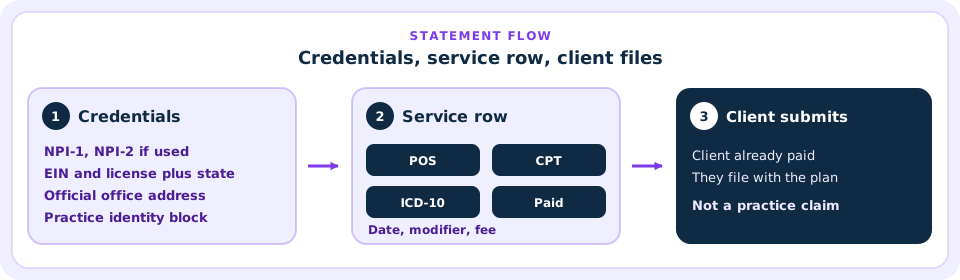
NPI, tax ID, POS, and amount paid
- NPI-1 versus NPI-2. Put the rendering clinician on NPI-1. Add NPI-2 only when the organization is on the statement. Confirm the NPI and provider or entity match in NPPES. NPPES is a registry lookup, not a checksum test.
- EIN versus SSN. The tax ID on the statement must match the practice W-9 and payer records. A sole proprietor may use an SSN when it is the tax ID on the practice’s W-9 and payer records. The digits still have to match.
- POS. CMS place of service codes distinguish office (11) from telehealth. Use POS 10 when the client was at home, POS 02 when telehealth was elsewhere, POS 11 for in-office care.
- Modifier. Add 95 or a payer-required GT only when that plan still requires a telehealth modifier on a real-time video row. Pair video rows with the CPT 95 modifier for telehealth. Check the plan before you print 95 as a default.
- Amount paid. Enter what the client actually paid, not the fee you wish had posted.
CPT on the row must match documented time and service family. Use psychotherapy CPT time rules to distinguish 90834 from 90837. The statement only prints the code you already selected.
Worked outpatient therapy example
Illustrative only. Names, NPIs, and member IDs are fake. Verify current CPT descriptors and payer rules before you copy a row.
Practice. Cedar Hollow Therapy, PLLC, 100 Example Ave, Austin, TX 78701. EIN 00-0000000. Practice NPI-2 0000000000. Phone (512) 555-0100. Email billing@example.org.
Provider. Alex Rivera, PhD. License LP 00000, Texas. Individual NPI-1 0000000001.
Client. Jordan Lee. DOB 01/01/1985. Member ID EX-000000000. Payer: Example Health Plan. ICD-10 F41.1.
| Date | POS | CPT | Modifier | ICD-10 | Fee | Amount paid |
|---|---|---|---|---|---|---|
| 03/04/2026 | 11 | 90837 | none | F41.1 | $180 | $180 |
| 03/18/2026 | 02 | 90834 | 95 | F41.1 | $150 | $150 |
The first row is in-office 90837. The second is telehealth 90834 with POS 02 and modifier 95 as one common commercial pairing. Fee and amount paid match because this client paid in full at the visit. These rows are illustrative only. Verify current CPT descriptors and payer rules.
Common denial drivers
Preventable OON problems on this document are identity and field mismatches: names, NPI, POS, modifiers, CPT and time, and amount paid.
- Name mismatch. Nickname on the statement, legal name on the plan.
- Missing or wrong NPI. Blank NPI-1, swapped NPI-1/NPI-2, or digits that do not match NPPES.
- Wrong POS. Office code on a video hour, or home telehealth billed as POS 02 when the payer wants POS 10.
- Missing telehealth modifier. Video row with no telehealth modifier when that payer still requires 95 or GT.
- CPT and time mismatch. 90837 on a 40-minute note is a timed-psychotherapy error. 90837 on a documented urgent crisis assessment, safety work, resource mobilization, and disposition is a service-family error that belongs on 90839. Code choice follows the crisis service delivered, not duration alone.
- Unpaid versus charged. Fee listed as paid when the client still owes the balance.
Fix the row and reissue the statement before the client files.
What never goes on the statement
Keep the chart in the chart.
- Psychotherapy notes and extra clinical narrative
- A mailing-only address that does not match enrollment when the payer expects the enrolled service location
- Nicknames, preferred names that do not match the plan, or informal email handles as the legal name
- 42 CFR Part 2 protected substance-use narrative or records when Part 2 applies
- A diagnosis lecture, rule-out paragraph, or risk narrative
ICD-10 supports medical necessity without dumping the note. When Part 2 applies, keep protected SUD narrative in the chart. Do not put it on the statement. A code on this statement is not the letter a plan asks for before it will cover a service. When they want that letter, use a medical justification letter for therapy written from the chart.
How often to issue
Issue a completed superbill per session when POS or modifier can change. A monthly recap is workable when every row still carries its own date, POS, CPT, modifier, ICD-10 pointer, fee, and amount paid.
Write the cadence in the financial policy. Do not improvise it in the waiting room. Tell the client, once, that the practice cannot promise what the plan will pay.
How documentation support fits
Emosapien helps the clinician produce a signed, therapy-shaped note so the CPT and ICD-10 on the statement match the chart. The therapist still chooses codes, fees, and whether to issue the document. The product does not file out-of-network claims, run eligibility, or replace a clearinghouse.
After you have the pack, see pricing.
Use the printable pack
The printable pack is four US Letter pages: fillable statement, required-field checklist, worked example, and a short client instruction sheet. The fields above are the same fields in this superbill template PDF. Do not treat the PDF as a CMS-1500.
How to make a superbill
A practical office workflow is to start with practice and rendering-provider details that match your enrollment records, add the client’s plan-facing identity and ICD-10 code, and then record each date of service in its own row. Use CPT, POS, modifier, fee, and amount-paid fields that match the chart and payment record. This is a documentation workflow, not a universal payer requirement: confirm the plan’s current form, filing instructions, and required fields before issuing the statement. The CMS NPI fact sheet distinguishes the individual NPI-1 from the organization NPI-2 (CMS, NPI fact sheet), and CMS publishes the current place-of-service code set (CMS, Place of Service code sets).
Treat the pack as educational. It is not a claim form, not legal or reimbursement advice, and not a crisis service.
Email me the OON statement pack
Get the fillable statement, required-field checklist, worked therapy example, and short client instruction sheet.
- Fillable therapy superbill with practice, provider, client, and service-row fields
- Required-field checklist for NPI, tax ID, POS, modifier, CPT, ICD-10, and amount paid
- Fictional in-office 90837 and telehealth 90834 worked example
- Short client instruction sheet that does not promise reimbursement
Free. We'll email the PDF link right away and add you to the therapist toolkit, sent every two weeks. Unsubscribe any time.
Where should we send the link?
We'll email the PDF link right away. You'll also get the therapist toolkit every two weeks. Unsubscribe any time.
✓ Check your inbox
We've sent you the PDF
The download link is on its way to your inbox, usually within a minute or two. The email will come from Emosapien (hello@team.emosapien.com); check your spam folder if you don't see it.
You're also on the therapist toolkit list, sent every two weeks. Unsubscribe any time from the email footer.
References
- American Medical Association. Current Procedural Terminology (CPT) code set.
- Centers for Medicare & Medicaid Services. Place of Service code set.
- Centers for Medicare & Medicaid Services. National Plan and Provider Enumeration System (NPPES) NPI Registry.
- Centers for Medicare & Medicaid Services. NPI fact sheet (Type 1 individual and Type 2 organization).