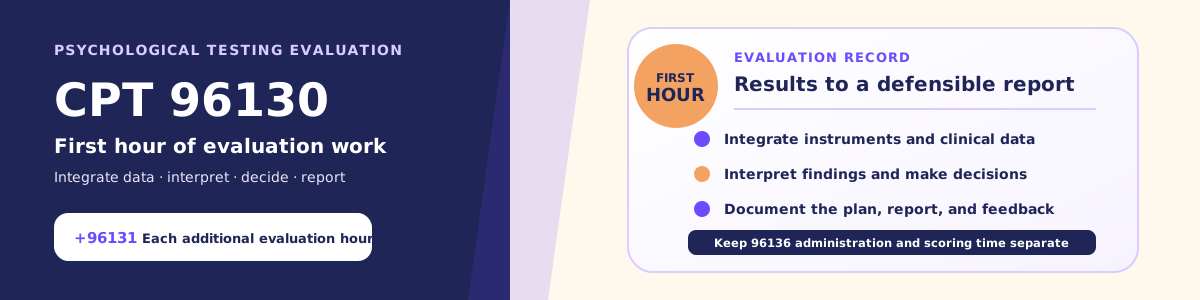
CPT 96130 Psychological Testing: Evaluation Units and Documentation

Outline
CPT 96130 psychological testing evaluation is easy to miscode because practices collapse three different jobs into one vague “testing” label: who administered the instrument, who scored it, and who integrated the results into a clinical decision and written report. Those jobs sit in different CPT families.
This guide separates evaluation from administration, shows first-hour and add-on unit logic for 96130 and 96131, maps the documentation components a reviewer expects, and includes a printable unit and documentation worksheet with worked examples. Use the CPT codes for therapists hub for the surrounding code map when you need the wider psychotherapy and E/M index.
Free PDF: CPT 96130 Unit and Documentation Worksheet
A printable unit-math and documentation worksheet for psychological testing evaluation: evaluation versus administration, midpoint hours, instrument log, and report checks.
- Evaluation-versus-administration split for 96130 and 96136
- Time log and midpoint unit helper for 96130 and 96131
- Nine-point documentation checklist before claim submission
- Three worked claim patterns including multi-day episodes
Free. We'll email the PDF link right away and add you to the therapist toolkit, sent every two weeks. Unsubscribe any time.
Where should we send the link?
We'll email the PDF link right away. You'll also get the therapist toolkit every two weeks. Unsubscribe any time.
✓ Check your inbox
We've sent you the PDF
The download link is on its way to your inbox, usually within a minute or two. The email will come from Emosapien (hello@team.emosapien.com); check your spam folder if you don't see it.
You're also on the therapist toolkit list, sent every two weeks. Unsubscribe any time from the email footer.
Educational reference for licensed US psychologists and other qualified health care professionals authorized to perform psychological testing evaluation, plus the billing staff who support them. CPT descriptors, credentialing, and payer coverage vary. Verify current rules against official AMA CPT guidance, the CMS Physician Fee Schedule, and your local coverage determinations before billing.
Testing evaluation also changes what a carrier has to have named on the policy. Before you bill 96130, confirm the testing column on psychologist malpractice insurance.
What CPT 96130 actually covers
In the AMA CPT structure, CPT 96130 psychological testing evaluation is the first hour of services by a physician or other qualified health care professional. The service includes integration of patient data, interpretation of standardized test results and clinical data, clinical decision making, treatment planning and report work, and interactive feedback to the patient, family member, or caregiver when performed.
That list is the clinical product. 96130 is not a code for handing a client a checklist during psychotherapy. It is not automatic reimbursement for every validated measure you file in a chart. It is the professional evaluation work that turns standardized results and clinical data into an integrated opinion, plan, and report.
96131 is the add-on for each additional hour of the same evaluation service. The first-hour code is used once for the evaluation episode, even when the assessment stretches across more than one calendar day. Additional hours attach with 96131 only when the documented evaluation time supports them.
Evaluation versus administration: keep the families separate
The single highest-value distinction on this page is evaluation versus test administration and scoring.
| Code family | What it is | Typical unit | Who performs it |
|---|---|---|---|
| 96130 / 96131 | Psychological testing evaluation, interpretation, decision making, report, feedback | First hour, then each additional hour | Physician or other qualified health care professional |
| 96136 / 96137 | Test administration and scoring by a qualified health professional | First 30 minutes, then each additional 30 minutes | Qualified health professional |
| 96138 / 96139 | Test administration and scoring by a technician | First 30 minutes, then each additional 30 minutes | Technician under applicable supervision rules |
| 96132 / 96133 | Neuropsychological testing evaluation | First hour, then each additional hour | Physician or other qualified health care professional |
If the work was mostly giving and scoring instruments, start with the 96136/96137 test administration and scoring path, not 96130. If the work was integrating results, writing the report, and making clinical decisions, stay with CPT 96130 psychological testing evaluation and 96131. When both families apply in one episode, split the time and the narrative so a reviewer can see two distinct services.
How CPT 96130 differs from 90791 and routine measures
A psychiatric diagnostic evaluation under 90791 opens an episode of care with history, mental status, risk, diagnosis, and plan. It is not a timed psychological testing evaluation code. A printable treatment summary therapy template closes a psychotherapy episode; 96130 is a testing-evaluation report, not that closing document. Do not convert a standard intake into 96130 because a PHQ-9 or GAD-7 sat in the packet. A catalog of measures by domain, without converting the hour into 96130, lives on the list of psychological assessment measures.
Routine measurement-based care inside psychotherapy usually supports medical necessity on the psychotherapy claim. It does not, by itself, create a standalone testing-evaluation encounter. Use this evaluation family when the encounter is structured testing evaluation work with standardized instruments, professional interpretation, decision making, and report components that meet the code and the payer’s medical-necessity standard.
Unit logic for 96130 and 96131
Use one clock for evaluation activities that belong to this family:
- Count evaluation work only. Integration of history and prior records, interpretation of standardized results, differential reasoning, treatment planning tied to findings, report drafting or finalization, and interactive feedback when performed.
- Exclude administration and scoring minutes already counted under 96136, 96137, 96138, or 96139.
- Apply midpoint timing for the hour. Under common CPT midpoint practice for a one-hour code, the first unit is reportable at 31 minutes or more of qualifying evaluation time. Additional whole-hour units follow the same midpoint logic for each 96131.
- Bill 96130 once per evaluation episode. Multi-day assessment work still uses one first-hour unit for the episode, then 96131 for documented additional hours.
- Stop the clock when the evaluation ends. Chart review days later for an unrelated therapy session is not free additional 96131 time.
Worked unit example 1: single-day ADHD evaluation
A licensed psychologist reviews referral records (20 minutes), interprets a standardized ADHD battery and rating scales already administered and scored under 96136 (35 minutes), completes differential reasoning and a written report (40 minutes), and provides interactive feedback to the client and partner (25 minutes). Qualifying evaluation time is 120 minutes. Claim pattern: 96130 x 1 and 96131 x 1, with administration remaining on the 96136 line. The note lists instruments, start and stop or total evaluation time, findings, decisions, and report or feedback content.
Worked unit example 2: multi-day learning evaluation
Day 1 includes record review and partial interpretation (50 minutes). Day 2 completes remaining interpretation, decision making, report finalization, and caregiver feedback (70 minutes). Qualifying evaluation time is 120 minutes across the episode. Claim pattern: one 96130 and one 96131 for the episode, not a fresh 96130 on day 2. The chart ties both days to the same assessment episode and keeps technician or QHP administration time off the evaluation clock.
Worked unit example 3: the denial pattern to avoid
A therapist bills 96130 for a 45-minute psychotherapy session that included a PHQ-9 and a brief score comment, with no separate testing evaluation report and no documented evaluation time log. The claim is vulnerable because the service looks like psychotherapy plus a routine measure, not a full testing-evaluation service. Fix the coding path: keep the psychotherapy code when that is the service delivered, or build a true testing-evaluation encounter with instruments, interpretation, decision making, and report documentation when that is the service delivered.
Documentation components reviewers look for
A defensible 96130 chart answers five questions without hunting through free text.
- Medical necessity and referral question. Why testing evaluation was needed now, and what clinical question the battery addresses.
- Instruments and data sources. Named standardized tests, rating scales, records, and interview data integrated into the opinion.
- Time. Total qualifying evaluation time, or start and stop blocks, limited to evaluation activities for 96130 and 96131.
- Interpretation and clinical decision making. Scores in clinical context, differentials considered, and the conclusions the data support.
- Plan, report, and feedback. Treatment or referral recommendations, written report work, and interactive feedback when performed, with the billing clinician’s credentials and signature.
Pair the procedure code with ICD-10-CM diagnoses the evaluation supports. A vague “rule out” without formulation weakens both the clinical chart and the claim.
Credentialing and scope boundaries
96130 sits with physicians and other qualified health care professionals who are authorized to perform psychological testing evaluation. Scope, state licensure, payer enrollment, and supervision rules decide who may bill. Many counselors, social workers, and marriage and family therapists do not bill this family even when they use brief measures in therapy.
Before the first claim, confirm:
- The clinician’s license and payer credentialing cover psychological testing evaluation.
- Any technician administration path uses the correct technician codes and supervision documentation.
- Prior authorization rules for testing, if the payer requires them.
- Whether the case is psychological evaluation (96130 family) or neuropsychological evaluation (96132 family).
This page does not convert an unauthorized clinician into a testing provider. It only organizes coding and documentation once the service is within scope. Holding the license is not the same as enrollment. The therapist insurance credentialing checklist is the path before the first 96130 claim, not a substitute for scope of practice. The profile plans read during that enrollment is the CAQH profile checklist. The tool that builds the claim after enrollment is a separate buy: compare therapist billing software when the question is claims, ERA, and denials rather than the testing code.
Common denial and audit patterns
- Administration minutes billed as evaluation. Move administration and scoring to 96136 or technician codes.
- First-hour code repeated across days of one episode. Use one 96130, then 96131.
- No written synthesis. A score printout without integration, decisions, and report language fails the service definition.
- Psychotherapy note relabeled as testing. If the encounter was therapy, bill the therapy code and keep measures inside that chart narrative unless a separate testing evaluation truly occurred.
- Missing medical necessity. Document the referral question and why standardized evaluation was required beyond a routine intake.
- Credential mismatch. The rendering provider on the claim must match who performed the evaluation service.
Use the unit and documentation worksheet
The CPT 96130 unit and documentation worksheet puts the evaluation-versus-administration split, midpoint unit math, instrument and time log, and report checklist on one printable page with the three worked examples above. Run it before any CPT 96130 psychological testing claim leaves the practice, then store the completed worksheet with the assessment episode if your compliance process uses billing workpapers.
How Emosapien supports testing-adjacent documentation
Emosapien keeps therapy-session notes structured around modality, intervention, client response, risk, and plan. When a practice also runs authorized testing evaluation workflows, the clinician still owns code selection, unit math, and the formal testing report. The product helps the surrounding clinical chart stay complete so assessment findings, treatment recommendations, and later psychotherapy notes do not drift apart. Create a free clinician account to review the session-documentation workflow on your own cases.
Used well, CPT 96130 psychological testing is a documentation and unit problem more than a mystery code. Separate evaluation from administration, count only evaluation time, write the synthesis, and the claim has a chart behind it.
References
- American Medical Association. Current Procedural Terminology (CPT) code set.
- Centers for Medicare & Medicaid Services. Physician Fee Schedule lookup.
- American Psychological Association Services. Psychological and neuropsychological testing billing and coding guidance.