IFS Training for Therapists: Levels, Hours, Cost

Outline
Scroll the table sideways to view every column
| Level | Provider | Format | Hours |
|---|---|---|---|
| IFS Informed | IFS Institute Learning Hub, conference, or a trainer workshop | Course, conference, or workshop. Not a Level training. | Not the Level 1 total. The help center does not assign the approximate 90-hour Level 1 figure to this label. |
| Level 1 | IFS Institute, or a recognized partner for a partner-run cohort | Live. Online, hybrid, or on-site. Several session shapes. | Help center: approximately 90 hours, with supervised practice at about 3 participants to 1 staff. Cohort #1357 brochure (document history 9.17.26): 91 program hours. You must complete 76 of those 91 for that certificate. Read your cohort brochure. |
| Level 2 | IFS Institute, or a partner such as Intimacy from the Inside Out | Live intensive on a named topic. Online or on-site. 5-day, 6-day, and 8-day shapes. | Cohort #1346 brochure (document history 9.17.26): 32 program hours. Complete 27 of 32 for that certificate. Do not treat 32 as every intensive. |
| Level 3 | IFS Institute | Live intensive with advanced practitioners. Online or on-site. | Cohort #1359 brochure (document history 9.17.26): 20 instructional hours plus 7.5 personal growth hours. Complete 16 of the 20 instructional hours for that certificate. |
| Program Assistant | IFS Institute, North American trainings | Volunteer staff role inside a training you have already completed. Not a first seat. | Daily stipend, including, if applicable, scheduled Bridge Days on Level 1. No stipend for a session under two hours. |
| IFS Certification | IFS Institute | Application and review, not a training cohort. Policy effective May 1, 2023, still the published policy. | Minimum 2 years and 200 hours of post-Level 1 practice, plus 15 continuing-education hours after Level 1, plus a 45 to 60 minute recorded or live session. |
Then read the same level across for consultation, cost, the certification step, and what you do next.
Scroll the table sideways to view every column
| Level | Consultation | Cost | Certification step | Your next step |
|---|---|---|---|---|
| IFS Informed | None for this label. | Not one tuition on the training listings. Read the course page before you pay. | Does not make you IFS Trained or Certified. | Use it if you want the lens before a Level 1 seat. |
| Level 1 | In-training practice groups. Not the 15 certification hours. | Institute rows: $3,200 USD (online #1369, Canada), $3,990 (online #1357), $4,200 on several online rows, and $5,240 (hybrid #1328). The #1357 brochure lists a $75 application fee and a $500 deposit. No formal payment plan. | Certificate of completion lets you apply for Level 2 and register certification candidacy. It is not certification. | Apply when you want the IFS Trained label. The Level 1 general application is closed. A submitted application does not expire. |
| Level 2 | Practice inside the intensive. Certification consultation is still separate. | Online #1346: $2,550. Other Institute rows: $2,675, and on-site #1334 in Stevenson, WA at $3,000. Intimacy from the Inside Out rows: $3,200 and $4,200. Those do not use the Institute Level 2 application. | One Level 2 certificate plus Level 1 meets requirement 1. A Level 1 completed as a Program Assistant can replace Level 2. | Wait until you hold a Level 1 certificate. The Institute recommends at least six months after Level 1. The Level 2 general application is closed. |
| Level 3 | In-training practice and feedback. Not one of the five certification requirements. | Online #1359 $2,700, Asheville #1546 $3,050, St. Charles #1380 $3,150, Madison #1290 $4,762. | Not required for certification. | Only after a Level 2 certificate. The Institute recommends at least six months after Level 2. The Level 3 general application is closed. |
| Program Assistant | The role counts toward IFS Certification and Recertification hours, and you can earn continuing-education credits. It does not replace the 15 consultation hours. A Level 1 you complete as a PA can replace Level 2 for requirement 1. | Tuition-free. $155 daily stipend. You must already have graduated from that level. North American applicants need a U.S. Social Security number or a Canadian Social Insurance number. | Substitute path for requirement 1 only, and only for a Level 1 you complete as a PA. | Consider this after Level 1 if Level 2 tuition is the blocker and you can staff a later Level 1. |
| IFS Certification | 15 hours with an Approved Clinical Consultant. At least 7 must be individual. Group consultation may not exceed 6 participants. Your consultant cannot also be your reviewer. | $200 to the Institute ($50 application plus $150 certification), plus $200 paid directly to the reviewer for a session up to 60 minutes. Fees are subject to change. Recertification is $150 every two years. | This is the designation. For the Therapist path you attest to a master's in a human services or appropriate mental health field, and to being licensed, registered, or certified for clinical practice in your country. Certification does not expand your scope. | Open candidacy after Level 1 if you want the 2-year clock documented. Do not wait until Level 2 to learn the five requirements. |
Prices and program details from each provider’s public page, read September 25, 2026.
Email me the professional development plan
One focus theme, one try, one reading, a monthly check-in, and a CPD/CEU log for the training path you just chose.
- Five-line skeleton: focus theme, one try, one reading, monthly check-in, CPD/CEU log
- Four monthly rows that ask whether you tried the move, not how you score
- CPD/CEU log with date, title, provider, hours, and focus-tie column
- Reminder that you set the goals; this is not a ranking or an owner file
Free. We'll email the PDF link right away and add you to the therapist toolkit, sent every two weeks. Unsubscribe any time.
Where should we send the link?
We'll email the PDF link right away. You'll also get the therapist toolkit every two weeks. Unsubscribe any time.
✓ Check your inbox
We've sent you the PDF
The download link is on its way to your inbox, usually within a minute or two. The email will come from Emosapien (hello@team.emosapien.com); check your spam folder if you don't see it.
You're also on the therapist toolkit list, sent every two weeks. Unsubscribe any time from the email footer.
You are choosing a seat, not collecting a vocabulary. IFS training for therapists is that seat decision. If the live question is how Self, protectors, and exiles work in the room, use Internal Family Systems basics for therapists. Forms and parts maps belong on the IFS worksheets guide. Neither one is a training seat.
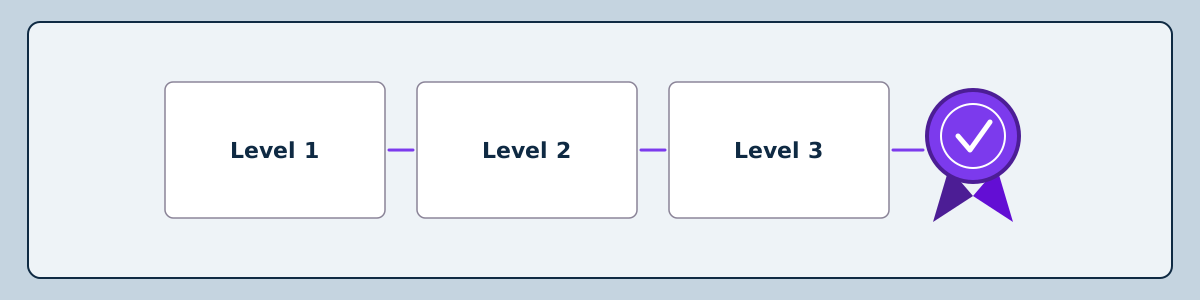
IFS training for therapists is the Institute sequence: Informed learning, Level 1, Level 2, Level 3, and a separate certification file. The training programs page says the levels run from beginning through advanced, and that a certificate of completion is not certification. Completion of Level 1 does not guarantee that you may enter the certification process.
What the IFS Trained label actually requires
The IFS Institute help center draws the line you will be asked to honor.
IFS Informed covers Learning Hub courses, the annual conference, and workshops from IFS trainers. You may take on an IFS lens. The same page says that is not what an IFS Trained therapist or practitioner would do. Examples it gives include helping people build relationships with parts, embody the 8 Cs, or map an inner world, inside the scope your own profession already allows.
IFS Trained requires graduation from Level 1 at minimum. The page says full clinical use of the model is taught in Level 1, over approximately 90 hours, with supervised small practice groups at about a 3-to-1 participant-to-staff ratio. Successful completion also lets you apply for Level 2 and Level 3, serve as a Level 1 Program Assistant, list in the provider directory, and register certification candidacy if you want it.
Do not borrow the Trained label from a weekend workshop. If a client, a consultee, or a directory asks what you completed, name the certificate you hold.
Hours come from the cohort brochure
In IFS training for therapists, treat every hour figure as cohort-specific until the brochure in your hand says otherwise.
Level 1 formats on the learning objectives page include two multi-day sessions, three multi-day sessions, four multi-day sessions plus two single days, six 3-day sessions, and a shape with fourteen 4-hour sessions plus one multi-day session. Those are different calendars. They will not all print the same total.
The brochure for online Level 1 #1357 (Leafy Canopy) carries a document history line of 9.17.26. You must complete 76 of the 91 program hours to earn that certificate. You may miss a maximum of 15 hours. There are no recordings or transcripts for missed hours. The continuing-education line on that brochure is 91.00 contact hours: 19.5 for each of four 3-day sessions, and 6.5 for each of two 1-day sessions, awarded session by session, with full attendance required at the sessions you attend. A different cohort can print a different total. Copy the line from the PDF linked on the cohort page, not from a colleague’s old binder.
Level 2 is the same kind of problem. The Level 2 objectives page lists 5-day, 6-day, and 8-day intensives, plus topic tracks such as trauma, addictions and eating disorders, children and adolescents, and shame, anxiety, and depression. The brochure for online Level 2 #1346, document history 9.17.26, offers 32 program hours and requires 27 of those 32 for the certificate. You may miss a maximum of 5 hours. That is the rule for #1346. It is not a promise about the 5-day track.
Level 3 #1359, document history 9.17.26, includes 7.5 personal growth hours and 20 instructional hours. You must complete 16 of the 20 instructional hours. Continuing education on that brochure is the 20 instructional hours, not the personal-growth block. If you are logging CE for a board, copy the contact-hour line, not the personal-growth line, and then check whether your board accepts the sponsor.
A certificate of completion is not IFS therapy certification
Before you put “certified” on a website, separate IFS training for therapists from the certification file. The training programs page states that earning a certificate of completion is not the same as being IFS Certified, and that Level 1 completion does not guarantee eligibility for certification.
The certification policy, effective May 1, 2023 and still the published policy, and the eligibility help-center article list five requirements. You need all five.
- Training completion. One Level 1 and one Level 2, or one Level 1 and one Level 1 completed as a Program Assistant. Completion means the relevant certificate of completion.
- Post-Level 1 practice. A minimum of 2 years and 200 hours of regular IFS application after Level 1, signed by an Approved Clinical Consultant. The policy says that minimum is not a maximum.
- Fifteen hours of IFS continuing education after Level 1, and 15 hours of clinical consultation with an Approved Clinical Consultant. At least 7 consultation hours must be individual. A group may not exceed 6 participants. The help center says those continuing-education hours have no expiration for the initial application if they were completed after Level 1.
- A recommendation from that consultant, who verifies the practice hours, confirms the consultation, observes you in a live or recorded session, demonstration, or role play, and completes the forms.
- A 45 to 60 minute recorded session, or a live observation of the same length, plus a one-page summary and a one-page self-evaluation. Reviewers are active trainers. You may not use your consultant as your reviewer. A new session is required for each review attempt.
Two fees both use the number 200, and they are not the same check. The policy lists a $200 certification fee, split as a $50 application fee and a $150 certification fee, paid in the certification process. It also lists a flat $200 paid directly to the reviewer for a session up to 60 minutes. If the recording runs long, the policy says additional time is prorated to that $200 rate, and you confirm the extra fee before you send it. Recertification is a third charge: $150 every two years, with 20 hours of IFS continuing education, or 10 continuing-education hours plus 10 consultation hours, inside that two-year window. The recertification page says 10 of the 20 hours can come from consultation with an Approved Clinical Consultant.
Level 3 does not appear in those five requirements. It is an advanced intensive, not the gate to the designation. If your goal is the Certified Therapist mark, Level 2 (or a Level 1 Program Assistant seat) is the training step the policy names. Level 3 is a craft choice after that.
The Therapist designation has its own attestation. You must hold a master’s, or the equivalent your country defines, in a human services or appropriate mental health field, and you must be licensed, registered, or certified for clinical practice where you live. The Practitioner designation is for someone registered or certified in their own field, and the help center says certification does not expand professional scope. If you are a licensed clinician, the Therapist path is the one that matches the attestation. Do not pick Practitioner to avoid a license question. Your board still sets your scope.
Consultation hours sit in the certification file
Do not confuse three different “hours” conversations when you plan IFS training for therapists.
The Level 1 help-center description of supervised practice groups, about 3 participants to 1 staff, is how the training is staffed. Those groups are part of the program hours. They are not the 15 consultation hours in requirement 3.
The 15 consultation hours are post-training, with an Approved Clinical Consultant, at least 7 of them individual, group size capped at 6. Your consultant signs the 2 years and 200 practice hours. Your reviewer is a different person. If you book one senior clinician for both jobs, the policy says that dual relationship is not permitted.
Program Assistant time is a third bucket. The Program Assistants page says the role counts toward IFS Certification and IFS Recertification hours, that you can earn continuing-education credits, and that you are not charged tuition. It also says you must already have graduated from the level you want to assist. A Level 1 assistant seat can stand in for Level 2 in requirement 1. It does not erase the consultation hours.
Record those hours in the certification file the consultant signs.
What you will actually pay
Cost figures below are from the Institute’s North American listing pages and from brochures whose document history line reads 9.17.26. A later cohort can change the number. Open the row before you send money.
On the Level 1 listing, Institute cohort tuitions are $3,200 USD for online #1369 (Canada), $3,350 USD on other Canada-labeled rows, $3,990 for online #1357, $4,200 on several online rows, and $5,240 for hybrid #1328 in Black Mountain, NC. A partner row on the same listing, Cambridge Health Alliance Level 1 #1492, is $5,299 and does not use the Institute Level 1 application. Central Connecticut State University Level 1 #1499 is $3,990 and also does not require that Institute application. Partner recognition is not the same registration path. Read the location line before you assume the $75 Institute application is the door.
The #1357 brochure adds the fees the listing headline leaves off: a $75 non-refundable application fee, a $500 non-refundable deposit, and a $3,490 balance due July 1, 2026. The Level 1 listing says the Institute does not offer formal payment plans, and that you may make early payments toward the remaining balance. That is not an installment plan. Late payment on the brochure can draw a $20 late fee, and the Institute may withdraw you if the balance is unpaid seven days after the due date.
Level 2 examples from the Level 2 listing: online #1346 at $2,550, several online intensives at $2,675, and on-site #1334 in Stevenson, WA at $3,000. Intimacy from the Inside Out partner rows on that listing are $3,200 and $4,200, and those do not require the Institute Level 2 general application. The #1346 brochure repeats the $75 application fee and the $500 deposit.
Level 3 on the Level 3 listing: online #1359 at $2,700, Asheville #1546 at $3,050, St. Charles #1380 at $3,150, and on-site Madison #1290 at $4,762. The #1359 brochure again lists the $75 fee and the $500 deposit.
The general application for Level 1, Level 2, and Level 3 is closed on those listings. A general application does not expire once you have submitted it, and it covers Institute-organized trainings, not every international partner. If you already applied, you do not reapply when a registration window opens. If you have not applied, the next action is the notification list, not a deposit on a cohort you cannot enter yet.
Affordable IFS training, without a fictional free Level 1
If you searched for a no-cost Level 1, the North American listing does not publish one. Affordable IFS training, as the Institute actually describes it, is a partial scholarship or a later assistant seat. That is the cost question inside IFS training for therapists, not a second curriculum.
The scholarships page says the Institute cannot fully defray training costs. A scholarship is a small financial contribution toward tuition. It is not meant to cover tuition in full, and it is not meant to cover travel, lodging, or food. You are asked to apply only if you have been invited to submit a General Application for a North American Training Program and you meet both Diversity/Inclusion and Economic Need. On that page, Diversity/Inclusion means you identify as part of the Global Majority and/or LGBTQ+ communities and the way you are currently serving your community within your professional capacity supports Global Majority communities, LGBTQ+ communities, marginalized communities, and/or poverty-stricken communities. Economic Need, on that page, is total household income at or below $90,000 USD a year. Household income at or below that line is not enough by itself. Awards cannot be applied to the tuition deposit. The page says the budget will not cover everyone who applies. Do not plan the $500 deposit as if a scholarship will erase it.
The assistant route is the one that is tuition-free, and it is not a beginner discount. You assist a level you have already completed. North American Program Assistants receive a $155 daily stipend, including, if applicable, scheduled Bridge Days for Level 1, and no stipend for a session under two hours. The page calls the role a volunteer position with a stipend to offset expenses. Applicants need a U.S. Social Security number or a Canadian Social Insurance number. Preference may be given to applicants who are already IFS Certified. That is a way to staff a later Level 1 without paying Level 1 tuition again, and a way to meet requirement 1 without a Level 2 tuition bill. It is not a way to skip Level 1.
Canada-labeled online Level 1 rows at $3,200 or $3,350 USD are the lowest Institute tuitions on the North American listing. Confirm eligibility on the cohort page before you treat a Canada price as an open seat for a U.S. license. The hybrid rows are higher than those online Institute rows. Lodging is still yours if you choose on-site days.
Internal family systems therapy training at the Institute is not a single product with one price. Write the cohort number, the tuition, the deposit due date, and whether a scholarship can touch any of it. If you cannot name those four, you are not ready to register.
Write the next step before you pay
You have used parts language for a year. You have not completed Level 1. A consultee asked if you were IFS certified. Familiar language is not the label.
The help-center line stops that. Full clinical use is taught in Level 1. Certified is a later file: another training step, two years, 200 hours, consultation, and a review. You may apply for a scholarship only if you have been invited to submit a General Application for a North American Training Program and you meet both Diversity/Inclusion and Economic Need. On that page, Diversity/Inclusion means you identify as part of the Global Majority and/or LGBTQ+ communities and the way you are currently serving your community within your professional capacity supports Global Majority communities, LGBTQ+ communities, marginalized communities, and/or poverty-stricken communities. Economic Need is total household income at or below $90,000 USD a year. Household income at or below that line is not enough by itself. You still plan for the $500 deposit, because a scholarship cannot be applied to it. You do not register for Level 2. You do not buy a certification packet. You do not list yourself as trained.
That is a smaller month than the fantasy of a certification packet. It is the month that matches the Institute’s published path.
Put the same eight fields on one line you will see before you register. The professional development plan for therapists is a one-page file you own: one focus theme, one thing to try, one thing to read, a monthly check-in, and a CE log. Use the focus line for the seat, not for a score of how IFS-fluent you feel. The try is the notification signup, the brochure download, or the consultant inquiry. The reading is the certification policy if you are already past Level 1, or the Learning Streams page if you are not. The monthly line asks whether you did the try. It does not rate your parts work.
Download the professional development plan
Fill the five lines this week, with the cohort number in the focus line if you have one. IFS training for therapists still has to sit on a sheet you will see before you register. Leave the tuition cell blank until the brochure states it. Do not write a client name on the sheet. Do not convert consultation hours into a competence score.
The plan is yours. The Institute’s certification file is the consultant’s signature page. Those are different binders. You still write the session note. If you want a draft beside the training log you keep, see Emosapien features.
Email me the professional development plan
One focus theme, one try, one reading, a monthly check-in, and a CPD/CEU log for the training path you just chose.
- Five-line skeleton: focus theme, one try, one reading, monthly check-in, CPD/CEU log
- Four monthly rows that ask whether you tried the move, not how you score
- CPD/CEU log with date, title, provider, hours, and focus-tie column
- Reminder that you set the goals; this is not a ranking or an owner file
Free. We'll email the PDF link right away and add you to the therapist toolkit, sent every two weeks. Unsubscribe any time.
Where should we send the link?
We'll email the PDF link right away. You'll also get the therapist toolkit every two weeks. Unsubscribe any time.
✓ Check your inbox
We've sent you the PDF
The download link is on its way to your inbox, usually within a minute or two. The email will come from Emosapien (hello@team.emosapien.com); check your spam folder if you don't see it.
You're also on the therapist toolkit list, sent every two weeks. Unsubscribe any time from the email footer.
References
- IFS Institute. IFS Training Programs. Accessed September 25, 2026.
- IFS Institute Help Center. Learning Streams: IFS Informed v. IFS Trained. Accessed September 25, 2026.
- IFS Institute. Level 1 North American trainings, Level 2 listing, and Level 3 listing. Accessed September 25, 2026.
- IFS Institute. Level 1 learning objectives and Level 2 learning objectives.
- IFS Institute. Level 1 #1357 brochure, September 17, 2026. PDF.
- IFS Institute. Level 2 #1346 brochure, September 17, 2026. PDF.
- IFS Institute. Level 3 #1359 brochure, September 17, 2026. PDF.
- IFS Institute. IFS Certification Policy, effective May 1, 2023. Accessed September 25, 2026.
- IFS Institute Help Center. Eligibility requirements for IFS Certification. Accessed September 25, 2026.
- IFS Institute. Recertification, scholarships, and Program Assistants. Accessed September 25, 2026.