
Mental Health Questions for Discussion This Hour

Outline
Authored by Priya Mehta, LCSW, with eight years in addiction recovery and intensive outpatient programs, specializing in group facilitation, relapse prevention, and peer dynamics.
A mixed adult hour can stall in two directions. One member treats the round like a confession contest. Another stays silent because last week’s hard share became advice from three chairs at once.
Mental health questions for discussion are facilitator-led open prompts for a licensed therapist running a mixed adult outpatient, IOP, or community group. They are not a consumer list of what to say in therapy, and they are not a check-in bank.
The deck holds forty prompts across five topics, opening stems, pass language, risk stops, and a close. Print six to eight for this hour. Hold the rest for next week.
Email me the discussion deck
Get 40 open prompts by topic, opening language, pass options, risk stops, and a closing round.
- Forty open prompts across help-seeking, coping, belonging, values, and being in this group
- Opening language, pass or observe roles, and stop flags
- Risk-escalation, closing moves, and a documentation stem
Free. We'll email the PDF link right away and add you to the therapist toolkit, sent every two weeks. Unsubscribe any time.
Where should we send the link?
We'll email the PDF link right away. You'll also get the therapist toolkit every two weeks. Unsubscribe any time.
✓ Check your inbox
We've sent you the PDF
The download link is on its way to your inbox, usually within a minute or two. The email will come from Emosapien (hello@team.emosapien.com); check your spam folder if you don't see it.
You're also on the therapist toolkit list, sent every two weeks. Unsubscribe any time from the email footer.
Educational resource for licensed mental-health clinicians facilitating therapy groups. This deck does not diagnose, treat, monitor crisis, or replace formulation, consent, or the agreed safety plan. Adapt every prompt to population, setting, stage, risk, culture, access, and the group contract.
What mental health questions for discussion are and are not
An open facilitated discussion deck names the topic, shows the pass option before the first share, invites a short round, stops if risk or ranking takes the room, and closes on a shared thread plus one owned next step.
It is not group therapy check-in questions. Use that bank when the job is arrival.
It is not an ice breaker. First-session warm-ups belong earlier, or in a different hour.
It is not an opening prompt. The first turn seeds tone. Discussion is later-hour work.
It is not trivia. There is no answer key and no score.
It is not the individual therapy questions library. That shelf calibrates questions across a session. Use this pack when the hour is a facilitated group discussion.
It is not a child or family blank-agenda handout, a workplace peer-support circle, or a consumer “what should I tell my therapist” list.
For the wider facilitation frame, start at the group therapy resource hub. Use group therapy topics to select a theme. If you still need a mixed adult theme menu before a discussion deck, use mental health group topics for adults. Use this deck when the job is an open discussion hour. If the hour is structured CBT skills work rather than an open discussion, use cbt group topics.
When this discussion hour fits
Use this deck when the clinical job is discussion, not arrival and not a game. The mixed adult group can hold a shared topic. Cohesion is high enough that a hard share does not become a status event.
A useful hour looks like this: you name the topic and the time box, you show the pass option before anyone speaks, you run six to eight prompts, you close on a thread the room actually named, and you leave unused prompts in the pack.
Association for Specialists in Group Work guiding group work keeps the hour tied to purpose and active facilitation. An open round still needs a purpose. It is not filler between a check-in and the door.
When to pause a discussion round
Stop the deck when discussion is no longer the job, or when the room starts to use answers as rank.
| Pause when | What to do instead |
|---|---|
| Acute risk, including suicide-method curiosity | Follow the practice safety plan. Do not turn methods into prompts |
| The room still needs an opener or a check-in | Land first. Do not start with open depth |
| Members ask you to guess a diagnosis | Refuse the stem. Stay with lived experience, not labels |
| Graphic trauma detail starts in the circle | Pause. Do not process trauma narrative as group discussion |
| Unresolved conflict or advice-giving is already running the hour | Process the rupture. Do not hide it behind a prompt |
| The hour needed a game or a closed literacy key | Use a different task. This deck stays open |
AGPA practice guidelines for group psychotherapy treat the group as a clinical setting with individual, interpersonal, and whole-group forces. Pause a round that ranks people and return to process and safety.
SAMHSA TIP 41 keeps group safety and active facilitation in view. Use it for the container, not as a substance-use curriculum.
Walk the five topics
Walk mental health questions for discussion across five topics, eight each. Show the map in the room. Do not run all forty. Recovery-only craving stems and child blank-agenda items stay out of this deck.
Scroll the visual sideways to view the full diagram
1. Talking about mental health and help-seeking
Stigma, asking for help, what “doing something about it” looked like, talking with family or work without oversharing. Not a diagnosis quiz.
- What did “doing something about it” look like the first time you tried?
- Who is the last person you told, and what made that possible?
- What story about help-seeking still sits in the room even if no one says it?
- What would you want a family member to understand without hearing your whole chart?
- When has talking about mental health at work cost more than it helped?
- What does stigma sound like in your own voice, not other people’s?
- What would asking for help this week look like in one concrete step?
- What do you protect by staying quiet, and what does that protection cost?
2. Stress, coping, and regulation
What shows up in the body, what was tried, what got in the way. Not a skills-rehearsal activity hour.
- Where does stress show up in your body before you have a name for it?
- What did you try this week that actually changed the next hour?
- What coping move looks useful and still leaves you more tired?
- What got in the way of the plan you already knew?
- What does “over it” look like in behavior, not in a rating?
- When did a small pause work better than a big reset?
- What do you reach for when the room gets loud inside?
- What would a lower-demand version of today’s coping look like?
3. Relationships, support, and belonging
Who is safe to tell, what support actually helped, what isolation looked like this week. Not couples work.
- Who is actually safe to tell this week, and how do you know?
- What support landed, even if it was smaller than you hoped?
- What did isolation look like in the last seven days, in hours and rooms?
- When has advice from someone who cares made it harder to keep talking?
- What do you want from this circle that you cannot get from a text thread?
- Who do you protect by not asking, and what support do you put off for yourself?
- What is the difference between being around people and being with them?
- What would belonging look like in one ordinary weekday moment?
4. Values, meaning, and next steps
What mattered enough to protect, one small owned next step, what “better” would look like without a miracle. Not a values worksheet pack.
- What mattered enough this week that you protected it?
- What would “better” look like by Friday without a miracle?
- Which value did you spend, and which one did you keep?
- What is one owned next step that still fits if energy is low?
- What are you waiting to feel before you act, and what if the feeling lags?
- What does a good-enough week protect that a perfect week never reaches?
- Where did meaning show up in something ordinary?
- What will you put down so the next step has room?
5. Being in this group
Voice, pass, impact of advice-giving, what it is like to hear someone else’s story. Process-adjacent, still a prompt, not a process-group lecture.
- What is it like to have a voice in this room this week?
- What happens in you when someone else tells a story close to yours?
- When does passing help you stay in the group, and what would make speaking possible later?
- What impact does advice-giving have on the person who just shared?
- What do you need the group to do less of so you can stay?
- What is it like to hear a hard share and not fix it?
- How did you enter the circle today, and what would help you leave it cleanly?
- What thread from someone else’s share still sits with you?
Opening, opt-out, risk-escalation, and closing
These four moves are the deck. The prompts only work inside them.
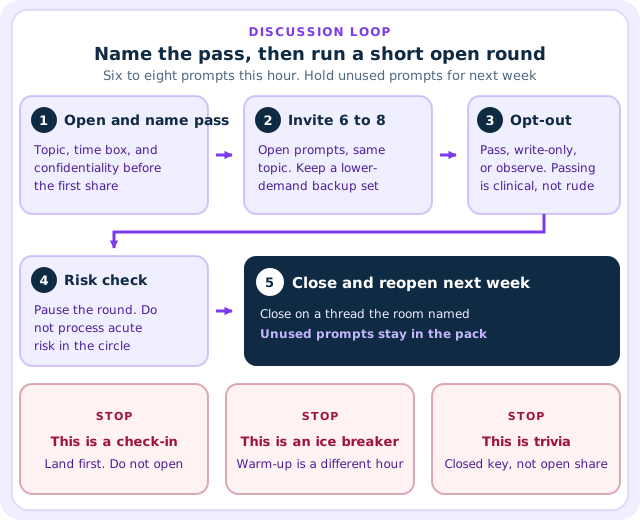
Opening, said before the first share. Name the topic, the time box, confidentiality limits, and the pass option. Example: “For the next twenty minutes we will stay with help-seeking. You can answer aloud, write only, observe, or pass. A pass keeps you in the group. It is not a penalty.”
Dose. Six to eight primary prompts. Keep a lower-demand backup set (write-only versions of prompts 2, 12, 20, and 28). Unused prompts stay in the pack.
Opt-out. Pass, write-only, or observe. Passing is clinical, not rudeness. Repeated passing may invite a private check later. It does not establish a motive on its own.
Risk-escalation. Pause the round. Do not process trauma detail or acute risk in the circle. Follow the setting’s crisis procedure. Document separately from the group summary.
Closing. Name the shared thread without flattening different answers. Invite one owned next step. Say what returns next week. Do not open new depth in the last minutes.
Contraindications. Acute risk. Unresolved conflict. A room that still needs an opener or a check-in. A process rupture the prompts would dodge. A request to “just do ice breakers.” Diagnosis-guessing. Suicide-method curiosity.
Do not put diagnostic bands, PHQ or GAD items, member names on a board, or AA/NA content on the prompts.
Next-week reopen
Used, mixed, or unused:
- Used and it landed. Name the thread that actually moved, and the smaller next step it changes.
- Mixed. Some members can name a theme and still have no owned next step. Treat that as data about the hour, not as a failed round.
- Unused. Leave unused prompts for next week. Do not run extra rounds just because unused cards are still in the pack.
Stop the round if shares turn into confession, ranking, or advice-giving.
Privacy, documentation, and safety
Name the shared intervention once: which prompts, open discussion structure, pass option visible.
Then write each member’s response: participation, remaining theme, observe or pass, risk follow-up, one owned next step. Two members can hear prompt 20 and leave with opposite next steps.
Do not chart a transcript of every answer.
Do not send completed prompt sheets through ordinary consumer email or SMS. This deck is not monitored in real time. It is not a crisis service. It is not a diagnosis. It is not a substitute for the agreed safety plan.
The PDF repeats that boundary on every client-facing page.
How Emosapien carries the discussion point
Emosapien keeps the discussion point the member agreed to reopen visible for the next group, so you return to what actually landed instead of reconstructing a circle transcript. You still choose the prompts, the pass language, and whether a member belongs in the room. Emosapien does not run the hour, monitor crisis, or decide who speaks.
Keep the agreed discussion point visible until next group
Emosapien carries the thread the member agreed to reopen, so you can review it before the next group.
Download mental health questions for discussion
Print mental health questions for discussion on 3 to 4 US Letter pages with selectable text:
- Forty open prompts across help-seeking, stress and coping, support and belonging, values and next steps, and being in this group
- Opening language, pass or observe roles, and stop flags
- Risk-escalation and closing moves, plus a documentation stem
- Next-week reopen for unused prompts
Each client-facing page carries a printed safety line: not a crisis service, not monitored in real time, not a diagnosis, not a substitute for the agreed safety plan.
Take the printed deck into the hour. Use it as the open discussion deck, not as a consumer talk-about list or an ice breaker catalog.
Email me the discussion deck
Get 40 open prompts by topic, opening language, pass options, risk stops, and a closing round.
- Forty open prompts across help-seeking, coping, belonging, values, and being in this group
- Opening language, pass or observe roles, and stop flags
- Risk-escalation, closing moves, and a documentation stem
Free. We'll email the PDF link right away and add you to the therapist toolkit, sent every two weeks. Unsubscribe any time.
Where should we send the link?
We'll email the PDF link right away. You'll also get the therapist toolkit every two weeks. Unsubscribe any time.
✓ Check your inbox
We've sent you the PDF
The download link is on its way to your inbox, usually within a minute or two. The email will come from Emosapien (hello@team.emosapien.com); check your spam folder if you don't see it.
You're also on the therapist toolkit list, sent every two weeks. Unsubscribe any time from the email footer.
References
- American Group Psychotherapy Association. Practice guidelines for group psychotherapy.
- Association for Specialists in Group Work. Guiding group work.
- Center for Substance Abuse Treatment. TIP 41: Substance Abuse Treatment: Group Therapy. Used here for general group-safety and facilitation points, not as a substance-use module.