
Mental Health Trivia You Can Run This Hour

Outline
Authored by Priya Mehta, LCSW, with eight years in addiction recovery and intensive outpatient programs, specializing in group facilitation, relapse prevention, and peer dynamics.
Thursday psychoeducation can stall in two directions. One member treats the handout like an exam. Another stays silent because a wrong answer last month became a joke in the circle.
Mental health trivia is a facilitator-led myth/fact literacy task for licensed therapists running mixed adult outpatient, IOP, or community groups. It is not a consumer quiz that guesses a diagnosis, and it is not a workplace party list.
The pack below holds forty cited items, a facilitator key, debrief prompts, pass language, and stop rules. Print 8 to 10 for this hour. Hold the rest for next week.
Email me the trivia pack
Get 40 cited myth/fact items, a facilitator answer key, debrief prompts, pass language, and stop rules.
- Forty cited items across stigma, population literacy, treatment myths, and group-process myths
- Facilitator answer key, debrief prompts, and pass or observe language
- Scoring rule, stop conditions, and a documentation stem
Free. We'll email the PDF link right away and add you to the therapist toolkit, sent every two weeks. Unsubscribe any time.
Where should we send the link?
We'll email the PDF link right away. You'll also get the therapist toolkit every two weeks. Unsubscribe any time.
✓ Check your inbox
We've sent you the PDF
The download link is on its way to your inbox, usually within a minute or two. The email will come from Emosapien (hello@team.emosapien.com); check your spam folder if you don't see it.
You're also on the therapist toolkit list, sent every two weeks. Unsubscribe any time from the email footer.
Educational resource for licensed mental-health clinicians facilitating therapy groups. This pack does not diagnose, treat, monitor crisis, or replace formulation, consent, or the agreed safety plan. Adapt every item to population, setting, stage, risk, culture, access, and the group contract.
What this pack is and is not
This pack is a closed myth/fact bank with an answer key. You read a statement, the room marks myth or fact (aloud, in pairs, or on paper), you give the cited framing, and you debrief one belief that would change a plan.
It is not open discussion prompts.
It is not an ice breaker. First-turn prompts belong earlier in the hour.
It is not a fun non-game activity. Fun non-game hours do not use a closed answer key.
It is not the group therapy games menu. Jeopardy, bingo, and the short team myth-or-fact format live there. Use this bank for the cited items. If the hour needs a recovery play mechanic with printable cards rather than cited myth/fact items, use free addiction recovery games for groups.
It is not Mental Health America screening, workplace Mental Health Awareness Month trivia, a nursing-board exam drill, or a consumer “what condition do I have” quiz.
For the wider facilitation frame, start at the group therapy resource hub. Choose the clinical job with group therapy activities. Use group therapy topics to select a theme. Use this pack when the job is shared literacy with a key. If the job is a take-home engagement sheet rather than a scored literacy round, assign fun worksheets for adults pdf.
SAMHSA’s mental health facts page is built to correct public myths. Use it as a source, not as a script to quiz members about their own charts.
When mental health trivia fits
Use this bank when the clinical job is psychoeducation, not process and not check-in. The mixed adult group can hold a low-demand shared literacy task. Cohesion is high enough that a wrong answer does not become a status event.
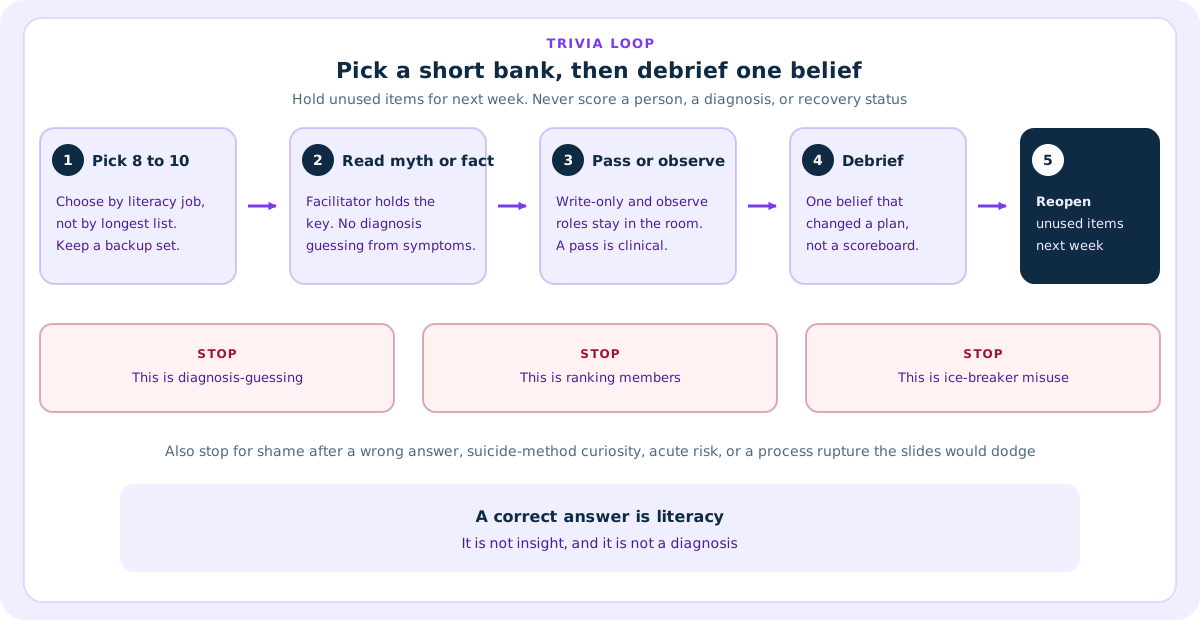
A useful mental health trivia hour looks like this: you name the literacy job, you show the pass option before the first item, you run eight to ten statements, you debrief one belief, and you leave unused cards in the pack.
NIMH mental illness statistics support population literacy (conditions are common; treatment receipt is uneven). They do not authorize a diagnosis from a trivia score.
Association for Specialists in Group Work Best Practice Guidelines keep the hour tied to purpose and active facilitation. A myth round still needs a purpose. It is not filler between a check-in and the door.
When to pause this bank
Stop the pack when literacy is no longer the job, or when the room starts to use answers to rank members.
| Pause when | What to do instead |
|---|---|
| Acute risk, including suicide-method curiosity | Follow the practice safety plan. Do not turn methods into items |
| Shame, jokes, or withdrawal after a wrong answer | Drop the score, name the rupture, return to process or individual follow-up |
| The room still needs an opener | Use a first-turn prompt. Do not start with a key |
| Members ask you to “guess the diagnosis” from a symptom list | Refuse the stem. Stay at population literacy |
| Graphic trauma trivia appears | Stop. Trivia is not exposure and not a story contest |
| Unresolved conflict or advice-giving is already running the hour | Process the rupture. Do not hide it behind slides |
| The hour needed a game mechanic | Use a game mechanic for rules and teams. Keep this bank for the items |
AGPA practice guidelines for group psychotherapy treat the group as a clinical setting with individual, interpersonal, and whole-group forces. A quiz that ranks people turns that setting into a performance contest.
Walk the four jobs
Forty items, four jobs, ten each. Show the structure in the room. Do not run all forty. For substance-specific myths, use a dedicated SUD prevention hour instead of stretching these cards.
Scroll the visual sideways to view the full diagram
1. Stigma and help-seeking
Correct the belief that help is weakness, that recovery is impossible, or that “people like us” are dangerous. Cite NAMI, SAMHSA, or NIMH. Do not invent percentages.
Scroll the table sideways to view every column
| # | Myth | Fact | Source | Pass | Stop |
|---|---|---|---|---|---|
| 1 | Mental health problems only happen to other people | They can affect anyone | SAMHSA facts | Write myth/fact privately | No |
| 2 | Asking for help is a character flaw | Help-seeking is a treatment step, not weakness | SAMHSA facts | Observe the round | No |
| 3 | Most people with mental illness are violent | Most people with mental illness are not violent | SAMHSA facts | Skip this item | Yes if the room starts listing crimes |
| 4 | Once someone has a condition, they will never recover | Recovery is possible and is not a straight line | SAMHSA recovery | Pass any personal story | No |
| 5 | People with mental health conditions cannot hold jobs | Many people work while managing a condition | SAMHSA facts | Write-only | No |
| 6 | Treatment does not work | Effective treatments exist; about half of U.S. adults with AMI received mental health treatment in the past year | NIMH mental illness | Observe | No |
| 7 | Only “unstable” people use therapy | Therapy is a health service, not a last resort | NAMI conditions | Pass | No |
| 8 | Stigma is just rude language | Stigma is associated with reduced help-seeking and is a commonly reported barrier to care | Clement et al. 2014 | Observe | No |
| 9 | If someone looks fine, they do not need support | Many conditions are not visible from the chair next to you | WHO mental health | Write-only | No |
| 10 | Talking about mental health always makes it worse | Sharing accurate facts can correct myths; it does not automatically make symptoms worse | SAMHSA facts | Pass personal examples | No |
2. Population literacy without diagnosis-guessing
Name conditions at the population level. Never ask, “Which diagnosis fits this symptom list?”
Scroll the table sideways to view every column
| # | Myth | Fact | Source | Pass | Stop |
|---|---|---|---|---|---|
| 11 | Anxiety disorders are rare | Anxiety disorders are among the more common mental disorders | NIMH anxiety | Write-only | Yes if stems become symptom-to-label |
| 12 | Depression is just sadness | Depression is more than a low mood; it affects function | NIMH depression | Observe | No |
| 13 | OCD means liking cleanliness | OCD is intrusive thoughts and rituals, not a preference for tidy rooms | NIMH OCD | Pass personal rituals | No |
| 14 | ADHD is laziness | ADHD is a neurodevelopmental condition, not a motivation failure | NIMH ADHD | Observe | No |
| 15 | Bipolar means ordinary moodiness | Bipolar disorder involves distinct mood episodes, not a personality style | NIMH bipolar | Pass | Yes if members start diagnosing each other |
| 16 | PTSD only happens after combat | PTSD can follow many kinds of trauma, not only military service | NIMH PTSD | Skip trauma detail | Yes if graphic detail starts |
| 17 | Panic is “just nerves” | Panic attacks are sudden waves of fear or discomfort, not a character test | NIMH panic | Write-only | No |
| 18 | Schizophrenia means split personality | Schizophrenia is not dissociative identity, and it is treatable | NIMH schizophrenia | Observe | Yes if the room turns comic or cruel |
| 19 | Eating disorders are a lifestyle choice | Eating disorders are mental illnesses, not diets with better branding | NIMH eating disorders | Pass body talk | Yes if the room compares bodies or numbers |
| 20 | Grief and clinical depression are the same thing | Grief and depression can overlap; they are not automatic equivalents | NIMH depression | Pass recent loss stories | No |
3. Treatment myths
Therapy is not only for crisis. Medication is not the only path and not a moral failure. “Snap out of it” is not a treatment. Psychoeducation is not process work.
Scroll the table sideways to view every column
| # | Myth | Fact | Source | Pass | Stop |
|---|---|---|---|---|---|
| 21 | Therapy is only for crisis | People use therapy for maintenance, skills, and relationships, not only emergencies | NIMH psychotherapies | Observe | No |
| 22 | Medication is the only real treatment | Medication is one option. It is not required for every presentation | NIMH medications | Pass med lists | Yes if the room starts ranking meds |
| 23 | Taking medication is a moral failure | Using a prescribed medicine is treatment, not a character verdict | NIMH medications | Write-only | No |
| 24 | People can snap out of it if they try | Effort is not a substitute for care | SAMHSA facts | Observe | No |
| 25 | A teaching hour is the same as process group | Psychoeducation teaches a model. Process work works the here-and-now | AGPA guidelines | Pass | No |
| 26 | One information session is a full course of care | Literacy is a step. It does not replace ongoing treatment | NIMH psychotherapies | Observe | No |
| 27 | An app can stand in for a functioning health system | Digital health interventions are not a substitute for functioning health systems | WHO digital health guideline | Pass app brands | No |
| 28 | Hospitalization is the only “real” treatment | Hospitalization is one setting. Most U.S. mental health treatment facilities provide outpatient care | SAMHSA N-SUMHSS 2024 | Skip hospital stories | Yes if war stories start |
| 29 | Talk therapy is only venting | Structured therapies target skills, patterns, and functioning | NIMH psychotherapies | Observe | No |
| 30 | Everyone should be on the same plan | Fit is individual. Combined care can be appropriate; neither meds nor therapy wins as a slogan | NIMH medications | Pass | No |
4. Group and therapy-process myths
Pass options are clinical, not rudeness. Confidentiality has limits. Group is not advice-giving. Ice breakers are not the working hour.
Scroll the table sideways to view every column
| # | Myth | Fact | Source | Pass | Stop |
|---|---|---|---|---|---|
| 31 | Passing is rude or resistant | A pass, write-only, or observe role is a clinical option | AGPA trauma group notes | Model a pass | No |
| 32 | Everything said in group stays in group with no limits | Confidentiality has legal and safety limits the facilitator already named | APA Ethics Code | Observe | Yes if members demand a loophole list |
| 33 | Group time is for giving each other advice | Group is not a fix-it circle. Advice-giving is a process event to name | AGPA guidelines | Pass | No |
| 34 | The opener is the working hour | State the group’s purpose and goals. Choose techniques and a leadership style that fit that group | ASGW Best Practice Guidelines | Observe | No |
| 35 | Showing up is the same as participating | Attendance is not the whole clinical response. Silence can still be data | AGPA guidelines | Write-only | No |
| 36 | A correct answer means the member has insight | A correct item is knowledge in the moment. Evaluate member and group progress separately against the stated goals | ASGW Best Practice Guidelines | Observe | No |
| 37 | Ranking who “gets it” builds motivation | Ranking members spends the hour on status | AGPA guidelines | Pass | Yes if a scoreboard appears |
| 38 | Members should compete to show knowledge | Match the task to the group’s stated purpose. Choose techniques appropriate to that group | ASGW Best Practice Guidelines | Observe | No |
| 39 | Silence means the member is checked out | Observation can be the role that keeps someone in the room | AGPA trauma group notes | Model observe | No |
| 40 | The group’s score is what belongs in the chart | Record the items used and each member’s response. Do not chart a group score | Facilitator template | Write-only | No |
Facilitator key, scoring, and pass language
You hold the answer key for this mental health trivia round. Members do not hunt for a hidden diagnosis.
Room state. Confirm literacy is the job this hour. If the chairs still need an opener, or if a rupture is live, leave the cards down.
Dose. Eight to ten primary items. Keep a lower-demand backup set (write-only versions of items 1, 12, 21, and 31). Unused cards stay in the pack.
Pass language, said before the first item. “You can answer aloud, answer on paper, observe, or pass. A pass keeps you in the group. It is not a penalty.”
Scoring rule. If you score at all, score the cards or a pair of written answers. Never score people. Never score diagnoses. Never score recovery status. Prefer no score.
Contraindications. Acute risk. Unresolved conflict. Shame after wrong answers. A room that still needs an opener. Diagnosis-guessing. Suicide-method curiosity. A process rupture the slides would dodge.
Do not put diagnostic bands, PHQ or GAD items, game boards with member names, or AA/NA content on the cards.
Debrief and next-week reopen
Close mental health trivia on one belief, not on who won.
Useful, mixed, or unused:
- Used and it landed. Name the myth that actually moved, and the smaller plan it changes.
- Mixed. Some members have the language and not the plan. That is data, not failure of the round.
- Unused. Leave those items for next week. Do not “finish the deck” because paper remains.
Ask one debrief: “Which correction would change a plan this week, and which one only changed vocabulary?”
Stop processing if it becomes confession, ranking, or advice-giving.
Privacy, documentation, and safety
Name the shared intervention once: which items, myth or fact structure, pass option visible.
Then write each member response: comprehension or remaining myth, shame or withdrawal, observe or pass, one next literacy point. Two members can hear item 13 and leave with opposite next steps.
Do not chart a scoreboard. Write the shared intervention once, then each member’s comprehension, remaining myth, shame, or pass.
Do not send completed item sheets through ordinary consumer email or SMS. This pack is not monitored in real time. It is not a crisis service. It is not a diagnosis. It is not a substitute for the agreed safety plan.
The PDF repeats that boundary on every client-facing page.
How Emosapien carries the literacy point
Emosapien keeps the literacy point the member agreed to revisit visible for the next group, so you reopen the myth that actually stuck instead of reconstructing a scoreboard. You still choose the items, the pass language, and whether a member belongs in the room. Emosapien does not score trivia, monitor crisis, or run the hour.
Keep the agreed literacy point visible until next group
Emosapien carries the myth the member agreed to reopen, so you can review it before the next group.
Download the pack
The printable pack fits onto 3 to 4 US Letter pages with selectable text:
- Forty cited items across stigma, population literacy, treatment myths, and group-process myths
- Facilitator answer key, debrief prompts, and pass or observe language
- Scoring rule, stop conditions, and a documentation stem
- Next-week reopen for unused items
Each client-facing page carries a printed safety line: not a crisis service, not monitored in real time, not a diagnosis, not a substitute for the agreed safety plan.
Email the pack using the download form. This mental health trivia pack is a cited myth-and-fact bank for facilitated groups, not a consumer quiz or a Jeopardy board.
Email me the trivia pack
Get 40 cited myth/fact items, a facilitator answer key, debrief prompts, pass language, and stop rules.
- Forty cited items across stigma, population literacy, treatment myths, and group-process myths
- Facilitator answer key, debrief prompts, and pass or observe language
- Scoring rule, stop conditions, and a documentation stem
Free. We'll email the PDF link right away and add you to the therapist toolkit, sent every two weeks. Unsubscribe any time.
Where should we send the link?
We'll email the PDF link right away. You'll also get the therapist toolkit every two weeks. Unsubscribe any time.
✓ Check your inbox
We've sent you the PDF
The download link is on its way to your inbox, usually within a minute or two. The email will come from Emosapien (hello@team.emosapien.com); check your spam folder if you don't see it.
You're also on the therapist toolkit list, sent every two weeks. Unsubscribe any time from the email footer.
References
- Substance Abuse and Mental Health Services Administration. Get the facts about mental health.
- Substance Abuse and Mental Health Services Administration. Recovery and recovery support.
- National Institute of Mental Health. Mental illness statistics.
- National Institute of Mental Health. Health topics (anxiety, depression, OCD, ADHD, bipolar disorder, PTSD, panic, schizophrenia, eating disorders, psychotherapies, medications).
- National Alliance on Mental Illness. Mental health conditions.
- Clement S, Schauman O, Graham T, Maggioni F, Evans-Lacko S, Bezborodovs N, Morgan C, Rüsch N, Brown JS, Thornicroft G. What is the impact of mental health-related stigma on help-seeking? A systematic review of quantitative and qualitative studies. Psychological Medicine. 2015.
- World Health Organization. Mental health: strengthening our response.
- World Health Organization. WHO guideline: recommendations on digital interventions for health system strengthening.
- Substance Abuse and Mental Health Services Administration. National Substance Use and Mental Health Services Survey (N-SUMHSS): 2024.
- American Group Psychotherapy Association. Practice guidelines for group psychotherapy.
- Association for Specialists in Group Work. Best Practice Guidelines.
- American Psychological Association. Ethical principles of psychologists and code of conduct.