Professional Liability Insurance for Social Workers

Outline
| Field | Write down from the quote or policy | Your check |
|---|---|---|
| Policy form | Occurrence, or claims-made plus retroactive date | ☐ |
| Limits | Per claim and aggregate; defense inside or outside limits | ☐ |
| License-board defense | Sublimit, covered proceeding, and whether defense erodes it | ☐ |
| Tail or prior acts | ERP terms, cost, deadline, and new-carrier retro date | ☐ |
| Supervision | Your supervisees, employees, contractors, volunteers, and entity | ☐ |
| Telehealth | Modalities, client-state territory, and license or compact conditions | ☐ |
| Renewal check | Changes in license, setting, scope, states, and exclusions | ☐ |
Free PDF: Professional Liability Coverage Checklist
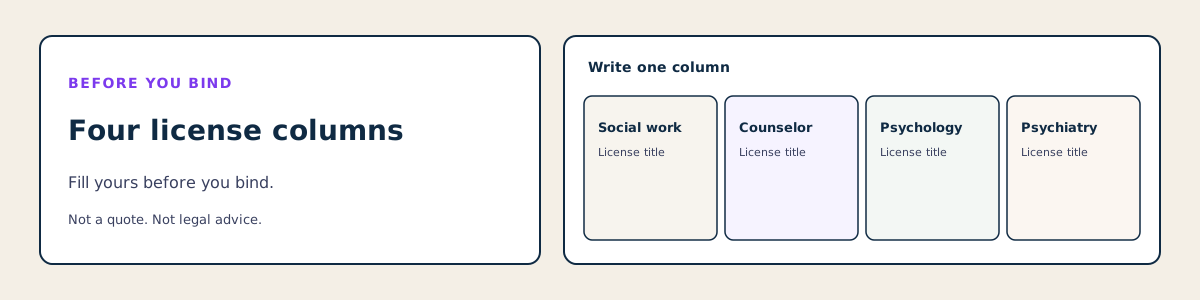
A printable checklist to fill before buying or renewing a professional liability policy, with one column each for social worker, counselor or therapist, psychologist, and psychiatrist.
- Policy form, limits, and licensing-board defense fields to fill from the quote
- Tail coverage, telehealth territory, and supervisee coverage checks
- Broker questions that must be answered in writing before you bind
- Four license columns so you fill yours and do not copy another license type
Free. We'll email the PDF link right away and add you to the therapist toolkit, sent every two weeks. Unsubscribe any time.
Where should we send the link?
We'll email the PDF link right away. You'll also get the therapist toolkit every two weeks. Unsubscribe any time.
✓ Check your inbox
We've sent you the PDF
The download link is on its way to your inbox, usually within a minute or two. The email will come from Emosapien (hello@team.emosapien.com); check your spam folder if you don't see it.
You're also on the therapist toolkit list, sent every two weeks. Unsubscribe any time from the email footer.
Educational guidance for US social workers and practice leaders. This is not legal, insurance, or licensure advice. Policy forms, state rules, compact privileges, exclusions, and carrier endorsements vary. Read your policy and confirm the answer with your carrier, licensing board, broker, or counsel.
What professional liability insurance is meant to answer
Professional liability insurance for social workers addresses the risk that a client, former client, employer, licensing board, or other party alleges that your professional service caused harm. HPSO’s clinical social worker coverage page says professional liability coverage helps protect against a claim resulting from a covered incident and that its policies pay legal defense costs for covered claims. The exact insuring agreement, exclusions, limits, and conditions in your policy control.
That makes the buying question more useful than “Which social worker insurance is cheapest?” Ask instead:
- What professional services does this policy define and cover?
- Who is insured: you, your practice entity, your employees, or your supervisees?
- What triggers coverage, and when must you report a claim or circumstance?
- Which defense expenses are covered, and do they reduce the liability limit?
- Which board, ethics, subpoena, privacy, abuse, or employment matters are excluded or sublimited?
- Where does the policy apply when your client is in another state?
If you work for an agency, do not confuse the agency’s certificate with your personal coverage. NASW Minnesota’s liability guidance notes that employer coverage may not follow a social worker after leaving the employer. Treat that as a reason to compare the policies, not as proof that every employer policy is inadequate.
Policy form: occurrence versus claims-made
The policy form changes what you must do when you renew, change carriers, close a practice, or stop practicing.
| Question | Occurrence form | Claims-made form |
|---|---|---|
| What usually activates the policy? | The covered incident occurs during the policy period | The claim is first made during the policy period, subject to the retroactive date and other terms |
| What happens after cancellation? | A covered incident from the active period can generally be reported later | A later claim may not be covered unless the policy continues, prior acts are carried forward, or an ERP applies |
| What date should you record? | The effective period and any reporting conditions | The effective period and the retroactive date |
| What should you ask before switching? | Which prior incidents remain assigned to this carrier | Whether the new policy preserves the old retroactive date or you need tail coverage |
American Professional Agency’s explanation of occurrence and claims-made forms gives the same practical distinction: an occurrence policy looks to when the incident occurred, while a claims-made policy looks to when the claim was made and may require an extended reporting period when the policy ends.
Do not choose a form from a one-line summary. Read the declarations page and endorsements. Confirm how the policy treats a notice of circumstance, related claims, a retroactive date, a carrier change, and a lapse in payment.
Limits: per claim is not the same as aggregate
When you compare professional liability insurance for social workers, a policy may show two limits, such as $1 million per claim and $3 million aggregate. The first is the most the policy may pay for one covered claim under the applicable terms. The second is the most it may pay across covered claims during the policy period. Your quote may use different limits, deductibles, sublimits, or shared limits.
Write down all of these before comparing prices:
- Per-claim limit
- Annual aggregate limit
- Deductible or self-insured retention
- Whether defense costs are inside or outside the limits
- Sublimits for license-board defense, privacy, subpoena assistance, or other extensions
- Whether your practice entity shares your individual limits
- Whether a separate general liability policy is needed for premises or bodily-injury risks
A limit is not a recommendation. The right amount depends on your practice setting, client acuity, contracts, scope, supervision, entity structure, and carrier underwriting. If a credentialing contract names a minimum, compare that requirement with the policy’s actual limits and certificate language. Do not treat a common limit as a guarantee that it fits your exposure.
License-board defense deserves its own line
A malpractice claim and a licensing-board complaint are different proceedings. A policy can offer a license-board defense benefit with a separate sublimit, exclude it, or include it only through an endorsement. American Professional Agency’s social worker program describes a license-board defense reimbursement limit and an option to increase it; that is an example of a program feature, not a universal market term.
Ask these questions in writing:
- Does the policy defend a complaint before my state social-work board, an ethics committee, or another credentialing body?
- Is the benefit reimbursement or a duty to defend?
- Is there a separate per-proceeding or aggregate sublimit?
- Do attorney fees reduce that sublimit or the main professional-liability limit?
- Does the policy cover a subpoena, deposition, or records request without a negligence claim?
- Must the carrier approve counsel before you incur defense costs?
A board complaint may not become a damages claim, but responding still takes time, records, and specialized counsel. Keep your policy’s notice instructions with your compliance contacts. Notify the carrier promptly when the policy requires notice; do not wait for a formal lawsuit if the policy requires notice of a circumstance that could lead to a claim.
Tail coverage and the renewal handoff
Tail coverage, also called an extended reporting period, is most relevant when a claims-made policy ends. It can extend the time to report claims arising from covered prior acts. It does not turn an excluded service into a covered one, and it does not replace the need to preserve the policy, declarations, endorsements, and claim notices.
Before you cancel or replace a claims-made policy, compare two routes:
- Extended reporting period: Ask the old carrier about the reporting window, eligible acts, cost, purchase deadline, and whether the option is irrevocable after cancellation.
- Prior-acts or nose coverage: Ask the new carrier whether it will preserve the old retroactive date and provide written confirmation that the prior work is included.
American Professional Agency’s coverage explanation describes an extended reporting endorsement. Whether a new carrier preserves the old retroactive date or provides prior-acts coverage must be confirmed in writing for your policy. Your policy may use different terms and conditions. Never rely on a broker’s verbal assurance when a declarations page or endorsement can answer the question.
Supervision, associates, employees, and the practice entity
Supervision creates a coverage question beyond your own client work. NASW Assurance Services’ supervision risk guidance describes how a supervisor may face direct or vicarious exposure connected to supervisees, interns, volunteers, and other workers. The document is older, so use it as a risk prompt and verify current policy language, state requirements, and your contracts.
Ask the carrier to distinguish these roles:
- Your own clinical services
- A supervisee’s services while you supervise
- An employee’s services for the practice
- An independent contractor’s services
- Students, interns, volunteers, or paraprofessionals
- Your practice entity’s vicarious liability
- Administrative or nonclinical services
A policy may cover some roles only while they work for a named organization and within a defined scope. It may exclude independent contractors or require each clinician to carry a separate policy. It may also share limits between you and the entity. Get the answer from the policy, schedule, and endorsements, not from a generic certificate.
Keep a supervision file that matches your risk process: agreement, role and scope, credentials, supervision cadence, escalation path, evaluations, and records of decisions. Pair this insurance review with clinical supervision documentation and social work ethical dilemmas, when available for your setting.
Telehealth and clients across state lines
Telehealth adds two separate checks: authority to practice and insurance territory. A policy may cover telehealth as a professional service while still limiting the states, licenses, modalities, or client locations it recognizes. A compact privilege may change licensure eligibility, but it does not automatically rewrite your policy.
Professional liability insurance for social workers should be checked against the client-location rule every time your telehealth footprint changes. Keep the policy question separate from the licensure question, then resolve both before the session.
Before a cross-state session, record:
- The state where the client is physically located for the session
- Your active license or compact privilege for that state
- The policy territory and telehealth wording
- Any required telehealth consent or registration step
- The carrier’s written confirmation, if the policy or situation is unusual
The NASW-CT telehealth provisions show why state-specific rules matter: telehealth provisions can address communication technology, consent, provider information, and records. That page is Connecticut-specific and should not be generalized to another state.
Ask your carrier a narrow question: “Does my policy respond to professional services delivered by [modality] to a client physically located in [state], where I hold [license or privilege], on [date]?” Ask how the answer changes for phone-only, asynchronous messages, home visits, supervision, and a client who relocates during treatment. Keep the written response with your policy review.
A renewal check for your actual practice
Run this review at every renewal and whenever your practice changes:
Scroll the table sideways to view every column
| Review field | What to confirm |
|---|---|
| Policy form | Confirm occurrence or claims-made, retroactive date, and reporting conditions. |
| Scope | List current services, populations, settings, home visits, group work, case management, supervision, and consultation. |
| People | Reconcile named insureds, employees, contractors, interns, volunteers, and the practice entity. |
| Geography | Reconcile every state where a client may be located and every active license or compact privilege. |
| Limits | Compare per-claim, aggregate, deductibles, shared limits, and sublimits with contracts and your risk profile. |
| Defense | Confirm license-board, subpoena, privacy, and complaint provisions and whether defense costs erode limits. |
| Claims-made continuity | Record the retroactive date and plan for prior acts or tail before changing carriers. |
| Records | Save the quote, declarations page, endorsements, certificate, carrier answers, and renewal date in one restricted folder. |
If the answer is “I think so,” mark the field incomplete. A coverage checklist is useful because it turns a vague reassurance into a list of documents and questions.
Download the professional liability coverage checklist
Use the professional liability coverage checklist to compare the policy form, limits, license-board defense, tail coverage, supervision, and telehealth terms before you buy or renew professional liability insurance for social workers. The worksheet includes columns for social workers, counselors or therapists, psychologists, and psychiatrists; fill only the column that matches your license and practice.
Free PDF: Professional Liability Coverage Checklist
A printable checklist to fill before buying or renewing a professional liability policy, with one column each for social worker, counselor or therapist, psychologist, and psychiatrist.
- Policy form, limits, and licensing-board defense fields to fill from the quote
- Tail coverage, telehealth territory, and supervisee coverage checks
- Broker questions that must be answered in writing before you bind
- Four license columns so you fill yours and do not copy another license type
Free. We'll email the PDF link right away and add you to the therapist toolkit, sent every two weeks. Unsubscribe any time.
Where should we send the link?
We'll email the PDF link right away. You'll also get the therapist toolkit every two weeks. Unsubscribe any time.
✓ Check your inbox
We've sent you the PDF
The download link is on its way to your inbox, usually within a minute or two. The email will come from Emosapien (hello@team.emosapien.com); check your spam folder if you don't see it.
You're also on the therapist toolkit list, sent every two weeks. Unsubscribe any time from the email footer.
If you want a practice platform that helps keep clinical documentation organized while you remain responsible for review and sign-off, see Emosapien.