
Clinical Supervision Documentation for Therapy Practices

Outline
Monday morning. A board auditor asks for one associate’s supervision file. You can produce three meeting notes. You cannot find the signed agreement, the hour log that matches those notes, or the evaluation from six months ago. That is a documentation system failure, not a writing problem.
Clinical supervision documentation is the controlled set of records that proves supervision happened, what competence work was done, how risk was escalated, and who owned follow-up. It is educational guidance for US mental-health clinicians and practice leaders. It is not legal advice and not a universal board policy.
Educational resource for licensed therapists and clinical supervisors. Supervision, privacy, hour, and retention rules vary by license type, state board, employer, and training program. Confirm your board chapter and counsel when risk is high.
What belongs in the supervision binder
Clinical supervision documentation covers the full binder: agreement, attendance log, case discussion record, competence plan, ethics and risk escalation path, evaluation, corrective action, storage and access, and board overlays.
Keep sibling tools in their own lanes:
- The single meeting form lives on the clinical supervision notes template
- Client chart craft lives on the clinical documentation hub
- How long records stay after closure sits on therapy records retention by state
- Federal and state compliance spokes live under the compliance resource hub
If you only need today’s meeting note, use the template. If you need the binder that survives an audit, build the system below. If those hours are Australian peer consultation toward the Psychology Board cycle, use the AHPRA CPD requirements psychologists guide.
Download the audit checklist and record-register worksheet, then wire each component into one storage map your supervisors can actually open.
Free PDF: Clinical Supervision Documentation Audit
A printable supervision binder audit for agreements, hour logs, competence plans, evaluations, corrective action, and storage access checks.
- Agreement and attendance-log completeness checks
- Competence plan and evaluation-cycle prompts
- Ethics escalation and corrective-action file fields
- Storage, access, and board-overlay review checklist
Free. We'll email the PDF link right away and add you to the therapist toolkit, sent every two weeks. Unsubscribe any time.
Where should we send the link?
We'll email the PDF link right away. You'll also get the therapist toolkit every two weeks. Unsubscribe any time.
✓ Check your inbox
We've sent you the PDF
The download link is on its way to your inbox, usually within a minute or two. The email will come from Emosapien (hello@team.emosapien.com); check your spam folder if you don't see it.
You're also on the therapist toolkit list, sent every two weeks. Unsubscribe any time from the email footer.
Why a meeting note is not enough
APA’s Guidelines for Clinical Supervision in Health Service Psychology treat accurate, timely documentation as part of ethical and legal obligation. That includes the occurrence of supervision, the conduct of the work, and supervisee progress with clients. APA’s Record Keeping Guidelines reinforce accuracy, currency, and privacy safeguards for clinical records more broadly.
In practice, weak systems fail in four predictable ways:
- Agreement drift. Cadence, goals, and emergency paths live in memory after the kickoff meeting.
- Hour mismatch. Notes exist, but the board-facing hour log does not match dates, modality, or totals.
- Competence without a plan. Coaching repeats without a written professional development plan for therapists or evaluation cycle.
- Wrong storage. Identifiable case detail lands in chat threads, personal drives, or the client chart by default.
A privacy-aware meeting note fixes the hour-level layer. Clinical supervision documentation fixes the binder around it. When the agreement has to name the model, not only the hour log, use the clinical supervision models card.
When the case discussion needs a named move the supervisee can chart, use the social work interventions cards rather than another binder heading.
The eight components of a defensible binder
Build one register per supervisee (or per dyad if your policy uses shared peer files). Keep every component named, owned, and findable.
| Component | Purpose | Typical owner |
|---|---|---|
| Supervision agreement | Roles, cadence, goals, emergencies, confidentiality, evaluation rules | Supervisor + clinical director |
| Attendance / hour log | Board-ready dates, duration, modality, individual vs group, running totals | Supervisee maintains; supervisor verifies |
| Case discussion record | Meeting note with anonymized case IDs, guidance, actions | Supervisor completes same day |
| Competence plan | Domains, learning goals, methods, review dates | Joint; supervisor owns sign-off |
| Ethics / risk escalation path | How safety, dual relationships, and board-reportable issues move upward | Clinical director names path |
| Evaluation cycle | Mid-term and end-of-cycle ratings tied to competence domains | Supervisor |
| Corrective action file | Performance or safety remediation, timelines, close-out | Clinical director + supervisor |
| Storage and access map | Where files live, who can open them, export/custodian path | Practice owner or privacy officer |
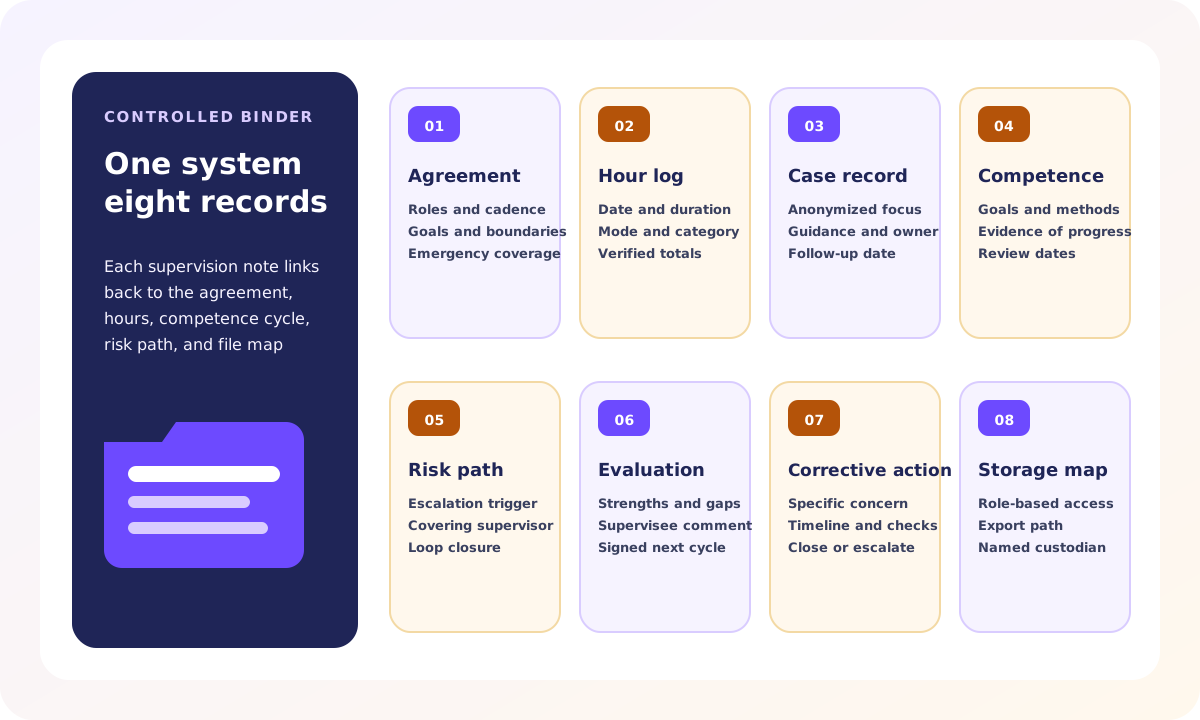
Print this table into your operations manual. Then run the downloadable audit against real folders, not the manual alone.
Supervision agreement fields that hold up
Write the agreement before the first hour counts toward licensure or employment expectations.
Minimum fields
- Parties, credentials, license numbers, and roles (pre-licensure, employment, peer)
- Start date, expected end or review date, and cadence (weekly 60 minutes, biweekly, group plus individual)
- Modality rules (in person, video, phone) and any board limits on remote hours
- Competence domains and learning goals for this cycle
- Emergency and after-hours contact path, including who covers when the primary supervisor is unavailable
- Confidentiality rules, record location, and what never enters the client chart from supervision
- Evaluation schedule and what happens if goals are not met
- How dual relationships, conflicts, and supervisee grievances are handled
- Signature, credentials, and date for both parties
When that dual-relationship line has to name a second role with a client, sort prohibited, avoidable, or managed on dual relationships in therapy before you write the agreement. Attach the board hour worksheet your jurisdiction recognizes when the supervisee is pre-licensed. Do not invent hour ratios. Open the board chapter.
Attendance and hour log design
The log is the arithmetic surface boards and training programs check first.
Log each entry with
- Date, start and end time, duration
- Individual, triadic, or group
- In person, video, or phone
- Supervisor name and credentials
- Running total by category if your board splits direct vs group hours
- Link or ID to the meeting note for that date
Reconcile the log against meeting notes monthly. A note without a log line, or a log line without a note after a risk discussion, is an audit gap. Pre-licensure hour attestation is often a separate signed form. The log supports that form; it does not replace it when the board requires a distinct affidavit. The log proves the hours happened. It does not prove the supervisor met the board’s training rule. Check hours, approved provider, and renewal on the clinical supervision training checklist before you attest.
Case discussion records without building a second chart
Use the meeting note as the case layer inside the binder. Keep client identifiers to initials or case IDs unless your policy and law require more. Capture discussion focus, ethical or risk issues, guidance given, actions with owners and due dates, and signatures.
Do not paste session transcripts. Do not store the only copy of a safety plan inside the supervision file while the client chart stays silent. Treatment changes and safety steps belong in the client record under the treating clinician. The supervision note records that the issue was raised, what guidance was given, and what follow-up was assigned. When the case is about where the supervisee sits in a racial identity model, the prompt is not a generic culture question. Use the racial identity models for supervision stage card.
For the copy-ready field set, use the sibling clinical supervision notes template linked above. This page does not reproduce that full form.
Competence plan, evaluation, and corrective action
A competence plan turns vague coaching into a cycle reviewers can follow. Cultural humility on that list is a practice, not a finished badge. The supervision contrast is cultural humility versus cultural competence.
Competence plan (living document)
- Domains (assessment, intervention, risk, cultural humility, documentation, ethics, group facilitation, or board-listed competencies)
- Current level and target level for this cycle
- Learning methods (observation, co-therapy, reading, deliberate practice, case presentation)
- Review dates and evidence of progress
- Barriers and supports
When the domain is how you hold power with a client from a community you do not share, use a cultural humility practice rather than a competence score.
Evaluation
- Mid-cycle check that names strengths, gaps, and revised goals
- End-of-cycle evaluation tied to the same domains
- Opportunity for supervisee comment
- Signatures and next-cycle start date
Corrective action (when needed)
- Specific performance or safety concern, dated
- Required behaviors, coaching, or external requirements
- Timeline and check-in dates
- What happens if targets are not met
- Close-out note when remediated or escalated
Skip corrective action language for ordinary growth edges. Use it when client safety, ethical breach risk, or failed hour standards are in play. Those files are the first ones requested after a complaint. Board-listed multicultural domains need a question, a case, and a note line, not a checkbox. Use the multicultural counseling competency checklist in the evaluation cycle.
Ethics and risk escalation path
Write the path before you need it.
- Supervisee raises a risk or ethics issue in supervision or immediately after a session.
- Supervisor documents the discussion on the meeting note and confirms whether a client-chart entry is required.
- If imminent risk, board-reportable duty, or supervisor conflict exists, escalate to the named clinical director or covering supervisor the same day.
- Record who was notified, what guidance was given, and the next check time.
- Close the loop at the next supervision meeting with action status.
Mandatory reporting, Tarasoff-type duties, and emergency hospitalization rules are jurisdiction-specific. Pair your escalation path with your state board sources and the practice’s broader compliance map. This guide does not set a universal reporting threshold. A social work ethics question needs a worked decision, not a vibe. Walk it on social work ethics decision examples before the escalation note only records that you talked.
Storage, access, and privacy
Name one system of record for supervision files. Shared email threads are not a system.
| Practice shape | Practical home |
|---|---|
| Solo supervisor + associates | Encrypted supervision folder or HR/training system with a named access list |
| Multi-site group | Supervision module in the EHR or a dedicated workforce system with role-based access |
| University or training program | Program-required portal plus any employer copy your contract demands |
| Peer consultation only | Separate peer-consult log, clearly labeled as non-hierarchical |
Access rules:
- Minimum necessary. Clinicians see their own file and what policy allows for covering supervisors.
- No open shared drives with full roster visibility by default.
- Export and custodian path when a supervisor leaves or the practice closes.
- Retention schedule that cites board, employer, and training sources rather than a slogan.
HIPAA Privacy Rule documentation duties for policies and certain workforce records can overlay your binder even when the clinical chart has a different clock. For stacked retention research, use the retention-by-state guide linked above. For team role access, pair with a group-practice HIPAA policy.
State and board overlays you must not skip
Clinical supervision documentation is license-aware before it is brand-aware.
Check at least:
- Who may supervise whom for your license types
- Required hour ratios (individual vs group, direct observation rules)
- Remote supervision limits
- Evaluation or attestation forms the board publishes
- How long supervision records must be kept if the board speaks to them
- What happens when the supervisee or supervisor practices across state lines
Re-open those sources when you add a license type, hire a supervisor from another jurisdiction, or expand telehealth. Do not copy another practice’s binder ratios without reading your own chapter.
Supervision documentation audit checklist
Run this audit on real files. Mark Pass, Gap, or N/A. Assign an owner and due date for every Gap.
Record-register worksheet
Keep one register row per active supervisee. Update it when supervisors change.
| Field | Entry |
|---|---|
| Supervisee | |
| Credentials / track | |
| Primary supervisor | |
| Covering supervisor | |
| Agreement date / review date | |
| Storage path or system ID | |
| Access list (roles) | |
| Hour-log location | |
| Last evaluation date | |
| Open corrective action? (Y/N) | |
| Retention source citation | |
| Custodian if practice closes |
The downloadable PDF combines this register with the audit checklist so you can print both for a quarterly file review.
Common system mistakes
- Meeting notes only. No agreement, no hour log, no evaluation.
- PHI sprawl. Full names and transcripts in shared folders.
- Chat as the record. Slack threads disappear; boards do not accept them as the file of record.
- Invented retention. “Seven years” printed without a source.
- Peer consult mislabeled as supervision. Hour claims fail later.
- No covering supervisor. Risk cases stall when the primary is on leave.
- Corrective action in hallway conversation only. If it mattered enough to say, it mattered enough to file.
- Client chart used as the supervision binder. Wrong audience and access model.
How Emosapien fits without replacing the binder
Emosapien drafts structured therapy notes from session context for clinician review. Cleaner client-chart context helps supervision time go to judgment instead of reconstructing the week. Consistent note structure helps supervisors compare clinicians fairly.
The product does not auto-complete clinical supervision documentation, verify board hours, or replace signed evaluations. Those stay human under your policy. If you want the clinical-admin layer beside a human supervision system, start free: Try Emosapien free.
Quick start
- Create one register row for each active supervisee.
- File a signed agreement before hours count.
- Standardize the meeting note fields with the sibling template.
- Reconcile the hour log to notes every month.
- Write a competence plan with mid-cycle and end-cycle evaluation dates.
- Name the ethics and risk escalation path and the covering supervisor.
- Put all of it in one access-controlled location with a custodian path.
- Run the audit checklist this quarter and calendar the next one.
References
- American Psychological Association. Guidelines for Clinical Supervision in Health Service Psychology.
- American Psychological Association. Record Keeping Guidelines.
- U.S. Department of Health and Human Services. HIPAA Privacy Rule guidance for professionals.
Verified against publicly posted APA and HHS materials as of July 2026. Board and employer rules can change after publication.