
Psychoeducational Groups: Topics and Session Framework

Outline
A mixed outpatient circle can get a polished anxiety handout and still stall. The slides may be clear while the room is not: two members nod through vocabulary they do not own, one shuts down when the worksheet asks for a private trigger list, and the longest-tenured member turns the last ten minutes into advice-giving.
The miss is usually not the content. The miss is treating a topic like a lecture instead of a module the room can practice and leave with.
Psychoeducational groups give therapists a different job than a process-only hour or a support meeting. You teach one plain-language model, move into supported practice, process what members noticed without forcing disclosure, and close with one transfer step they can try before the next session.
This guide is for licensed mental-health clinicians planning that format. It is not client self-help, not a multi-week curriculum, and not a second bank of generic themes. For the wider facilitation frame, start at the group therapy resource hub.
Free PDF: Group Facilitation Pack
A printable facilitator pack for group therapy topics: population-goal-stage checks, topic selector menu, and primary-plus-backup planner.
- Population, goal, and stage decision checklist before you pick a topic
- 12 group therapy topics across forming, anxiety, depression, relationship, process, and ending lanes
- Primary topic plus backup planner for activated or shut-down rooms
- After-group note stems for intervention, response, risk, and next step
Free. We'll email the PDF link right away and add you to the therapist toolkit, sent every two weeks. Unsubscribe any time.
Where should we send the link?
We'll email the PDF link right away. You'll also get the therapist toolkit every two weeks. Unsubscribe any time.
✓ Check your inbox
We've sent you the PDF
The download link is on its way to your inbox, usually within a minute or two. The email will come from Emosapien (hello@team.emosapien.com); check your spam folder if you don't see it.
You're also on the therapist toolkit list, sent every two weeks. Unsubscribe any time from the email footer.
Educational resource for licensed mental-health clinicians facilitating therapy groups. Adapt every module to the group’s population, setting, stage, risk level, culture, accessibility needs, consent, and clinical contract.
Choose the topic by the learning job
A topic is not a curriculum week and not an activity menu. For psychoeducational groups, the topic is the one learning job the room can hold today.
If you need a broad theme bank by population, goal, and stage, stay with group therapy topics. Come back here when the chosen theme needs a teach, practice, process, and transfer module.
Before you write anything on a board, answer the selector on paper:
| Field | Purpose |
|---|---|
| Presenting need | What the room needs help understanding or doing |
| Learning objective | What members should be able to name, notice, or practice by the close |
| Teaching point | The one model or distinction worth explaining |
| Practice | What members try in the room |
| Process prompt | How the group makes meaning without forced disclosure |
| Transfer | What members carry into the week |
| Scale-down or stop cue | What changes when activation, comprehension, consent, or risk shifts |
Suggested module lanes stay narrow on purpose:
- Orientation and shared language
- Symptom or cycle mapping
- Coping-skill rationale
- Communication and boundary teaching
- Relapse or maintenance planning
- Support-system education
Keep modality protocols, diagnosis-specific treatment claims, and multi-week sequences on their own pages. If the module is DBT skills work, choose dbt group topics. If the module is CBT skills work, choose cbt group topics. Association for Specialists in Group Work best practice guidelines keep group work tied to purpose, preparation, and active facilitation. That preparation is the module, not the handout pile.
Use a teach, practice, process, transfer arc
The session arc for psychoeducational groups is more than time boxes. It is a clinical sequence that can stop early when the room needs containment.
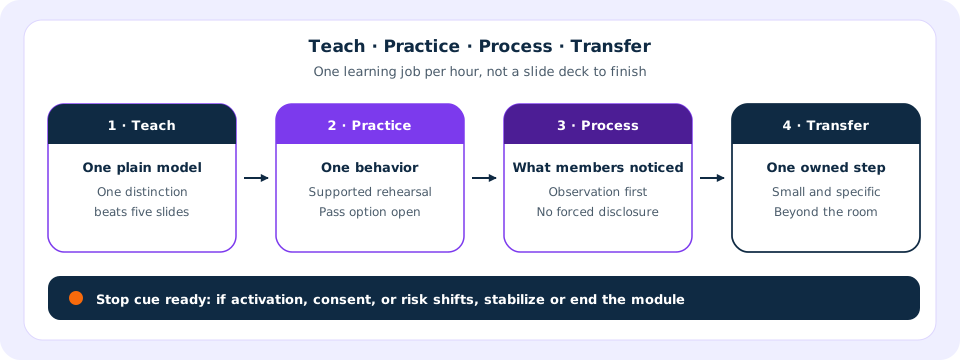
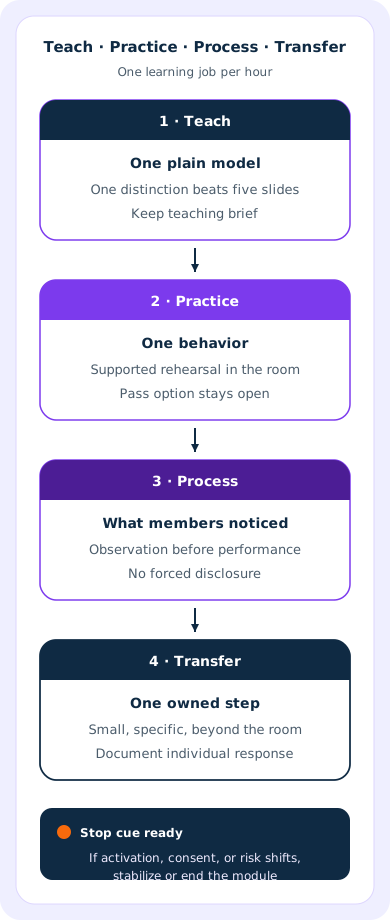
Teach one model, practice one behavior, process what members noticed, and transfer one owned step. Keep a stop cue ready.
- Orient and check fit. Name the module, the pass option, and the depth ceiling.
- Teach one plain-language model. One distinction beats five slides.
- Demonstrate or practice one behavior. Supported rehearsal beats silent worksheet fill-in.
- Process what members noticed. Observation first, performance second.
- Check understanding and applicability. Teach-back, one example, one barrier.
- Transfer one step beyond the room. Small, specific, and owned by the member.
- Document individual response and follow-up. Shared intervention, separate records.
Completion of slides or handouts is not the clinical goal. If activation rises, comprehension drops, consent shifts, or peer process turns sharp, return to stabilization or end the module. The American Group Psychotherapy Association practice guidelines for group psychotherapy keep facilitation responsive to the room, not to the paper plan.
For a multi-week sequence across formats, use the group therapy curriculum template. The curriculum template covers multi-week planning across formats. This guide covers the within-session teaching arc.
Show one worked module
Here is one fully worked example: an avoidance-cycle module for a mixed adult outpatient skills group.
| Module piece | Content |
|---|---|
| Learning objective | Members can name one personal avoidance move and one smaller approach step that still respects safety. |
| Teaching point | Avoidance lowers short-term distress and often strengthens the longer loop. |
| Practice | In pairs, map one recent moment: trigger, urge, avoidance move, short-term relief, later cost. Pass option stays open. |
| Process prompt | What did you notice in your body or thinking when the shorter relief showed up? |
| Transfer | Choose one low-stakes place this week to take a smaller approach step, and name one support cue. |
| Stop cue | If a member becomes flooded, shuts down, or starts forced disclosure, stop mapping and return to grounding or individual follow-up. |
Do not treat the example as a universal protocol. Change the language, the practice intensity, and the transfer size to the room in front of you.
Adapt the module to the room
The same teaching point can land well or poorly depending on membership, access needs, and process load. A psychoeducational group still needs those room-fit decisions even when the model is simple.
Open membership needs self-contained modules and a brief orientation for late arrivals. Closed membership can carry a short thread across weeks without turning one session into a full curriculum.
Mixed literacy, language access, cognitive load, and neurodivergent needs change the teaching medium. Prefer spoken models, visual anchors without dense text, optional written work, and extra time for practice. Never assume a worksheet is accessible because it is tidy.
Guarded rooms need lower disclosure ceilings and stronger pass options. Activated rooms need shorter teaching, earlier stabilization, and a backup topic that does not demand private narrative. Caregiver or mixed-role groups need clear boundaries about whose story is being taught and whose privacy is protected.
Individual follow-up is required when a member shows acute risk, unresolved confusion about a safety-related skill, or a process injury the group cannot hold. Teaching can also become avoidance of live group process. If the room keeps asking for more slides because peer feedback feels unsafe, name the process job and shrink the lecture.
Adaptation stays clinician-led. Do not make categorical rules by diagnosis, age band, or recovery stage alone.
Keep group process alive
Psychoeducational groups fail when the facilitator becomes a classroom lecturer and the members become an audience.
Brief teaching should create shared language, then return the work to member observation, supported practice, and peer meaning-making. Invite members to notice what changed in the room, what stayed hard, and what another person’s example clarified without turning anyone into the case study of the hour.
Information delivery is not therapeutic change. A member who can recite the model and still cannot try a smaller step has not finished the clinical job. A member who practiced imperfectly and named one barrier often has.
Protect voice equity. Quieter members need clean turn structure. Fluent storytellers need a depth ceiling. Pass options are clinical tools, not politeness.
Check learning and document the response
Use modest, observable checks:
- Teach-back in one sentence
- Demonstration of the practiced behavior
- One application example from the member’s week
- One barrier that would block transfer
- One next-step plan small enough to try
A cited myth/fact round is mental health trivia, not a performance quiz of the module.
After group, separate the shared intervention from each member’s response. Note participation, risk material, comprehension or confusion, and follow-up. Two members can hear the same model and leave with opposite next steps.
When you want a therapist-reviewed draft that starts from that shared-plus-member split, use the free group notes generator. The tool supports documentation after the group. It does not replace clinical review, signature, or your chart of record.
Use the Group Facilitation Pack before you build the module
The Group Facilitation Pack helps you lock a primary topic and a backup before the hour starts. It is not a full session plan and not a psychoeducational curriculum.
It includes:
- Population, goal, and stage checks
- Twelve broad group therapy topics
- A primary-plus-backup planner
- After-group note stems
Use it to lock the theme and the backup before you write the teaching point. Then build the module arc on top of that choice. The pack stays at theme selection and note stems; condition-specific teaching handouts are built in the module after you choose the topic.
Close the plan before the chairs fill
Psychoeducational groups work when the facilitator walks in with one learning job, one teaching point, one practice, one process prompt, one transfer step, and one stop cue.
Name the primary topic and the backup on the Group Facilitation Pack. Leave the rest of the bank on the desk. The room needs a module it can practice, not a lecture it can survive.
Free PDF: Group Facilitation Pack
A printable facilitator pack for group therapy topics: population-goal-stage checks, topic selector menu, and primary-plus-backup planner.
- Population, goal, and stage decision checklist before you pick a topic
- 12 group therapy topics across forming, anxiety, depression, relationship, process, and ending lanes
- Primary topic plus backup planner for activated or shut-down rooms
- After-group note stems for intervention, response, risk, and next step
Free. We'll email the PDF link right away and add you to the therapist toolkit, sent every two weeks. Unsubscribe any time.
Where should we send the link?
We'll email the PDF link right away. You'll also get the therapist toolkit every two weeks. Unsubscribe any time.
✓ Check your inbox
We've sent you the PDF
The download link is on its way to your inbox, usually within a minute or two. The email will come from Emosapien (hello@team.emosapien.com); check your spam folder if you don't see it.
You're also on the therapist toolkit list, sent every two weeks. Unsubscribe any time from the email footer.