
ADHD Treatment Plan Goals and Objectives

Outline
Authored by Dr. Elena Vasquez, licensed psychologist (PsyD), play-therapy and child-and-family-therapy trained, with a family-systems lens across home, school, and clinic.
The school wants homework on the desk. A parent wants “better listening.” The child in your office is already tired of being the problem in both buildings.
You don’t need a longer goal gallery. You need one identified client, one functional target in ordinary language, and two or three SMART objectives that can survive a week across home, school, and clinic. This ADHD treatment plan goals PDF is that pack: a child and family sheet, an adolescent sheet, and a clinician review card.
Licensed therapists in outpatient talk therapy choose the targets, the reporters, and the cadence. Caregivers are partners. They are not a second prosecutor, and the young person is not “the ADHD in the room.”
Email me the ADHD treatment plan goals pack
Get the child and family sheet, the adolescent sheet, and the clinician review card for cadence, stop conditions, and next-session reopen.
- Child and family sheet with one functional goal and two or three SMART objectives
- Adolescent and young-adult sheet in age-appropriate adolescent and young-adult language, with a private-report line
- Clinician card for cadence, measurement, stop conditions, F90 handoff, and reopen
Free. We'll email the PDF link right away and add you to the therapist toolkit, sent every two weeks. Unsubscribe any time.
Where should we send the link?
We'll email the PDF link right away. You'll also get the therapist toolkit every two weeks. Unsubscribe any time.
✓ Check your inbox
We've sent you the PDF
The download link is on its way to your inbox, usually within a minute or two. The email will come from Emosapien (hello@team.emosapien.com); check your spam folder if you don't see it.
You're also on the therapist toolkit list, sent every two weeks. Unsubscribe any time from the email footer.
Educational content for licensed therapists, not clinical, legal, or emergency advice. Goal selection sits inside formulation, consent, risk, developmental stage, and setting. This pack does not diagnose ADHD, write an IEP, order medication, or replace assessment, supervision, or a safety plan.
What this pack is and is not
Use this ADHD treatment plan goals PDF to write SMART goals and objectives for ADHD in talk therapy. It is not a whole-plan skeleton, code table, or school form.
For generic SMART language across presenting issues, use treatment plan goals and objectives examples. When the identified client is an adult outpatient chart that needs the SMART split, not a home-school reporter field, use the treatment plan goals and objectives for ADHD PDF. When the chart needs F90 coding, consult ADHD ICD-10 codes. For a blank whole-plan structure, open treatment plan templates.
| This pack is | This pack is not |
|---|---|
| One identified client across home, school, and clinic | An IEP goal bank or classroom behavior plan |
| One functional goal in ordinary language | A 30-plus generic example gallery |
| Two or three SMART objectives with who reports | An ABA data sheet or replacement-behavior log |
| A child sheet and an adolescent sheet | Adult occupational coaching or a stimulant protocol |
| A clinician card for cadence, stop, and F90 handoff | A blank whole-plan template or crisis service |
The AAP clinical practice guideline asks primary care clinicians diagnosing ADHD to document symptoms and impairment in more than one major setting, using reports from parents or guardians, teachers, school personnel, and mental-health clinicians. That diagnosis rule is not a treatment-plan mandate. Home and school reporter lines still let the therapist compare settings without treating one account as definitive.
One client, one field, several reporters
Write the goal in the child’s or caregiver’s words. “I want mornings to stop being a fight” is a goal. “Reduce inattention” is a label looking for a defendant.
Objectives carry the measurable work: a named behavior or skill, a count or frequency, a time window, and who will notice. Write two or three SMART objectives so the family can actually track them.
Who reports is a clinical choice, not a vote:
- The child may pass. Passing is data, not noncompliance.
- A caregiver report is optional. It must not become a weekly prosecution.
- A teacher or school report is optional. It informs therapy. It does not convert this sheet into an IEP.
- No single reporter is the whole truth. Disagreement across home and school is often the formulation, not a lie to catch.
CDC’s ADHD treatment overview places behavior therapy and caregiver coaching beside, not instead of, the rest of care. Write home-routine objectives without turning the parent into the identified patient.
Domains that belong on the page
Stay inside function. Pick one domain for the current goal, then write objectives that can be seen in that domain.
Attention and task completion. Starting, returning after a break, finishing one agreed piece of work. Count attempts or completed pieces, not “focus.”
Organization. Backpack, homework folder, or a two-pocket home and school communication folder that actually travels. Count nights the folder comes back, not “being organized.”
Emotion regulation. A named pause, a named help-ask, a named repair after a blow-up. Count the skill use you agreed to watch, not “less ADHD.”
Home routines. Morning, homework, or bedtime as a sequence with one adult partner. Count completed steps in the sequence the family already runs.
School and clinic coordination. What gets shared, with whom, and how often. Count agreed contacts. Do not write classroom consequences for the school to enforce.
If the hour needs a cycle map, a repair, or a multi-perspective family sheet, use a family-session format. Keep this sheet on measurable ADHD objectives.
Child and family sheet
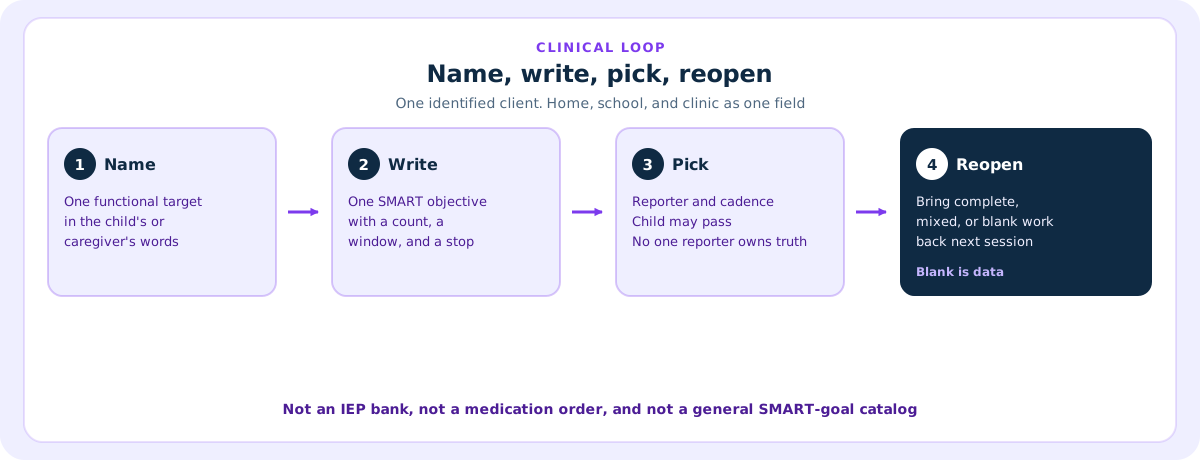
One identified client. Home, school, and clinic as one field. Fill this side of the ADHD treatment plan goals PDF in session before it goes home.
Fields. Client and ID. Date. Clinician. Age band. The functional goal in ordinary language. Domain. Two or three SMART objectives. For each objective: what, how counted, by when, who reports, and a pass line for the child. Optional caregiver line. Optional school line. What this page is not allowed to prove.
Introduce. “We are writing what mornings or homework could look like, not a case against you.”
Worked shape. Goal: “Homework can leave the backpack without a fight most weeknights.” Objective 1: Child and caregiver start a 20-minute homework block on 4 school nights for 3 weeks; child may pass on reporting; caregiver marks start/stop only. Objective 2: Folder returns with one school paper on 3 of 5 school days for 3 weeks; school staff may initial the pocket if they already do so. Objective 3: Child uses one agreed pause phrase before the volume goes up, twice a week, reviewed in session.
Stop. The sheet names the child as the problem, asks the child to confess, or writes IEP-style classroom percentages for a teacher who never agreed to collect them.
Adolescent and young-adult sheet
Same method, in age-appropriate adolescent and young-adult language. The teen authors more of the goal. Caregivers stay in the field without taking the pen.
Fields. The same SMART columns, written so a 14- or 17-year-old can recognize their week. Autonomy line: what the teen reports privately versus what can be shared with a caregiver. School or work coordination without turning the page into job coaching.
Introduce. “You get the first line. Adults can add what they see. Nobody gets to use this as a rap sheet.”
Worked shape. Goal: “I want to start the thing I already decided to start.” Objective 1: Open the assigned task within 10 minutes of sitting down, 3 weeknights, for 4 weeks; teen self-marks; caregiver does not grade the mark. Objective 2: Send one clarifying message to a teacher or coach when the instruction is fuzzy, twice in 4 weeks. Objective 3: Use one agreed wind-down before screens on 4 of 5 school nights, reviewed in session.
Stop. The sheet becomes adult occupational coaching, a stimulant log, or a parent surveillance form.
Young adults in family-involved outpatient care can use this sheet when the field is still home and school or training. They do not need a workplace productivity plan from this pack.
When to pause ADHD goal-writing
Goal language is cheap. Safety, sleep, and a coherent diagnosis are not.
Pause, shrink, or switch tasks when:
- Safety takes the hour. Suicidality, aggression that is not containable, or a new disclosure that applicable state law, your license board, or practice policy requires you to report, consult on, or document. A SMART objective does not sit on top of that.
- Sleep needs assessment. The AAP clinical practice guideline directs clinicians evaluating ADHD to screen for physical conditions such as sleep apnea. Document the sleep concern and coordinate that screening with the family’s medical clinician. Separately, hold ADHD-specific treatment targets until sleep is assessed well enough to distinguish ADHD from a sleep-driven picture.
- Trauma load is uncontained. Task-completion goals can land as another demand. The APA Ethics Code still requires informed consent, practice within the boundaries of competence, and reasonable steps to avoid harm. Name that before anyone signs an objective.
- The diagnosis is still unclear. If you do not yet know whether you are looking at ADHD, anxiety, sleep, trauma, or a learning problem, do not freeze a semester of attention goals.
- The page is prosecuting the identified client. Pause when the sheet is being used as evidence against the young person, including for a custody file. A school meeting is not, by itself, prosecutorial. Consented school coordination can still happen.
- School wants an IEP catalog. Redirect. Therapy objectives can inform a school conversation. They do not replace the school process.
Medication decisions stay with the treating prescriber and the family. These sheets do not titrate medication and do not replace a medical evaluation.
Clinician review card
Cadence, measurement, stop conditions, a short F90 crosswalk, and how you reopen whatever came back.
Scroll the visual sideways to view the full diagram
Cadence. Review at the next appointment, not by text. Name how many school days or home nights you are actually watching.
Measurement. Record the count, reporter, setting, and any disagreement across home and school. Use ABC or direct observation only when it fits the objective and consented plan.
Stop conditions. Safety, sleep, trauma load, unclear diagnosis, prosecution of the child, or an IEP request the sheet cannot answer.
F90 crosswalk. If the chart already carries an ADHD impression, this card only asks whether the goals still match the documented presentation. To confirm or select a code, work from ADHD ICD-10 codes and the current ICD-10-CM source rather than from this planning card.
Next-session reopen. Complete work is a signal. Mixed work is a signal. Blank work is a signal. Ask what the page missed before you interpret motivation.
Privacy, documentation, and safety
Agree on delivery and storage before anyone writes names.
Delivery. Write it on paper in session, send it through a portal the practice already uses, or complete it together. Do not send clinical content through ordinary consumer email or SMS.
Storage. The working copy may stay with the family or enter the file under practice policy. Do not leave a sheet where an unsafe household can use it in a school or custody fight.
Documentation. Chart the clinically relevant signal, the intervention, the response, and the next step. Do not paste the family’s private writing into the note unless there is a specific clinical reason.
A concise entry might read:
Reviewed ADHD goals sheet. Family kept the homework-start objective and left the school-folder line blank after a teacher declined to initial. Child passed on self-report. Agreed to keep caregiver start/stop marks only for two more weeks and to pause the school line.
Safety boundaries. This sheet is not a diagnosis, not an IEP, not a medication order, not a crisis service, and is not monitored in real time.
If risk language appears, leave goal-writing. Follow the practice’s risk, consultation, and emergency procedures.
How Emosapien carries the thread
Emosapien keeps the current treatment-plan goals visible for the next appointment so you can reopen what the family actually agreed to, not a reconstructed story about the week. You choose the targets, the cadence, and the response plan. Emosapien does not diagnose ADHD, write an IEP, titrate medication, monitor crisis risk, or contact emergency services.
When you want the same SMART layer inside a full plan instead of this ADHD treatment plan goals PDF, open the treatment plan generator.
Download the pack
The printable ADHD treatment plan goals PDF fits three sheets onto 3 US Letter pages with selectable text:
- Child and family sheet: one identified client; home, school, and clinic; one functional goal; two or three SMART objectives with who reports
- Adolescent and young-adult sheet: the same method in age-appropriate adolescent and young-adult language, with a private-report line
- Clinician review card: cadence, measurement, stop conditions, F90 handoff, next-session reopen for complete, mixed, or blank work
Walk one sheet in session before it goes home.
Email me the ADHD treatment plan goals pack
Get the child and family sheet, the adolescent sheet, and the clinician review card for cadence, stop conditions, and next-session reopen.
- Child and family sheet with one functional goal and two or three SMART objectives
- Adolescent and young-adult sheet in age-appropriate adolescent and young-adult language, with a private-report line
- Clinician card for cadence, measurement, stop conditions, F90 handoff, and reopen
Free. We'll email the PDF link right away and add you to the therapist toolkit, sent every two weeks. Unsubscribe any time.
Where should we send the link?
We'll email the PDF link right away. You'll also get the therapist toolkit every two weeks. Unsubscribe any time.
✓ Check your inbox
We've sent you the PDF
The download link is on its way to your inbox, usually within a minute or two. The email will come from Emosapien (hello@team.emosapien.com); check your spam folder if you don't see it.
You're also on the therapist toolkit list, sent every two weeks. Unsubscribe any time from the email footer.
References
- Pliszka, S., and the AACAP Work Group on Quality Issues. (2007). Practice parameter for the assessment and treatment of children and adolescents with attention-deficit/hyperactivity disorder. Journal of the American Academy of Child and Adolescent Psychiatry, 46(7), 894-921.
- Wolraich, M. L., Hagan, J. F., Jr., Allan, C., et al. (2019). Clinical practice guideline for the diagnosis, evaluation, and treatment of attention-deficit/hyperactivity disorder in children and adolescents. Pediatrics, 144(4), e20192528.
- Centers for Disease Control and Prevention. Treatment of ADHD.
- American Psychological Association. Ethical Principles of Psychologists and Code of Conduct.