
AHPRA CPD requirements psychologists can meet and record

Outline
It is 6:15pm in a Brisbane consulting room. Renewal is next week. You can name the workshops you sat through. You cannot find the learning plan, the peer-consultation log, or a reflection that ties any of it to this year’s goals.
That is the real problem under the AHPRA CPD requirements psychologists have to meet: not memorizing a headline hour count, but keeping a file that would survive a 28-day audit.
This guide is for psychologists with general registration in Australia, including clinicians with an area of practice endorsement and practice managers who help them file the year. It maps who the standard covers, how the 30 hours split, how peer consultation is timed, what belongs in the portfolio, and how endorsements, registrars, leave, and audits change the file. It is educational guidance, not legal, AHPRA, or Psychology Board advice. Confirm the live standard before you declare hours.
Educational resource for registered psychologists practicing in Australia. Psychology Board of Australia registration standards, CPD guidelines, and professional competencies change over time. Verify current requirements on official Board and Ahpra pages before you rely on any workflow.
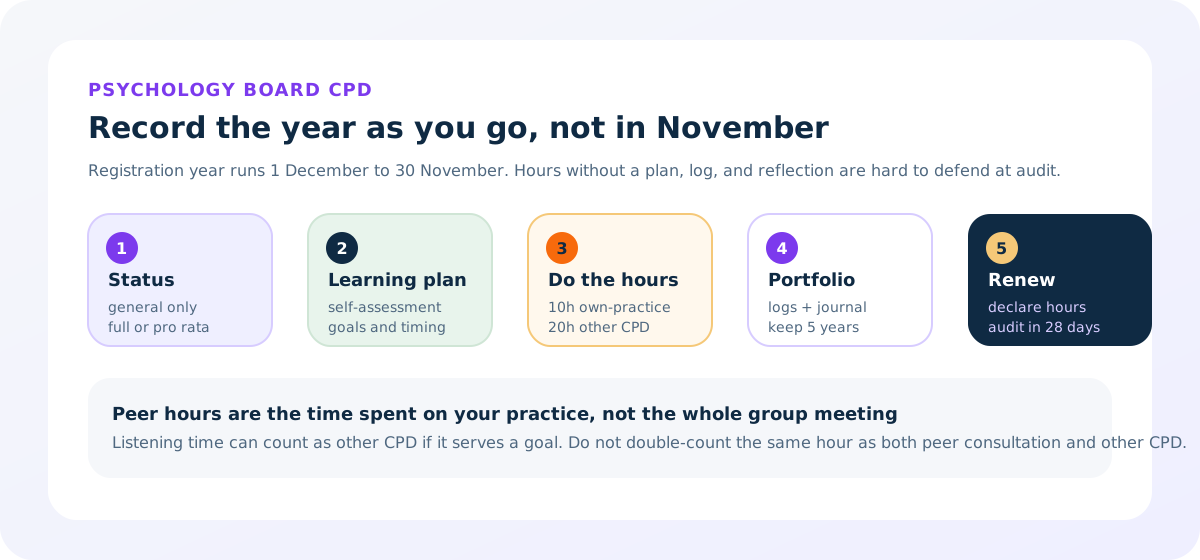
Scroll the visual sideways to view the full diagram
Who the standard actually covers
The live AHPRA CPD requirements psychologists follow sit in the Psychology Board of Australia continuing professional development registration standard (in effect 1 December 2015) and the guidelines for continuing professional development. Ahpra runs audits and the practitioner portal. The Board writes the psychologist rules.
| Registration type | CPD duty under this standard | Common mix-up |
|---|---|---|
| General registration (full year) | 30 hours, including 10 hours of peer consultation | Treating part-time work as a reduced quota |
| General registration (part year) | 2.5 hours for every full month, one third peer consultation | Counting hours from before general registration started |
| Area of practice endorsement | Same 30 hours, with most hours inside the endorsed area | Adding a second 30-hour pile on top |
| Registrar program | Registrar supervision and PD usually cover the minimum if you stay on track | Assuming part-time or leave still auto-covers the year |
| Provisional registration | This CPD standard does not apply | Logging internship PD as if it were general-registration CPD |
| Non-practicing registration | No CPD under this standard | Staying on general registration through a long absence, then missing hours |
If you hold general registration for the full year, you complete the full 30 hours whether you see 8 clients a week or 28. The Board is explicit: part-time work does not lower the bar.
A 2026 public consultation on draft CPD and recency standards closed on 17 July 2026. The Board’s live CPD page, reviewed 21 July 2026, still lists a learning plan, 10 hours of peer consultation, 20 hours of other CPD, and a portfolio due within 28 days of an audit notice. Until a new standard takes effect, run the 2015 rules, not a vendor blog’s rewrite.
Better Access claiming is a different operating system. If the same client file also needs referral batches and session counters, keep that work on the Medicare Better Access plan guide.
Hours, the registration year, and pro rata
The Board cycle is 1 December to 30 November, not the calendar year and not your APS membership year. Hours after 30 November land in the next cycle, even if you renew in the December late window. That calendar is part of the AHPRA CPD requirements psychologists actually have to hit, even when an employer reviews CPD on a financial year.
| Requirement | Board rule of thumb | How to record it |
|---|---|---|
| Total CPD | 30 hours in the registration year | Running total that you can show without reconstructing November |
| Peer consultation | At least 10 hours | Separate log; only time on your own practice |
| Other CPD | 20 hours | Courses, reading, conferences, listening time in peer groups, and other activities tied to the plan |
| Pro rata | 2.5 hours (150 minutes) per full month of general registration | 50 minutes peer plus 100 minutes other CPD per full month |
| Active CPD | Recommended, optional for general registration | Registrars still follow the active-CPD rules of the registrar program |
| Pre-approval | The Board does not certify hours in advance | You justify quality and relevance at audit |
You need at least one written learning goal. The Board template has space for three. That is a prompt, not a quota. The Board learning plan is the audit file; a professional development plan for therapists is the one-page focus you actually work from. A modality certificate is not this Board plan. Compare hours, format, supervised practice, and cost on the narrative therapy training checklist before you log those hours as CPD.
From 1 December 2025, the Board expects psychologists with general registration to self-assess against the professional competencies for psychologists when they build the year’s learning plan. Use the Board’s self-assessment template if it helps. Do not treat competency refresh work as extra hours on top of the 30. It is the same 30 hours, aimed at the competencies that actually sit in your scope.
The Board does not accredit a closed list of providers. If an activity advances a goal in your plan and you can show what you did, what you learned, and how it changed practice, it can count. If you cannot show that chain, it is a nice Thursday, not CPD.
Peer consultation: only the time on your practice
Peer consultation means supervision, mentoring, or consultation, one-to-one or in a group, for professional development and support in the practice of psychology. For the split among those three hours, see clinical supervision vs mentoring vs consultation. It has to include a critically reflective focus on your own practice; that focus is reflective practice for therapists.
Count the minutes spent on your work. If you and a colleague split a 60-minute meeting down the middle, you each log about 30 minutes of peer consultation. The half hour you spent on their case can go toward the 20 hours of other CPD if it serves a goal. It cannot be claimed twice.
| Situation | Peer hours you can claim | Other CPD you can claim |
|---|---|---|
| Individual supervision entirely about your caseload | The whole session | None from that same hour |
| Two-person meeting, 30 minutes each | About 30 minutes | The listening half, if it serves a goal |
| Group of four with equal case time | About one quarter of the meeting | Remaining listening time, if relevant |
| Formal supervisor role in a Board internship or registrar program | None toward the 10 hours | Other CPD only if the activity independently serves your plan |
| Consultation with a provisional psychologist | None toward the 10 hours | Do not use this to fill the peer quota |
| Peer consult with a psychiatrist, academic, or overseas psychologist | Allowed when it advances a goal; majority still with psychologists | Record the link to the plan |
You may consult by video, phone, or correspondence. You may talk about clinical cases, ethics, record keeping, practice systems, burnout, or a paper you plan to present. Psychological practice, in the Board’s wording, is not only direct clinical care.
You should usually consult someone more experienced in the issue on the table. You may include non-psychologist experts when that matches the goal. You may not fill the 10 hours with provisional psychologists. You may count another generally registered psychologist, including a registrar.
Board-approved supervisors have a separate duty: complete a Board-approved supervisor training course or refresher at least every five years. That sits inside CPD planning. It does not replace the annual 10 hours of peer consultation on your own practice.
What belongs in the CPD portfolio
Hours without a file are a declaration you cannot back. The guidelines ask for an electronic or paper portfolio that holds:
| File | What an auditor is looking for | Practical keep |
|---|---|---|
| Learning plan | Goals from objective self-assessment, proposed activities, timeframes, expected outcomes | Review at least annually; update when the job changes |
| CPD activity log | Dated other-CPD hours aligned to the plan | One running log, not a pile of certificates |
| Peer consultation log | Dated own-practice hours and who you consulted | Allocate group time as you go |
| Professional development journal | Some written reflection on every claimed activity, including peer consultation | Date each entry; length is not scored |
| Evidence | Attendance certificates, receipts, reading lists, transcripts, supervision plans | Enough to justify the hours if asked |
| Optional context | Resume or position description | Helps show the plan matches current practice |
Keep the portfolio for five years. Ahpra’s audit team samples practitioners after renewal, not as a condition of clicking submit. If you are selected, you get a notice in the mail and 28 days to send the file. You can be audited on more than one registration standard, and for more than one year, in the same notice.
There is no required word count for reflections. Auditors mainly check that reflection exists. If an activity looks thin, the journal is how you show why it belonged in the plan.
You may use an APS, employer, or overseas logging system if the export contains everything the Board asks for and covers 1 December to 30 November. If your other cycle is a calendar or financial year, extend it or submit two plans that together cover the Board year.
Endorsements, registrars, and extra duties
Endorsement does not add a second 30-hour mountain. It changes where the hours sit.
| Endorsements held | Hours inside endorsed area(s) | Remainder |
|---|---|---|
| One | 16 hours in that area | 14 hours in any area relevant to your practice |
| Two | 15 hours in each area | None left over |
| Three or more | 30 hours split equally across those areas | None left over |
Peer consultation does not have to follow the same split. You can put all 10 peer hours plus some other CPD into one endorsed area, and put the rest of the 20 hours into the second area, as long as the endorsement totals still add up if you want those peer hours to count toward the endorsement share.
Registrars in an area-of-practice program already do extra supervision and professional development. A full-time registrar who stays on the program usually exceeds the general-registration minimum. A part-time registrar, or one who takes leave while keeping general registration, still has to show 10 hours of supervision or peer consultation plus 20 hours of other CPD for that Board year. Registrar CPD also has to stay relevant to the endorsement pathway and the Board’s active-CPD rules for that program.
Exemptions, leave, and a failed year
If you keep general registration through parental leave, illness, or a long break, the default is still the full 30 hours unless the Board grants an exemption or variation. Apply in writing before registration expires. The Board prefers partial exemptions. If you will not practice at all for a year or more, the guidelines recommend switching to non-practicing registration, then returning through the proper form, rather than sitting on general registration with no CPD.
Exceptional circumstances named in the standard include serious illness, injury, bereavement, parental or adoption leave, carer’s leave, or other exceptional circumstances. An exemption is not something you invent after an audit letter arrives.
At renewal you declare whether you met the standard. You do not upload the portfolio unless asked. If you did not meet it and you do not hold an exemption, the Board can still consider renewal with conditions such as extra CPD, further education, supervised practice, or the national psychology exam. Conditions can appear on the public register. In more serious cases the Board can refuse renewal or take other action.
A year on the desk
Priya holds general registration and clinical endorsement in a two-day private practice in Brisbane. In December she prints the Board learning-plan template and self-assesses against the current competencies. She sets three goals: cultural safety with Aboriginal and Torres Strait Islander clients, a tighter risk formulation habit, and supervisor skill before her five-year supervisor refresher is due.
She books a monthly 60-minute peer meeting with an endorsed colleague. They split case time. She logs 30 minutes of peer consultation and 30 minutes of other CPD each month (6 hours peer, 6 hours other by November if they never miss). She adds 4 hours of individual supervision on her own caseload to finish the peer quota. Workshops, a journal club, and the supervisor master class fill the remaining other CPD, with 16 hours clearly inside clinical endorsement.
She writes a short dated reflection the same day, not in November. Certificates land in one folder named for the Board year. In October she can open the file in five minutes. That is the job the hour count cannot do on its own.
If your practice is also choosing software that has to sit beside Ahpra, Medicare, and note review, start with the best therapy software for Australia shortlist. Keep CPD files out of the client chart. Write clinical notes for continuity; write the Board portfolio for the year.
Recording checklist
Use this as the desk-side runbook for the Board year. It is how you record the AHPRA CPD requirements psychologists must be able to show, not a second set of hours.
In December (or the month you gain general registration)
- Confirm you hold general registration for the months you will claim
- Write or refresh the learning plan from a competency self-assessment
- Name at least one goal, proposed activities, timeframes, and expected outcomes
- Open a peer log, an other-CPD log, and a dated journal
- Note endorsement, registrar, and supervisor-refresher duties if they apply
Each month
- Log peer minutes that focused on your practice
- Log other CPD against a goal
- Write some reflection the same day, including for peer sessions
- Store evidence (certificate, receipt, reading list, supervision plan)
- Recalculate endorsement splits if you hold one or more endorsements
Before you declare at renewal
- Totals show at least 10 peer hours and 20 other hours, or the correct pro rata
- Board year dates run 1 December to 30 November
- No hours from before general registration, and no leftover hours from last year
- Portfolio is complete enough to send in 28 days
- File will remain available for five years
Emosapien can help you keep session notes in a reviewable form. It does not replace the Board portfolio, the peer log, or your renewal declaration. If you want structured notes with clinician review before anything is filed, start a free trial of Emosapien. You still own Ahpra declarations, peer consultation, and clinical sign-off.
For product context on how the console sits next to local Australian workflows, see Emosapien features.
References
- Psychology Board of Australia. Continuing professional development (page reviewed 21 July 2026).
- Psychology Board of Australia. Registration standards, including the continuing professional development registration standard (date of effect 1 December 2015).
- Psychology Board of Australia. Guidelines for continuing professional development (1 December 2015).
- Psychology Board of Australia. Professional competencies for psychologists (date of effect 1 December 2025).
- Psychology Board of Australia. Forms, including the CPD learning plan and reflective practice journal templates.
- Ahpra. Consultations (draft CPD and recency standards; consultation closed 17 July 2026).