
Canada Psychotherapy Record Keeping: Retention Clocks by College

Outline
It is 18:20 in a Toronto consulting room. Maya has two notes left and an access request in the inbox. The session is clear in her head. The file is not: she cannot say who the custodian is, whether the couple session lives in one chart or two, or which clock starts if the 16-year-old never books again.
That is the working problem behind Canada psychotherapy record keeping. The job is not a prettier progress note. It is a file another clinician, a college investigator, or a privacy commissioner could open without guessing.
This guide is for registered psychotherapists, psychologists, clinical counselors, social workers providing psychotherapy, and practice managers who keep the chart. It maps the three files, the privacy statute that actually binds them, college retention clocks, access and joint records, and what to do when you stop practicing. It is educational guidance, not legal, college, or privacy-commissioner advice. Confirm the live standard for your province and title before you change a workflow.
Educational resource for licensed and registered mental-health clinicians practicing in Canada. College standards and privacy statutes change. Verify current requirements on official college and commissioner pages before you rely on any workflow.
Scroll the visual sideways to view the full diagram
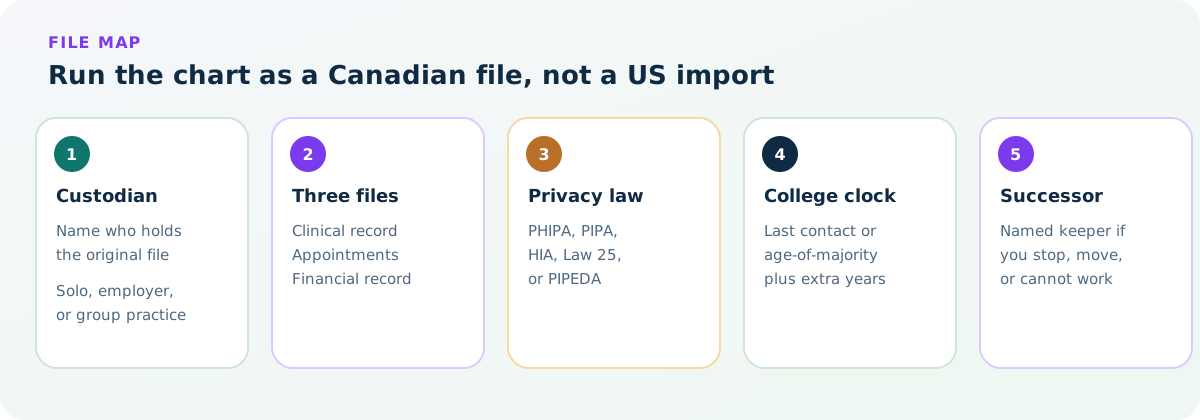
Three files, not one note
Colleges treat the client record as more than the session write-up. Ontario’s CRPO record-keeping standards are the most detailed public map for psychotherapy, and they split the work into clinical records, appointment records, and financial records. Other Canadian colleges use different numbering. The same three jobs still show up.
| File | What it has to show | What fails in practice |
|---|---|---|
| Clinical record | Identity, assessment, plan, progress, risk actions, reports, closing | A note that cannot support continuity or a complaint |
| Appointment record | Date, time, duration, and canceled or missed contacts | A calendar you cannot reconstruct two years later |
| Financial record | Who was billed, for what, the fee, any waiver, any third-party payer, any balance | An invoice that does not match the clinical contact |
You can keep all three in one electronic system. You still need to retrieve each layer. Format choice (SOAP, DAP, BIRP) is secondary. For wording templates, use the clinical documentation hub. On the chart, Canada psychotherapy record keeping is custody, content, clocks, and access: who holds the original, what belongs in it, how long you keep it, and who may see it.
Who holds the original file
Privacy statutes use “health information custodian,” “custodian,” or “organization.” The label changes. The question does not: who is responsible for the original record?
| Practice setup | Usual custodian | What to write down |
|---|---|---|
| Solo private practice | You | Your successor, storage location, and destruction method |
| Employment in an agency or hospital | The organization, if its system meets the statute | That you can still produce a complete clinical record |
| Group or shared premises | Whoever the written agreement names | Who keeps originals and who may issue copies |
| Supervised practice | The named custodian in the supervision agreement | That the client was told who holds the file |
If you practice alone, you usually are the custodian. If you are an employee, follow the employer’s system when it complies. If it does not, you still have to keep a record that meets the statute. In a group, do not wait for a dispute to discover that three people each thought the other owned the chart. If you are still choosing, who owns the record when you practice alone or in a group is that decision, not this college clock. Once you have chosen solo, the six-line opening sequence for a therapy practice puts records on their own line.
The custodian keeps originals and issues copies. That is the access workflow, not a preference.
What belongs in the clinical record
CRPO Standard 5.1 is a useful contents list even if you are not an Ontario RP, because it is specific enough to audit. Your own college may add testing data, supervision records, or extra identity fields. Do not subtract from this floor unless your college says the item is out of scope.
| Record element | Put this in | Leave this out |
|---|---|---|
| Client profile | Full name, address, phone, date of birth, unique identifier if used, authorized representatives, referrer or self-referral | Informal nicknames with no key |
| Assessment | Methods, results, conclusions, formulation, professional opinion of status | Unwritten hunches you never tested |
| Plan for therapy | Direction of the work, modality, consents, later changes | A slogan with no next step |
| Progress notes | Client statements, observations, impressions, the plan in response | A transcript of the hour |
| Work product | Photographs, copies, or descriptions of objects made | Unlabeled artwork in a desk drawer |
| Consultations and referrals | Date and relevant details of every consult or referral | A hallway conversation with no note |
| Reports | A list and copy of reports sent or received | Attachments you cannot find |
| Incident and mandatory reports | The incident, action, follow-up, and a written summary of any verbal report | A memory of a call to a child-protection agency |
| Closing | Reasons, outcomes, referrals, follow-up recommendations | A silent last DNA with no closing note |
CRPO commentary also draws a useful line around two extras. Rough notes do not have to stay in the clinical record. If you are not keeping them, use them to finish the note and destroy them the same day. Developmental notes about your own process, used in supervision and not identifying the client, are generally not part of the clinical record.
Every entry needs who wrote it and when. An amendment should show what changed, when, by whom, and why, with the original still legible. Key information (the profile and anything a covering clinician would need in an emergency) stays in English or French. Progress notes may be in the language of the therapy.
Appointment and financial records
Appointment records are easy to skip because the calendar already exists. Colleges still want a reconstructable history of contact. CRPO Standard 5.4 asks for date, time, and duration of each professional encounter, plus canceled or missed appointments. Keep that layer at least as long as the clinical file.
Financial records sit beside the clinical file, not inside the progress note. When a fee is charged, record who provided the service and their title, who received it (full name, address, unique identifier if used), the fee, any reduction or waiver and why, any third-party payer, any balance, and any collection step. Ontario RPs keep financial records on the same 10-year / 18th-birthday clock as the clinical file.
If the invoice says 60 minutes and the note says 45, the file has a problem before anyone reads the formulation.
Which privacy statute actually binds the chart
Canada does not run one national health-privacy code. Canada psychotherapy record keeping therefore starts with the statute that applies to this practice, this client location, and this transfer.
| Where the work sits | Statute you usually open first | What it is for |
|---|---|---|
| Ontario health information custodians | Personal Health Information Protection Act, 2004 (PHIPA) | Collection, use, disclosure, access, and correction of personal health information |
| Alberta private practice | Alberta PIPA and, for some custodians, the Health Information Act | Private-sector personal information; HIA for designated custodians |
| British Columbia private practice | BC PIPA | Private-sector personal information, including counseling files |
| Quebec | Quebec’s private-sector privacy law (Law 25 reforms) plus professional regulations | Sensitive personal information and dossier rules |
| Other provinces without a displacing private-sector statute | PIPEDA | Commercial collection, use, and disclosure of personal information |
| Interprovincial or cross-border commercial transfer | PIPEDA still reaches the transfer | Do not assume the in-province carve-out follows the file out of province |
Ontario PHIPA, New Brunswick, Nova Scotia, and Newfoundland and Labrador health-information statutes have been treated as substantially similar to PIPEDA for health information. Alberta, British Columbia, and Quebec have private-sector statutes treated as substantially similar for in-province commercial activity. The federal statute still matters when information leaves the province.
Name the statute in your privacy notice. Consent to therapy is not automatically consent to every later disclosure. If you add email, video, or a new record system, treat that as a new collection and use, with safeguards you can describe.
Do not import a US psychotherapy-notes carve-out into a Canadian chart. Canadian access rules start from the client’s right to their personal health information, with listed exceptions, not from a separate US note class.
Retention clocks you should not guess
There is no Canada-wide retention number. Use your college’s live standard, then keep longer if another law or a claim requires it. The table below is a starting map, not a destruction warrant.
| Jurisdiction and title | Common minimum clock | Minor / extra rule | Verify here |
|---|---|---|---|
| Ontario RP (CRPO) | At least 10 years from last interaction | Or 10 years from the 18th birthday, whichever is later | CRPO Standard 5.1 |
| Ontario psychologist (CPBAO) | At least 10 years after last professional contact | Or 10 years after the service recipient reaches 18, whichever is later | CPBAO Standards of Professional Conduct, 2024 |
| Alberta psychologist (CAP) | College materials have used 10 years after last contact, sometimes plus an extra year for limitation periods | Longer for some minors, disability, or serious-crime files | Live CAP Standards of Practice and Psychological Records guideline |
| Quebec psychologist | At least 5 years from the last professional service | Separate rules when the psychologist ceases practice | Règlement sur la tenue des dossiers |
| BC clinical counselor (BCACC) | Association materials often use 7 years after last contact | Often 7 years after age 19 when the client was a minor | Live BCACC documentation standard |
| CCPA members in unregulated settings | No single CCPA clock | Follow the provincial or territorial law that actually applies | CCPA Standards of Practice |
A child last seen at seven, under the Ontario RP rule, is kept until the 28th birthday. That is the example CRPO publishes. Do not destroy a minor file on the adult 10-year habit.
If you work across provinces, keep to the longer clock and the stricter access rule unless counsel tells you otherwise. Destroy securely when the clock is done. A recycling bin is not destruction.
Access, correction, and joint records
Clients can usually obtain a copy of their personal health information and ask you to correct facts. PHIPA lists exceptions. A reasonable cost-recovery fee may be allowed; it cannot be a barrier. CRPO commentary has treated $30 for the first 20 pages and 25 cents a page after that as an example of a fee that has been held reasonable, not as a tariff you must charge.
Reports and certificates are not the same as a copy of the chart. CRPO Standard 5.2 asks you to provide a report relating to treatment within a reasonable time, generally 30 days, unless there is reasonable cause not to. Say whether you are giving opinion, stating fact, or summarizing what the client told you.
Couple, family, and group files need a plan before the first session. CRPO commentary: keep one file when people attend in the same combination; use separate files or sub-files when combinations change. Tell joint clients how records are kept. They may see the whole joint record if everyone consents or they make a joint request. One person, without the others, receives only their own information plus communal themes not attributable to another participant. For session-note wording in family work, use the family therapy progress notes guide. On couple, family, and group charts, work custody and access: who holds the original and what each person may receive.
When you stop, move, or cannot work
A complete chart with no living custodian is a future complaint. Ontario psychologists who are custodians must arrange security and maintenance of records in case of expected or unexpected incapacity or death, and inform the college, preferably naming another registrant. Quebec psychologists who cease practice must follow a dossier-transfer regulation, including naming a cessionnaire. CRPO advises designating a health information custodian successor in writing, with that person’s consent.
Do it now:
- Name a successor who understands the statute
- Say where the files live and how to open them
- Say how long to keep them and how to destroy them
- Tell the college when your rules require it
- Keep a destruction log (client identifier, service period, destruction date) after the clock runs
If you want a non-Canadian comparison for documentation habits, the UK therapy documentation guide is the closest sibling page. Do not copy UK GDPR language into a PHIPA or PIPA notice.
A week on Maya’s desk
Maya is an Ontario RP in a two-day private practice. On Monday she writes a one-page custodian note: she holds originals, her colleague Dana is the successor, files live in one encrypted system plus a locked cabinet for paper consents.
A new couple starts Tuesday. She opens a couple file and tells them that an individual hour will live in a separate sub-file. Thursday she sees the 16-year-old. The closing plan, if they stop now, already uses the 18th-birthday clock, not a 10-year adult guess.
The access request is from one member of a former couple. Maya releases that person’s own entries and the shared themes, not the other person’s attributed words. She invoices a cost-recovery fee that would not stop the request. She logs the request and what went out.
That is Canada psychotherapy record keeping in a working week: custody, three files, the right clock, and an access path you can defend.
Desk checklist
Use this as the desk-side runbook for Canada psychotherapy record keeping, then check your college.
Before the first session
- Name the custodian in writing
- Name a successor
- Choose the privacy statute for this practice and this client location
- Open clinical, appointment, and financial layers
- Explain joint-record access if more than one person will attend
Each contact
- Date, time, duration, who was present
- Progress note that another clinician could use
- Risk or mandatory-report actions, if any
- Fee, payer, and any waiver
- Same-day destruction of rough notes you are not keeping
When the work ends
- Closing note with reasons, outcomes, referrals
- Start the correct retention clock (last contact vs age-of-majority)
- Keep appointment and financial records for the same span unless your college says otherwise
Before you destroy anything
- Confirm the live college minimum
- Check open complaints, claims, or statutory holds
- Destroy so the file cannot be rebuilt
- Keep a destruction log
Emosapien can help you keep session notes in a reviewable form. It does not replace college custody, the privacy statute, or your sign-off. If you want structured notes with clinician review before anything is filed, start a free trial of Emosapien. You still own the record, the clock, and clinical sign-off.
For product context on how the console sits next to local documentation workflows, see Emosapien features.
References
- College of Registered Psychotherapists of Ontario. Record-Keeping and Documentation (Professional Practice Standards, Section 5).
- College of Registered Psychotherapists of Ontario. Standard 5.1: Clinical Records.
- College of Registered Psychotherapists of Ontario. Standard 5.2: Requests for Reports.
- College of Registered Psychotherapists of Ontario. Standard 5.4: Appointment Records.
- College of Registered Psychotherapists of Ontario. Standard 5.5: Financial Records.
- College of Registered Psychotherapists of Ontario. Standard 5.1 commentary on language of records and access to joint therapy records.
- Ontario. Personal Health Information Protection Act, 2004.
- Ontario. Professional Misconduct regulation under the Psychotherapy Act, 2007 (provisions on records).
- CPBAO. Standards of Professional Conduct, 2024, including record storage and retention.
- Office of the Privacy Commissioner of Canada. PIPEDA.
- Légis Québec. Règlement sur la tenue des dossiers et des cabinets de consultation des psychologues.
- CCPA. Standards of Practice (maintenance of records; follow provincial law for retention).