
Family Therapy Progress Notes

Outline
Authored by Dr. Sofia Reyes, a clinical psychologist with a forensic and healthcare-compliance specialty and over a decade of practice across the US and Canada.
The identified patient has gone quiet. One parent is answering for them. The other is watching the door. You named the parent-child cycle in the room. The official record now has to show who was present, who was absent, and how each member responded, without becoming a transcript.
Family therapy progress notes are the official multi-party chart for licensed therapists documenting an outpatient household hour. They hold attendance, identified-patient presence, consent and shared-record limits, observed interaction, one intervention plus member responses, risk, and the next step.
The pack below is a blank chart plus a clinician card with two worked examples. Work through what each field has to show before the note enters the chart.
Email me the household chart
Get the blank family progress note, a clinician card for fit and stop conditions, and two worked examples (patient present and patient absent).
- Blank household chart: header, attendance, identified patient, consent, member reports, interaction, intervention plus member responses, risk, next step
- Clinician card for purpose, fit, stop conditions, sort, and the documentation prompt
- Two worked examples: patient present and patient absent, initials only
Free. We'll email the PDF link right away and add you to the therapist toolkit, sent every two weeks. Unsubscribe any time.
Where should we send the link?
We'll email the PDF link right away. You'll also get the therapist toolkit every two weeks. Unsubscribe any time.
✓ Check your inbox
We've sent you the PDF
The download link is on its way to your inbox, usually within a minute or two. The email will come from Emosapien (hello@team.emosapien.com); check your spam folder if you don't see it.
You're also on the therapist toolkit list, sent every two weeks. Unsubscribe any time from the email footer.
Educational content for licensed therapists, not clinical, legal, or payer advice. This template does not diagnose, treat, establish medical necessity, select a family psychotherapy code, or make a family safe. Adapt every note to consent, risk, formulation, and local policy.
What this household template is and is not
This is the official multi-party record for one family or household hour. Another clinician covering next week should see who was in the room, the live goal, the interaction you observed, what you did, how members responded, and what happens next.
It is not a SOAP-only overlay. Choose your note format from progress note templates and examples. SOAP, DAP, or BIRP headings can hold these same fields when your setting requires them.
It is not a family therapy intake form. Intake holds the roster and consent before the first hour. This note records one session after that frame is already set.
It is not a treatment-plan rewrite, not a genogram, not family worksheets, not a two-adult couples dyad, not a group note, not a play-only child hour, and not a private process note. Each of those is a different clinical document. When the hour is a multi-family or family group rather than one household chart, pick the activity from family group therapy activities and keep this note for the single-household record.
When this household chart fits
Use family therapy progress notes for an outpatient family or household hour when more than one member is present, or for a documented caregiver-only hour that still sits inside an ongoing family frame. Multi-party consent is already in place. You already decided who the identified patient is. The chart needs more than one voice without a transcript.
A useful hour for this skeleton looks like a pattern you can name in observable language: a parent speaking for a teen, a sibling triangulation, a cutoff, or a repair attempt. One intervention is enough. Member-level responses belong on the page even when they differ.
When to pause the family note
Stop this skeleton when the hour is no longer family work you can document as a shared official record.
| Pause when | What to do instead |
|---|---|
| IPV, coercion, or a member cannot freely participate | Follow local safety procedure. Do not use a family note as the safety response |
| Multi-party consent or no-secrets limits are missing or broken | Repair consent before you chart a shared record |
| The hour is a two-adult couples dyad | Do not stretch this household chart into a partner note |
| The hour is group or individual therapy | Use the record that matches that contact |
| The job is a treatment-plan rewrite | Return to the plan, not this session skeleton |
| The job is a genogram map or family worksheets | Use a genogram or a family worksheet instead of this chart |
| The hour is a play-only child session | Use the play-session record, not this household chart |
| The text is hypothesis, countertransference, or supervision | Keep it in a private process note if your practice uses that category |
APA Ethics Standard 10.02 requires you to clarify which individuals are clients, the psychologist’s role and relationship with each person, and the probable uses of the services or information when more than one person is in the room (Ethical Principles of Psychologists and Code of Conduct). Standard 4.02 requires you to discuss the limits of confidentiality. If those limits are not in place, do not write a shared household chart as if they were.
What belongs in family therapy progress notes
Keep each field short enough that a covering clinician can continue the work. Presence is a documentation fact: the identified patient was in the room, or was not. It is not a code picker. Select the code for family psychotherapy with the patient present (90847) or without the patient present (90846) using the family therapy billing guide.
Scroll the visual sideways to view the full diagram
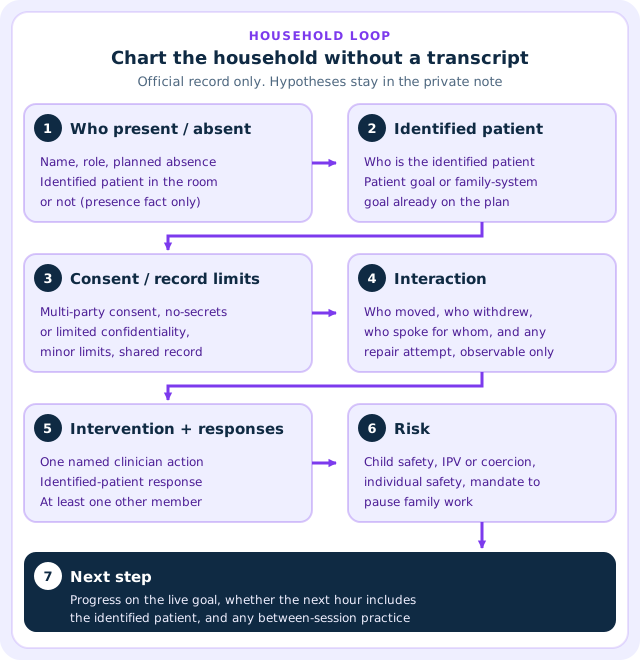
A field is not done because it contains a sentence. “Family engaged” hides who moved. “Processed communication” hides who spoke for whom.
Worked examples
These fictional, de-identified examples use initials and cover a communication and school-attendance conflict, with no graphic safety content.
The note holds enough for continuity. It does not hold your working hypothesis about family history. That stays out of the shareable chart unless local policy requires it there for safety.
Privacy, multi-record, and safety
The HIPAA Privacy Rule at 45 CFR 164.501 already names joint counseling sessions in the psychotherapy-notes definition. Heightened protection applies only when a private record meets that definition and stays separate from the rest of the medical record. A folder titled “private” is not enough.
Sort after the hour:
- Attendance, presence, consent, interaction, intervention, member responses, risk, and plan stay in this official household chart.
- Hypotheses, countertransference, and supervision prompts stay in a private process note if your practice uses that category.
- Graphic or extra detail with no care value stays out.
If you are unsure whether the material belongs in a process note or a progress note, see process notes vs progress notes. This template is the shareable household chart.
A covering clinician next week needs who was in the room, whether the identified patient attended, the live goal, the interaction you named, the intervention, member responses, risk, and the next step. They do not need your untested formulation.
Do not send this chart through ordinary consumer email or SMS. Do not treat the note as real-time monitoring. If IPV, coercion, or child or individual safety takes over the hour, leave family documentation and follow the practice risk procedure.
APA Record Keeping Guidelines treat content, confidentiality, and retention as professional judgments, not as one universal family template. Follow the controlling rule for your setting.
How Emosapien carries the thread
Emosapien drafts a clinician-reviewed progress note after the family hour so who attended, the interaction you named, and each member’s response are still visible at sign-off, instead of reconstructed from memory. You choose the content, correct errors, and sign. Emosapien does not run the family hour, classify process notes, or select a family psychotherapy code.
Draft the household hour, then sign
Once you know what each field has to show, review member responses before the note enters the chart.
Download the pack
The printable pack fits a blank multi-party chart, one clinician card, and two worked examples onto 2 to 3 US Letter pages with selectable text:
- Session header, attendance and presence, identified-patient frame, consent, member reports, interaction, intervention plus member responses, risk, and next step
- Clinician card: purpose, when it fits, stop conditions, sort, documentation prompt
- Two worked examples (patient present; patient absent), initials only
Each template page carries a printed safety line: not a crisis service, not legal or payer advice, not a 90847 claim, not a substitute for local policy.
Use these family therapy progress notes as one official-record pack, not as a SOAP overlay and not as a plan rewrite.
Email me the household chart
Get the blank family progress note, a clinician card for fit and stop conditions, and two worked examples (patient present and patient absent).
- Blank household chart: header, attendance, identified patient, consent, member reports, interaction, intervention plus member responses, risk, next step
- Clinician card for purpose, fit, stop conditions, sort, and the documentation prompt
- Two worked examples: patient present and patient absent, initials only
Free. We'll email the PDF link right away and add you to the therapist toolkit, sent every two weeks. Unsubscribe any time.
Where should we send the link?
We'll email the PDF link right away. You'll also get the therapist toolkit every two weeks. Unsubscribe any time.
✓ Check your inbox
We've sent you the PDF
The download link is on its way to your inbox, usually within a minute or two. The email will come from Emosapien (hello@team.emosapien.com); check your spam folder if you don't see it.
You're also on the therapist toolkit list, sent every two weeks. Unsubscribe any time from the email footer.
References
- U.S. Department of Health and Human Services. 45 CFR 164.501. HIPAA Privacy Rule definitions, including psychotherapy notes.
- American Psychological Association. Ethical Principles of Psychologists and Code of Conduct. Standard 10.02, therapy involving couples or families; Standard 4.02, discussing the limits of confidentiality.
- American Psychological Association. Record Keeping Guidelines.