
CPT 96136 Psychological Testing: Administration Units and Time Log

Outline
CPT 96136 psychological testing administration is easy to miscode when practices treat every testing minute as one bucket. Administration and scoring sit in one family. Evaluation, interpretation, decision making, and the written report sit in another. Technician-administered batteries sit in a third.
This guide covers qualified-professional administration and scoring under 96136 and 96137, the two-or-more-tests rule, unit and midpoint timing, the split from evaluation and technician codes, and a printable administration time/unit log with a pre-claim checklist. Use the CPT codes for therapists hub for the wider psychotherapy and E/M map, and the sibling CPT 96130 psychological testing guide when the work is evaluation rather than administration.
Free PDF: CPT 96136 Administration Time and Unit Log
A printable administration time and unit log for CPT 96136 and 96137: instruments, face-to-face minutes, midpoint units, and the split from 96130 evaluation work.
- Instrument list and who administered and scored
- Face-to-face administration time log with start/stop fields
- Midpoint unit helper for 96136 and 96137
- Pre-claim checklist separating administration from 96130 evaluation
Free. We'll email the PDF link right away and add you to the therapist toolkit, sent every two weeks. Unsubscribe any time.
Where should we send the link?
We'll email the PDF link right away. You'll also get the therapist toolkit every two weeks. Unsubscribe any time.
✓ Check your inbox
We've sent you the PDF
The download link is on its way to your inbox, usually within a minute or two. The email will come from Emosapien (hello@team.emosapien.com); check your spam folder if you don't see it.
You're also on the therapist toolkit list, sent every two weeks. Unsubscribe any time from the email footer.
Educational reference for licensed US psychologists and other qualified health care professionals authorized to administer and score psychological or neuropsychological tests, plus the billing staff who support them. CPT descriptors, credentialing, and payer coverage vary. Verify current rules against official AMA CPT guidance, the CMS Physician Fee Schedule, and your local coverage determinations before billing.
Administration and scoring are a different service from evaluation, and some policies split them the same way. Check the testing line on malpractice coverage for psychologists against the work you actually perform, not the brochure label.
What CPT 96136 actually covers
In the AMA CPT structure, CPT 96136 psychological testing is the first 30 minutes of psychological or neuropsychological test administration and scoring by a physician or other qualified health care professional, two or more tests, any method. Describe it as administration and scoring by the QHP, not as a face-to-face-only service; qualifying scoring can occur after the patient leaves.
That descriptor is narrow on purpose. 96136 is not the code for integrating results into a diagnostic opinion. It is not automatic reimbursement for every PHQ-9 filed during psychotherapy. It is the professional administration and scoring block when a qualified clinician personally gives and scores a multi-test battery.
96137 is the add-on for each additional 30 minutes of the same administration and scoring service. Additional units attach only when documented qualifying administration-and-scoring time supports them under the timing rules you apply.
Administration versus evaluation versus technician paths
Keep three lanes on the claim and in the chart.
| Code family | What it is | Typical unit | Who performs it |
|---|---|---|---|
| 96136 / 96137 | Test administration and scoring by a qualified health professional | First 30 minutes, then each additional 30 minutes | Physician or other qualified health care professional |
| 96138 / 96139 | Test administration and scoring by a technician | First 30 minutes, then each additional 30 minutes | Technician under applicable supervision rules |
| 96130 / 96131 | Psychological testing evaluation, interpretation, decision making, report, feedback | First hour, then each additional hour | Physician or other qualified health care professional |
| 96132 / 96133 | Neuropsychological testing evaluation | First hour, then each additional hour | Physician or other qualified health care professional |
If the work was integrating results, writing the report, and making clinical decisions, move to CPT 96130 psychological testing evaluation. If a technician administered and scored under supervision, use 96138 and 96139. When CPT 96136 psychological testing administration and a 96130 evaluation both apply in one episode, split the time and the narrative so a reviewer can see two distinct services.
Two or more tests, and what does not fit
The 96136 descriptor requires two or more tests, any method. A single brief emotional or behavioral assessment instrument often belongs on another path, such as 96127 when that service definition fits the encounter. Brief outpatient scales for mental health are selected on the clinician matrix; 96136 is timed administration of two or more tests, not that matrix. Do not stretch one checklist into a multi-test administration claim.
Paper, digital, or mixed methods can all count when they are true psychological or neuropsychological tests in a structured battery. Name the instruments in the note. “Testing completed” without a list is a weak chart and a weak claim.
A psychiatric diagnostic evaluation under 90791 still opens many episodes with history, mental status, risk, diagnosis, and plan. That intake is not automatic conversion to 96136 because two screening forms sat in the packet. Use administration codes when a multi-test battery was actually administered and scored under the service rules.
Unit logic for 96136 and 96137
Use one administration-and-scoring clock, with separate entries for patient-present administration and qualifying scoring, for activities that belong to this family:
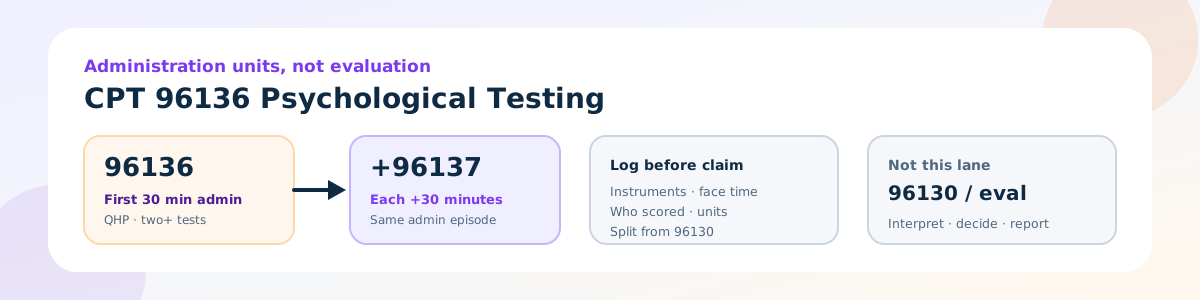
- Count administration and scoring only. Give instructions, administer instruments, and score those instruments; log patient-present administration separately from qualifying scoring without the patient present.
- Exclude evaluation minutes already counted under 96130, 96131, 96132, or 96133.
- Apply midpoint timing for the 30-minute unit. Under common CPT midpoint practice for a 30-minute code, the first unit (96136) is reportable once qualifying time reaches at least 16 minutes. Each further 30-minute block needs its own midpoint on cumulative time: one 96137 from 46 minutes total, a second 96137 from 76 minutes, a third from 106 minutes, and so on. Typical cumulative bands are 16 to 45 minutes (96136 x 1), 46 to 75 minutes (96136 x 1 and 96137 x 1), and 76 to 105 minutes (96136 x 1 and 96137 x 2). Verify the active CPT timing rule and payer policy before claim submission.
- Do not double-bill the same tests under both QHP administration codes and technician codes on the same encounter.
- Stop the clock when administration and scoring end. Later pure interpretation and report drafting belong on the evaluation family, not as free 96137 time.
Worked unit example 1: single-day QHP battery
A licensed psychologist personally administers and scores a multi-instrument ADHD battery face to face for 55 minutes, then spends 90 minutes on separate evaluation work (integration, report, feedback) billed under 96130 and 96131. Qualifying administration time is 55 minutes. Claim pattern for administration: 96136 x 1 and 96137 x 1. Evaluation remains on the 96130 line. The administration note lists instruments, who administered them, and start/stop or total administration minutes.
Worked unit example 2: multi-block same day
Morning block: 45 minutes of QHP administration and scoring. Afternoon block: 40 more minutes finishing remaining instruments with the same client the same day as one continuous administration service. Qualifying administration time is 85 minutes. Claim pattern: 96136 x 1 and 96137 x 2 (85 minutes falls in the 76 to 105 band under cumulative midpoint math). The chart ties both blocks to the same battery and keeps evaluation minutes off this clock.
Worked unit example 3: the denial pattern to avoid
A therapist bills CPT 96136 psychological testing for a 45-minute psychotherapy session that included a PHQ-9 and a GAD-7 glance, with no multi-test administration log and no separate scoring work product. The claim is vulnerable because the service looks like psychotherapy plus routine measures, not a QHP multi-test administration encounter. Fix the coding path: keep the psychotherapy code when that is the service delivered, or build a true multi-test administration encounter with instrument list, face-to-face administration time, and scoring documentation when that is the service delivered.
Documentation components reviewers look for
A defensible 96136 chart answers five questions without hunting through free text.
- Medical necessity and referral question. Why a multi-test administration was needed now.
- Instruments. Named tests (two or more), method (paper, digital, mixed), and who administered and scored them.
- Time. Total qualifying administration and scoring time, or start and stop blocks, with patient-present administration separate from other qualifying scoring, limited to this code family.
- Separation from evaluation. Clear boundary so 96130 minutes are not recycled as 96136 minutes, and vice versa.
- Credentials and signature. Rendering clinician matches the QHP administration service billed.
Pair procedure codes with ICD-10-CM diagnoses the assessment supports. A vague “rule out” without formulation weakens both the clinical chart and the claim.
Credentialing and scope boundaries
96136 sits with physicians and other qualified health care professionals authorized to administer and score these tests. Scope, state licensure, payer enrollment, and supervision rules decide who may bill. Many counselors, social workers, and marriage and family therapists do not bill this family even when they use brief measures in therapy. When that hour is a chartable social-work move rather than test administration, use the chartable social work intervention cards.
Before the first claim, confirm:
- The clinician’s license and payer credentialing cover psychological or neuropsychological test administration.
- Technician paths use 96138 and 96139 with the required supervision documentation.
- Prior authorization rules for testing, if the payer requires them.
- Whether the evaluation portion is psychological (96130 family) or neuropsychological (96132 family).
This page does not convert an unauthorized clinician into a testing provider. It only organizes coding and documentation once the service is within scope. Payer enrollment for this family is the same paperwork problem as getting credentialed with insurance as a therapist. Confirm the effective date before the first testing claim.
Common denial and audit patterns
- Evaluation minutes billed as administration. Move interpretation, decision making, and report work to 96130 or 96131.
- Single-instrument claims forced onto 96136. Respect the two-or-more-tests rule and the correct brief-assessment path when it applies.
- Same battery billed under both QHP and technician administration codes. Do not double-bill overlapping work, but distinct nonoverlapping QHP and technician portions may be reported together when documentation supports the current NCCI-associated modifier (for example, 59 for a same-encounter sequential handoff or XE for a separate encounter) and payer rules permit it.
- No instrument list or time log. Score printouts without who/when/how long fail review.
- Psychotherapy note relabeled as testing administration. If the encounter was therapy, bill the therapy code unless a separate multi-test administration truly occurred.
- Credential mismatch. The rendering provider on the claim must match who performed the administration service.
Use the administration time and unit log
The CPT 96136 administration time/unit log puts the QHP-versus-technician split, the two-or-more-tests check, midpoint unit math, instrument and time rows, and a pre-claim checklist on one printable page with the three worked examples above. Run it before any CPT 96136 psychological testing claim leaves the practice, then store the completed log with the assessment episode if your compliance process uses billing workpapers.
How Emosapien supports testing-adjacent documentation
Emosapien keeps therapy-session notes structured around modality, intervention, client response, risk, and plan. When a practice also runs authorized testing workflows, the clinician still owns code selection, unit math, and the formal testing record. The product helps the surrounding clinical chart stay complete so assessment findings, treatment recommendations, and later psychotherapy notes do not drift apart. Create a free clinician account to review the session-documentation workflow on your own cases.
Used well, CPT 96136 psychological testing is a documentation and unit problem more than a mystery code. Separate administration from evaluation, count qualifying administration and scoring time while logging patient-present administration separately from scoring, list the instruments, and the claim has a chart behind it.
References
- American Medical Association. Current Procedural Terminology (CPT) code set.
- Centers for Medicare & Medicaid Services. Physician Fee Schedule lookup.
- American Psychological Association Services. Psychological and neuropsychological testing billing and coding guidance.