
Scales for Mental Health

Outline
Authored by Dr. Sofia Reyes, clinical psychologist with a forensic and healthcare-compliance specialty and over a decade of practice across the US and Canada.
A client names worry and low mood. You need one primary measure you can repeat in outpatient talk therapy. You do not need a testing battery, a consumer quiz, or a diagnosis from a total.
Scales for mental health, in this outpatient use, are brief, repeated instruments a licensed therapist selects to track load, alliance, or functioning across sessions. They are not diagnoses. They are not 96136 batteries. They are not public self-checks.
The pack is a six-row selection matrix plus a clinician card with a worked outpatient example. Use the rows below while you choose a first-choice measure, then print the same matrix.
Email me the selection matrix
Get the printable clinician matrix, a card for fit and stop conditions, and one worked outpatient example.
- Six-row matrix: depression, anxiety, mixed distress, trauma clusters, alliance, functioning
- Clinician card for purpose, fit, stop conditions, sort, and the documentation prompt
- Worked example of one fictional outpatient adult, initials only
Free. We'll email the PDF link right away and add you to the therapist toolkit, sent every two weeks. Unsubscribe any time.
Where should we send the link?
We'll email the PDF link right away. You'll also get the therapist toolkit every two weeks. Unsubscribe any time.
✓ Check your inbox
We've sent you the PDF
The download link is on its way to your inbox, usually within a minute or two. The email will come from Emosapien (hello@team.emosapien.com); check your spam folder if you don't see it.
You're also on the therapist toolkit list, sent every two weeks. Unsubscribe any time from the email footer.
Educational content for licensed therapists, not clinical, legal, or payer advice. This matrix does not diagnose, treat, establish medical necessity, select a CPT code, or make a client safe. Confirm current instrument license terms before you administer or photocopy anything.
What this matrix is and is not
This matrix is a documentation aid for choosing a brief outpatient measure and recording it defensibly: name, date, total, band, flagged item if relevant, and one clinical next step.
It is not a PHQ-9 administration tutorial. Use the PHQ-9 administration guide for scoring bands and item 9.
It is not a GAD-7 scoring walkthrough.
It is not the measurement based care loop. Use that guide for cadence, review with the client, and plan adjustment.
It is not a score log. Record baseline, date, change, and clinical review of the trend on a progress monitoring template.
It is not timed psychological testing, not a daily idiographic mood chart, not a weekly functioning worksheet, and not a consumer hospital quiz. When the take-home is a three-minute stem rather than a scored instrument, assign anxiety journal prompts.
APA Professional Practice Guidelines on Measurement-Based Care treat repeated measures as a clinical process that informs communication and planning. They do not treat a total as a diagnosis.
When scales for mental health fit outpatient therapy
Use this matrix when outpatient talk therapy already has an identified goal, informed consent for therapy is in place, and the practice can keep one primary measure on a stable cadence.
Choose a brief instrument the client can finish in a few minutes. Confirm the practice holds the current license. Record it in a stem another clinician can follow without hunting through free text.
Kroenke, Spitzer, and Williams validated the PHQ-9 as a brief depression severity measure in Journal of General Internal Medicine. Spitzer, Kroenke, Williams, and Lowe validated the GAD-7 as a brief anxiety severity measure in Archives of Internal Medicine. Those papers support severity tracking. They do not authorize a diagnosis from a total, and they do not reprint item wording.
When to pause this matrix
Stop this sheet when the job is no longer brief-measure selection for outpatient therapy.
| Pause when | What to do instead |
|---|---|
| The job is PHQ-9 administration, bands, or item 9 | Use the one-instrument administration guide |
| The job is GAD-7 administration or functional-impact bands | Use the one-instrument administration guide |
| The job is timed testing of two or more instruments (96136 / 96137) | Keep administration time on the testing log, not this matrix |
| The job is a daily bipolar mood chart | Use an idiographic chart, not a named inventory |
| The job is a weekly symptoms or functioning worksheet | Use a tracker, not this selection sheet |
| Informed consent for therapy is missing | Repair consent before you store responses |
| Active crisis, including a suicide signal | Follow the practice risk pathway. Do not treat a total as the safety response |
| You do not hold the current license for a paid inventory | Obtain the form from the publisher. Do not photocopy |
The USPSTF evidence review on adult depression, anxiety, and suicide-risk screening instruments is a screening-accuracy source. It is not a therapy-chart template and not a consumer quiz.
Walk the selection rows
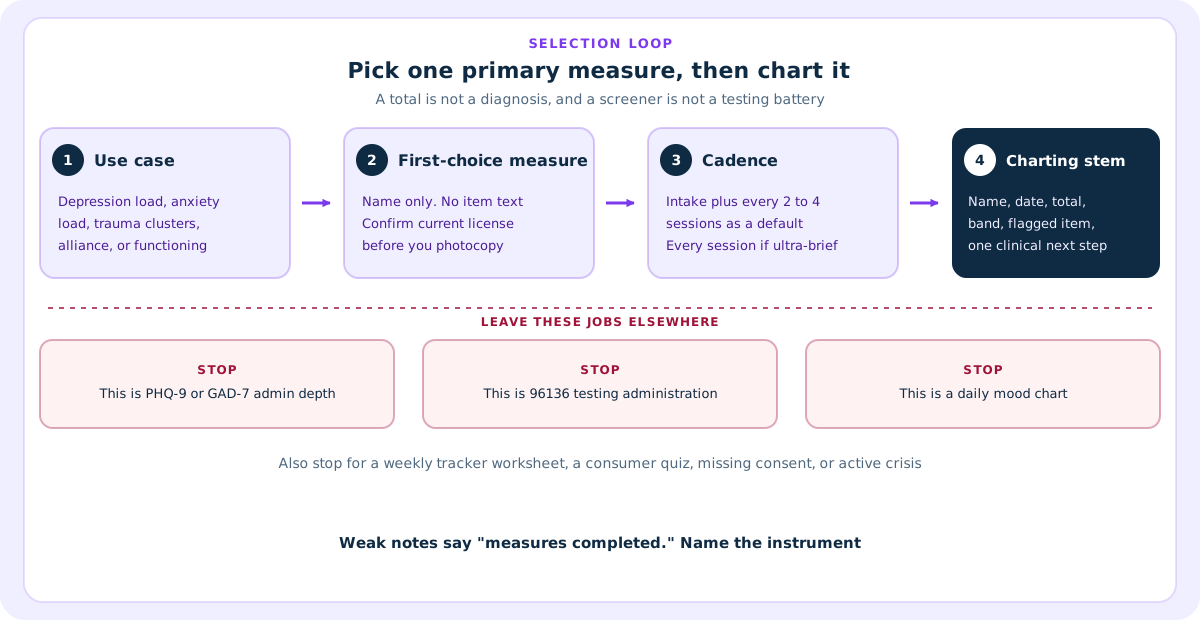
Keep each row short enough that you can name one primary measure and defend why it belongs in this episode. Compare brief scales for mental health by use case. Do not turn the sheet into a 20-instrument catalog.
Scroll the visual sideways to view the full diagram
| Use case | First-choice measure | Who reports / burden | Access | Cadence |
|---|---|---|---|---|
| Depression load | PHQ-9 | Self-report. 9 items. About 2 to 3 minutes | Free to download from PHQ Screeners under current site terms | Intake, then every 2 to 4 sessions |
| Anxiety load | GAD-7 | Self-report. 7 items. About 2 minutes | Free to download from PHQ Screeners under current site terms | Intake, then every 2 to 4 sessions |
| Mixed distress | DASS-21 | Self-report. 21 items. About 5 minutes | Public domain on the UNSW DASS site. Permission is not required to copy | Intake, then every 2 to 4 sessions |
| Trauma clusters | PCL-5 | Self-report. 20 items. About 5 to 10 minutes | Public domain from the National Center for PTSD. Not copyrighted | Intake, then every 2 to 4 sessions after you hold the current form |
| Alliance / session-by-session progress | ORS / SRS | Self-report. 4 items each. About 1 minute | Copyrighted inventory. Individual paper license from the publisher. Do not photocopy without it | Every session only if the client tolerates it |
| Functioning / quality of life | WHOQOL-BREF | Self-report. 26 items. About 8 to 10 minutes | Obtain the current English form from WHO. Confirm current user terms before you copy or adapt | Intake, then every 4 sessions or at planned review |
Item counts follow the official publisher pages cited below. Minute estimates are clinic time, not publisher scoring rules. Cadence is a private-practice default so you can repeat one primary measure.
Charting stem for every row: instrument name, date, total, band, flagged item if relevant, one clinical next step. Weak notes say “measures completed.”
Do not reproduce item wording. Do not treat any total as a DSM diagnosis. A positive PHQ-9 item 9 is a clinical event for the practice risk pathway, not a matrix cell. Score the ideation and behavior level, and the same-day outpatient action, on the Columbia suicide severity rating scale. Do not treat an item 9 yes as that level.
PCL-5 is a custom scale on Emosapien Professional and Enterprise plans. It is not a free-plan default. PHQ-9, GAD-7, ORS, SRS, DASS-21, and WHOQOL-BREF are the standard library. Score the cut points, the cluster counts, and the 10-point change on the PCL-5 score interpretation card. Do not apply them from memory.
Worked example
This fictional, de-identified example follows an adult in weekly CBT with generalized worry plus low mood, and reproduces no instrument items.
The note holds the instrument, the date, the total, the band, and the next move. It does not hold item text.
Sort selection against administration, measurement-based care, testing, and the log
Use this matrix when the clinical job is still which measure to pick. When you need administration depth for depression, including bands and item 9, work from the PHQ-9 administration guide.
When you need administration depth and functional-impact bands for anxiety, work from the GAD-7 administration guide. Use this matrix when the job is still first-choice selection.
When the screen covers tobacco, alcohol, and other drug classes in one pass, use the TAPS screening tool. When the question is drug use rather than alcohol, use the DAST screening tool. When the client is a child or adolescent and the question is trauma symptoms, use the CATS trauma screen. When the job is which published behavioral screen to pick, including school and ADHD forms, use the behavioral assessment tools guide.
Use the measurement-based care guide for cadence, review with the client, and plan adjustment. Use this matrix only when the question is which measure to choose.
Timed administration of two or more tests belongs on CPT 96136, not on this sheet. A PHQ-9 plus GAD-7 glance during psychotherapy is not a 96136 battery.
Record the score log, including baseline, date, change, and clinical review of the trend, on the progress monitoring template. This matrix is a selection sheet, not a trend grid.
Do not send completed responses through ordinary consumer email or SMS. Do not treat a total as real-time monitoring. If crisis takes over the hour, leave this matrix and follow the practice risk procedure.
When the question is which childhood trauma screen to hand a child or caregiver, leave this mood matrix and open tests for childhood trauma. When the client reads Spanish and the screen is perinatal, use a published Edinburgh Postnatal Depression Scale in Spanish rather than translating the English items. When you still need to learn the Columbia question set, that job is C-SSRS training, not a PHQ-9 band. When you need a filled initial assessment instead of a scale total, use the mental health assessment example.
How Emosapien carries the thread
Emosapien schedules and auto-scores the brief measures you chose, then surfaces the trend in the pre-session brief so the number is in the room instead of reconstructed later. You choose the instrument, interpret the score, and sign. Emosapien does not diagnose from a total, administer a 96136 battery, or replace local license terms.
Keep the chosen measure on a cadence the client completes
Emosapien carries the selected scale between sessions, so the trend is ready before the next review.
Download the pack
The printable pack fits a six-row matrix, one clinician card, and a worked example onto 2 to 3 US Letter pages with selectable text:
- Use case, first-choice measure, who reports, access, cadence
- Clinician card: purpose, when it fits, stop conditions, sort, documentation prompt
- Worked example of one fictional outpatient adult (initials only)
Every printed sheet carries the same footer: not a crisis service, not legal or payer advice, not a diagnosis, not a substitute for local policy, board rules, or the instrument’s current license terms. Do not reproduce copyrighted item text.
Download the pack. Keep it as the selection matrix for scales for mental health, not a PHQ-9 reprint and not a testing log.
Email me the selection matrix
Get the printable clinician matrix, a card for fit and stop conditions, and one worked outpatient example.
- Six-row matrix: depression, anxiety, mixed distress, trauma clusters, alliance, functioning
- Clinician card for purpose, fit, stop conditions, sort, and the documentation prompt
- Worked example of one fictional outpatient adult, initials only
Free. We'll email the PDF link right away and add you to the therapist toolkit, sent every two weeks. Unsubscribe any time.
Where should we send the link?
We'll email the PDF link right away. You'll also get the therapist toolkit every two weeks. Unsubscribe any time.
✓ Check your inbox
We've sent you the PDF
The download link is on its way to your inbox, usually within a minute or two. The email will come from Emosapien (hello@team.emosapien.com); check your spam folder if you don't see it.
You're also on the therapist toolkit list, sent every two weeks. Unsubscribe any time from the email footer.
References
- American Psychological Association. Professional Practice Guidelines on Measurement-Based Care. Approved February 2025.
- Kroenke K, Spitzer RL, Williams JBW. The PHQ-9: validity of a brief depression severity measure. J Gen Intern Med. 2001;16(9):606-613.
- Spitzer RL, Kroenke K, Williams JBW, Lowe B. A brief measure for assessing generalized anxiety disorder: the GAD-7. Arch Intern Med. 2006;166(10):1092-1097.
- US Preventive Services Task Force Evidence Synthesis. Screening for depression, anxiety, and suicide risk in adults. NCBI Bookshelf.
- Pfizer. PHQ Screeners terms of use. PHQ Screeners site content is exempted from Pfizer’s general copyright restrictions and is free to download and use as stated on that site. Pfizer’s 2010 release of PHQ and GAD-7 stated those downloads carry no copyright restriction and no charge.
- University of New South Wales School of Psychology. DASS FAQ. The DASS questionnaire is public domain. Permission is not needed to use it. Questionnaires and the scoring key may be copied without restriction from the DASS website.
- U.S. Department of Veterans Affairs, National Center for PTSD. PTSD Checklist for DSM-5 (PCL-5). 20-item self-report. Public domain and not copyrighted. Intended for qualified health professionals and researchers.
- Miller SD. Download measures. A license to use the ORS and SRS in paper and pencil format is available for free to individual practitioners. Group, agency, and electronic-system licenses are separate.
- World Health Organization. WHOQOL-BREF. 26-item quality-of-life instrument. Obtain the current English form from WHO and confirm current user terms before you copy or adapt.