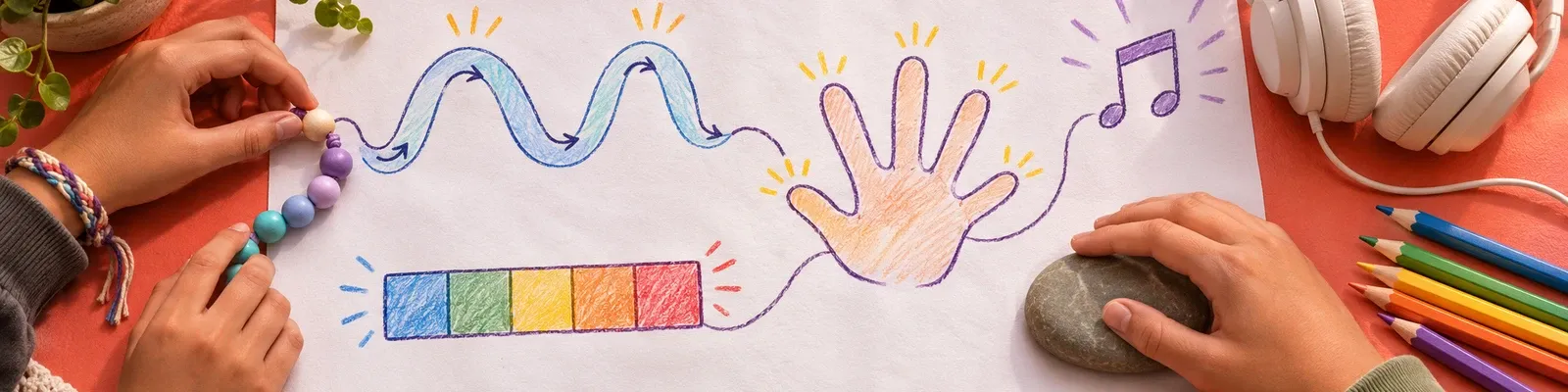
Emotional Regulation Activities for Teens in Therapy

Outline
A teen maps a recent hallway interaction and identifies face heat, the thought “everyone noticed,” and an urge to leave. They choose a water break before responding to a peer; clinician and teen agree to review whether it was available and useful.
| Activity | Skill | Setup | What to chart |
|---|---|---|---|
| Signal map | Name early emotion cues | Teen chooses one recent, manageable moment and marks body, thought, urge, and action options. | Teen named chest heat and an urge to leave; chose a pause phrase for next time. |
| Wave timer | Tolerate a short emotion wave | Set a two-minute timer; teen tracks intensity with words, color, or fingers while using an agreed anchor. | Teen remained present, intensity shifted from “eight” to “six,” and requested a longer pause next session. |
| Choice-point cards | Change one next action | Place two or three realistic next actions beside one cue; teen selects, rehearses, or passes. | Teen selected a hallway water break before replying to a message and identified a barrier. |
For printable practice beyond these examples, use the Skill-Station Rotation Sheet and Debrief and Charting Cues alongside the Signal Map, Emotion Wave Timer, and Choice-Point Cards.
Practice Regulation Skills With Teens
Use the signal map and debrief cues to guide and document a teen's session this week.
- Signal Map for body cues, thoughts, urges, and actions
- Emotion Wave Timer with anchor, stop signal, and observation fields
- Choice-Point Cards and Skill-Station Rotation Sheet for rehearsal
- Debrief and Charting Cues for participation, clinical decisions, and follow-up
Free. We'll email the PDF link right away and add you to the therapist toolkit, sent every two weeks. Unsubscribe any time.
Where should we send the link?
We'll email the PDF link right away. You'll also get the therapist toolkit every two weeks. Unsubscribe any time.
✓ Check your inbox
We've sent you the PDF
The download link is on its way to your inbox, usually within a minute or two. The email will come from Emosapien (hello@team.emosapien.com); check your spam folder if you don't see it.
You're also on the therapist toolkit list, sent every two weeks. Unsubscribe any time from the email footer.
Use emotional regulation activities for teens to make one clinical moment more observable: help the teen name what is happening, tolerate a manageable wave, or choose one next action. Do not offer an activity as a menu to hand over, a replacement for risk assessment, or a full DBT program.
Gross’s process model describes points where regulation can occur across an emotional episode, including attention, cognition, and response. That makes a useful session frame: locate the point you are working on, then keep the activity small enough to process before the hour ends (Gross, 1998). DBT adapted for adolescents includes individual work alongside family-oriented skills training; a single activity is not equivalent to that treatment structure (Rathus & Miller, 2002).
For a take-home record rather than an in-session activity, use emotion regulation worksheets. For a short list of teen-chosen practices between appointments, use coping skills checklist for teens. Run the activities below in the room or a facilitated group, then chart the intervention, the teen’s response, and the next clinical decision.
Match the activity to the skill
| Clinical job | Activity | Clinician prompt | Keep it bounded |
|---|---|---|---|
| The teen cannot name what changed | Signal map | “Where did you first notice this in your body, thoughts, or urge?” | One recent moment, not the whole week |
| The teen can notice activation but wants it gone immediately | Wave timer | “What helps you stay here for two minutes without making the feeling a test?” | Stop for flooding, dissociation, escalating risk, or withdrawal from the task |
| The teen knows the cue but repeats one unhelpful next move | Choice-point cards | “What is one action you could try before the urge takes over?” | Two or three realistic options, including pass |
| A group needs a shared rehearsal without personal disclosure | Skill stations | “Which skill would fit a low-to-medium stress moment?” | Use composites and voluntary sharing; do not elicit trauma details |
The table is a selection aid, not a sequence. Naming may be the whole session. A tolerance exercise may show that the teen needs a slower pace, direct assessment, or a different intervention. A change activity is not a demand to think positively or suppress a valid emotion.
Set up emotional regulation activities for teens
State the purpose before materials appear. A useful opening is: “We are trying a short way to notice what shows up before it gets bigger. You can write, point, use a color, talk, or pass.” The pass protects choice and also gives you information about fit, privacy, shame, and activation. When you introduce emotional regulation activities for teens this way, the teen can decide whether the format fits before the exercise becomes a demand.
Choose a manageable episode rather than the most charged one. A school hallway, unread message, practice mistake, or family transition can be specific enough to work with without making disclosure the price of participation. Keep the task to six to ten minutes and reserve time to ask what the teen noticed, what changed, and what should happen next.
For a group, explain what stays private. Invite members to practice with a composite or low-stakes example, and do not make personal stories a condition of participation. If the group needs a broader activity structure, use group therapy activities for adolescents.
Run activities that build naming skills
Signal map
Skill: Identify an early emotion cue without reducing the teen to a mood label.
Setup: Draw four small areas labeled body, thoughts, urges, and actions. Ask the teen to choose one recent manageable moment. They can use words, lines, colors, or a rating in each area, and they may leave any area blank.
Run it: Ask for the first cue, not the best explanation. If the teen says, “I was a mess,” follow with, “What did your body or your next move do first?” Then ask which cue might be noticed earlier next time.
What to chart: Record the selected moment, the cue in the teen’s own language, participation or pass options used, and one agreed next observation. Do not document a drawing or color as a diagnosis.
Name-and-sort cards
Skill: Separate emotion, thought, body sensation, and action urge.
Setup: Make four piles with those labels. Offer a few neutral, prewritten examples and blank cards. The teen sorts examples, makes one card of their own, or uses only the prewritten set.
Run it: Read one card at a time. “My face got hot” belongs with body sensation; “they hate me” belongs with thought; “leave the room” belongs with action urge. Ask what changes when the parts are not all called “anxiety.”
What to chart: Note the distinction the teen was able to make, any language they rejected, and whether the activity clarified the next target for assessment or skill work.
Run activities that build tolerance
Wave timer
Skill: Stay with a manageable emotional wave without demanding that it disappear.
Setup: Agree on an anchor the teen already finds acceptable, such as feet on the floor, a neutral object, a paced exhale, or looking around the room. Set a two-minute timer. Agree in advance that the timer stops if the teen signals stop or regulation decreases.
Run it: At the start, middle, and end, ask for a word, color, finger number, or brief note about intensity. Keep your language descriptive: “What is changing, if anything?” Avoid promising that the number should fall.
What to chart: Document the anchor, duration, the teen’s observable engagement, their stated intensity or description, and whether the activity was continued, shortened, stopped, or replaced.
Temperature and movement choice
Skill: Notice whether a brief sensory or movement-based change supports re-engagement.
Setup: Offer options that are appropriate to the setting and the teen’s health needs: cool water on hands, holding a cool object, standing to stretch, or a short paced walk in the clinic. Confirm that the teen can decline and that the activity is physically appropriate.
Run it: Ask the teen to choose one option, try it briefly, and compare the body cue before and after. Keep the question narrow: “Did this make it easier, harder, or no different to stay with the next minute?”
What to chart: Record the chosen option, any relevant limit or decline, the teen’s own report, observable response, and whether you selected a different regulation strategy next.
For a focused distress-tolerance practice with a teen, see TIPP skill worksheet. Match any body-based strategy to your clinical judgment, the setting, and the teen’s health context; an activity does not replace direct assessment when risk or medical concerns are present.
Run activities that support change
Choice-point cards
Skill: Rehearse one workable next action between cue and urge.
Setup: Write one cue on a card in the teen’s words, such as “I see a message that feels like criticism.” Put two or three next-action cards beside it: pause and take water, write a one-sentence draft and wait, ask for clarification, or pass. Include only actions that fit the teen’s actual setting.
Run it: Ask the teen to pick one card, say what could get in the way, and rehearse the first ten seconds. If they reject every option, treat that as useful information and return to the cue or the context rather than increasing pressure.
What to chart: Document the cue, the options offered, the teen’s selected action or pass, a barrier named, and the plan to review fit next session.
Thought-to-action bridge
Skill: Use a CBT-informed pause between a hot thought and an automatic action.
Setup: Divide a page into three short lines: situation, first thought, next helpful action. Use one specific, lower-intensity situation. The goal is not to prove the thought false; it is to identify the action that the teen wants to test.
Run it: Ask, “What did your mind say first?” Then, “What action would help you learn more or protect what matters here?” Keep the action observable and brief: wait ten minutes, ask one question, take a break, or bring the situation back to session.
What to chart: Record the situation, the teen’s stated thought, the action trial selected, and the plan for reviewing outcome without grading success or failure.
Use a simple group format
Use skill stations when a group needs shared practice without asking members to narrate personal high-stress events. Set up three stations: signal map, wave timer, and choice-point cards. Start with a composite example, rotate in small groups, and invite members to name a skill they might adapt rather than a private event.
Keep the same frame at every station: purpose, voluntary participation, pass option, brief practice, and a one-sentence debrief. A group member can observe or work with a fictional scenario. If a member becomes activated, respond to the clinical need rather than insisting on rotation or completion.
Chart the activity and the clinical decision
A good note distinguishes what you offered, what the teen did or declined, and what you decided next. It does not need a transcript of every card or a conclusion that the activity caused improvement.
If you need a structured activity library that reaches beyond emotion regulation, see therapeutic activities for teens. If the teen responds more readily to making than talking, art therapy for teens offers art-based activities with processing and documentation guidance.
Keep the activity inside treatment
The evidence for adolescent DBT supports a treatment approach, not a claim that one card sort or timer solves self-harm, suicidality, or severe dysregulation. In a randomized trial with high-risk adolescents, DBT included weekly individual psychotherapy, multifamily skills training, youth and parent telephone coaching, and therapist consultation; it was compared with individual and group supportive therapy (McCauley et al., 2018). Keep your claims and documentation aligned with what you actually delivered. Use emotional regulation activities for teens as focused practice within care, not as the care plan itself.
Use the activity to support clinical attention, not to outsource it. Pause for active safety concerns, dissociation, escalating activation, coercive conditions, or any situation where a brief practice would obscure a needed assessment or support response. The teen’s pass, partial participation, or blank page is information to explore, not a compliance score.
Keep the clinical thread in view
Keep the next session in view
Draft a progress note, then review and sign it yourself.
Get Started- Free plan
- No credit card
Teen said
My face got hot first.
Next session
Review the water break.
References
- Gross, J. J. (1998). The emerging field of emotion regulation: An integrative review. Review of General Psychology, 2(3), 271–299. https://doi.org/10.1037/1089-2680.2.3.271.
- McCauley, E., Berk, M. S., Asarnow, J. R., et al. (2018). Efficacy of dialectical behavior therapy for adolescents at high risk for suicide: A randomized clinical trial. JAMA Psychiatry, 75(8), 777–785. PMC6584278.
- Rathus, J. H., & Miller, A. L. (2002). Dialectical behavior therapy adapted for suicidal adolescents. Suicide and Life-Threatening Behavior, 32(2), 146–157. DOI: 10.1521/suli.32.2.146.24399.
Related reading
Art Therapy for Teens: Session Activities for Clinicians
Use art therapy for teens in individual sessions with goal-matched activities, teen-appropriate materials, processing questions, and charting cues.
Read article →Group Therapy Activities for Adolescents: 12 Structured Exercises
Choose among 12 group therapy activities for adolescents, from low-disclosure openings to peer practice. Includes a free printable facilitator menu.
Read article →Free PDF: Teen Emotion Regulation Activity Worksheets
Use printable activities to practice emotion regulation with a teen and document the session.
- Signal Map for body cues, thoughts, urges, and actions
- Emotion Wave Timer with anchor, stop signal, and observation fields
- Choice-Point Cards and Skill-Station Rotation Sheet for rehearsal
- Debrief and Charting Cues for participation, clinical decisions, and follow-up
Free. We'll email the PDF link right away and add you to the therapist toolkit, sent every two weeks. Unsubscribe any time.
Where should we send the link?
We'll email the PDF link right away. You'll also get the therapist toolkit every two weeks. Unsubscribe any time.
✓ Check your inbox
We've sent you the PDF
The download link is on its way to your inbox, usually within a minute or two. The email will come from Emosapien (hello@team.emosapien.com); check your spam folder if you don't see it.
You're also on the therapist toolkit list, sent every two weeks. Unsubscribe any time from the email footer.